

.svg) Product
Product








Table of content
That disconnect between TA metrics and business outcomes is one of the most expensive blind spots in professional services. Traditional measures like time-to-fill and time-to-hire track the recruiting funnel, but they ignore what happens before the requisition and after the offer letter. In an industry where every unbilled day erodes margin, what leaders actually need is a metric built around time to deploy and demand readiness.
This blog unpacks why the metrics your TA team reports may not align with what your CEO, CFO, or delivery head actually cares about. It also introduces a simple TA scorecard designed specifically for professional services, one that connects hiring speed to revenue impact.
The real timeline nobody measures
In most professional services firms, the hiring journey involves far more stages than a standard applicant tracking system captures. TA teams measure their slice of the process, from requisition to offer acceptance, while delivery and operations teams track a completely different timeline that begins when a client signs a statement of work.
Between these two views sits a gap filled with notice periods, background checks, onboarding, and project-specific training. No single team owns this entire cycle, which means no single dashboard reflects the true cost of a delayed deployment.
What TA sees vs what the business sees
Consider a mid-size IT services firm winning a cloud migration deal. The client expects the team to start in six weeks.
- TA’s view: Requisition raised on Day 1. Candidate sourced and offered by Day 28. Time-to-fill: 28 days. Dashboard shows green.
- Business’s view: The candidate has a 60-day notice period. After joining, they need two weeks of onboarding and access provisioning. Actual deployment: Day 102. The client has been waiting over 14 weeks.
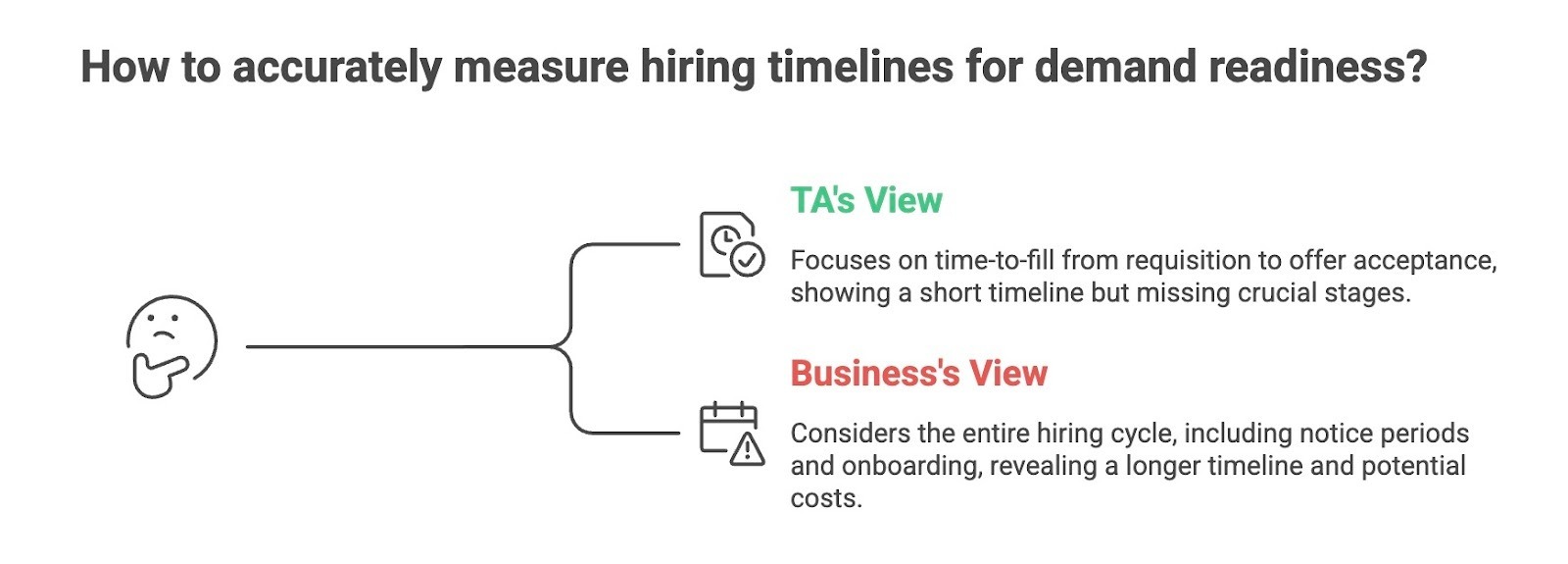
The TA metric said 28 days. The business experienced 102 days. That 74-day gap represents unbilled project weeks, a frustrated client, and possibly a penalty clause.
The hidden costs in that gap
According to the 2025 SPI Professional Services Maturity Benchmark, billable utilization across professional services firms dropped to 68.9% in 2024, falling below the 75% optimal threshold. EBITDA also declined sharply, from 15.4% in 2023 to 9.8% in 2024. While many factors drive these numbers, delayed deployments contribute directly to both.
Every week a role stays unbilled after the project has started, the firm absorbs salary costs without generating revenue. Multiply that across dozens of active engagements, and the margin impact becomes significant enough for any CFO to notice.
Why time-to-fill falls short in professional services
Time-to-fill remains the most commonly tracked TA metric across industries. It measures the calendar days from requisition approval to offer acceptance, and it works reasonably well in sectors where a hire is the endpoint. In professional services, however, a hire is just the midpoint.
Several structural realities make this metric insufficient for services firms.
It starts too late
In many firms, the requisition arrives only after a deal has been signed or a project kickoff date has been locked. By that point, the clock has already been ticking for the client. A metric that begins at requisition approval misses the entire pre-sales and demand planning window where early action could have made the biggest difference.
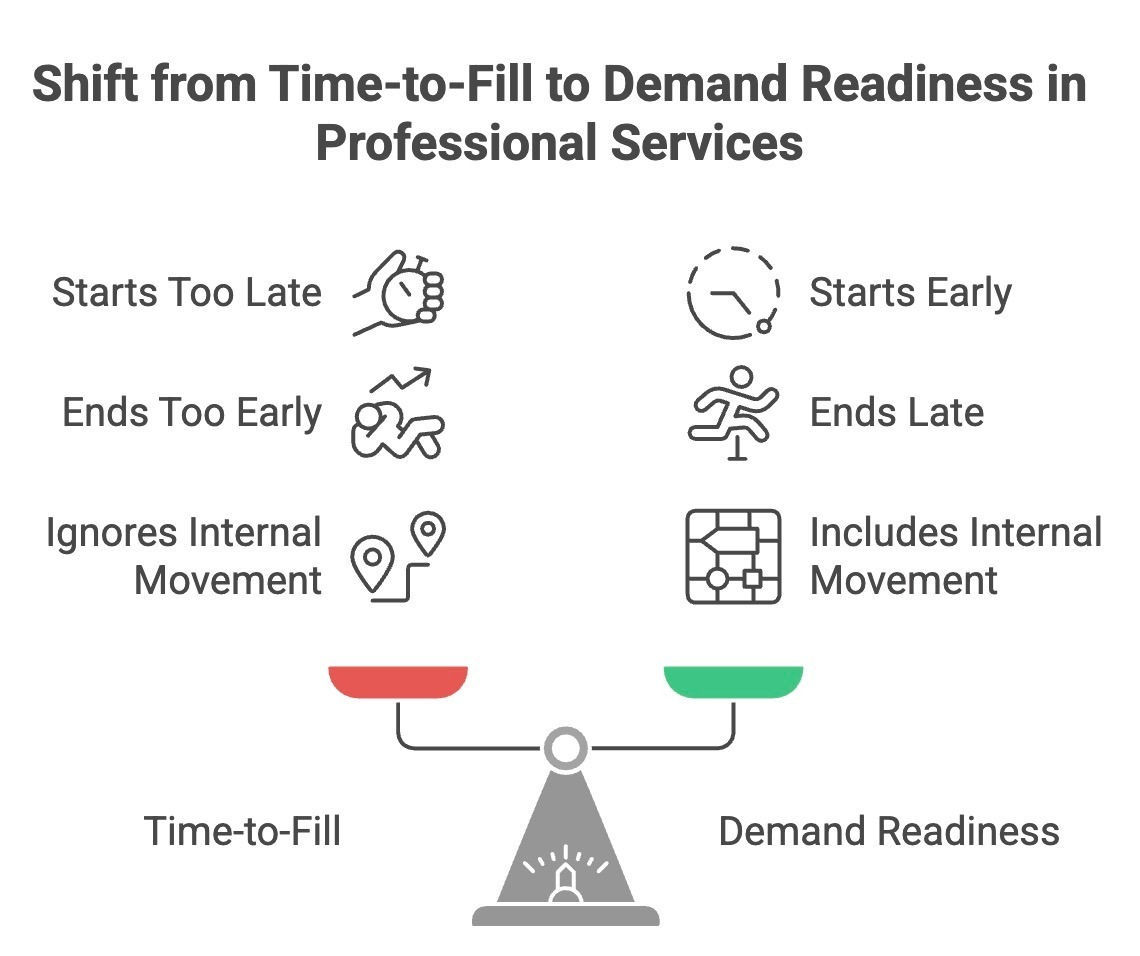
It ends too early
Offer acceptance is not deployment. In India, notice periods of 60 to 90 days are standard for experienced tech professionals. Add onboarding, compliance checks, and client-specific training, and the actual deployment date can stretch weeks beyond what time-to-fill captures. A metric that stops at “offer accepted” gives an incomplete and often misleading picture of hiring effectiveness.
It ignores internal movement
Professional services firms often fill roles through internal redeployment, moving a consultant finishing one project to the next engagement. Time-to-fill typically tracks only external hires, which means a significant portion of talent supply chain activity goes unmeasured. For firms where 30 to 40% of staffing comes from internal bench or project rollovers, this gap is substantial.
Introducing the simple TA scorecard for professional services
Rather than chasing a single metric, professional services firms benefit from a balanced scorecard approach that covers the full lifecycle from demand signal to billing start. The following four dimensions offer a more complete view of talent acquisition effectiveness, and they work whether you are filling roles externally, internally, or through a combination of both.
Together, these dimensions form a scorecard that speaks the language of delivery heads, CFOs, and CEOs, not just recruiters.
Dimension 1: Demand readiness
Core question: Are we seeing hiring needs early enough, or only when delivery is already under pressure?
Demand readiness measures the time between the first signal of a potential hiring need (a deal in the pipeline, a project expansion, an upcoming rolloff) and the moment TA begins active sourcing. A high demand readiness score means your TA function operates proactively, building shortlists before the requisition lands.
Track it by comparing deal pipeline milestones with requisition creation dates. If requisitions consistently arrive after project start dates, your demand readiness score is low, and time-to-deploy will suffer regardless of how efficient your recruiting funnel is.
Dimension 2: Hiring flow
This dimension covers the traditional recruiting funnel, but with sharper segmentation. Instead of a single time-to-fill number, break it down by:
- Sourcing speed: Days from requisition to first qualified shortlist.
- Interview velocity: Days from shortlist to hiring manager decision.
- Offer cycle: Days from decision to accepted offer.
Segmenting the funnel this way pinpoints exactly where delays happen. A firm might source candidates in five days but lose three weeks to interview scheduling, something a blended time-to-fill number would mask entirely.
Dimension 3: Offer to join
This is the metric most TA dashboards ignore completely, and it is often the longest segment of the entire timeline.
|
Factor |
Typical range |
Impact on deployment |
|
Notice period |
30 to 90 days |
Largest single delay driver |
|
Background verification |
5 to 15 days |
Can run parallel if planned |
|
Onboarding and access setup |
7 to 14 days |
Often sequential, rarely optimized |
|
Offer dropout |
10 to 25% industry average |
Resets entire cycle if it happens |
Tracking offer-to-join conversion, dropout rates by notice period length, and pre-boarding engagement scores gives your team the ability to intervene before a hire falls through, rather than discovering the dropout after the joining date has passed.
Dimension 4: Internal movement
For professional services firms, internal mobility is not a nice-to-have benefit. It is a critical supply channel.
Measure two things here:
- Redeployment speed: How quickly can a consultant finishing one project move to the next? Benchmark this in days from project end to next billing start.
- Bench-to-project conversion: What percentage of bench consultants find their next engagement internally, without TA needing to source externally?
Firms that actively manage internal movement can fill 30 to 40% of their demand without ever raising an external requisition. When your scorecard captures this, the contribution of internal mobility becomes visible to leadership for the first time.
Making the shift from vanity metrics to demand readiness
Adopting a new scorecard requires more than adding a few columns to an existing report. It means changing how TA, delivery, and finance collaborate around workforce planning. Below are practical steps to start the transition.
Connect your TA and delivery data
Most firms run their recruitment pipeline in one system and their project staffing in another. As a result, TA has no visibility into upcoming project needs, and delivery has no visibility into where candidates sit in the hiring funnel. Linking these two data streams, even through a shared weekly review, creates the foundation for demand readiness tracking.
Redefine your start and end points
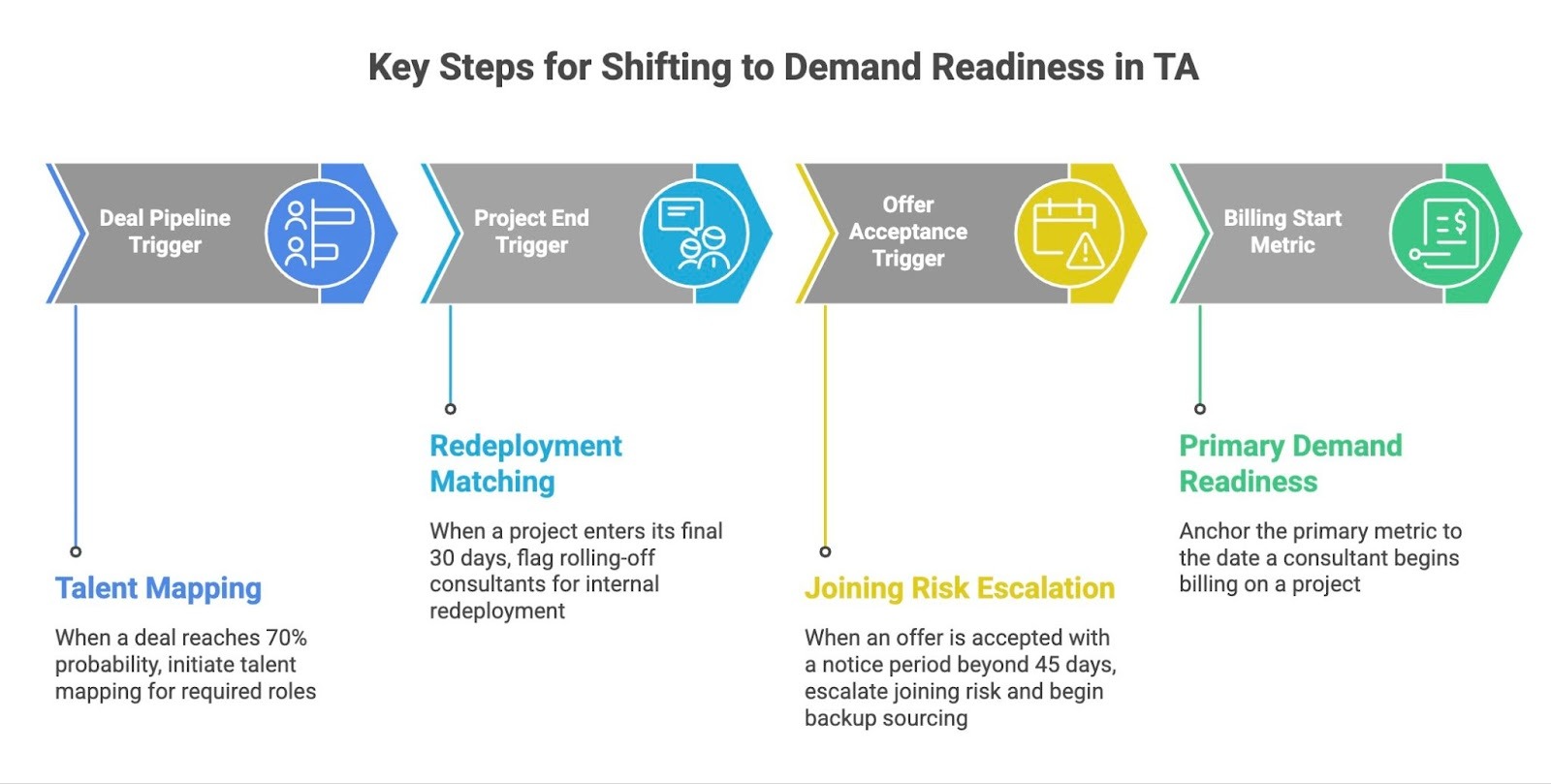
Stop measuring success at offer acceptance. Instead, anchor your primary metric to the date a consultant begins billing on a project. This single change forces every team involved, from sourcing to onboarding to IT provisioning, to own a piece of the deployment timeline.
When the endpoint shifts from “offer accepted” to “billing started,” accountability naturally distributes across functions instead of resting solely on TA.
Build early warning triggers
Set up alerts tied to your deal pipeline stages. For example:
- When a deal moves to 70% probability, trigger a talent mapping exercise for the required roles.
- When a current project enters its final 30 days, flag the rolling-off consultants for internal redeployment matching.
- When an offer is accepted with a notice period beyond 45 days, escalate the joining risk score and begin backup sourcing.
These triggers transform TA from a reactive function into a proactive talent supply chain that leadership can rely on.
Report in the language of revenue
Your CEO does not think in terms of “days to fill.” They think in utilization rates, billing start dates, and project margins.
Translate your scorecard into financial impact. Instead of saying “We reduced time-to-fill by 10 days,” present it as “We reduced the average gap between project start and consultant deployment by 10 days, which recovered approximately 200 unbilled days across the quarter.” That framing connects hiring speed to the P&L, which is exactly the conversation your leadership wants to have.
Streamline your talent supply chain with a platform built for professional services
Building a demand readiness scorecard becomes significantly easier when your talent acquisition platform understands the nuances of services hiring. Generic ATS platforms track applications and interviews, but they rarely account for project timelines, internal redeployment, or notice period risk.
That is where a purpose-built TA platform like RippleHire can help. RippleHire’s intelligent talent acquisition cloud is designed for enterprises that need to connect hiring outcomes to business outcomes, not just fill requisitions faster.
- End-to-end lifecycle visibility: Track every stage from demand signal through offer, joining, and deployment in a single system, eliminating the data silos that hide true time-to-deploy.
- Internal mobility workflows: Manage bench redeployment and project-to-project transitions alongside external hiring, giving your scorecard a complete view of talent supply.
- AI-powered joining risk detection: Flag candidates with high dropout probability based on notice period length, engagement signals, and historical patterns, so your team can intervene early.
- Seamless integration with delivery systems: Connect with Workday, SAP, Oracle, and other enterprise platforms through a no-code integration framework, ensuring TA and delivery share a single source of truth.
- Compliance and security built in: With ISO 27001, SOC 2 Type 2, and GDPR compliance, RippleHire ensures your hiring data stays protected across 50+ countries.
Book a demo to see how RippleHire helps professional services firms move from tracking time-to-fill to managing true time to deploy.
FAQs
FAQ
1. What is the difference between time-to-fill and time to deploy?
Time-to-fill measures the days from job requisition to offer acceptance. Time to deploy goes further, covering the entire cycle from demand signal to the day a consultant actually starts billing on a project. In professional services, time to deploy is a more accurate metric because it includes notice periods, onboarding, and project-specific training that time-to-fill ignores completely.
2. What is demand readiness in talent acquisition?
Demand readiness measures how early your TA team identifies and acts on hiring needs before they become urgent. It tracks the gap between the first signal of a potential requirement, like a deal moving through the sales pipeline, and when active sourcing begins. A high demand readiness score means your team builds candidate shortlists proactively instead of scrambling after a project has already started.
3. Why is time-to-fill not a good metric for professional services?
Time-to-fill only captures the recruiting funnel, from requisition to offer acceptance. In professional services, a hire is not the finish line. Notice periods of 60 to 90 days, onboarding timelines, and client-specific training all add weeks before a consultant starts generating revenue. Time-to-fill also ignores internal redeployment, which accounts for 30 to 40% of staffing in many services firms.
4. How do you reduce time to deploy in IT services hiring?
Start by connecting your TA pipeline with your delivery and project staffing data so hiring begins before requisitions land. Break down your funnel into sourcing speed, interview velocity, and offer cycle to find bottlenecks. Track offer-to-join risks like long notice periods and dropout signals. Also prioritise internal mobility by matching rolling-off consultants to upcoming projects before sourcing externally.
5. What hiring metrics should professional services firms track?
Move beyond a single time-to-fill number. Track four dimensions: demand readiness (how early TA engages), hiring flow (sourcing, interview, and offer speed), offer to join (notice period management and dropout risk), and internal movement (bench redeployment speed and conversion rates). Together, these metrics connect TA performance to utilization rates and project margins, which is what leadership actually monitors.


.png)