
.svg) Product
Product







Table of content
Every IT services company carries bench talent. Some treat it as an unavoidable cost of doing business. Others see it as a failure of planning. In reality, the bench is neither of these things. It is a deployment problem disguised as a talent problem. When skilled professionals sit idle for weeks while hiring managers simultaneously raise external requisitions for similar profiles, something in the system is fundamentally broken.
A well-designed internal mobility strategy can fix this, but only if organizations move past the informal negotiations and political dynamics that currently govern how people get redeployed.
Why internal movement stays broken in most IT services firms
Internal hiring should be simpler and cheaper than external hiring. The talent is already on your payroll, already familiar with your systems, and already cleared through background verification. Yet most organizations find internal movement harder to execute than hiring from outside. The reasons are structural, not technical, and until leaders address them head-on, no amount of process redesign will help.
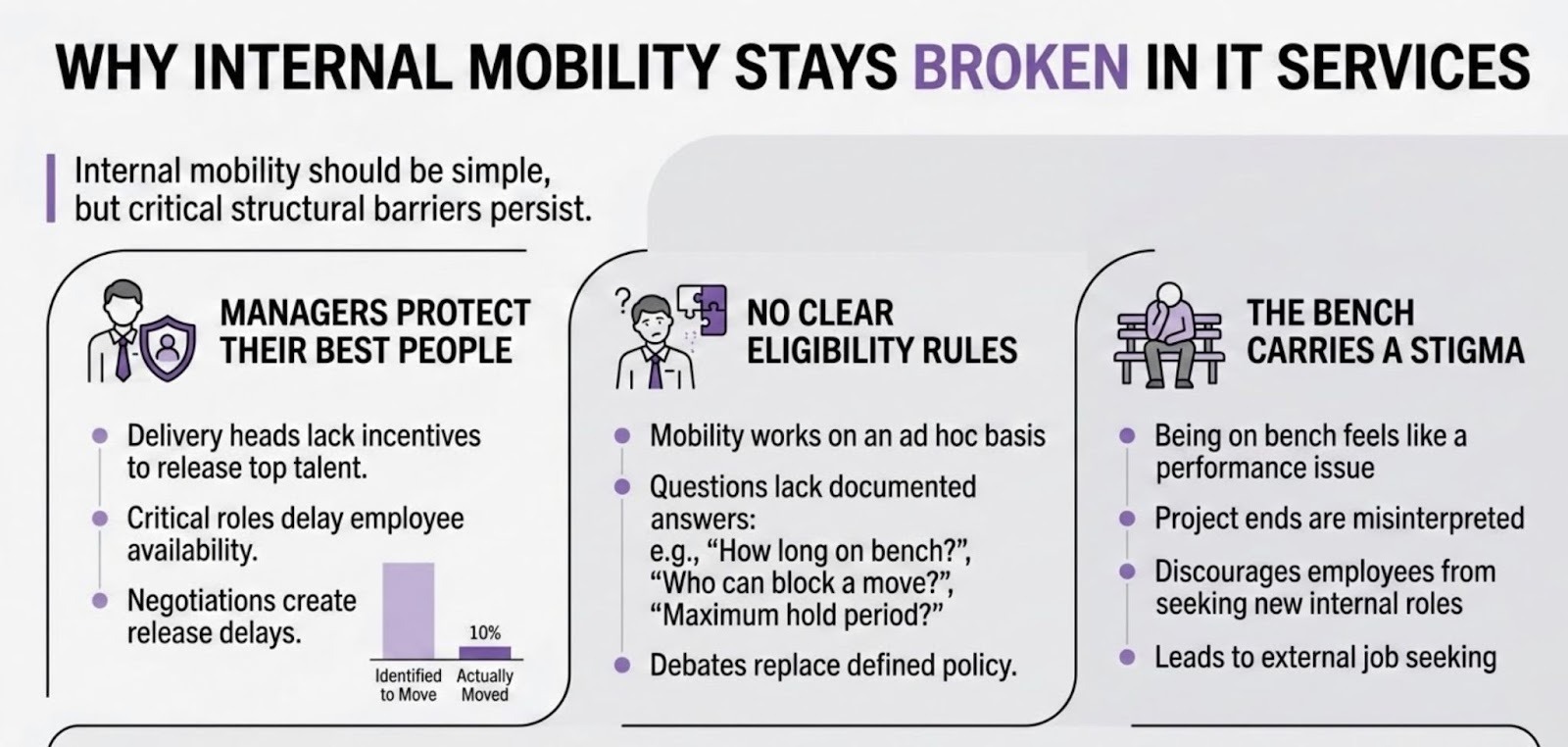
Why internal mobility is broken in IT services
Managers protect their best people
This is the single biggest blocker. A delivery head running a critical account has no incentive to release a high-performing Java architect to another team, even if that person has been flagged for redeployment. Release dates get pushed. Conversations turn into negotiations. The benched professional with a slightly different skill profile remains on the bench, and the receiving team opens an external requisition instead.
Take an example of a large IT services firm with 15,000 employees. The RMG team identifies 40 professionals on the bench who could fill open internal positions. After three weeks of discussions, only 12 actually moved. The rest stay stuck because their current managers delayed the release or because no one could agree on a transition timeline.
There are no clear eligibility rules
Internal mobility often works on an ad hoc basis. There is no published policy that defines when an employee becomes eligible for redeployment, how long a manager can hold someone beyond a project's end date, or what happens when two teams compete for the same person. Without these rules, every internal hiring conversation becomes a subjective debate.
Some common questions that go unanswered:
- Can an employee apply for an internal role if they have been in their current position for less than 12 months?
- Does the releasing manager have veto power, or is it an escalation-based process?
- What is the maximum number of days someone can remain on the bench before redeployment becomes mandatory?
- Who arbitrates when two delivery heads want the same person?
When none of these questions have documented answers, internal mobility depends entirely on relationships and influence.
The bench carries a stigma
In many IT services cultures, being on the bench feels like being sidelined. Employees worry that extended bench time signals poor performance, even when the cause is a project ramp-down or a client-side delay. This stigma discourages people from actively seeking internal opportunities and makes them more likely to look outside the organization altogether.
What a transparent internal mobility system looks like
Building a functioning internal mobility strategy does not require a massive transformation program. It requires three things: visibility, rules, and a queue. Most organizations have none of these in place, which is why internal movement remains chaotic.
A single, visible talent pool
Every benched or soon-to-be-available employee should be visible to every hiring manager and RMG leader in a single system. Not in spreadsheets shared over email. Not in a weekly call where names are read out loud. A live, searchable pool where managers can see skills, certifications, project history, availability dates, and preferences.
When a delivery head in Pune needs a Salesforce developer and can see that three qualified professionals in Hyderabad will be available within two weeks, the conversation shifts from political negotiation to logistics.
Published eligibility and release rules
Transparency starts with documentation. Organizations that handle internal mobility well typically publish rules like the following:
- Employees become eligible for internal redeployment once their current project enters the final 30 days, or immediately upon moving to the bench.
- Releasing managers can request a 15-day extension, but anything beyond that requires approval from the business unit head.
- If an employee has been on the bench for more than 30 days, any open internal requisition matching their profile takes automatic priority over external sourcing.
- Employees can express interest in up to three internal roles at any given time.
These rules do not eliminate all friction, but they replace emotional arguments with factual ones. When a manager says "I cannot release this person," the response becomes "The policy allows a 15-day extension, and that window has passed" rather than an open-ended negotiation.
A transparent queueing system
Once talent is visible and rules are in place, the final piece is a queue that tracks where each person stands in the redeployment process. Think of it as a simple workflow: available, shortlisted, interviewing, offered, and deployed. Everyone involved, from the employee to the releasing manager to the receiving team to the RMG coordinator, can see the current status in real time.
This transparency achieves two things simultaneously. First, it eliminates the information asymmetry that fuels politics. Second, it gives employees agency. When a benched professional can see that they are being actively considered for three roles, bench anxiety drops. They are less likely to start applying externally because they can see progress.
The cost of getting this wrong
Organizations that fail to fix internal mobility pay a compounding price. The direct cost is straightforward: bench salaries add up quickly, especially for senior professionals billing at Rs 15-25 lakh per year. A bench of 200 people carrying an average monthly cost of Rs 1.2 lakh each translates to Rs 2.4 crore per month in unproductive payroll.
The indirect costs are harder to quantify but equally damaging. External hiring for roles that could have been filled internally takes longer and costs more. New external hires need onboarding time, which delays project staffing. Meanwhile, the benched employee who could have filled that role either sits idle or leaves the company, taking institutional knowledge with them.
There is also an engagement cost.
Employees who see limited growth opportunities are nearly twice as likely to leave. For benched employees watching external hires get placed into roles they could have done, the message is clear: the organization does not prioritize its own people. That perception drives attrition among precisely the talent you have already invested in.
Overlapping internal movement with external hiring
One of the most common mistakes organizations make is treating internal mobility and external hiring as separate tracks. The RMG team manages redeployment through spreadsheets and calls, while the TA team runs external requisitions through an ATS. These two processes rarely talk to each other, which means a hiring manager can extend an offer to an external candidate while a perfectly matched internal professional sits on the bench two floors away.
A smarter approach treats every open requisition as a single pipeline that considers both internal and external candidates simultaneously. When a new role opens, the system checks the internal talent pool first. If a match exists, the internal candidate enters the pipeline alongside any external applicants, with clear SLAs for how quickly the internal match must be evaluated before external sourcing begins.
This does not mean internal candidates get the role by default. It means they get a fair and timely shot before the organization spends money and time sourcing externally.
Enable seamless internal mobility with a unified talent acquisition platform
Moving from political negotiation to structured redeployment requires more than good intentions. It requires a system that connects internal talent data with external hiring workflows in a single place. Most standard ATS platforms treat internal and external hiring as entirely separate functions, which is exactly why the disconnect persists.
RippleHire's TA Cloud bridges this gap by design. Built for enterprises managing complex, high-volume hiring across multiple business units, it brings internal mobility and external recruitment onto one platform.
- Unified talent pool: Benched and soon-to-be-available employees appear alongside external candidates in a single searchable pipeline, giving hiring managers complete visibility before they default to external sourcing.
- Automated matching: AI-powered screening maps internal profiles against open requisitions based on skills, certifications, and project history, reducing the manual effort RMG teams spend on matchmaking.
- Configurable eligibility rules: Set and enforce redeployment policies, such as release timelines and bench duration thresholds, directly within the system so decisions stay consistent and auditable.
- Real-time status tracking: Every stakeholder, from the releasing manager to the receiving team to the employee, can see exactly where a redeployment stands, eliminating information gaps and political maneuvering.
- Seamless HRMS integration: Connect with Workday, SAP, Oracle, and PeopleStrong to keep employee data synchronized without manual updates or duplicate records.
Book a demo to see how RippleHire can help you turn your bench into a strategic talent advantage instead of a recurring cost center.
FAQ
What is internal mobility and why does it matter in IT services?
Internal mobility is the process of moving existing employees into new roles, projects, or teams within the same organization. In IT services, it directly affects bench utilization, project staffing speed, and hiring costs. When done well, it reduces dependence on external hiring, shortens deployment timelines, and retains institutional knowledge that would otherwise walk out the door with departing employees.
Why do most IT services firms struggle with internal redeployment?
The biggest barriers are structural, not technical. Managers tend to hold onto their best people, there are no published rules governing eligibility or release timelines, and internal talent data often lives in disconnected spreadsheets. Without a transparent system, every redeployment conversation turns into a negotiation based on relationships and influence rather than facts and policy.
How do clear eligibility rules improve internal mobility?
Published rules remove ambiguity from the redeployment process. When everyone knows how long a manager can delay a release, when bench employees become eligible for new roles, and who arbitrates competing requests, conversations stay factual instead of political. Rules also create accountability, making it harder for any single stakeholder to block movement without justification.
Should internal candidates compete with external candidates for the same role?
Yes, but with a structured head start. A well-designed system checks the internal talent pool first when a new requisition opens and gives matched internal candidates a defined evaluation window before external sourcing begins. This does not guarantee internal candidates the role. It ensures they get a fair and timely shot, which reduces unnecessary external hiring spend and signals to employees that the organization values its own people.
What is the cost of not fixing internal mobility?
The costs are both direct and indirect. Bench salaries for undeployed professionals add up quickly, often running into crores per month for large firms. On top of that, external hiring for roles that internal talent could have filled takes longer and costs more. There is also an engagement cost, as benched employees who see external hires placed ahead of them grow disengaged and eventually leave, taking years of project experience with them.