
.svg) Product
Product







Table of content
In 2024, candidates reviewing employers on Glassdoor used the term "ghosting" nearly three times as much as they did in 2020 (Glassdoor Economic Research, October 2024). And a 2023 Indeed survey of job seekers found that 62% of respondents planned to ghost a prospective employer in a future job search, compared with only 37% in 2019 (Indeed Ghosting in Hiring Report, 2023).
Now flip the lens. If candidates are this comfortable walking away from employers during the hiring process, imagine what happens after the offer is signed.
In high-demand sectors like BFSI and analytics, the post-offer window is where the real damage quietly unfolds. The offer drop-out rate in these sectors is not just an HR inconvenience. It is a direct hit to sourcing spend, recruiter productivity, and time-to-fill. The financial services sector already records the highest attrition of any industry at 24%, driven largely by churn in sales, relationship management, and digital roles (EY Future of Pay Report, February 2026). Every candidate who accepts and then vanishes adds fuel to that problem.
The problem happens when TA teams treat the window between offer acceptance and Day 1 as an administrative gap instead of what it actually is: the highest-risk phase of the entire hiring funnel.
Why competitive compensation does not guarantee a join
There is a deeply held belief in TA teams that if you match or beat the candidate’s expected CTC, the deal is done. Pay them well, and they will show up. This sounds logical, but it breaks down fast in BFSI and analytics hiring, where the candidates you are going after are rarely sitting with just one offer on the table.
Consider a data scientist with three years of experience in fraud detection models. This person is interviewing at a private bank, an insurance analytics firm, and a fintech startup all at once. Each company is offering competitive pay. The salary difference between the three offers might be 8–12%. That margin is not large enough to lock in a decision on its own.
What actually tips the scale is what happens after the offer letter is signed.
Does the candidate hear from anyone at the company during the notice period? Does their future manager reach out? Do they get clarity on what their first project will look like?
When nothing happens in that window, doubt creeps in. And doubt, once it sets in, makes the competing offer feel safer. It does not matter that your offer was 5% higher. Silence after acceptance tells the candidate: we got what we needed from you; now wait.
In BFSI, counter-offers are almost a given for high-performers. The moment a candidate puts in their resignation, the current employer will often match or beat the new offer within 48 hours. If your post-offer engagement has been zero, the candidate is now comparing your silence against their current employer’s active retention effort. It is not a fair fight, and it does not need to be this way.
How candidates actually evaluate risk after saying yes
Once the excitement of a new offer fades (usually within 48–72 hours), candidates shift from decision mode to evaluation mode. They are no longer asking “should I take this?” They are asking “will I regret this?”
This is especially true for mid-career professionals in banking, insurance, and analytics. These are people with EMIs, family considerations, and career trajectories they have been building for years. A job switch is not a casual decision for them. They are running a quiet risk assessment in the background, and here is what they are weighing:
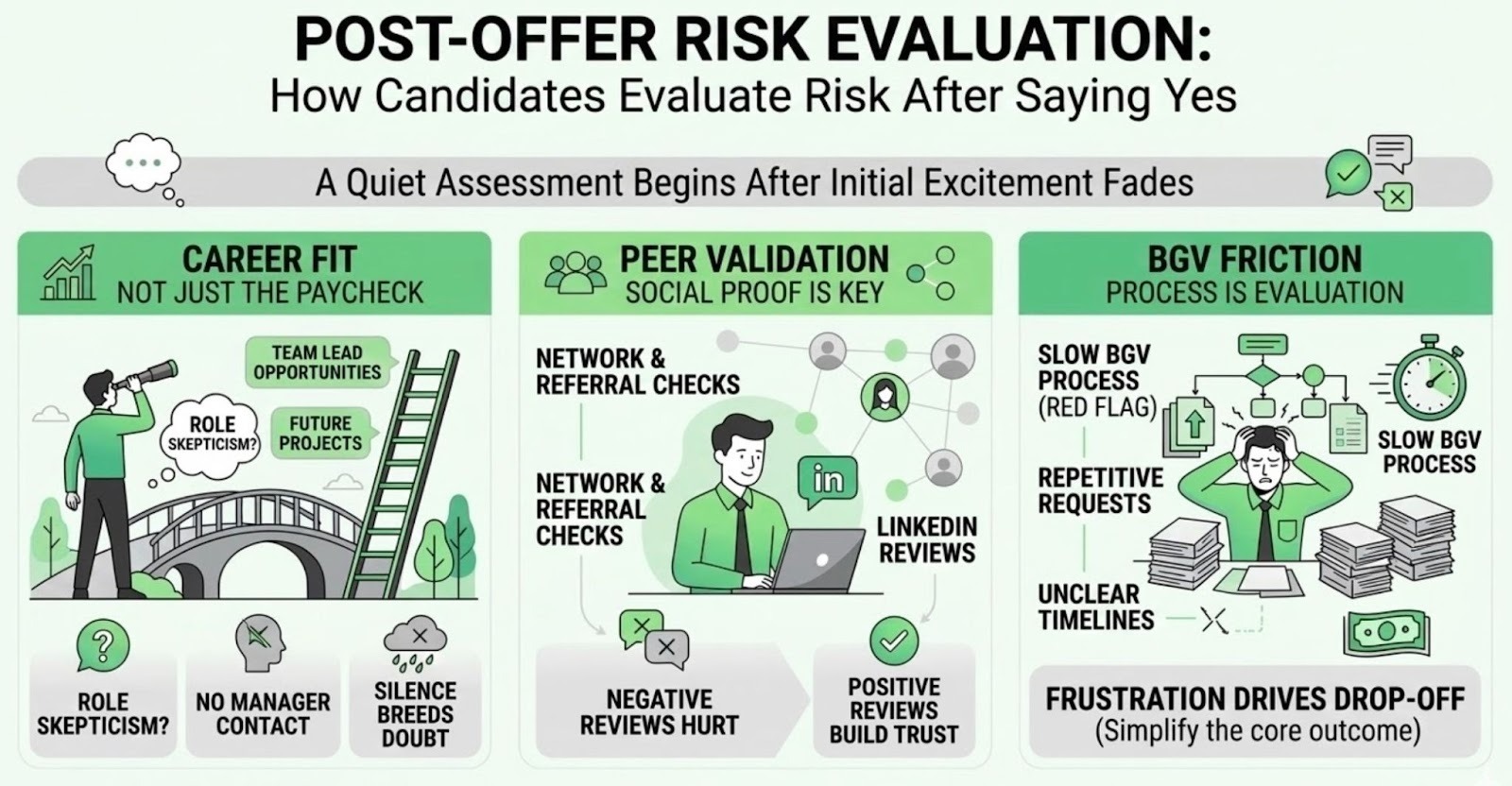
Long-term career fit, not just the next paycheck
A credit underwriting manager at a mid-size NBFC might accept your offer at a larger bank because it looks like a step up. But during the notice period, they start thinking: will I actually get to lead a team there, or will I be one of fifteen managers doing the same thing?
If nobody from your side addresses this during the 30–60 day notice window, the candidate builds their own narrative. And that narrative often leans negative because uncertainty breeds pessimism.
Peer validation and social proof
Candidates talk. They check LinkedIn. They reach out to ex-colleagues who work at the company they have accepted an offer from. What they hear during this informal reference check matters far more than what the recruiter told them during the interview. If a former employee posts about long hours, micromanagement, or stalled promotions, that becomes the lens through which the candidate sees the offer.
This is why candidate experience scores matter well beyond the interview stage. The perception your brand carries on platforms like LinkedIn and Glassdoor directly affects whether accepted offers convert to actual joins.
Friction in the background verification or onboarding steps
In BFSI, background verification is non-negotiable. But for the candidate, a slow or confusing BGV process feels like a red flag. Repeated document requests, unclear timelines, and no updates on verification status create frustration. One analytics lead at a private bank described it this way: they had accepted an offer, submitted all documents on day one, and then heard nothing for three weeks. During those three weeks, another company called with an offer. That second company’s HR called every five days with a progress update. Guess which company the candidate joined.
What TA teams can do to reduce post-offer drop-offs
The good news is that post-offer engagement does not require a massive budget or a new team. It requires a shift in mindset: stop treating offer acceptance as the finish line and start treating it as the beginning of a relationship. Here are concrete actions that work, especially in BFSI and analytics contexts.
Track candidate behavior, not just status updates
Most ATS systems mark a candidate as “offered” and then wait for “joined” or “dropped.” That binary view hides all the warning signs. Instead, track leading indicators: how quickly does the candidate respond to emails after accepting? Did they complete the document submission within the expected timeframe? Are they engaging with pre-onboarding communications?
A candidate who responded to every interview scheduling email within two hours but now takes four days to reply to a document request is sending a signal. Your system and your team should be set up to catch it.
Get the hiring manager involved early
This one sounds simple, and it is. But it is also the most skipped step. A short call from the future reporting manager can do more for offer-to-join conversion than any amount of HR follow-up. Why?
Because the hiring manager represents the reality of the role. When a VP of analytics at a bank calls the candidate and says something like “We are kicking off a new collections scoring model next quarter and I would like you to lead it,” that gives the candidate something tangible to look forward to.
It shifts the conversation from “I accepted a job” to “I am joining a team with a specific mission.” That shift makes a real difference.
Create a structured touchpoint calendar
Do not leave post-offer engagement to chance. Map out a simple communication plan for the notice period. Here is a straightforward example for a 30-day notice period:
|
Day |
Action |
Owner |
|
Day 1–2 |
Welcome email with team intro and first-week agenda |
Recruiter |
|
Day 7 |
Call from hiring manager discussing role specifics |
Hiring Manager |
|
Day 14 |
Share a relevant article, team update, or invite to a team event |
Recruiter / HRBP |
|
Day 21 |
Check-in call to address questions and confirm logistics |
Recruiter |
|
Day 28–30 |
Final confirmation with joining day details and buddy assignment |
HR Ops |
This does not need to be complicated. It just needs to be consistent. The moment a candidate feels like they have been forgotten after acceptance, the competitor who is still engaging them wins.
Personalize the pre-boarding experience for niche roles
Generic welcome kits and template emails do not land the same way with a quantitative risk modeler as they do with a branch banking officer. For specialized analytics and BFSI roles, personalization is the difference between engagement and indifference. Send them a brief about the team they will be joining. Share a case study from a recent project.
Give them access to a knowledge resource relevant to their domain. These small gestures signal that you see them as more than a headcount number.
Build a simple risk-scoring mechanism
Not every accepted offer carries the same risk of dropping off. A few signals can help TA teams prioritize where to focus their engagement effort:
- Candidates with long notice periods (60–90 days) are at higher risk than those with 15–30-day windows
- Candidates who negotiated heavily on compensation are more likely to entertain counteroffers
- Candidates who were passive (sourced via headhunting rather than applied directly) need more reassurance
- Candidates relocating from another city face additional emotional and logistical friction
Tag these candidates as high-risk in your system and make sure they get additional touchpoints. Even a quick WhatsApp message from the recruiter asking how their notice period is going can make a surprising difference.
Turn your offer-to-join ratio into a competitive advantage with RippleHire
Everything above works. But doing it manually, across dozens of open roles and hundreds of candidates, without things falling through the cracks? That is where it gets difficult. Spreadsheets and calendar reminders can only take you so far, especially when your TA team is already stretched thin managing sourcing pipelines and interview scheduling.
This is exactly the kind of challenge that RippleHire’s Talent Acquisition Cloud is built to solve. Trusted by leading BFSI enterprises like Axis Bank, HDFC Bank, and Tata AIA, the platform helps TA teams move from reactive hiring to proactive candidate engagement, right through to Day 1 and beyond.
Here is how it helps with post-offer engagement specifically:
- Automated engagement workflows: Set up touchpoint calendars that trigger personalized emails, WhatsApp messages, and reminders to hiring managers automatically. No candidate falls through the cracks during their notice period.
- Real-time behavior tracking: Track candidate responsiveness, document submission status, and engagement signals in one dashboard. Spot drop-off risks early, before the candidate stops replying.
- Hiring manager collaboration: Make it easy for managers to receive nudges, send quick messages, and stay connected with incoming hires without disrupting their workday.
- Candidate experience that converts: RippleHire customers consistently score 4.5+ out of 5 on candidate experience. That reputation carries weight during the notice period when candidates are second-guessing their decision.
- Built-in compliance and security: ISO 27001 certified, SOC 2 Type 2 compliant, and GDPR ready. For BFSI organizations where data security is non-negotiable, the platform ensures your hiring process stays airtight.
Reducing post-offer drop-offs is not about working harder. It is about having the right system in place so that every accepted offer gets the attention it deserves until the candidate walks through the door on Day 1.
Book a demo to see how RippleHire can help your team convert more accepted offers into actual joins, without adding manual work to your recruiters’ plates.
FAQs
FAQs
1. Why do candidates accept an offer and then not join?
The most common reasons include receiving a counteroffer from their current employer, getting a better offer from another company during the notice period, unclear or slow onboarding communication, anxiety about the new role after the initial excitement fades, and personal factors like relocation concerns.
In BFSI and analytics, long notice periods of 60–90 days give candidates more time to second-guess their decision, which is why structured engagement during this window matters so much.
2. How can I tell if an accepted candidate is likely to drop off?
Watch for behavioral signals rather than waiting for a direct withdrawal. Delayed responses to emails or document requests, reluctance to confirm a joining date, skipping scheduled pre-boarding calls, and reduced engagement compared to earlier in the hiring process are all warning signs.
Candidates who negotiated heavily on compensation, have long notice periods, or were passively sourced (rather than having applied directly) tend to carry higher drop-off risk.
3. Does a higher salary guarantee that a candidate will join?
Not on its own. While competitive compensation is necessary, research consistently shows that salary alone does not secure joins, especially in sectors where multiple employers are offering comparable packages.
What often tips the scale is post-offer experience: hearing from the hiring manager, getting clarity on the role and first project, and feeling genuinely welcomed before Day 1. When a candidate receives silence from one employer and active engagement from another, the engaged employer wins, even if their offer was slightly lower.
4. What should a post-offer engagement plan look like for a 30-day notice period?
A simple, consistent communication cadence works best. Start with a welcome email and team introduction within the first two days. Have the hiring manager call in week one to discuss the role and upcoming projects. Around the midpoint, share a relevant team update, article, or event invite. In week three, do a check-in call to address any questions and confirm logistics.
In the final days, send joining-day details and assign a buddy. The key is that every touchpoint should feel intentional and personal, not templated. For candidates flagged as high-risk (long notice periods, passive sourcing, relocation), add extra informal touchpoints like a quick WhatsApp message from the recruiter.