
.svg) Product
Product








Table of content
Senior engineers are your most expensive, most in-demand people. They design systems, unblock teams, and make architectural calls that shape product direction for years. Yet in many analytics, ER&D, and IT services companies, these same engineers spend a disproportionate chunk of their week sitting on interview panels, often evaluating candidates on overlapping criteria across rounds that no one has properly scoped.
The problem is not that engineers interview. Interview panel coordination becomes a recruitment bottleneck when the process lacks structure, when rounds duplicate each other, and when senior technical staff end up judging things they were never meant to evaluate.
According to Clockwise's benchmarks report, the average engineering team member spends 2.6 hours per week interviewing candidates, and that number rises with seniority.
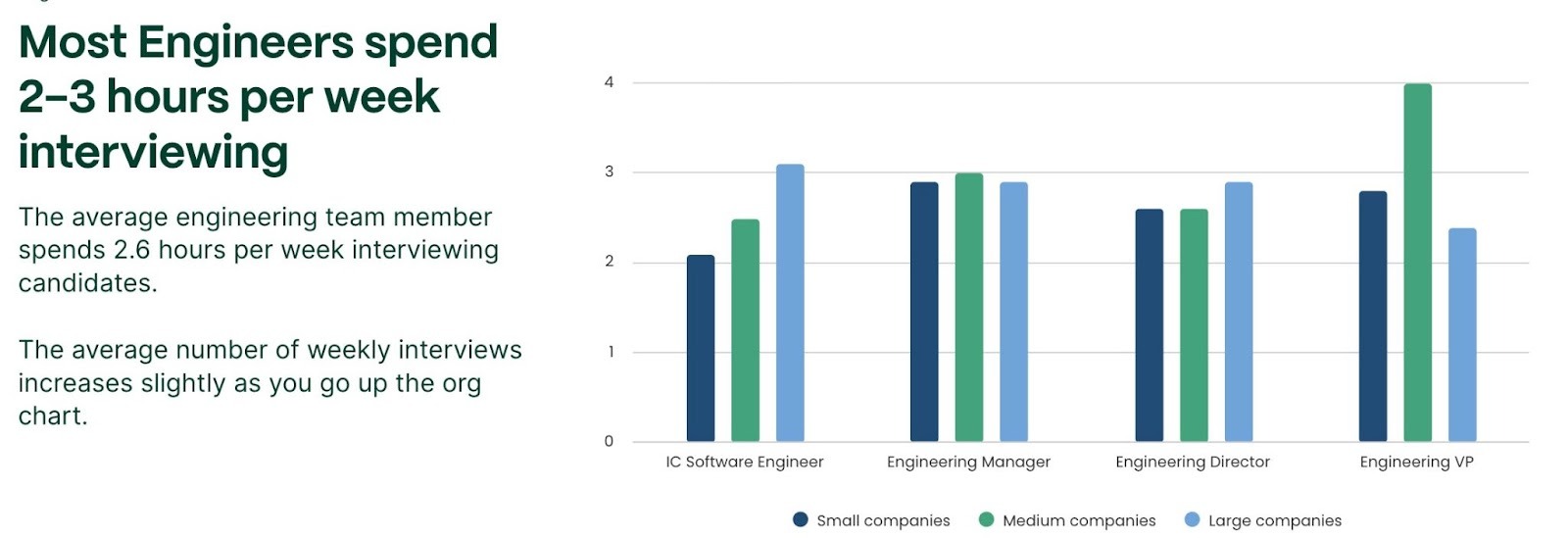
For a staff engineer already stretched between code reviews, architecture discussions, and sprint commitments, even three hours of poorly structured interviewing is three hours of deep work lost.
When every interviewer tests the same thing, everyone loses
Before exploring how to fix the technical hiring process, it is worth understanding why interview overlap happens so often in the first place. In most organizations, interview rounds get added over time without a clear audit of what each one is supposed to measure. A hiring manager adds a system design round. A tech lead insists on a problem-solving session. A senior architect wants to probe the candidate on trade-offs. On paper, these look like three different rounds. In practice, all three end up testing some version of system design thinking because nobody defined the boundaries.
This creates a chain of problems that compound quietly.
The candidate repeats themselves and checks out
Picture a senior data engineer interviewing at a mid-size IT services firm. In round two, the tech lead asks her to design a data pipeline for a real-time fraud detection system. In round three, the architect asks her to walk through how she would handle schema evolution in a streaming pipeline. Both rounds are probing system design, just from slightly different angles.
By round four, the candidate is mentally fatigued and wondering whether the company even coordinated internally. For high-quality candidates fielding multiple offers, this kind of experience tips the scale toward a competitor who ran a tighter, more respectful process.
Interviewers burn time generating redundant signals
If three panelists independently assess system design, the hiring committee ends up with three overlapping scorecards and zero structured input on collaboration, communication, or domain knowledge. The debrief becomes a debate about whose system design assessment was "more accurate" rather than a multi-dimensional evaluation of the candidate.
Meanwhile, each of those interviewers spent 30 to 45 minutes preparing, 60 minutes interviewing, and another 15 to 20 minutes writing feedback. Multiply that across a hiring pipeline of 15 to 20 candidates for a single role, and you have consumed hundreds of engineering hours on duplicated effort.
Split your interviews into "intent" and "depth"
One of the most effective ways to eliminate redundancy in interview panel coordination is to separate every round into one of two categories: intent or depth.
Intent rounds answer a single question: is this candidate directionally aligned with what the role needs? These are shorter (30 to 45 minutes), broader in scope, and designed to filter out clear mismatches early. Think of them as calibration rounds. They cover things like:
- General problem-solving approach and reasoning style
- Communication clarity and ability to explain technical concepts
- Broad alignment with the domain (analytics, cloud infrastructure, embedded systems, etc.)
Intent rounds do not need your most senior engineers. A mid-level engineer or engineering manager with interviewer training can run these effectively.
Depth rounds are different. They go narrow and deep into a specific competency that the role demands. A depth round for a platform engineering role might focus exclusively on distributed systems trade-offs. For a data engineering role, it might zero in on pipeline orchestration and failure recovery patterns.
The critical rule: each depth round gets one clearly defined focus area, and the interviewer knows exactly what they are not expected to evaluate.
Assign focus areas so interviewers know what to ignore
Defining intent and depth categories is the structural fix. Assigning explicit focus areas to each interviewer is the operational fix that makes it stick.
Here is how this works in practice for a five-round loop hiring a senior backend engineer at an analytics firm:
|
Round |
Type |
Focus area |
What the interviewer does NOT evaluate |
|
1 |
Intent |
Problem-solving approach, communication |
Technical depth, system design |
|
2 |
Depth |
System design and architecture |
Coding proficiency, cultural fit |
|
3 |
Depth |
Code quality and live coding |
System design, domain knowledge |
|
4 |
Depth |
Domain-specific knowledge (e.g., data pipelines) |
General problem-solving, coding |
|
5 |
Intent |
Collaboration, team dynamics, values alignment |
Any technical competency |
Three things change when you implement this.
1. Interviewers prepare faster because their scope is narrow. A panelist covering only "code quality and live coding" does not need to design a system design question as backup.
2. Debrief meetings become more productive. Each interviewer brings a distinct signal rather than a competing opinion on the same dimension. Decisions get made faster.
3. Senior engineers participate in fewer rounds. If a staff architect's strength is evaluating system design, they sit on one depth round per candidate instead of three overlapping ones. Their weekly interview load drops from five or six hours to under two, and those reclaimed hours go back to shipping products.
Build an interviewer rotation that protects deep work
Even with clearly scoped rounds, interview panel coordination fails if the same five people absorb the entire load. A rotation model distributes interviews across a wider pool and protects individual contributors' focus time.
A practical rotation framework looks like this:
- Define a qualified interviewer pool per focus area. For system design, you might have eight engineers across two teams who are trained and calibrated. For live coding, you might have twelve.
- Set a weekly cap per person. Two interviews per week is a reasonable ceiling for senior ICs. Engineering managers might handle three, given that hiring is a more explicit part of their role.
- Rotate based on availability, not habit. The default in many companies is to pull the same "reliable" interviewers repeatedly because they give good feedback. This is exactly how burnout builds. Use a round-robin or load-balanced assignment instead.
- Pair new interviewers with experienced ones for their first three sessions. This builds your bench without lowering evaluation quality.
The net effect is that no single engineer becomes the bottleneck for scheduling, and your interview pipeline moves without waiting on one person's calendar to open up.
Measure what actually matters: signal per round, not rounds per candidate
Once you restructure panels around intent and depth, the way you measure interview effectiveness should also shift.
Instead of tracking how many rounds each candidate goes through, track signal clarity per round. After each interview, ask the panelist: "Based on this round alone, can you make a clear hire/no-hire recommendation on your assigned focus area?" If interviewers consistently answer "not sure," the round's scope may still be too broad, or the interviewer needs better calibration.
Additionally, track unique signal coverage across the full loop. Map every scorecard submission against the focus areas defined above. If two interviewers both submitted feedback on system design when only one was assigned to it, you have scope creep that needs correcting.
These two metrics together tell you whether your interview process is generating distinct, decision-ready data, or just creating noise.
Streamline interview panel coordination with RippleHire
Restructuring interview rounds requires more than good intentions. TA leaders need a platform that brings structure, speed, and visibility to the entire hiring process, so the fixes you put in place actually hold at scale.
RippleHire's talent acquisition cloud is built for enterprises hiring across geographies and business units. Trusted by over one million employees in leading organizations across 50+ countries, the platform helps TA teams move faster without sacrificing process quality.
- A high-velocity hiring engine that gives hiring managers the tools to track candidates, share feedback instantly, and access hiring data in real time, so decisions do not stall waiting on scattered email threads
- Data-driven hiring dashboards that enable teams to make informed decisions as business needs shift, rather than relying on gut feel or delayed reports
- AI-powered screening and shortlisting that reduces the manual load on recruiters and interviewers early in the funnel, so senior engineers only spend time on candidates who have already cleared initial filters
- Seamless integration with your existing tech stack including Workday, SAP, Oracle, Microsoft Teams, and WhatsApp through a no-code integration framework, meaning the process fits into how your teams already work
Enterprises like Axis Bank, HDFC Bank, and Tata AIA Life Insurance already use RippleHire to run high-velocity hiring processes that respect both candidate and interviewer time.
Book a demo to see how RippleHire can help your engineering and TA teams run a faster, leaner interview process that respects everyone's time.
FAQs
FAQs
What is the difference between an intent round and a depth round in technical interviews?
An intent round checks whether a candidate is broadly aligned with the role's requirements. It covers reasoning style, communication, and general domain fit. A depth round goes narrow, evaluating one specific competency like system design or live coding in detail.
How do you prevent the same engineers from doing all the interviews?
Set a weekly interview cap per person, maintain a trained interviewer pool for each focus area, and rotate assignments using a round-robin model. Pair new interviewers with experienced ones for calibration during their first few sessions.
Why do overlapping interview rounds lead to candidate drop-off?
Candidates who answer similar questions across multiple rounds perceive the process as disorganized. Combined with scheduling delays that result from over-reliance on the same senior panelists, this creates friction that pushes strong candidates toward faster-moving competitors.