
.svg) Product
Product

.png)




Table of content
Most enterprises in BFSI and analytics still rely on competitive salaries, health insurance, and annual bonuses as the backbone of their employee value proposition.
Yet a March 2024 Gartner survey of over 1,300 employees found that only 33% believe their organization consistently delivers on its EVP promises (Gartner, 2024). PwC’s 2023 India Workforce Hopes and Fears Survey revealed that 42% of Indian employees planned to switch jobs within the next year, compared to just 26% globally (PwC India, 2023). The gap between what companies think they offer and what employees actually experience has never been wider.
This disconnect matters most when you are hiring high-demand talent: cloud architects, risk modelling experts, data engineers, and strategy consultants. These professionals have abundant choices. They do not leave because a competitor offered a marginally higher salary. They leave because the day-to-day reality of working at your organization did not match the promise.
In other words, your employee value proposition (EVP) is not your careers page. It is the actual working arrangement between your company and its people, as experienced every single day. And unless you rethink it from the ground up, no number of perks will stop your best hires from walking out.
Why traditional EVPs are failing
For decades, large Indian enterprises leaned on a predictable formula: offer job security, a respected brand name, and a comprehensive benefits package. That formula worked when talent pools were deep and employee expectations were relatively uniform. Today, however, the rules have shifted.
According to Aon’s Annual Salary Increase and Turnover Survey 2024-25, India’s overall attrition rate stood at 16.9% in 2024, down from 21.4% in 2022, but services sector attrition remained elevated at 19.2%. In BFSI specifically, frontline attrition can exceed 100% in some segments, forcing companies to refill every position more than once a year.
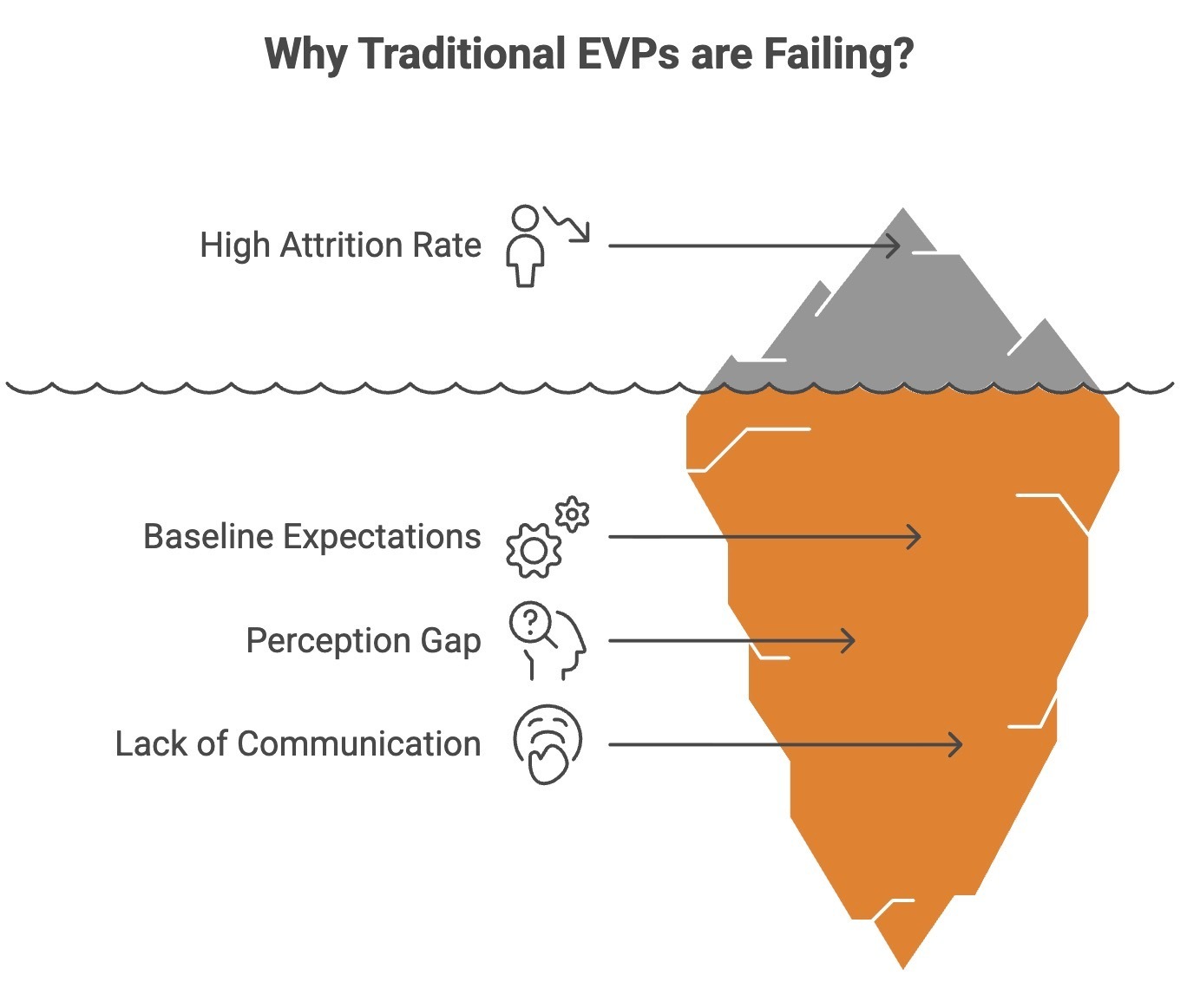
The reason traditional EVPs are breaking down is not that benefits have become worse. On the contrary, most large enterprises have added mental health support, flexible work policies, and learning stipends over the past three years. The problem is that these additions have become industry-wide baseline expectations rather than differentiators. When every major bank and consulting firm offers similar health coverage, similar bonuses, and similar work-from-home policies, none of these features help a candidate choose one employer over another.
Benefits have become hygiene factors
Think about how candidates in analytics and consulting evaluate offers today. Health insurance, provident fund contributions, and annual increments sit in the same category as office Wi-Fi: you notice only when they are missing. A strong post-pandemic EVP must go beyond these basics and articulate what genuinely makes working at your organization different from every other option on the table.
The perception gap is widening
Gartner’s 2024 research surfaced a striking number: only 16% of employees reported knowing what actually makes up their organization’s EVP. Additionally, 75% of HR leaders admitted they are not doing a great job of communicating their EVP internally. This creates a dangerous loop:
- Companies invest heavily in building a compelling EVP.
- Employees never hear about it clearly enough to feel it.
- When reality does not match the vague promise, frustration builds.
- High-demand talent, who always has alternatives, leaves first.
Your EVP is the real working deal, not a marketing tagline
One of the biggest mistakes employer branding teams make is treating the employee value proposition as a communication exercise. They craft aspirational messaging, design attractive careers pages, and highlight awards and recognitions. All of these activities matter for awareness, but they do not define the EVP. Your EVP is determined by what happens after someone joins. It lives in how projects are assigned, how managers give feedback, how promotions are decided, and how honestly the organization communicates during difficult periods.
Consider a mid-sized analytics firm that advertises a culture of innovation and continuous learning. A newly hired data scientist joins expecting dedicated time for experimentation and access to cutting-edge tools. Instead, she finds herself fully allocated to client delivery from day one, with no protected time for learning. Within six months, she is exploring other opportunities. The firm’s careers page still says “innovation is in our DNA.” The data scientist’s lived experience tells a different story.
This gap between stated EVP and experienced EVP is where most attrition originates.
PwC’s 2024 Global Workforce Hopes and Fears Survey confirmed this pattern: 28% of employees globally said they were likely to switch employers within 12 months, a figure higher than during the Great Resignation peak of 2022. Among those planning to leave, 67% said skills development opportunities were a significant factor in their decision.
Every job has trade-offs, and a strong EVP names them
No organization can offer everything. A high-growth fintech may provide rapid career advancement but demand intense working hours. A large bank may deliver stability and global exposure but move slowly on promotions. A boutique consulting firm might give its analysts direct client access but expect them to handle administrative tasks that larger firms delegate to support staff. Each of these arrangements involves a trade-off, and the most effective EVPs do not hide them.
Explicitly naming trade-offs serves two critical purposes. First, it builds trust. Candidates who know exactly what they are signing up for are less likely to feel deceived three months in. Second, it acts as a self-selection filter, attracting people whose priorities genuinely align with what the organization offers.
How to identify your real trade-offs
Start by asking your current employees three questions:
- What is the hardest part of working here that nobody warned you about?
- What do you give up by choosing this organization over alternatives?
- What makes the trade-off worth it for you personally?
The answers will reveal patterns. At a large BFSI enterprise, you might hear that the compliance-heavy environment slows down decision-making but also provides exceptional regulatory knowledge that is hard to build elsewhere. At an analytics firm, the trade-off might involve long project cycles in exchange for working on complex, intellectually stimulating problems.
Communicating trade-offs without scaring candidates away
Transparency does not mean listing every inconvenience in a job posting. Rather, it means framing trade-offs honestly during interviews and onboarding. For example:
“We are a compliance-first organization. That means approval cycles are longer than at a startup, and you will spend time on documentation that might feel tedious. In return, you will build deep expertise in regulatory frameworks that few other environments can offer.”
This kind of honesty resonates with experienced professionals. They have seen enough vague promises to appreciate a company that respects their intelligence. McKinsey’s research on the Great Attrition found that employees were far more likely to prioritize relational factors such as feeling valued and having a sense of belonging over purely transactional ones like compensation. Stating where people are expected to stretch, and what they gain in return, directly addresses that relational need.
Building an EVP that actually retains high-demand talent
Redesigning your employee value proposition is not about adding more benefits to an already long list. Instead, it requires a fundamental shift in how you define and deliver the employment experience. Below are four principles that leading BFSI and analytics enterprises are using to rebuild their EVPs.
Move from features to experiences
Stop listing what you offer and start describing what it feels like to work at your organization. Instead of “we provide mentorship programs,” explain how a junior risk analyst paired with a senior leader built a fraud detection model that went live within four months. Real stories carry more weight than bullet points on a benefits brochure.
Segment your EVP by talent persona
A cloud architect evaluating your organization cares about different things than a relationship manager or a compliance officer. Gartner’s research emphasizes that effective EVP design requires segmenting by talent persona and tailoring the message accordingly. For technology roles, emphasize the tech stack, engineering autonomy, and learning budgets. For consulting roles, highlight client diversity, travel expectations, and the path from analyst to partner.
- Data engineers: Talk about infrastructure maturity, data governance practices, and opportunities to work with large-scale production systems.
- Risk and compliance professionals: Emphasize regulatory impact, cross-functional exposure, and stability.
- Strategy consultants: Focus on project variety, leadership access, and speed of career progression.
Make managers the EVP delivery mechanism
Gartner’s 2024 survey found that employees who believe they can depend on their manager to deliver EVP promises are five times more likely to agree that their organization follows through on those promises. Yet managers are rarely equipped or incentivized to play this role. Training managers to connect daily interactions, whether a project assignment, a performance conversation, or a team meeting, back to the organization’s EVP can bridge the gap between marketing promises and lived reality.
Invest in skills growth, not just compensation
PwC’s 2024 Global Workforce Hopes and Fears Survey highlighted a powerful insight: fewer than half of employees (46%) agree that their employer provides adequate opportunities to learn career-relevant skills. Among employees planning to leave, skills growth was nearly twice as influential as it was for those planning to stay. In an era where technical skills evolve rapidly, offering structured upskilling paths, certifications, and cross-functional rotations can differentiate your EVP more than a 10% salary bump.
Reading your EVP signals: early tenure attrition versus applicant volume
Many organizations track applicant volume as a measure of employer brand strength. A high number of applications for each open role feels reassuring. However, applicant volume alone tells you almost nothing about whether your employee value proposition is working. To truly diagnose EVP health, you need to pair it with a second metric: early tenure attrition.
What early tenure attrition reveals
Early tenure attrition, typically measured as voluntary exits within the first 12 months of employment, is one of the clearest indicators of a mismatch between your stated EVP and the actual employee experience.
When new hires leave within their first year, they are telling you something specific: what they expected when they accepted the offer did not match what they encountered after joining. A high early attrition rate, even alongside strong applicant numbers, signals that your employer brand is effective at attracting attention but your EVP is failing at retention.
A diagnostic framework for TA leaders
Use the following combinations to diagnose where your EVP stands:
- High applicant volume + low early attrition: Your EVP is working. The promise aligns with reality, and new hires are staying because their expectations match their experience.
- High applicant volume + high early attrition: Your employer brand is strong, but your EVP has a credibility problem. You are attracting people with promises you cannot keep. Investigate what candidates are being told during recruitment versus what they experience in their first 90 days.
- Low applicant volume + low early attrition: Your EVP is honest but not compelling enough to attract a wide talent pool. The people who do join tend to stay because there are no surprises. Focus on amplifying what makes your organization genuinely distinctive.
- Low applicant volume + high early attrition: This is the most concerning scenario. Both your employer brand and your EVP need significant work. Start with internal listening, exit interviews, and stay conversations before investing in external branding.
Turning signals into action
Once you identify where your organization falls in this framework, the next step is connecting the data to specific stages of the employee journey. Conduct structured interviews with employees who left within their first year. Look for recurring themes around unmet expectations, manager quality, role clarity, and cultural fit. Then map those themes back to your recruitment messaging and onboarding process to close the gaps.
Organizations that treat early tenure attrition as a strategic metric rather than an HR housekeeping number tend to build EVPs that genuinely reflect reality. Over time, this approach creates a self-reinforcing cycle: honest EVPs attract better-fit candidates, who stay longer, who then become authentic ambassadors of the employer brand.
Strengthen your EVP delivery with a smarter talent acquisition engine
Rethinking your employee value proposition is a strategic exercise, but executing on it requires operational muscle. From ensuring that recruitment messaging stays consistent across every channel to tracking early tenure attrition by source, team, and hiring manager, the gap between EVP intent and EVP delivery often comes down to the tools and processes your TA team uses daily.
A purpose-built talent acquisition platform can help bridge this gap by aligning your hiring process with the EVP you want to deliver. RippleHire’s TA Cloud is designed to help enterprises do exactly this.
- Consistent candidate experience: Dynamic, user-friendly application forms ensure that every candidate interaction reflects your employer brand, with customers scoring 4.5+/5 on candidate experience.
- Data-driven hiring insights: Track metrics like source effectiveness, time-to-hire, and early attrition patterns to identify where your EVP promise breaks down.
- AI-powered screening: Whitebox AI automates candidate shortlisting and fraud detection, allowing recruiters to spend more time on the human conversations that bring your EVP to life.
- Seamless integration: Connect with HRMS platforms like Workday, SAP, and Oracle, plus communication tools like Teams and WhatsApp, so your EVP messaging stays consistent from first touchpoint to onboarding.
- Global compliance built in: ISO 27001, SOC 2 Type 2, and GDPR compliance ensure your hiring process meets the highest security standards across 50+ countries.
Book a demo to see how RippleHire can help you align your talent acquisition process with the employee value proposition your best hires deserve.
FAQs
FAQ
1. What is an employee value proposition and why does it matter?
An employee value proposition is the complete set of benefits, experiences, and trade-offs that define what it means to work at your organization. It goes beyond salary and perks to include culture, growth opportunities, manager quality, and daily work experience. A strong EVP helps attract the right candidates, reduces early attrition, and builds long-term loyalty by setting honest expectations from the start.
2. Why are traditional EVPs failing to retain tech and consulting talent?
Traditional EVPs rely on health insurance, bonuses, and brand reputation as differentiators. However, most large enterprises now offer similar packages, turning these into baseline expectations rather than reasons to choose one employer over another. High-demand professionals like data engineers and strategy consultants evaluate offers based on learning opportunities, work autonomy, and cultural fit. When every company sounds the same, none stand out.
3. How can organizations identify the real trade-offs in their EVP?
Start by conducting honest conversations with current employees and recent hires. Ask what surprised them after joining, what they gave up by choosing your organization, and what makes the trade-off worthwhile. Exit interviews with early leavers also reveal recurring gaps between expectations and reality. These patterns highlight the real trade-offs your EVP should acknowledge openly rather than hide behind aspirational messaging.
4. What is early tenure attrition and why should TA leaders track it?
Early tenure attrition measures voluntary exits within the first 12 months of employment. It signals a mismatch between what candidates expected during recruitment and what they experienced after joining. Tracking this metric alongside applicant volume gives TA leaders a clear picture of whether their employer brand attracts attention and whether the EVP actually delivers on its promises once people are on board.
5. How can managers play a role in delivering the EVP effectively?
Managers are the most direct touchpoint employees have with the organization. They shape daily experiences through project assignments, feedback conversations, and team dynamics. When managers understand the EVP and connect everyday interactions back to its promises, employees feel the organization is following through. Training managers to reinforce EVP during regular conversations turns abstract brand messaging into a tangible, lived experience.