
.svg) Product
Product

.png)




Table of content
Every quarter, professional services firms spend lakhs hiring externally for skills that already exist inside their organization. Internal mobility offers a faster, cheaper, and lower-risk path to filling roles. Yet most firms default to external hiring because matching internal talent to open needs feels harder than posting a job on LinkedIn.
This is not a talent problem, but a visibility problem.
The skills exist. The availability exists. What does not exist is a system that connects them in real time before the external hiring decision is made.
This blog breaks down why internal mobility deserves a seat at your resource planning table, and how leading firms are making it work without adding complexity to an already stretched RMG function.
What does bench cost actually cost?
Bench cost is the total salary and overhead for unallocated consultants. External hiring to fill roles that bench talent could cover costs 1.7 times more per hire and adds 29 additional days to time-to-fill, directly eroding project margins.
The numbers tell a story that most resource managers already feel but rarely see quantified.
Utilization directly impacts your bottom line.
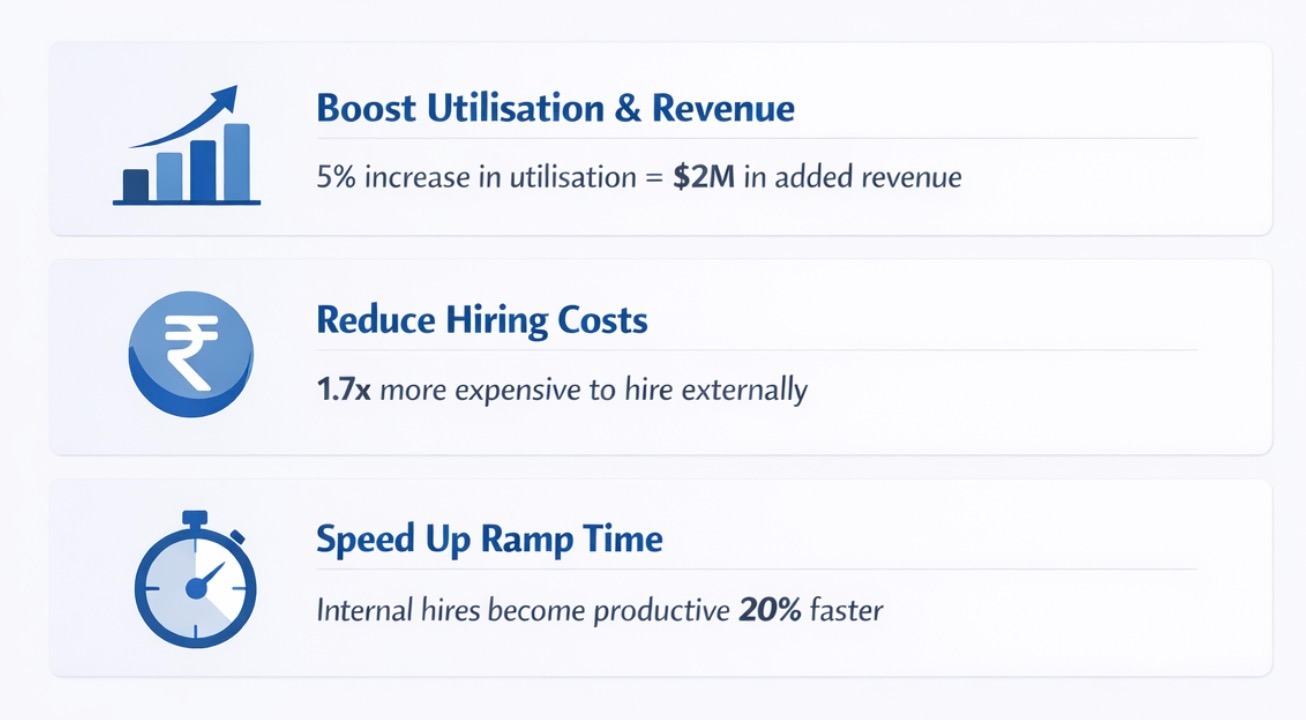
Consider a firm with 100 consultants, each billing $1,500 per day, operating at 70% utilization. That firm generates around $27.3 million annually. By increasing utilization to just 75%, the same firm could boost revenue to $29.25 million. That's nearly a $2 million swing from a 5% improvement. Now flip that: every point you drop below optimal utilization is revenue walking out the door while your people wait for work.
When a role goes external instead of internal, according to Gloat's internal mobility research, it costs 1.7 times more to recruit, train, and onboard the external hire. For a senior consultant role in professional services, that premium can run to several lakhs before the person has billed their first hour.
Speed compounds the problem. Internal recruitment takes an average of 20 days; external recruitment stretches to 49 days on average. For a business where empty seats mean unbilled mandates, that is nearly a month of lost revenue per role on top of the premium cost of the external hire.
Then comes ramp time.
Benefits of internal hiring
Internal hires reach full competency 20% faster than external hires. It takes an external hire two years to gain the organizational knowledge that an internal hire already has. For client-facing roles where speed to contribution directly affects margin, this gap is material.
Put these together: bench salary cost running without revenue, a 1.7x premium on the external hire, 29 additional days of unbilled mandate, and a two-year gap in organizational knowledge. That is the actual cost of defaulting to external hiring when bench talent exists.
Why do internal mobility programs fail ?
Internal mobility fails primarily because of three structural gaps: roles are posted externally before internal talent is checked, there is no real-time visibility into bench skills and availability, and managers are implicitly penalized for releasing their best people to other teams.
The sequence problem. Most firms post roles externally the moment a mandate is confirmed. By the time anyone thinks to check internally, the recruiter has three external shortlists and hiring momentum has already committed to the external path. The internal check becomes a formality rather than a genuine first option.
The visibility problem. A spreadsheet with consultant names and their last project is not a skills inventory. It cannot tell you who has cloud migration experience from a project two years ago, who is coming off a mandate in 12 days, or who picked up a new certification during their last bench period. Without that visibility, resource managers default to who they personally know which is typically 20% of the actual bench.
The manager problem. A delivery manager with a high-performing consultant will not volunteer them for a role in another business unit. That means losing their best person and absorbing the gap. The organizational benefit is real. The manager's incentive is the opposite. Without structural change to what is measured and rewarded, managers will consistently prioritize retention of talent over deployment of it.
According to LinkedIn's Global Talent Trends, companies with strong internal mobility retain employees nearly twice as long as those without. The same research found that internal hires are three times more likely to be engaged with the organization. The retention benefit is significant , but it only materializes if the structural barriers to internal mobility are removed first.
How to make internal mobility the default sourcing strategy?
The fastest way to make internal mobility the default is to introduce a 48-72 hour internal posting window before any role goes external, build a real-time skills inventory that shows availability and adjacent capabilities, and measure managers on talent development, not just headcount retention.
Give internal talent a head start before roles go external
Post roles on internal channels and flag them in team meetings for 48 to 72 hours before any external search begins. Notify consultants who are ramping down from current projects. This is not about slowing down hiring, it is about checking the bench before paying to source externally what already exists internally.
An internal job board that goes live two days after the external search has started is not genuine internal-first hiring. It is compliance with a policy that has already been bypassed in practice.
Build a skills inventory that reflects what people can actually do
A skills inventory needs to answer three questions in real time:
- Who has the capabilities this mandate requires?
- Who is coming off a project in the next two to three weeks?
- Who picked up new certifications or domain experience during their last bench period?
One large consulting firm solved this by tagging consultants by adjacent capabilities they'd demonstrated on past projects. When a fintech transformation mandate came in requiring both cloud migration and regulatory compliance experience, their system surfaced a consultant who'd done both but was sitting in a completely different practice. Without that visibility, she'd have stayed on bench while an external hire got the role.
The key design principle: the inventory needs to capture what people have done and are capable of, not just what their job title says. Job titles in professional services lag actual capabilities by 12 to 18 months. The inventory has to catch up.
Change what you measure for managers
This is where most internal mobility programs quietly stop working.
Some firms now track a talent exporter metric that rewards managers for developing people who move into bigger roles elsewhere in the organization. Others factor internal mobility into performance reviews , asking not just "did your team deliver?" but "did you build people who grew beyond your team?"
Without this change, the incentive structure actively opposes internal mobility. A manager who helps a top performer move to another business unit absorbs a gap and gets no credit. A manager who blocks that move keeps their team intact. The behavior that follows is predictable.
Track internal hiring with the same rigor as external
If you measure time-to-fill, cost-per-hire, and 12-month retention for external hires but have no equivalent metrics for internal moves, you're flying blind.
Set up parallel tracking:
- How long does it take to fill a role internally versus externally?
- What's the retention rate for internal moves at 6 and 12 months?
- How many roles went external that could have been filled from the bench?
This data tells you whether your internal mobility program is actually working or just existing on paper.
5 Questions to ask before any role goes external
These five questions take five minutes. They can save six weeks of external hiring and significant recruiter spend.
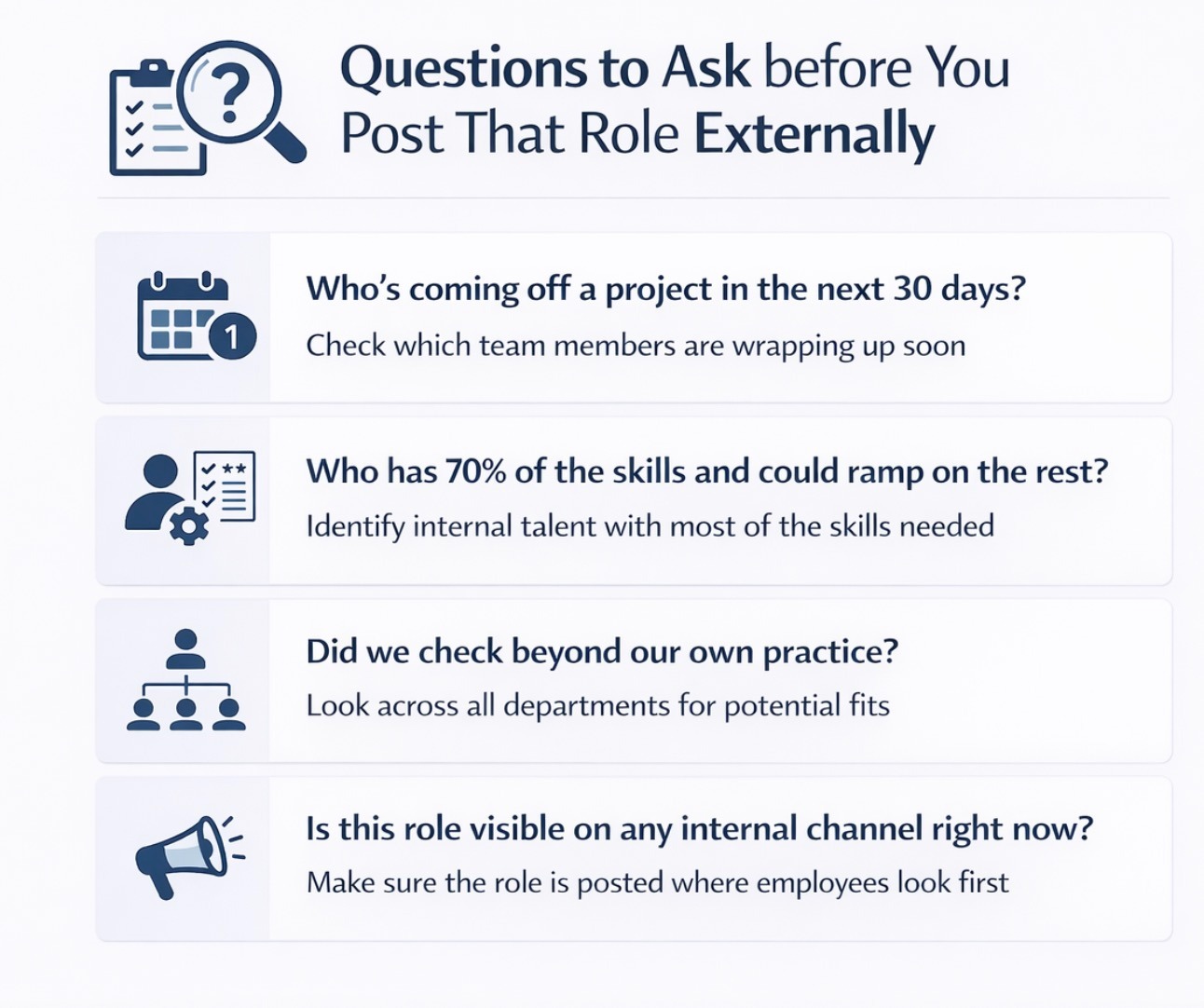
1. Who's coming off a project in the next 30 days?
Your bench isn't just who's free today. It's who's about to be free. If you're only checking current availability, you're missing consultants who are wrapping up deliverables and would be ready to start exactly when your new mandate kicks off.
2. Who has 70% of the skills and could ramp on the rest?
Stop looking for perfect matches. An internal consultant who knows your delivery model, client expectations, and ways of working but needs to pick up one new tool will outperform an external hire who ticks every box on paper but takes three months to understand how your firm actually operates.
3. Did we check beyond our own practice?
A delivery lead in the cloud practice isn't going to know that there's a consultant in the data analytics team who spent two years doing exactly the kind of transformation work this mandate requires. If your search is limited to who you personally know, you're searching maybe 20% of your actual talent pool.
4. Is this role visible on any internal channel right now?
Not "did we mention it in a team call" but actually visible. Posted somewhere consultants check. Flagged to people whose projects are ending. If the answer is no, you haven't tried internal hiring. You've just assumed it won't work.
5. Could a near-fit with a ramp plan work?
Define what the ramp looks like before dismissing the near-fit internal candidate. A six-week ramp on a specific tool, paired with structured support from a senior team member, is often faster and cheaper than the full external hiring cycle.
What are the most common reasons internal mobility programs fail?
The three most common internal mobility failures are treating internal candidates as backup options after external searches stall, creating bureaucratic approval processes that make switching teams harder than leaving the firm, and providing no feedback to internal candidates who were not selected.
Treating internal candidates as backup options. The role goes external immediately. Only when that search stalls does anyone check the bench. By then, the consultant who would have been right has been staffed elsewhere or has mentally moved on from the opportunity.
Bureaucracy that signals staying put is easier than moving. Manager approvals, HR sign-offs, waiting periods before team transfers are permitted ,each step is individually defensible. Together they communicate that internal mobility is harder than external job applications. Some firms have made internal transfers so process-heavy that consultants find it easier to apply to a competitor than to move within their own organization.
Rejection without feedback. An internal candidate who does not get the role still has to show up to work. If no one explains why they were not selected or what would make them a stronger fit next time, the rejection stays. They stop applying internally. Eventually they stop applying at all and simply leave.
According to LinkedIn's Workplace Learning Report, 94% of employees say they would stay at a company longer if it invested in their career development. The inverse is equally true: when internal moves are consistently bureaucratic or opaque, the employees most capable of moving internally are precisely the ones with the best external options.
How to get real-time visibility Into bench talent?
Most internal mobility programmes fail because of infrastructure. HR knows the bench exists. Resource managers know projects need staffing. Connecting these two realities in real time, across business units, without emails and spreadsheets, is where things fall apart.
That is where RippleHire comes in. It is the AI ATS where recruiters and agents work together and Internal Mobility is built to give resource managers and TA teams a single real-time view of the full talent ecosystem, internal and external.
Bench talent is matched to open roles using the same AI-powered screening applied to external applicants, skills, certifications, project history, and availability are searchable and visible to everyone who needs them. Manager dashboards show which team members are ready to move and when. Approval workflows are built into the platform rather than running through email chains that take longer than the external hiring process they were meant to shortcut.
Atrayee Sanyal, HRM and Chief Diversity Officer at Tata Steel:
"RippleHire transformed our recruitment ecosystem with automation and analytics. It helped us cut costs, reduce time, and build a sustainable high-performance talent pipeline."
Book a demo to see how RippleHire can help you lower cost-per-hire, and utilization rates that actually reflect the talent you've invested in building.
Frequently asked questions
Q: Why is internal mobility more cost-effective than external hiring?
A: Relying on your bench is significantly cheaper and faster. Externally recruiting, training, and onboarding a new employee costs 1.7 times more than moving someone internally. Furthermore, internal recruitment takes an average of 20 days, whereas external recruitment can drag on for 49 days resulting in nearly a month of lost billable revenue.
Q: How does internal hiring impact ramp time and productivity?
A: Internal hires reach full competency 20% faster than external hires. It typically takes an external hire two full years to gain the same level of organizational insight, client understanding, and internal networking that an existing employee already possesses.
Q: Why do internal mobility programs fail in professional services firms?
A: Programs usually fail due to systemic friction rather than a lack of intent. Common pitfalls include treating internal candidates as backup options, complex bureaucracy involving endless manager approvals, managers hoarding their top-performing talent, and failing to provide feedback to internal candidates who are rejected.
Q: What metrics should leaders use to track internal mobility?
A: You must track internal mobility with the exact same rigor as external hiring. Essential metrics to monitor include the time-to-fill for internal versus external roles, 6-month and 12-month retention rates for internal moves, and the percentage of roles that went external but could have been staffed from the bench.
Q: How can we prevent managers from hoarding top talent?
A: The solution is to change what you measure and reward. Leading firms are shifting performance reviews to track a "talent exporter" metric. This rewards delivery managers who actively develop their people and help them move into bigger roles elsewhere in the organization, rather than penalizing them for losing headcount.