
.svg) Product
Product

.png)




Table of content
Quick Answer: Interview fraud in professional services is the deceptive practice of using proxy test-takers, fabricated credentials, or real-time AI assistance to pass recruitment evaluations. Because traditional post-offer background checks occur too late to prevent client delivery risks, talent acquisition (TA) teams must implement pre-offer controls specifically continuous ID verification, proctored testing, and primary-source credential auditing before extending job offers.
Hiring in professional services runs at a volume that demands constant vigilance. IT services firms, consulting houses, and engineering companies recruit tens of thousands of candidates every year across campus drives, lateral hiring, and specialist roles. The process moves fast, and the assessments are increasingly digital.
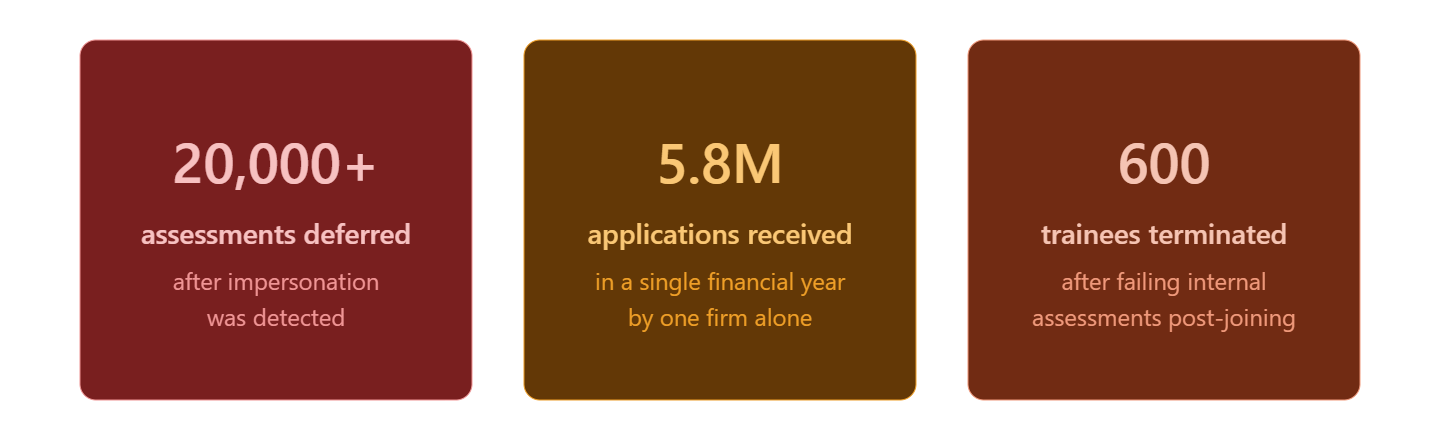
That speed creates opportunity for fraud. In June 2026, a leading Indian IT services firm deferred online assessment tests and in-person evaluations for more than 20,000 job applicants after detecting multiple instances of impersonation and candidate assessment malpractices. The company, which recruits from 300 to 400 colleges across India each year, postponed assessments for specialist programmer and digital specialist engineer candidates after uncovering attempts to game the evaluation process. The firm has since introduced additional guardrails and verification checks to preserve the integrity of its hiring assessments.
The incident is not an isolated one, and the numbers from that firm alone show how fast fraud compounds at scale. The pattern has been building across the professional services sector. During FY26 alone, the firm received 5.8 million job applications, interviewed 450,901 candidates, and extended offers to 87,286 applicants. At that scale, even a small percentage of fraudulent applications creates a significant operational problem.
The cost does not stop at hiring. In the same period, the firm terminated around 600 trainees at its Mysuru campus after they failed to clear internal assessments despite being given three attempts. Candidates who enter client-facing roles without the skills they claimed to have created real delivery risk, client relationship damage, and reputational exposure.
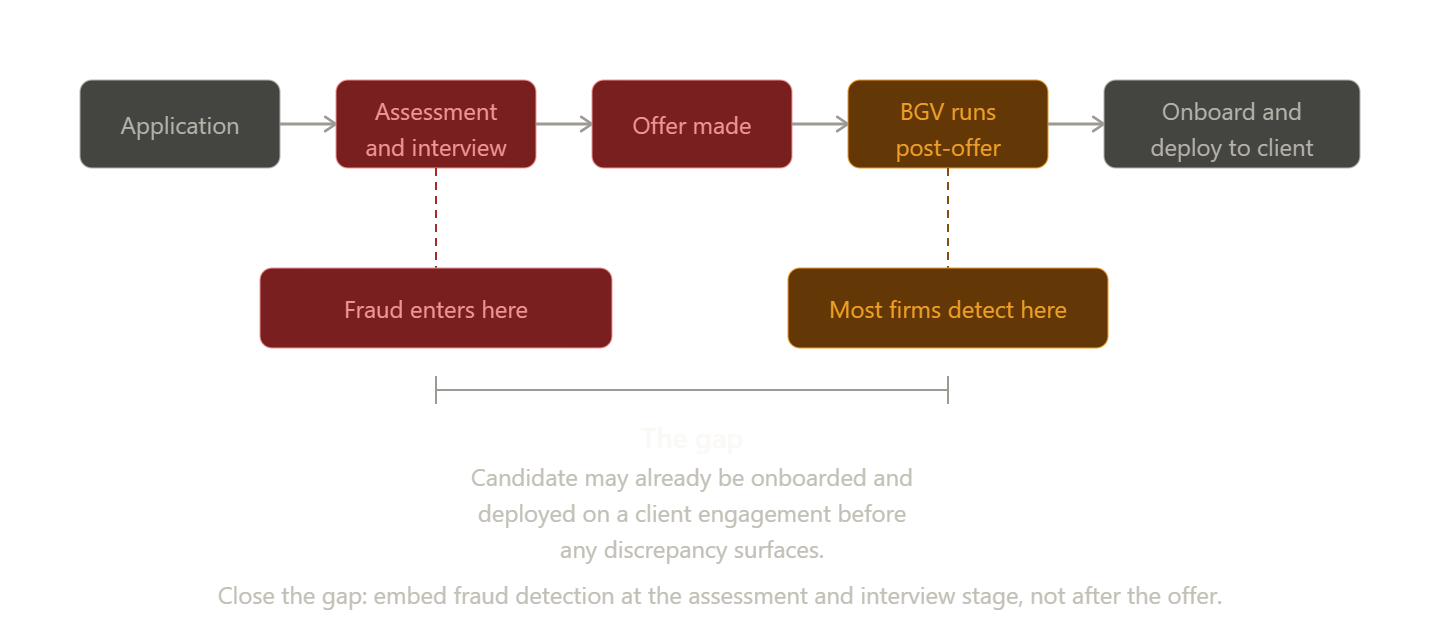
Most professional services firms still rely on post-offer background verification as the primary fraud check. By the time discrepancies surface, the candidate may already be onboarded, badged, and deployed on a client engagement. That gap is no longer acceptable.
Types of interview fraud professional services teams should watch for
Interview fraud in professional services is not a single problem. It takes different forms across campus hiring, lateral assessments, and specialist evaluations, and each type creates distinct risk for delivery, client trust, and organizational integrity. Understanding these categories is the first step toward building detection that catches fraud before an offer is made, not after.
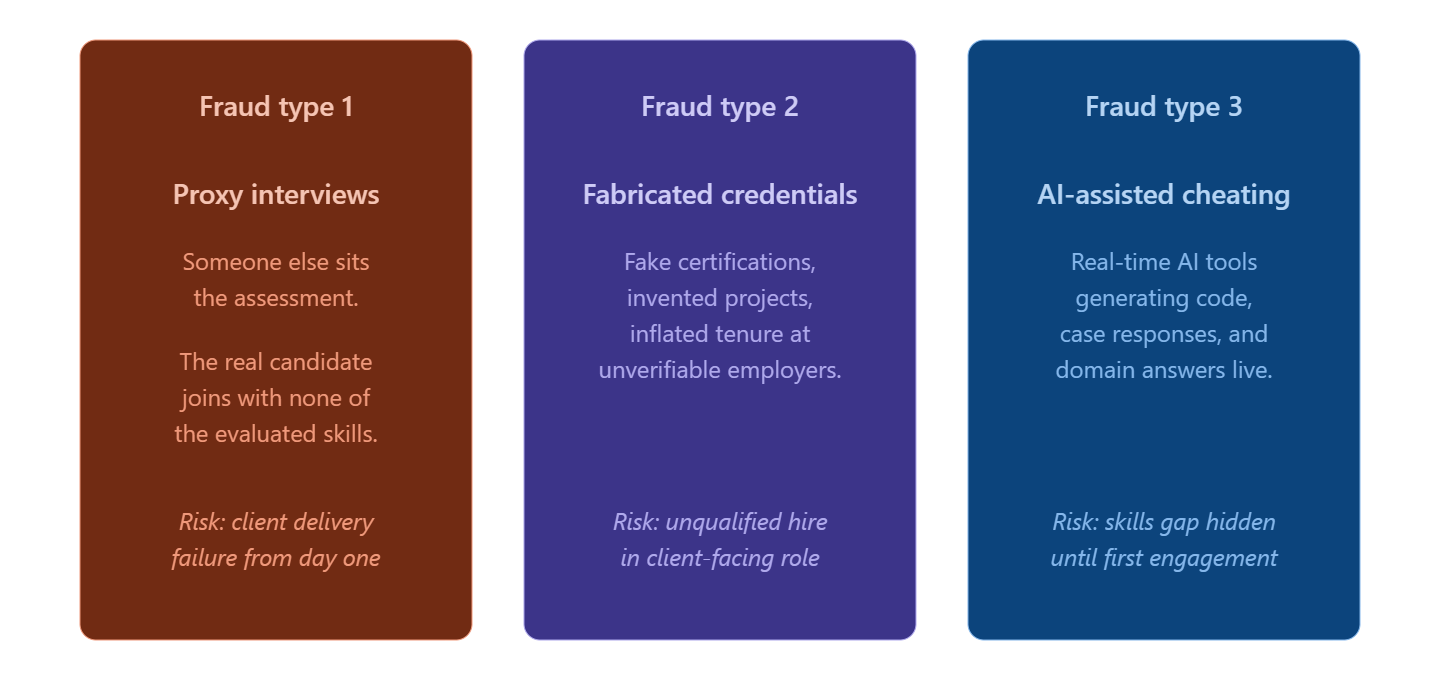
Here are three types of fraud that IT services and consulting TA teams encounter most frequently, each one harder to catch as AI tools become more accessible.
| Fraud Type | How It Works | When It Enters the Funnel | Why Post-Offer BGV Misses It |
|---|---|---|---|
| Proxy assessment | A technically stronger person completes the evaluation on the candidate's behalf | During online coding tests, aptitude assessments, and case study rounds | BGV checks documents not whether the assessment was completed by the candidate |
| Fabricated credentials | Inflated project experience, fake certifications, cloned profiles, non-existent employer records | At application and screening stage | BGV relies on submitted documents not primary source verification against EPFO, certification registries |
| AI-assisted cheating | Candidate uses real-time AI tools to generate code, structure case responses, or answer domain questions during live evaluations | During video interviews and online assessments | BGV has no visibility into assessment conduct only employment and education history |
Proxy interviews and impersonation during technical assessments
In a proxy assessment, someone other than the actual candidate completes the technical evaluation. The person who clears the coding test, the aptitude assessment, or the case study may be a professional test-taker or a technically stronger contact hired specifically for that purpose. The actual candidate who shows up on Day 1 lacks the skills the assessment was designed to verify.
This is particularly damaging in professional services because the hire is often placed directly on a client engagement. An IT services firm that deploys a developer who cannot code at the level assessed, or a consulting firm that places an analyst who cannot structure a problem, is not managing an internal HR issue. It is managing a client relationship that depends on the competence of the person in the room.
A single incident illustrates the operational scale of this problem. Multiple instances of impersonation were detected across assessments for specialist programmer and digital specialist engineer roles, prompting a full deferral of the process for tens of thousands of candidates. Virtual hiring, as the firm itself acknowledged when it moved to a hybrid model, presents specific challenges including fake profiles and limited opportunities to build personal rapport during the evaluation process.
Consider the practical mechanics. A candidate arranges for a technically stronger contact to appear for a video-based coding assessment or case interview. The proxy completes the round. The real candidate, who lacks that depth, joins the firm and struggles from day one. By the time the gap surfaces through project performance or client feedback, the firm has invested in onboarding, tool access provisioning, and client allocation.
Fabricated credentials, projects, and employment history
Credential fraud in professional services goes well beyond a padded resume. It includes specific fabrications that directly affect what a firm can safely deliver to its clients. Some of the patterns TA teams encounter most often include:
- Inflated project experience citing frameworks, tools, or technologies the candidate has not worked with in any meaningful capacity
- Fabricated employment at companies that no longer exist, were too small to verify, or had no formal HR documentation practices
- Fake platform certifications from providers where passing scores can be purchased or generated without genuine learning
- Cloned profiles adapted from legitimate professionals on LinkedIn, with minor modifications to names, employers, or timelines to avoid exact-match detection
- Claims of onsite, client-facing, or international project exposure that cannot be independently verified through standard BGV
The exposure here compounds when the fraudulent hire is placed on a client account. A candidate who inflates their experience by one year is deployable with closer supervision. A candidate who fabricates their entire background and presents themselves as independently capable represents a categorically different risk. When the shortfall surfaces mid-project, the professional services firm absorbs the cost in rework, escalation, and relationship repair.
The regulatory dimension matters for consulting and advisory firms in particular. A compliance consultant with fabricated audit experience who advises a financial services client on regulatory reporting carries liability that extends well beyond a bad performance review.
AI-assisted cheating during live evaluations and coding tests
This is the fastest-growing form of fraud and the hardest to detect manually. Candidates use real-time AI tools to generate code, structure case study responses, answer domain knowledge questions, or produce articulate answers during video interviews. A second screen running a large language model or a coding copilot can produce technically correct output within seconds.
What makes this particularly difficult to identify in professional services hiring is that the output often looks legitimate on first evaluation. A candidate with basic familiarity with a subject can use AI to produce answers that read as the work of someone with genuine depth. The responses pass initial evaluation because they are structurally and factually sound. They fail only when the candidate is asked to go deeper, adapt the answer to a novel scenario, or apply the same knowledge in a live client context.
This pattern is especially problematic for technical assessments. A candidate can submit code they did not write, structured case responses they did not think through, and financial models they did not build. Each one passes review at the assessment stage. Each one fails when the candidate is expected to own and extend that work in a real delivery environment.
Interviewers often notice the indicators without identifying the cause. Slight delays before each answer. Responses that are more polished than the candidate's overall communication style. Visible eye movement to a second screen. Noticeably weaker performance when follow-up questions push beyond the prepared answer. At the volume that professional services firms evaluate candidates, these signals are easy to attribute to nervousness rather than fraud.
How professional services teams can identify and prevent assessment fraud
Fraud in professional services hiring cannot be managed only at the background verification stage. Prevention needs to begin during assessments and interviews themselves, particularly for roles that go directly into client delivery. The strongest controls combine assessment integrity, identity verification, credential validation, and audit-ready documentation earlier in the process.
Verify identity at every stage of the assessment journey, not just at onboarding
Many professional services firms validate identity only at onboarding or after an offer is made. By then, the person who completed the technical evaluation may not be the same person who shows up on Day 1.
A stronger approach introduces identity checks at the assessment stage itself. This means verifying a photo ID before an online coding test begins, comparing the face on screen against the submitted ID during video interviews, and re-verifying identity at in-person rounds before the assessment starts. Cross-checking interview recordings against onboarding documentation later in the process gives TA and security teams a baseline for comparison if questions arise.
The firm explicitly cited this gap when it moved from a virtual-only recruitment model to a hybrid one. The hybrid approach was designed in part to create in-person touchpoints that are harder to game than remote assessments alone.
For high-volume campus hiring in particular, even small mismatches in appearance, communication style, or response patterns across rounds can signal integrity issues that warrant a closer look before an offer is made.
Use assessment integrity controls for technical and aptitude evaluations
For technical assessments, structural controls reduce the opportunity for proxy completion and AI assistance. These include:
- Proctoring with camera and screen monitoring during online tests
- Randomized question sets that prevent answer-sharing between candidates sitting the same assessment
- Time-constrained questions where AI generation speed becomes a distinguishing signal against genuine recall
- Follow-up oral rounds that require candidates to explain and extend their submitted solutions in real time
- Behavioral analytics that flag tab-switching, copy-paste activity, and unusual response timing during online assessments
These controls do not eliminate fraud, but they raise the cost of attempting it and create a paper trail that supports escalation when suspicion arises. The oral follow-up round is particularly effective. A candidate who used AI assistance to write code can rarely explain in real time why a specific design decision was made or how the code would behave under a different constraint.
Cross-check credentials and project experience at source
In professional services, candidate claims about tools, platforms, certifications, and project exposure are difficult to verify from a resume alone. Practical verification steps include:
- Validating platform certifications such as AWS, Azure, Google Cloud, and Salesforce through the official issuer verification portals rather than accepting submitted PDFs
- Reviewing employment history against EPFO and UAN records for duration and consistency
- Checking whether claimed employers are legitimate entities with verifiable registration and a traceable track record
- Structuring technical interviews to test depth on specific projects the candidate claims, not just general familiarity with the technology
- Asking candidates to walk through a decision from a named project in detail, including constraints, tradeoffs, and team structure
Candidates who have fabricated project experience typically cannot answer questions that require genuine contextual detail. An interview question that asks how a specific technical decision was made on a claimed project, rather than how such decisions are generally made, separates genuine experience from constructed claims.
This is especially important for compliance, advisory, and audit functions where the candidate's claimed experience is the basis for client-facing work. Engaging a client on the strength of a credential the candidate does not hold creates liability the firm cannot easily walk back.
Build behavioral monitoring into interview and assessment workflows
The signals that indicate AI assistance or coached responses are detectable with structured protocols. Interviewers should be trained to watch for:
- Responses that are significantly more polished than the candidate's general communication style across the same conversation
- Answers that match scripted templates rather than reflecting personal judgment or lived experience
- Delays that are consistent before every answer rather than varying by question difficulty
- Noticeably weaker performance when questions require real-time adaptation or problem-solving rather than recall
- Eye movement patterns that suggest reference to a second screen or off-camera prompt
Technology-assisted monitoring during virtual assessments adds a systematic layer. Platforms that flag unusual eye movement, multiple audio sources, or tab-switching during online evaluations surface signals that a human interviewer may miss at the scale professional services firms operate.
For case study rounds and structured interviews, recording and reviewing sessions after the fact also creates opportunities to identify inconsistencies across rounds that are not visible in the moment.
Build hiring audit trails like you build project delivery records
Professional services firms already maintain detailed records for client engagements, project milestones, and delivery outcomes. Hiring processes require the same discipline, particularly for roles that sit directly in client-facing delivery.
That means maintaining clear records of:
- Assessment recordings and timestamps for every evaluation stage
- Identity verification checks and the documents reviewed at each stage
- Credential validation outcomes and the source systems checked
- Escalation decisions taken during the hiring process when fraud was suspected
- Any changes made to candidate documents or profiles after submission
Bahwan CyberTek orchestrated a compliant candidate journey across four global regions from one platform demonstrating what audit-ready hiring looks like at multi-geography professional services scale.
When fraud concerns surface later through performance gaps, client escalations, or delivery failures, these records allow TA, legal, and delivery leadership to investigate quickly and respond with confidence.
Treat assessment fraud as a delivery risk, not just an HR issue
When a fraudulent hire makes it into a client engagement, the cost is not a bad performance review. It is a project delay, a client escalation, a contract penalty, or lasting damage to a relationship the firm has spent years building. In professional services, reputation compounds across accounts. A delivery failure at one client is known quickly across the industry.
The most effective professional services organizations address this by involving TA, information security, delivery leadership, and legal teams together when designing hiring controls. That alignment changes the conversation from managing a compliance requirement to protecting the client relationships and project outcomes the business depends on.
Protect your professional services hiring pipeline with built-in fraud detection
Tata Technologies turned global ERD hiring complexity into a competitive advantage a direct example of what structured, fraud-resistant hiring looks like when delivery quality depends on every hire being exactly who they claimed to be.
Background verification alone cannot contain assessment fraud risks in professional services. By the time discrepancies surface, the candidate may already be onboarded, allocated to a project, and interacting with client stakeholders. That is why professional services firms increasingly need fraud detection built into the hiring process from the assessment stage, not added as a final check after the offer.
That is where embedding fraud detection into the ATS changes the equation.
RippleHire is the AI ATS where recruiters and agents work together. Agents handle the systematic work: fraud checks, screening, scheduling, document validation, and compliance. Recruiters focus on decisions and closing. The platform supports high-volume enterprise hiring across campus sourcing, lateral hiring, assessments, offers, and onboarding, powering hiring for large enterprises across 50+ countries and more than 1 million users globally.
RippleHire helps professional services teams:
- Detect impersonation during live or recorded assessments using AI-powered voice and face verification
- Flag suspicious profiles, inflated experience, fake certifications, and cloned resumes using AI-based fraud detection
- Maintain tamper-proof audit trails across assessment changes, approvals, uploads, and candidate activity
- Enable compliance-ready hiring workflows with automated visibility across every stage
- Integrate fraud checks directly into sourcing, evaluation, onboarding, and background verification workflows
Book a demo to see how RippleHire helps professional services firms detect assessment fraud earlier, protect client delivery quality, and stay audit-ready at scale.
FAQs
Frequently asked questions
How does assessment fraud in professional services differ from resume fraud?
Resume fraud involves misrepresenting qualifications or experience on paper. Assessment fraud involves active deception during the evaluation itself, through proxy completion, AI assistance, or coaching during live interviews. In professional services, assessment fraud is often more damaging because the technical evaluation is the primary signal firms use to determine whether a candidate is deployable. A candidate who clears an assessment fraudulently enters a client role without the competencies that evaluation was designed to confirm.
Can background verification catch assessment fraud in IT services hiring?
Background verification confirms historical facts such as employment duration and educational qualifications. It does not detect whether the person who completed the technical assessment is the same person who shows up on Day 1. By the time BGV flags a discrepancy, the candidate may already be onboarded and allocated to a project. Embedding identity verification and fraud checks into the assessment stage itself closes this gap.
What delivery risk does assessment fraud create for professional services firms?
A fraudulent hire who enters a client engagement without the skills they claimed to have creates project delays, escalations, and damage to client confidence. In professional services, where the firm's reputation depends on consistent delivery quality, a single failure linked to a fraudulent hire carries disproportionate commercial and reputational risk. The cost extends beyond the individual hire to the client relationship and the firm's positioning in competitive sales conversations.
How can professional services firms detect AI-assisted cheating during technical assessments?
Structural controls help: randomized questions, time-constrained problem sets, and follow-up oral rounds that require candidates to explain and extend their submitted solutions. Behavioral signals during virtual assessments also indicate AI assistance, including unusual response timing, consistent delays before answers, visible eye movement to a second screen, and noticeably weaker performance on unscripted follow-up questions. Technology-assisted proctoring that monitors screen activity and flags copy-paste behavior adds a systematic layer above what a human interviewer can observe at scale.
Where should a professional services TA team start when addressing assessment fraud?
Start by mapping your current assessment process and identifying the stages where identity is not verified. For most firms, the gap lies between the online assessment and the in-person interview. Introduce photo ID verification before online tests begin, add structured oral follow-ups to technical assessments, and train interviewers to recognize the behavioral signals of AI assistance and coached responses. Choosing an ATS with built-in fraud detection capabilities significantly reduces the implementation effort compared to adding external proctoring and verification tools separately.
What prompted a major IT services firm to pause assessments for 20,000 candidates in June 2026?
A leading Indian IT services firm deferred online assessment tests and in-person evaluations for more than 20,000 job applicants after detecting multiple instances of impersonation and candidate assessment malpractices. The firm subsequently introduced additional guardrails and verification checks. The incident reflects a broader pattern in professional services hiring where remote and digital assessments create structural opportunities for fraud at scale.