
.svg) Product
Product

.png)




Table of content
Hiring in banking and financial services runs at a scale that few industries can match. Thousands of candidates move through hiring pipelines every quarter for branch operations, collections, compliance, and customer-facing roles.
Many of these positions come with early access to sensitive financial systems and customer data, which raises the stakes when hiring decisions go wrong. As a result, interview fraud has become a growing concern across the sector, especially as fraud now extends beyond resume manipulation to proxy interviews, fake credentials, identity mismatches, and candidates using external coaching during virtual assessments. Interview fraud detection is no longer just a recruitment safeguard; it is becoming a compliance and security risk for banks and financial institutions.
The scale of reported issues emerging during verification already points to the size of the problem. The ETBFSI report of 2024 found that discrepancies in BFSI background checks in India rose 18.1% year over year, with employment fraud emerging as a major concern. Yet many BFSI organizations still rely on post-offer background checks as the primary way to detect fraud. By the time concerns come to light, hiring decisions are complete, and candidates may already have access to regulated systems or sensitive customer environments. In banking, that delay creates a risk gap that, institutions can no longer afford to ignore.
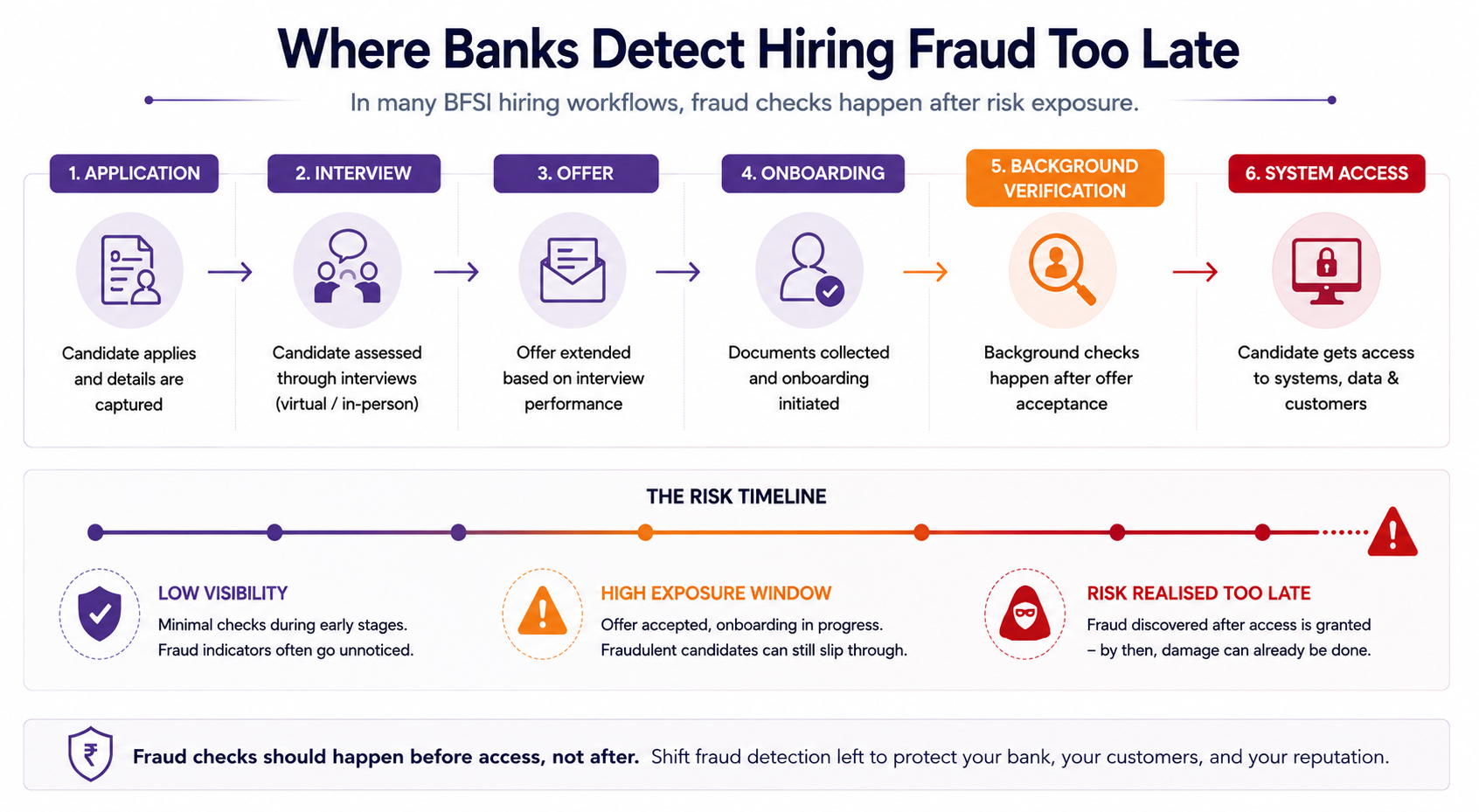
Types of interview fraud banking teams should watch for
Interview fraud in banking is not a single problem. It takes different forms at different stages of the hiring funnel, and each type carries distinct risks for compliance, operations, and customer safety. Understanding these categories is the first step toward building a detection strategy that catches fraud before the offer stage, not after.
Here are three types of interview fraud that BFSI talent acquisition and security teams encounter frequently, each one increasingly difficult to detect without the right technology.
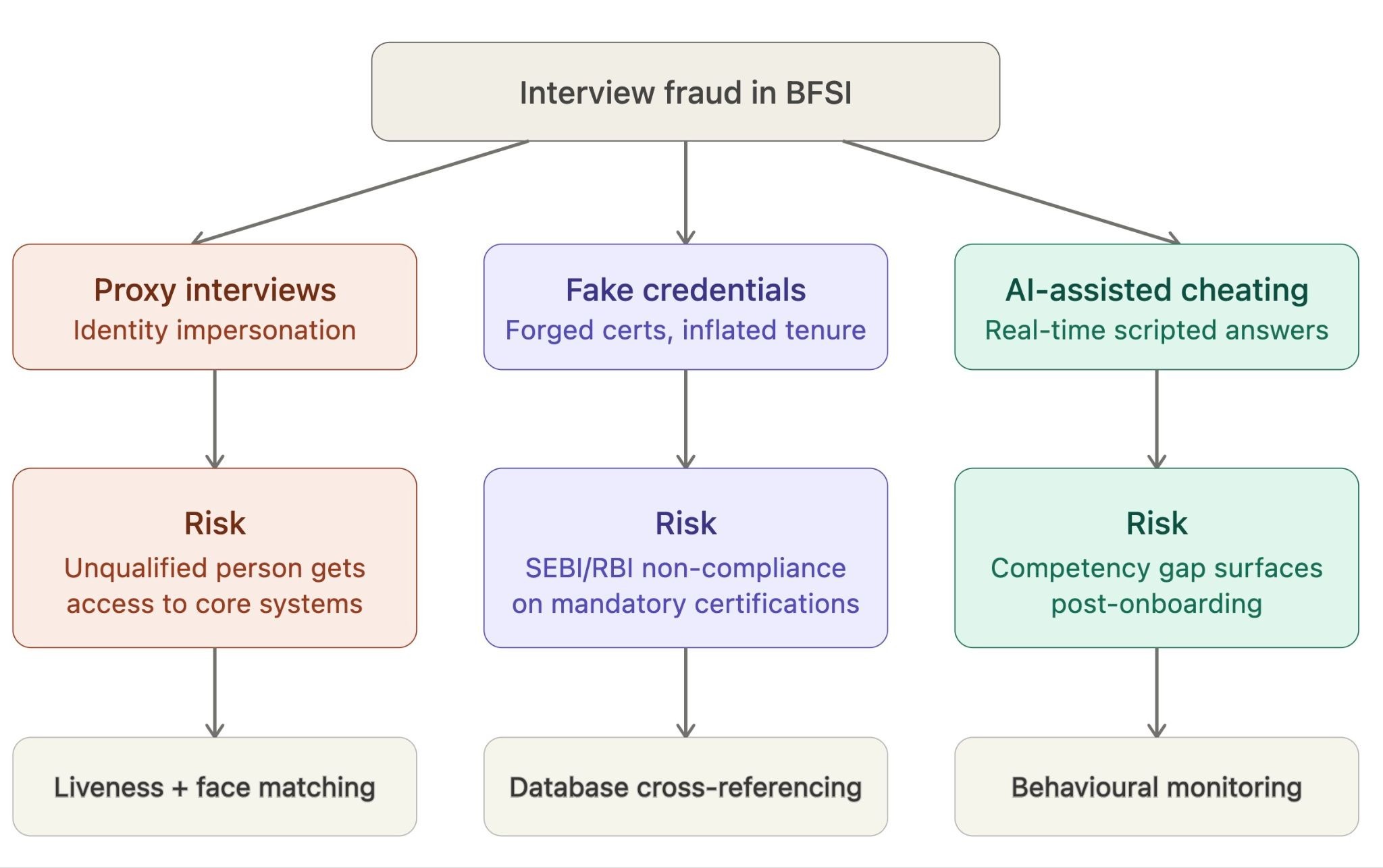
Proxy or impersonation interviews
In a proxy interview, someone other than the actual candidate appears for the assessment. The person who clears the technical round may have strong domain knowledge in core banking, credit risk, or treasury operations. But the individual who shows up on Day 1 is someone else entirely, often lacking the competencies that were evaluated.
This form of fraud is especially dangerous in banking because of the access these roles carry. A branch operations executive handles cash, a loan processor works with customer financial data, and an IT support hire touches core banking systems. When the person filling that role is not who they claimed to be, every transaction they touch becomes a compliance risk.
Consider the practical mechanics: a candidate hires a proxy with strong banking knowledge to appear for a video interview. The proxy answers questions about RBI guidelines, NPA classification norms, or Basel III requirements convincingly. The real candidate, who lacks this depth, reports for work and struggles through basic tasks. By the time the mismatch surfaces, the bank has invested in onboarding, system access provisioning, and training.
Fabricated credentials and experience
Credential fraud in banking goes beyond a padded resume. It includes specific, high-stakes fabrications that directly affect regulatory compliance. Some of the patterns that TA teams in BFSI should actively screen for include:
- Fake NISM (National Institute of Securities Markets) or AMFI certifications, which are mandatory for roles in mutual fund distribution, wealth management, and securities advisory
- Inflated tenure at previous employers to meet minimum experience thresholds for senior roles in compliance, risk, or audit functions
- Fabricated employment with non-existent NBFCs or regional banks that are difficult to verify manually
- Cloned resumes copied from legitimate professionals on LinkedIn, adapted with minor modifications to pass initial screens
The regulatory exposure here is significant. If a relationship manager advising HNI clients on investment products holds a fake NISM certification, the bank faces action from SEBI. If an audit officer with fabricated compliance experience misses critical reporting obligations, the RBI penalty could run into lakhs.
Coached or scripted responses using real-time AI assistance
The newest form of interview fraud is also the hardest to detect. Candidates use real-time AI tools to generate polished answers during video interviews. A second screen running a large language model can produce articulate responses to questions about trade finance processes, anti-money laundering procedures, or credit underwriting frameworks within seconds.
What makes this especially problematic in banking is the domain specificity. A candidate with basic knowledge of financial services terminology can use AI prompts to construct answers that sound like they come from someone with years of hands-on experience. The responses are technically accurate but lack the contextual judgment that comes from actually managing a compliance portfolio or navigating an RBI audit.
Interviewers often notice the symptoms without identifying the cause: the candidate’s eyes drift to a second screen, there are slight delays before every answer, and follow-up questions produce noticeably weaker responses. Without structured interview protocols and technology-assisted monitoring, these signals are easy to miss, especially in high-volume hiring drives where interviewers evaluate dozens of candidates per week.
How banking hiring teams can identify and prevent interview fraud
Interview fraud cannot be handled only at the background verification stage. In BFSI hiring, prevention has to begin during interviews themselves, especially for roles connected to customer data, lending, payments, collections, and regulated operations. The strongest controls combine hiring workflows with identity checks, credential validation, and audit-ready documentation much earlier in the process.
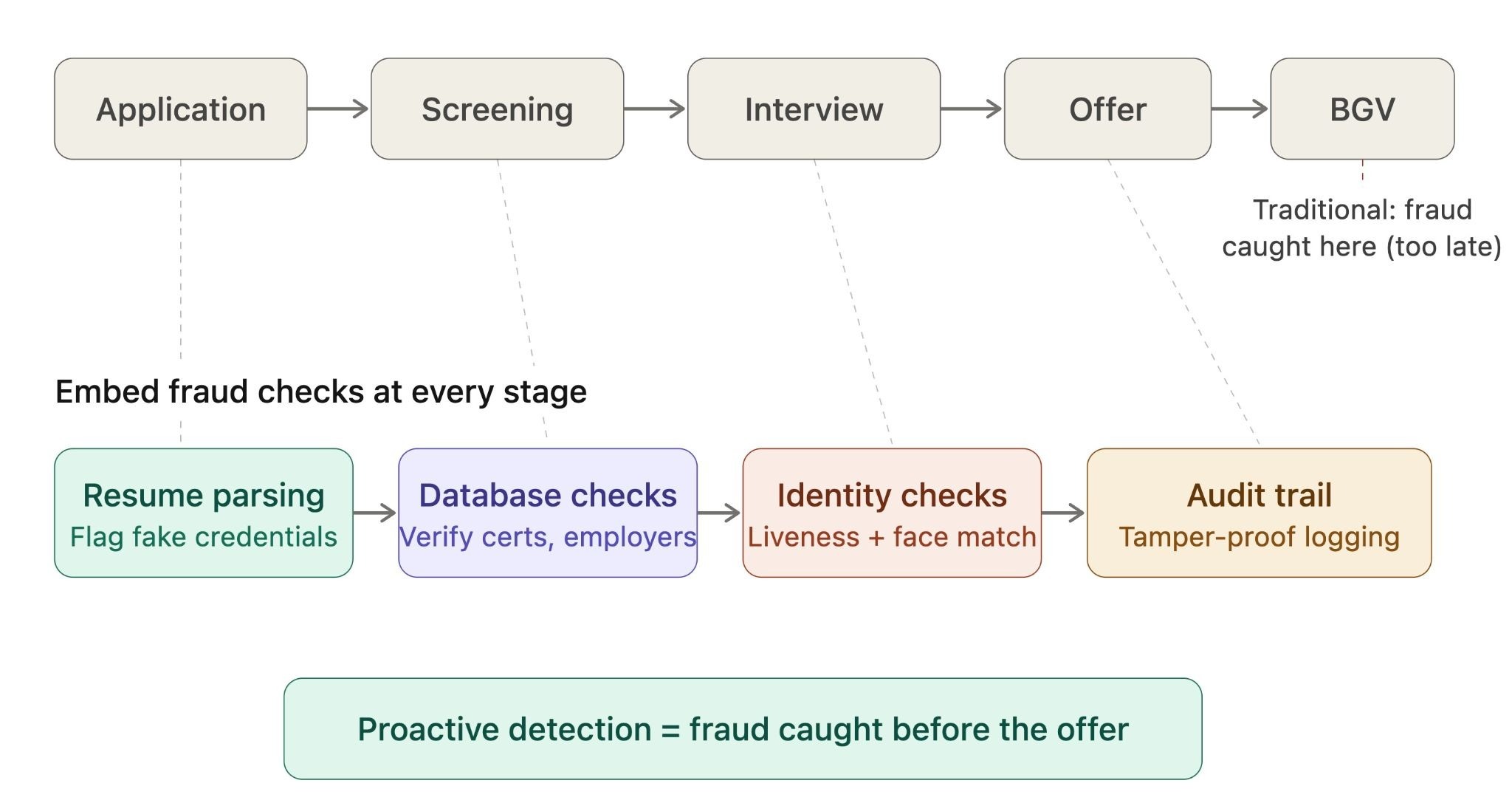
Verify identity throughout the interview journey
Many banks still validate identity documents only after the offer stage. That creates room for proxy interviews and impersonation during remote hiring rounds.
A stronger process includes verifying identity at multiple points during the interview journey, not just once. Recruiters and interview panels can compare live video feeds against submitted IDs, ask candidates to re-verify identity during final rounds, and cross-check interview recordings against onboarding documentation later in the process.
For high-volume banking hiring, even small mismatches in appearance, communication style, or response patterns across rounds can signal deeper integrity issues.
Cross-check banking credentials directly from source systems
In BFSI hiring, certifications, and employment records should never rely only on submitted PDFs or self-declared information.
Practical verification steps include:
- Validating NISM certifications through official NISM records
- Checking AMFI ARN registrations for wealth management roles
- Reviewing EPFO and UAN history for employment consistency
- Verifying employer legitimacy for lesser-known NBFCs or agencies
- Matching joining dates, designation history, and salary records across documents
This becomes especially important for compliance-heavy roles where employees interact with regulated financial products or customer investment data.
Use technology to spot suspicious interview behavior
Interview fraud has become harder to detect manually because many applicants now use external real-time support, off-screen assistance, and AI-generated guidance to navigate virtual interviews.
For example, a candidate interviewing for a fraud operations role may answer technical questions fluently during online rounds but struggle to explain the same workflows during in-person discussions or onboarding assessments. In several cases, banks have identified inconsistencies only after comparing interview recordings across stages.
To reduce this gap, some BFSI organizations now use monitoring tools that flag:
- Voice inconsistencies across rounds
- Unusual eye movement or repeated off-screen attention
- Multiple audio sources during interviews
- Delayed responses linked to external prompting
- Copy-paste behavior during assessments
These signals do not confirm fraud on their own, but they help recruiters and security teams escalate suspicious cases earlier.
Build hiring audit trails like operational audit trails
Banks already maintain strong audit records for transactions, approvals, and access controls. Hiring processes require the same discipline, especially for sensitive roles.
That means maintaining clear records of:
- Interview recordings and timestamps
- Identity verification checks
- Credential validation outcomes
- Escalation decisions during hiring reviews
- Changes made to candidate documents or profiles
When fraud concerns emerge later, these records help TA, compliance, and security teams investigate faster and respond more confidently during audits or internal reviews.
For banks hiring in India, fraud detection data collected during the interview process identity verification records, biometric markers where used, and behavioral monitoring logs is subject to DPDP Act requirements. Every check must be based on data the candidate has explicitly consented to, and every automated action must generate an auditable trail. The same audit discipline banks apply to financial transactions applies to the hiring process. Read our DPDP compliance guide for TA teams for the full picture.
Treat interview fraud as part of an insider risk strategy
Fraudulent hiring is no longer just an HR issue. In banking, it can become the starting point for insider threats, unauthorized access, compliance failures, or customer data misuse.
The most effective BFSI organizations now involve talent acquisition, information security, compliance, and risk teams together while designing hiring controls. That shift changes the focus from simply filling positions faster to ensuring the individual entering regulated systems is genuinely verified before access is ever granted.
Protect your banking hiring pipeline with built-in interview fraud detection
Background verification alone can no longer contain interview fraud risks in banking. By the time discrepancies surface, candidates may already be inside regulated workflows, customer-facing operations, or sensitive financial systems. That is why banks increasingly need fraud detection built directly into the hiring process instead of relying on disconnected checks after the offer stage.
That is where embedding fraud detection into the ATS changes the equation.
RippleHire integrates fraud prevention directly into hiring workflows so compliance and security teams can identify risks earlier without slowing recruitment down. The platform supports high-volume enterprise hiring across sourcing, interviews, onboarding, and compliance management. RippleHire also powers hiring for large enterprises across 50+ countries and supports more than 1 million users globally.
RippleHire helps BFSI teams:
- Detect impersonation during live or recorded interviews using AI-powered voice and face verification
- Flag suspicious resumes, inflated experience, fake certifications, and cloned profiles using AI-based fraud detection
- Maintain tamper-proof audit trails across interview changes, approvals, uploads, and candidate activity
- Enable compliance-ready hiring workflows with automated visibility and governance controls
- Integrate fraud checks directly into sourcing, evaluation, onboarding, and background verification workflows
Book a demo to see how RippleHire helps banks and financial institutions detect interview fraud earlier, strengthen hiring integrity, and stay audit-ready at scale.
Frequently asked questions
How does interview fraud differ from resume fraud in banking recruitment?
Resume fraud misrepresents historical credentials on paper, whereas interview fraud involves live deception such as proxy candidates or real-time AI assistance during the active evaluation stage.
- Resume Fraud: Manipulates past documents, titles, or tenures (e.g., fabricated experience or fake certifications).
- Interview Fraud: Bypasses live domain evaluations through impersonation or external coaching, allowing unqualified candidates to bypass technical and regulatory assessments.
Can background verification alone catch interview fraud in BFSI hiring?
No, traditional background verification (BGV) cannot catch interview fraud because it validates historical documentation post-offer rather than verifying live candidate identity or interview conduct.
- Document vs. Identity Gap: BGV verifies submitted papers, not whether the person sitting for the technical interview is the person showing up on Day 1.
- Timing Vulnerability: BGV occurs after the offer stage, leaving a critical risk window where fraudulent hires may already gain access to core banking systems and sensitive customer data.
What regulatory risks do banks face from hiring someone through a fraudulent interview?
Hiring through interview fraud exposes financial institutions to severe regulatory non-compliance, monetary penalties, and operational security breaches under governing bodies like the RBI, SEBI, and IRDAI.
- Compliance Failures: Unqualified staff handling mutual funds, trade finance, or AML checks can cause major KYC, reporting, and advisory violations.
- Legal & Financial Exposure: Regulators can enforce heavy monetary fines, conduct mandatory audits, and issue operational restrictions.
- Data Security & Insider Risk: Fraudulent candidates gain unauthorized entry into regulated customer data environments, increasing insider threat risks.
How can banks detect AI-assisted cheating during remote interviews?
Banks can detect AI-assisted cheating by tracking behavioral anomalies during live video assessments and using AI-powered monitoring software.
- Behavioral Red Flags: Eye movement consistently drifting to off-screen screens, systematic multi-second delays before answering basic technical questions, and stark drops in performance on unscripted follow-ups.
- Technical Safeguards: Automated proctoring tools that detect screen sharing, dual audio sources, or browser switching.
- Assessment Design: Replacing factual recall questions with scenario-based, judgment-heavy questions that AI models cannot easily solve in real time.
Where should a BFSI enterprise start when implementing interview fraud detection?
BFSI enterprises should start by auditing the gap between interview scheduling and post-offer BGV, then embedding automated verification directly into their Applicant Tracking System (ATS).
- Audit the Hiring Funnel: Identify unmonitored evaluation rounds between initial screening and final onboarding.
- Implement Early Identity Checks: Embed live face and voice verification at the interview scheduling stage.
- Automate Credential Cross-Checks: Validate certifications (e.g., NISM, AMFI) and employment history (e.g., EPFO records) directly against primary source databases.
- Deploy an Integrated ATS: Utilize an enterprise ATS with built-in fraud detection to maintain a centralized, audit-ready compliance log across all recruitment stages.