
.svg) Product
Product

.png)




Table of content
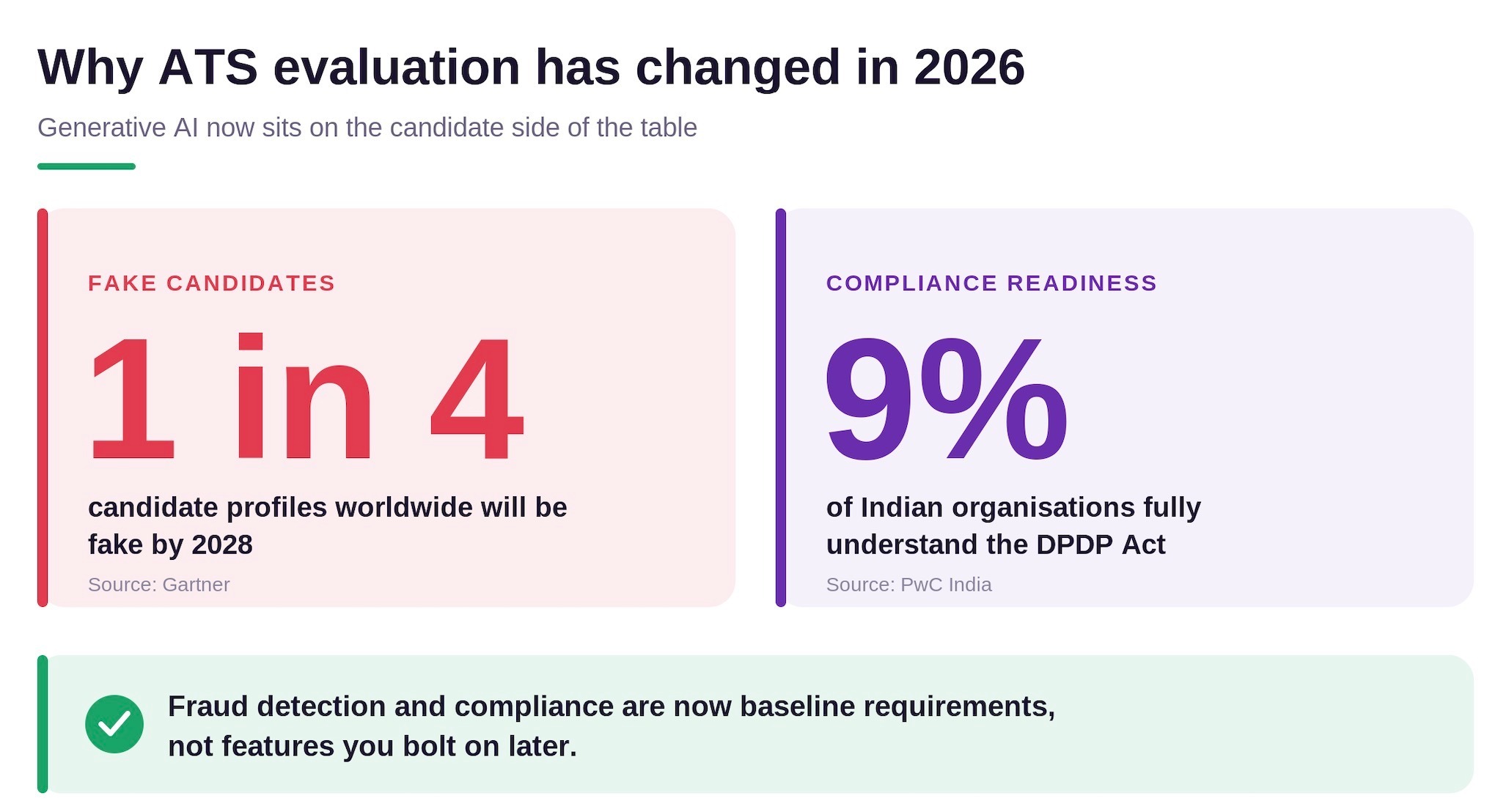
Hiring at enterprise scale has changed shape over the past two years, and the buying process has not kept up. Generative AI now sits on the candidate side of the table, which means resumes read cleanly, cover letters match the job description word for word, and a polished first-round answer no longer tells you much about the person behind it. Against that backdrop, Gartner predicts that by 2028, one in four candidate profiles worldwide will be fake (Gartner). That single shift makes interview fraud detection a baseline requirement for any enterprise applicant tracking system, rather than a feature you bolt on later.
Yet most enterprise ATS evaluation criteria still get written around the demo. A vendor walks procurement through a clean funnel, the dashboards look sharp, and everyone nods. The questions that actually determine whether the platform survives contact with your real hiring volume rarely come up. This guide covers 6 of those questions, explains why each one matters.
Why the demo is the weakest part of an ATS evaluation
A product demo is built to show the happy path. The data is clean, the integrations are pre-wired, and the recruiter on screen knows exactly which buttons to press. Your environment will look nothing like that on day ninety, when three business units are pulling in different directions and a hiring manager is escalating a stalled requisition. The point of a serious evaluation is to surface what happens when conditions are messy, because that is where switching costs and compliance exposure hide.
Treat the demo as the start of the conversation, not the basis for the decision. The questions below are the ones procurement teams skip, and they map directly to how an enterprise ATS holds up once it is carrying your full hiring load.
Six questions procurement teams never ask
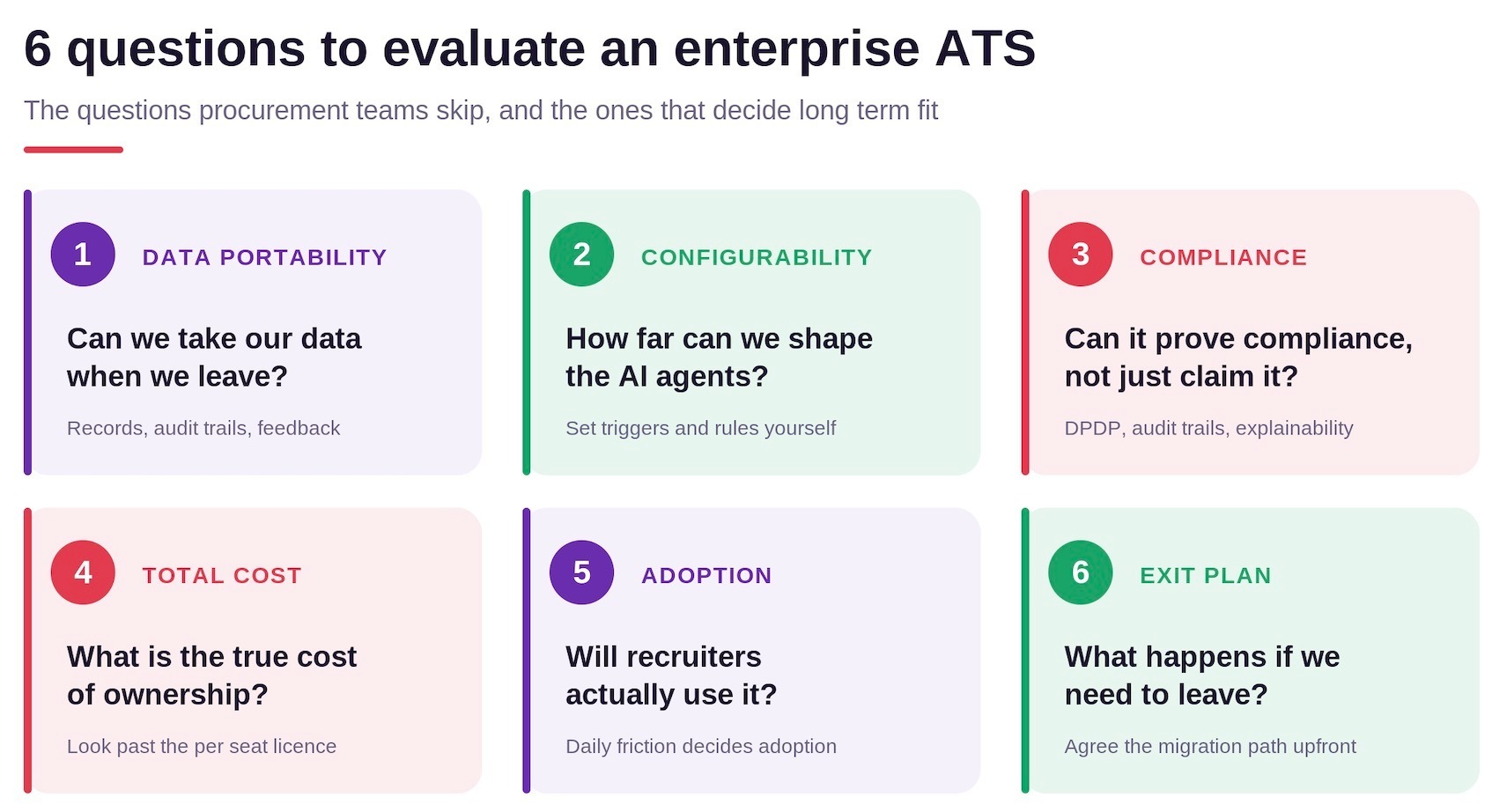
Each question targets a place where the gap between the sales narrative and the operating reality tends to be widest. Work through them in order and ask for evidence rather than assurances. A vendor who can answer all six in writing is worth shortlisting; one who deflects on three or more is telling you something.
1. How portable is our data if we decide to leave?
Data portability is the question vendors least want on the table, because the answer is often a soft form of lock-in. Ask exactly what you can export, in what format, and whether the export includes the things that took years to accumulate.
- Candidate records and resumes, including attachments and parsed fields.
- Full audit trails and stage-by-stage history, not just the current status.
- Interview feedback, scorecards, and structured assessment data.
- Communication logs across email, WhatsApp, and chat.
Get the commercial terms in writing too. Some contracts cap export frequency, charge for bulk extraction, or release data in a format that no other system can ingest cleanly. If the export is technically possible but practically painful, you are locked in regardless of what the contract says about ownership.
2. How deep does agent configurability actually go?
Most platforms now advertise AI agents, so the real question is not whether they exist but how far you can shape them. There is a wide gap between an agent you can switch on and an agent you can govern.
Ask whether your team can change an agent's behaviour without a support ticket and a six-week release cycle.
Can you set the trigger, define the action, and adjust the rules yourself?
Can you scope an agent to a single business unit, a hiring type, or a country with different rules?
A configurable agent mirrors your policy. A rigid one forces your policy to mirror the product.
The distinction matters most in screening and fraud checks, where the rules differ across a campus drive, a lateral tech role, and a regulated BFSI hire. If every adjustment routes back to the vendor, you do not own the workflow, you rent it.
3. Can the platform prove compliance, not just claim it?
Compliance readiness is where confident marketing meets thin documentation. India's Digital Personal Data Protection Act has moved this from a nice-to-have to a board-level concern, and the readiness gap across enterprises is real. Only 9% of Indian organizations reported a comprehensive understanding of the DPDP Act, according to a PwC India survey. Your ATS holds some of the most sensitive personal data in the company, so it needs to carry its share of that readiness.
Press for specifics in three areas:
- 1. DPDP alignment, including consent capture, data residency, retention limits, and the ability to honour a candidate's request to erase their data.
- 2. Labour-law audit trails, so that every automated decision and recruiter action is logged in a way an auditor or a works council will accept.
- 3. Explainability, meaning every AI-generated score or recommendation comes with reasoning a human can follow and defend, rather than a number with no story behind it.
A vendor that treats compliance as a framework you can configure to your policies is in a far stronger position than one offering a fixed checkbox, because the regulations will keep moving.
4. What is the true total cost of ownership?
The per-seat license is the part of the price you can see, and often the smallest part. Total cost of ownership is where budgets overrun, usually because the costs that matter never made it into the comparison sheet.
Build the real number from these line items:
- Implementation and configuration fees, including any required professional services.
- Integration work to connect your HRMS, background-verification, and assessment tools.
- Charges for additional modules, AI agents, or usage tiers that sit behind the base plan.
- Internal time spent on administration, training, and ongoing change requests.
- The cost of data export and migration when the contract eventually ends.
A platform that looks cheaper on the license line can cost more across three years once integration and change-request fees are counted. Ask every shortlisted vendor to quote against the same volume and the same module list, then compare the fully loaded figure.
5. Will recruiters actually use it?
Adoption risk is the failure mode that no demo reveals, and it sinks more rollouts than any missing feature. A platform that recruiters route around becomes an expensive system of record that no longer reflects what is happening in the pipeline.
Picture a recruiter closing twelve requisitions a month. If logging a candidate takes four extra clicks, if the search is slow, or if the AI recommendations feel like noise, that recruiter goes back to spreadsheets and side channels. Your reporting degrades, your audit trail develops holes, and the compliance work from question three falls apart at the point of data entry.
When you evaluate, put the platform in front of the people who will live in it all day and watch where they hesitate. Adoption is earned at the level of daily friction, so the recruiter's verdict should carry more weight than the dashboard.
6. What does a migration look like if things go wrong?
Every vendor describes onboarding. Almost none will walk you through the exit, which is exactly why you should ask. A migration plan you understand before signing is the cheapest insurance you can buy.
Ask the vendor to describe, step by step, what a move off their platform involves: how historical data is handed over, how long extraction takes, what support is provided during transition, and whether there is any period where you lose access to your own records.
A confident answer signals a vendor comfortable with the relationship being a choice rather than a trap. A vague one tells you the exit was designed to be hard, and that knowledge is worth more before you sign than after.
The cost of staying on the wrong platform
The price of a poor ATS decision is rarely a single visible failure. It compounds, and by the time it shows up in a metric, it has usually been draining the function for several quarters. Naming the cost up front helps you weigh it against the discomfort of switching.
Three costs tend to dominate. First, there is the fraud and quality cost, because a platform that cannot support real interview fraud detection lets impersonation and fabricated credentials slip through, and a wrong hire in a regulated role carries consequences well beyond the recruiting budget. Then there is the compliance cost, where weak audit trails and thin DPDP alignment turn an ordinary data request or audit into a scramble. Finally, there is the opportunity cost, the slow tax of recruiters fighting the tool instead of closing candidates, which widens time-to-hire month after month without ever announcing itself.
None of these appear on the renewal invoice, which is precisely why they persist. The right time to account for them is during the evaluation, while you still have leverage and a choice.
Choose an ATS where recruiters and agents work together
The hard parts of hiring in 2026 are no longer about posting jobs and tracking stages. But it's gotten tougher to tell real candidates from synthetic ones, proving compliance under a moving regulatory line, and keeping recruiters productive while the volume climbs. Those problems are well suited to solve with agentic AI, because an agent can take action inside the workflow rather than simply generate more content for a recruiter to process.
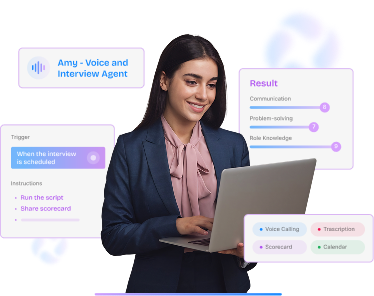
The way that capability is deployed is what separates a useful platform from a gimmick. RippleHire is built as an ATS where recruiters and agents work together. Specialist agents take the systematic, repetitive work off the recruiter's plate, and recruiters spend their time on judgement, relationships, and closing. The goal is partnership, not replacement, and the design reflects that at every stage.
The model shows up most clearly at screening, where interview fraud detection has become a daily task. Rather than asking a recruiter to spot impersonation or a fabricated employer by eye, agents run checks at the source, flagging candidate impersonation, fake university or employer claims, and rehire conflicts before a human ever spends time on the file. The recruiter then makes the call with the evidence already assembled.
What makes those agents dependable is the context and governance around them:
- Agents operate on the signal from 86 million candidate applications processed across 50-plus countries, which gives their recommendations real hiring context.
- Every score and action comes with explainable reasoning that humans can follow and auditors will accept.
- A no-code builder lets your team set the trigger, choose the action, and scope an agent to a business unit, so configurability sits with you rather than a support queue.
- The platform is built to mirror your policies, compliance needs, and workflows, which is exactly what the DPDP and audit-trail questions demand.
If you want to see how the six questions above hold up against a working platform, the most useful next step is to book a demo with RippleHire focused on interview fraud detection and agent configurability, and judge the answers against the criteria in this guide.
Frequently asked questions
What should an enterprise ATS evaluation criteria checklist include?
A strong checklist looks past features to the parts of the platform that decide long-term fit. Cover data portability and export terms, depth of AI agent configuration, compliance and audit capability, the fully loaded cost across three years, recruiter adoption, and a clear exit plan. Score each vendor on evidence rather than promises, and give more weight to the answers that affect daily use and risk than to the polish of the demo.
How is an enterprise ATS different from a recruitment tool for a small business?
The difference is mostly about scale, governance, and risk. An enterprise platform has to handle high hiring volume across business units, countries, and regulations at once, with audit trails and role-based controls that a small-business tool rarely needs. It also has to integrate with existing HR systems and prove compliance under laws like DPDP. Evaluating it means weighing security, configurability, and support far more heavily than price or speed of setup.
Is the most expensive ATS always the most secure choice?
No, and treating price as a proxy for security is a common and costly mistake. A high license fee tells you about positioning, not about data residency, audit trails, or certifications. Some lower-cost platforms hold stronger compliance credentials than premium ones. Ask every vendor for specifics on encryption, access controls, breach handling, and regulatory alignment, then judge security on documented evidence rather than on where the product sits on the price ladder.
How do we get started with an enterprise ATS evaluation across stakeholders?
Begin by assembling the people who will live with the decision: talent acquisition, IT, security, legal, and a few frontline recruiters. Agree on weighted criteria before you see any demos, so the sales narrative does not set your priorities for you. Run each shortlisted vendor against the same volume, module list, and questions. Give recruiters hands-on time with the tool, because their daily friction predicts adoption better than any feature comparison.
How long does it take to implement an enterprise ATS?
Timelines vary with hiring volume, the number of integrations, and how much configuration your workflows need, so treat any single number with caution. Data migration, HR-system integration, and user training usually drive most of the schedule. Ask each vendor for a phased plan tied to your environment rather than a generic estimate, and confirm what support you receive during cutover. A vendor who maps the steps clearly is usually one whose timeline you can trust.