
.svg) Product
Product

.png)


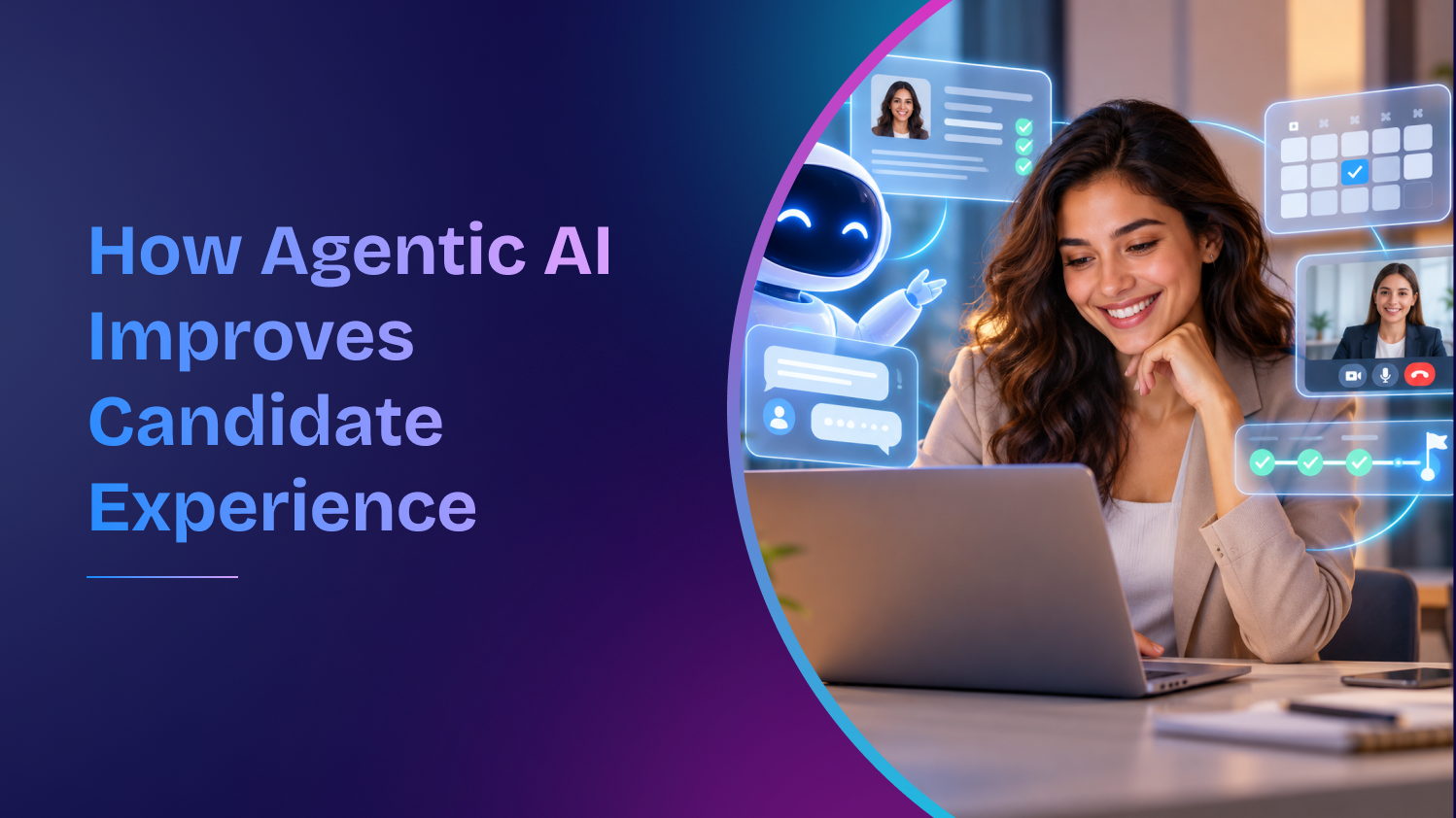


Table of content
Candidate experience is easy to talk about and hard to fix. Most recruiting teams know the basics: respond fast, keep communication personal, do not leave candidates guessing between stages. The gap is not knowledge. It is bandwidth.
Doing this well means staying on top of every candidate, at every stage, in real time. That is manageable at low volume. Once a team is running hundreds of applications across dozens of roles, it stops being something a person can keep up with on their own.
Agentic AI takes over that coordination work. Recruiters still handle the conversations that need judgment. AI handles the follow-ups, updates, and check-ins that need to happen consistently but do not need a human deciding each one.
This guide covers four specific ways agentic AI improves candidate experience in enterprise hiring, and what changes for the recruiting team once that coordination is handled for them.
Quick Answer: Agentic AI improves candidate experience by handling the coordination work that most enterprise recruiting teams cannot maintain at scale: timely communication at every stage, personalized outreach based on individual candidate signals, consistent follow-up with high-potential candidates who were not selected, and structured pre-onboarding engagement between offer acceptance and day one. Recruiters review, approve, and handle the interactions that need human judgment. Agentic AI handles the coordination in between.
Where Candidate Experience Breaks Down, and What It Costs
Four points tend to be where things go wrong.
Response lag after application
A candidate applies and hears nothing for four days. By day five, a competitor has already set up a first conversation. Your team reaches out to someone who has already moved on.
Generic communication despite personal interviews
A candidate goes through three rounds, talking about their career goals and questions about the team. The offer email that follows reads like a template, because it was written for everyone at once.
Silence between stages
The stretch between offer acceptance and start date is where most dropout happens. Three weeks of no contact gives a counteroffer time to land, even when the candidate was genuinely excited about the role.
Silver-medal candidates disappearing into a database
A strong candidate who was not selected goes into the talent pool. Months later, the right role opens up, but nobody goes back to check who is already there.
At low volume, a recruiter can manage all four without much effort. At 40 open roles, staying on top of every candidate this closely just is not realistic.
That is the specific gap agentic AI closes: keeping candidates informed and engaged at every stage so recruiters can spend their time where it matters most.
Here is how it works across each of these four points.
1. Personalized Communication at Every Stage
Most candidate communication at scale is templated. A candidate applies and receives the same acknowledgment as everyone else. They pass the screening and receive the same next-steps email as everyone else. They complete an interview and receive the same waiting-to-hear email as everyone else.
Templates are not the problem. Candidates can tell when they are reading one. Nothing in the message reflects what they actually said in their application, what they asked in the interview, or what they care about in the role.
At low volume, recruiters fix this by personalizing manually. At 300 applications a month, they cannot.
Agentic AI analyzes candidate signals throughout the hiring process which sections of the job description they engaged with, what they asked questions about during screening, how they described their career goals. It uses this to inform how communication is framed at each stage.
A candidate who asked detailed questions about the learning and development program receives follow-up that references what was discussed. A candidate who expressed specific interest in the technical architecture of the product receives materials that speak to that interest.
The recruiter sets the parameters for what gets communicated at each stage. Agentic AI applies those parameters to each candidate individually. The recruiter reviews the communication log and steps in when a conversation needs a human response.
The signal a candidate receives from personalized communication is simple: the organization was paying attention. That signal matters most at the point where a candidate is deciding between options. Generic communication at that moment often tips the decision toward the organization that felt more engaged with them as a person.
2.Consistent Engagement With Strong Candidates Who Were Not Selected
Organizations invest a lot in identifying strong candidates. A recruiter sources, screens, and interviews someone over several weeks. That candidate reaches the final round and does not get the offer. Not because they were weak. Because the selected candidate was marginally stronger for that specific role.
What happens next is almost universally the same. A rejection email goes out, usually templated. The candidate goes into a database. The database is rarely searched with any consistency.
The investment made in that candidate essentially disappears.
Agentic AI maintains structured contact with high-potential candidates who were not selected for a specific role. Contact is based on what is relevant to each individual : industry updates they would find useful, company news that connects to what they expressed interest in, and genuine role matches when they appear.
When a new role opens that fits a previous candidate's background, that candidate gets surfaced for the recruiter to review. The recruiter decides whether to reach out. Agentic AI drafts the outreach based on the candidate's history and the new role, and the recruiter reviews it before it goes out.
The distinction that matters here is between a talent pool that functions as an active resource and one that functions as a static database. Most organizations have the second. Agentic AI makes the first achievable without requiring a recruiter to manually manage hundreds of individual relationships.
A candidate who gets genuine, relevant follow-up from an organization that did not hire them walks away with a different impression than one who got a template rejection and then silence. The first candidate refers people to that organization. The second one does not.
3. Reducing the Silence Between Offer Acceptance and Day One
The period between offer acceptance and start date is one of the most consistently mismanaged windows in enterprise hiring.
A candidate accepts an offer. They are excited. They have mentally committed. And then they hear very little from the organization for two, three, sometimes four weeks until they receive a pre-joining checklist and a calendar invite for orientation.
During that window, they are still employed. Their current employer is almost certainly making a counteroffer or at least a retention attempt. And the new employer is mostly silent.
This is when offer-to-joining dropout happens. Not because the candidate changed their mind about the role. Because the silence left room for doubt.
Agentic AI builds a structured pre-onboarding communication journey between offer acceptance and day one. It is not a fixed sequence. It adapts based on the candidate's responses, the time left before start date, and the specific role they are joining.
Practical activities are scheduled based on the candidate's availability rather than arbitrary timelines. Team introductions are initiated based on role context. Company content is curated based on what the candidate expressed interest in during the hiring process.
When a candidate's engagement signals suggest hesitation, slower responses, fewer questions, less interaction with materials, the recruiter gets flagged. The recruiter decides how to respond. Agentic AI surfaces the signal. The recruiter makes the call.
A candidate who receives consistent, relevant engagement between offer acceptance and day one arrives feeling like they have already started. They know people. They understand the culture. They have completed the administrative requirements without a stressful last-minute rush. That foundation directly affects early performance and early retention.
Axis Bank revolutionized its talent acquisition strategy with RippleHire, driving seamless candidate engagement to hit an industry-leading 4.8/5 candidate satisfaction score.
4. Faster, Clearer Responses to Candidate Questions
Candidates ask questions throughout the hiring process. Some are logistical: what is the dress code for the interview, can the start date move, how many rounds does the process usually take. Some are substantive: what does the team structure look like, what happened to the person who previously held this role, what does growth look like from here.
At high volume, logistical questions often sit unanswered for days because recruiters are juggling too many conversations at once. Substantive questions get better answers, but still take longer than candidates have when they are deciding quickly.
For the candidate, the experience is waiting. And waiting is when they start looking at other offers.
Agentic AI handles logistical questions based on the information available about the role, the process, and the candidate's stage. The candidate receives a response within minutes, not days.
Questions that need human judgment get flagged for the recruiter, along with what was asked and the relevant context. The recruiter sees what was asked, when, and what information is already available to answer it. They spend their time on the questions that actually need them.
Candidate questions are also signal. A candidate who keeps asking about remote work flexibility is telling the recruiter something important about their priorities. Agentic AI surfaces these patterns so the recruiter can address what actually matters to that candidate instead of running through a standard script. What candidates ask is often more revealing than anything in their application, and recruiters should have the time to notice it.
Table: Recruiter vs. agentic AI responsibilities
| Stage | Agentic AI handles | Recruiter handles |
|---|---|---|
| Application & screening | Acknowledgment, logistical Q&A, signal tracking | Reviewing screening outputs, judgment calls |
| Interviews & offer | Personalized follow-up based on candidate signals | Interview delivery, offer negotiation |
| Offer to joining | Pre-onboarding journey, hesitation flags | Responding to flagged hesitation, retention conversations |
| Post-rejection | Ongoing relevant contact with strong candidates | Deciding when to re-engage for a new role |
Where Recruiters and AI Agents Collaborate
These four shifts only work if agents and recruiters aren't operating in separate systems. An AI agent that sends great follow-up but can't see what the recruiter already knows about a candidate, or a recruiter who has to log into a separate tool to check what the AI sent, breaks the coordination before it starts. The agent needs visibility into the same candidate history, interview notes, and stage data the recruiter has. The recruiter needs a single place to see what the agent has already handled and what's waiting for a decision. That is where RippleHire comes in.
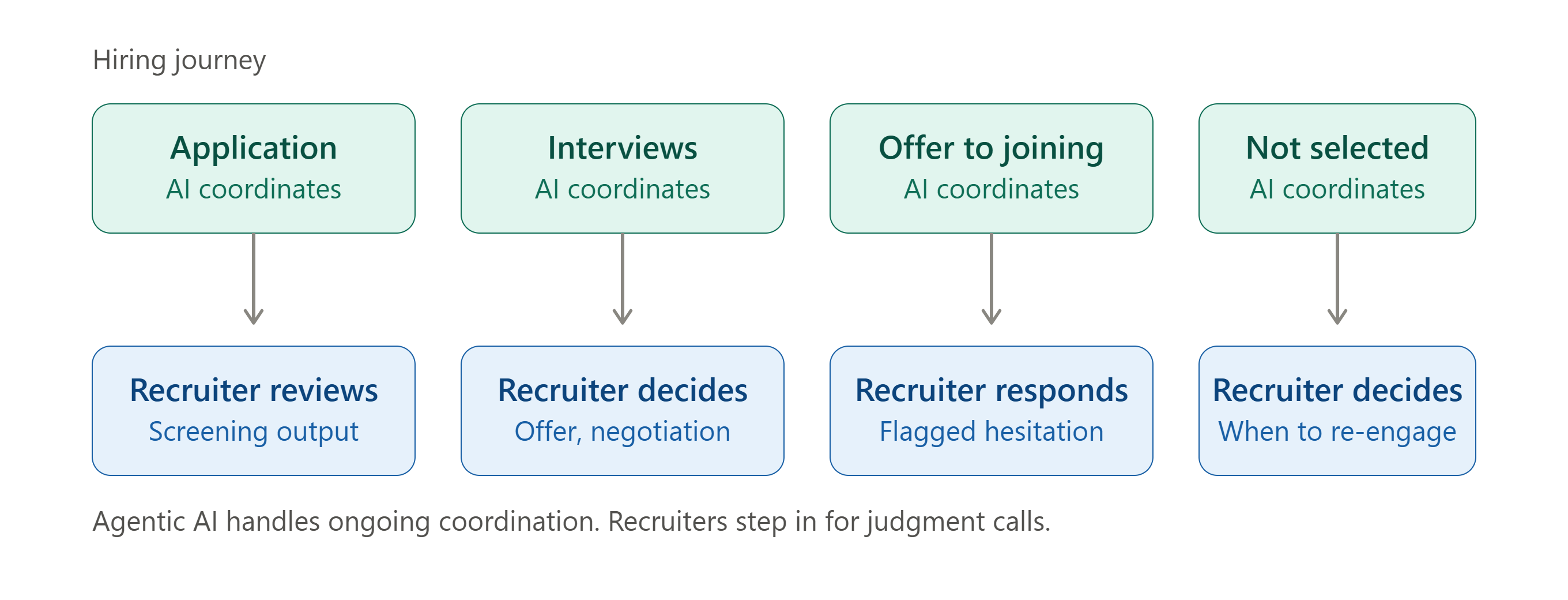
How RippleHire Powers Your Agentic AI Hiring Strategy
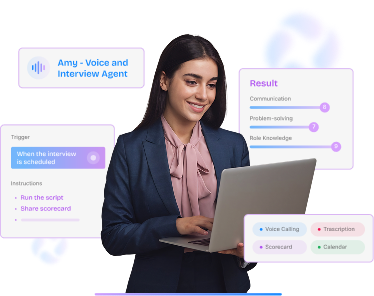
RippleHire's candidate experience layer connects across the full hiring journey. Amy, RippleHire's AI interview agent, handles first-round screening conversations and returns scored, explainable outputs for you to review. The Multi-channel automated outreach ensures candidates receive timely updates on WhatsApp, SMS, or email based on their preference -- not yours.
Pre-onboarding engagement, offer tracking, and candidate follow-up are coordinated through one workflow that you configure and monitor. You see where every candidate is, what they have received, and what needs your attention.
The data foundation matters here. RippleHire has processed more than 86 million candidate applications across 50 countries. The patterns that inform how agentic AI behaves are drawn from real hiring outcomes at scale.
All of this runs within an enterprise-grade framework with ISO 27001, SOC 2 Type 2 certification, and DPDP and GDPR alignment built into the architecture. So the speed gains do not come at the cost of compliance.
Stop losing top talent to slow communication and hiring silos.
See How RippleHire Transforms Your Candidate Experience →
Frequently Asked Questions
What is agentic AI and how does it improve candidate experience?
Agentic AI in recruitment coordinates multiple steps toward a defined goal without requiring a human to trigger each action individually. In candidate experience, this means handling the communication, follow-up, scheduling, and pre-onboarding coordination that currently consumes recruiter time. Candidates receive faster, more consistent, and more personalized engagement. Recruiters focus on the interactions that require their judgment.
How does agentic AI personalize candidate communication at scale?
Agentic AI analyzes candidate signals throughout the hiring process what they engaged with in the job description, what they asked during screening, what they expressed interest in during interviews. It uses this to inform how communication is framed at each stage for each individual candidate. The recruiter sets the parameters. Agentic AI applies them consistently across all candidates regardless of volume.
Can agentic AI help reduce candidate drop-off between offer and joining?
Yes. The period between offer acceptance and start date is when most offer-to-joining dropout occurs. Agentic AI creates structured pre-onboarding communication that keeps candidates engaged, completes administrative requirements based on their availability, and surfaces hesitation signals for the recruiter to respond to. The recruiter decides how to handle flagged situations. Agentic AI handles the ongoing engagement that prevents the silence that creates doubt.
How does agentic AI handle candidates who were not selected?
Agentic AI maintains structured contact with high-potential candidates who were not selected for a specific role, based on what is relevant to each individual. When a new role opens that matches their background, they are surfaced for the recruiter to review. The recruiter decides whether to reach out. Agentic AI prepares the outreach based on the candidate's history and the new role. The recruiter reviews it before it goes out.
Will candidates know they are engaging with AI?
This is a design decision organizations make based on their approach to transparency. Many organizations use a hybrid model where agentic AI handles coordination and routine communication and clearly identifies itself as automated when relevant. For substantive conversations offer discussions, sensitive questions, final-round interviews human recruiters are typically the primary point of contact. Transparency about where AI is used builds candidate trust rather than undermining it.
How does agentic AI improve response times to candidate questions?
Agentic AI handles logistical questions based on the information available about the role, the process, and the candidate's stage. Questions that require human judgment are flagged for the recruiter with the relevant context attached. The recruiter sees what was asked and what information is already available. They spend their time on the questions that need them, not on the routine ones.
What data does agentic AI need to improve candidate experience?
Agentic AI needs structured data from across the hiring process: candidate profiles, application details, communication history, interview feedback, and stage progression data. This is why a fully digitized hiring process is the foundation. When this data exists in one connected system, agentic AI can use it to make communication, follow-up, and pre-onboarding genuinely relevant rather than generic.
How to measure whether agentic AI has improved candidate experience?
Track application completion rates, time between candidate touchpoints, candidate satisfaction scores at each stage, offer acceptance rates, and offer-to-joining dropout rates. Also track qualitative signals: are candidates arriving better prepared, asking better questions, expressing more engagement in early-stage conversations? Measure both before and after implementation and give the data at least 90 days to reflect meaningful patterns.