
.svg) Product
Product

.png)


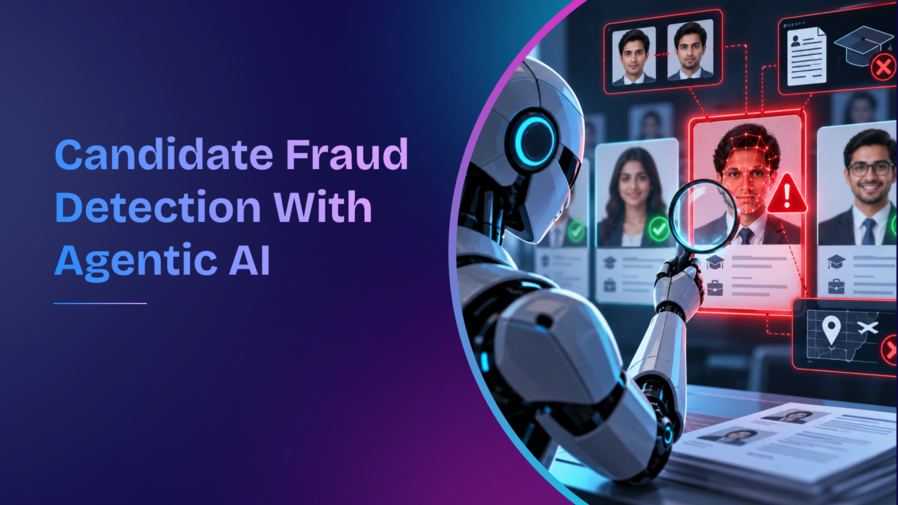


Table of content
Candidate fraud has become a genuine operational problem for enterprise hiring teams.
Fake credentials are easier to manufacture than they have ever been. Interview impersonation is increasingly common in remote hiring. And the cost of a fraudulent hire in a regulated role goes well beyond the recruitment budget.
The problem is not awareness. It is that the standard response manual verification and one-time background checks is not keeping pace. Checks happen at the wrong stage, cover too few sources, and produce results too late to act on.
This guide covers three specific ways agentic AI supports fraud detection in hiring credential verification, skill assessment integrity, and impersonation detection , and what each one means for the recruiting team doing the review.
Quick Answer: Agentic AI helps recruiting teams detect candidate fraud by running credential checks across multiple sources simultaneously, generating role-specific skill assessments that adapt based on candidate responses, and flagging biometric inconsistencies across interview stages. In each case, the system surfaces findings for the recruiting team to review. The team makes the decision. Agentic AI does the legwork.
What is Agentic AI in Fraud Detection?
Agentic AI refers to systems that coordinate multiple verification steps toward a defined goal, rather than waiting for a human to trigger each action individually.
In fraud detection, this means Agentic AI can run checks across several sources simultaneously, track results in one place, and surface consolidated findings for the recruiting team to act on. The recruiting team reviews the evidence. They decide what to do with it.
The distinction that matters here is between a system that checks one source and reports back, and one that coordinates across many sources, identifies patterns across all of them, and presents the recruiter with a picture rather than a data point.
For a full explanation of how agentic AI works across the talent acquisition process, Read What is Agentic AI in Recruitment.
How Agentic AI Helps Recruiters Catch Fraud Earlier
There are three stages where candidate fraud typically enters the hiring process. Each one has a verification gap that manual processes cannot close at scale. Here is what agentic AI does at each stage and what the recruiter's role looks like in practice.
Credential Verification
The gap sequential verification creates
Most credential verification happens sequentially. A recruiter contacts one source, waits for a response, follows up when it does not come, then moves to the next. For a candidate with five years of experience across three employers and two degrees, that process can take two to three weeks.
The delay is rarely because the information does not exist. It is because checking it manually, source by source, is slow. And at that pace, a determined fraudster has time to prepare.
The other problem is coverage. Most manual verification checks two or three sources. A candidate who has fabricated credentials across multiple institutions is unlikely to be caught by a two-source check.
From multiple sources to one consolidated view
Agentic AI runs checks in parallel across:
- Education and degree verification against institutional databases
- Professional certification validation against official registries
- Employment history cross-referencing against claimed dates and employer records
- Document authenticity checks against known fraud patterns
- Identification cross-checks where legally permitted
| Manual Credential Verification | Agentic AI Credential Verification | |
|---|---|---|
| How checks run | One source at a time, sequentially | Multiple sources simultaneously in parallel |
| Time to complete | Two to three weeks for complex profiles | Hours for the same profile |
| Sources covered | Two to three on average | Education, employment, certification, documents, ID , all at once |
| What recruiter does | Chases each source manually | Reviews consolidated findings and decides |
| When issues surface | After the process is already delayed | During the active pipeline while there is still time to act |
Rather than producing a binary pass/fail, agentic AI surfaces a consolidated picture with specific discrepancies flagged and the sources that produced them identified. The recruiter reviews the evidence and decides whether to proceed, request clarification from the candidate, or remove them from the process.
When a primary source is slow to respond, Agentic AI flags the delay and surfaces alternative options. The recruiter decides what to do next. It makes sure they have what they need to make that decision without chasing each thread manually.
For enterprise teams in India, credential verification must also align with DPDP Act requirements. Every check the system runs needs to be based on consented data, and every action needs to leave an auditable trail. Read our DPDP compliance guide for TA teams for the full regulatory picture.
Skill Assessment Integrity
The problem with tests candidates can prepare for
Standard skill tests have a predictable structure. Candidates who have taken similar tests before know what to expect. Fixed question banks get circulated. Standardized assessments do not match the specific claims a candidate has made in their resume. And one-size-fits-all tests can be completed by someone other than the candidate.
Technical hiring teams discover this most painfully. A candidate who aced the assessment cannot explain their own code in the first interview.
How adaptive challenges reveal what a fixed test misses
Agentic AI generates challenges based on what the specific candidate has claimed, not a generic test for the role category, but problems built around the technologies, project types, and experience levels the candidate listed.
When a candidate responds to a challenge, the next question adapts based on what they demonstrated. Areas where responses seem confident get probed deeper. Areas where answers seem uncertain get a different angle to verify whether the knowledge is actually there.
It also checks submitted code samples against public repositories to identify whether work is original or sourced externally.
| Fixed Skill Assessment | Adaptive Skill Assessment | |
|---|---|---|
| Question source | Standard question bank, same for all candidates | Generated based on what this specific candidate claimed |
| Response to answers | Moves to next predetermined question | Adapts based on what the candidate demonstrated |
| Code verification | Not checked | Cross-referenced against public repositories |
| What hiring manager receives | A pass/fail score | A picture of demonstrated skill with patterns flagged |
| Fraud risk | High question banks circulate, tests can be outsourced | Significantly lower, no fixed path to prepare for |
The hiring manager does not receive a score. They receive a picture of what the candidate demonstrated under adaptive conditions, with patterns in their responses flagged for review. The manager decides what those patterns mean for the role.
Impersonation Detection:
Where identity verification breaks down in remote hiring
Traditional identity verification happens once at the beginning of the process. After that, there is no mechanism to confirm that the same person is showing up at each subsequent stage.
In remote hiring, this gap is significant. Candidates can have someone else complete a phone screen, then show up themselves for the video interview. Or complete the first video interview themselves, then substitute someone more qualified for the technical round.
The person who joins on day one may not be the person the hiring team evaluated at any single point in the process.
How the recruiter gets from a flag to a decision
Agentic AI establishes markers during early application stages voice patterns, facial recognition where consent has been obtained, and communication style and vocabulary.
At each subsequent interview stage, it cross-references these markers against the baseline. When inconsistencies appear a shift in voice pattern, a change in communication style, a face that does not match the application photo , it flags the specific discrepancy with supporting evidence for recruiter review.
| Impersonation Type | What the Fraudster Does | Signal Agentic AI Detects |
|---|---|---|
| Proxy phone screen | Different person takes the initial screening call | Voice pattern does not match application stage recording |
| Interview substitution | Qualified person sits in for the actual candidate | Face does not match photo ID submitted at application |
| Stage switching | Candidate themselves for early rounds, proxy for technical | Communication style and vocabulary shift between stages |
| AI-assisted interview | Candidate uses real-time AI prompts during video call | Response patterns inconsistent with claimed experience level |
| Document forgery | Fabricated degree or employment certificate submitted | Document markers do not match institutional database records |
The recruiter sees what Agentic AI found and why it was flagged. They decide whether to investigate further, request an additional verification step, or remove the candidate from the process.
How RippleHire Approaches Candidate Fraud Detection
RippleHire's Fraud Management suite runs credential checks, photo validation, blacklist detection, and rehire governance inside the active hiring pipeline , so issues surface while the recruiting team still has time to act, not after an offer has been signed.
What makes this approach work in practice is where the checks happen. Most platforms verify after an offer. RippleHire runs checks at the resume stage, during the interview, and at the offer stage so a fraudulent candidate gets caught before they have consumed weeks of recruiter and assessor time.
As Ranjeet Garde, Director and HRIS Operations Leader at LTIMindtree notes:
"With RippleHire, we've implemented a global 'privacy by design' framework for our hiring process. By harnessing advanced AI, we proactively detect potential fraud."
The recruiting team makes the call on every flagged candidate. Agentic AI provides the evidence.
See how RippleHire can protect your hiring process.
Schedule a Demo
Frequently Asked Questions
What is candidate fraud in recruitment?
Candidate fraud in recruitment refers to deliberate misrepresentation during the hiring process fabricating educational qualifications, falsifying employment history, claiming certifications that do not exist, or having someone else complete interviews or assessments on the candidate's behalf. In enterprise hiring, the cost of a fraudulent hire in a regulated role goes well beyond the recruitment budget, including lost productivity, compliance exposure, and the cost of rehiring.
What is interview impersonation in hiring?
Interview impersonation occurs when someone other than the actual candidate completes one or more stages of the hiring process on their behalf. This has become more common in remote hiring, where video and voice technology make it easier to substitute candidates between stages. The person who joins on day one may not be the person the hiring team evaluated at any point in the process.
How does agentic AI detect fake credentials?
Agentic AI runs checks across multiple sources simultaneously education databases, certification registries, employment records, and professional platforms rather than checking sources one at a time. This parallel approach surfaces inconsistencies that are invisible when sources are checked individually. The consolidated findings are presented to the recruiting team, who review the evidence and decide how to proceed.
How does agentic AI detect interview impersonation?
Agentic AI establishes biometric markers during early application stages, including voice patterns, facial recognition where consented, and communication style. It cross-references these markers at each subsequent interview stage and flags inconsistencies for recruiter review. Rather than making a decision about the candidate, the system provides evidence the recruiter decides whether to investigate further, request additional verification, or remove the candidate from the process.
What is the difference between agentic AI and traditional AI in fraud detection?
Traditional AI follows fixed verification paths checking the same sources in the same sequence for every candidate. Agentic AI coordinates checks dynamically based on what it finds, running parallel verification across multiple sources and adapting based on the specific claims a candidate has made. The practical difference is that traditional AI catches predictable fraud. Agentic AI surfaces patterns that candidates who have prepared for standard verification are not expecting to face.
Can agentic AI replace manual background checks entirely?
No and it should not. Agentic AI handles the coordination and cross-referencing that consumes recruiter time without producing better results. The decisions about what to do with flagged information, including whether to request clarification from a candidate, escalate a discrepancy, or remove a candidate from the process stay with the recruiting team. Agentic AI makes those decisions faster and better-informed. It does not make them instead.
How does agentic AI fraud detection align with DPDP compliance in India?
Under India's DPDP Act, every verification check must be based on data the candidate has explicitly consented to, and every automated action must generate an auditable trail. Agentic AI fraud detection built on a consent-first architecture satisfies both requirements simultaneously the checks run on consented data, and the audit trail is generated automatically for every action the system takes.
Is agentic AI fraud detection suitable for high-volume hiring?
Yes, this is where it produces the most value. Manual verification at 500 to 1,000 hires a month is not feasible at the level of coverage an agentic system provides. Agentic AI applies the same checks to every candidate regardless of volume, which means the quality of verification does not degrade as hiring scales up. Recruiters review flagged cases rather than conducting routine checks on every application.