
.svg) Product
Product







Table of content
The Era of "One-Size-Fits-All" is Over.
In 2026, a unified global DEI strategy isn't just ineffective—it's dangerous. The legal landscape has fractured.
What is mandatory in the UK (Diversity Reporting) might be illegal in France (collecting race data).
For global companies, and especially those operating in India, the challenge is no longer just cultural nuance. It is about navigating a minefield of conflicting regulations—from the EU AI Act to India's newly notified DPDP Act Rules.
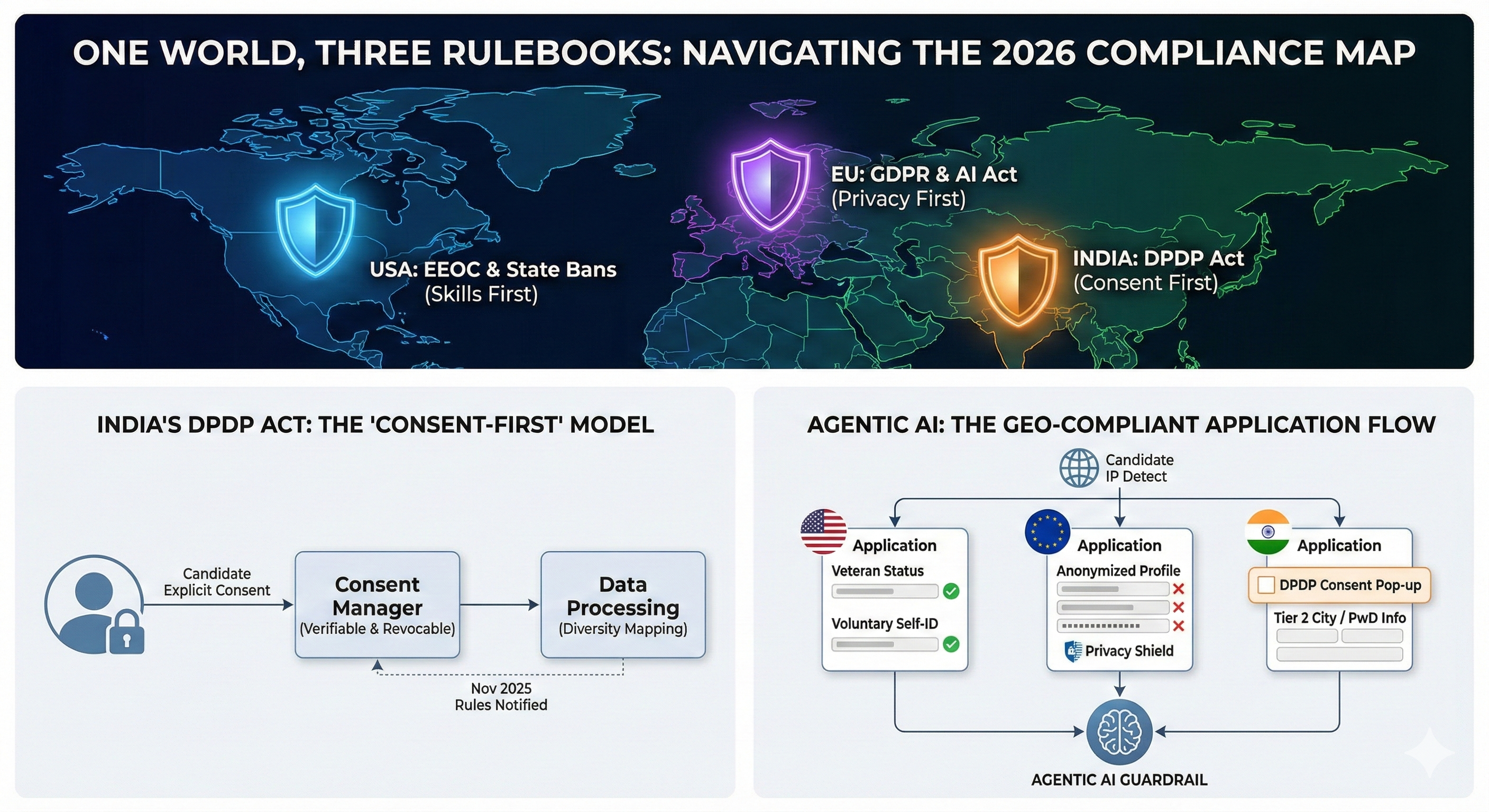
The Compliance Matrix: EU vs. USA vs. India
Localization is now a legal requirement. Here is how the three major talent markets diverge in 2026:
| Region | The Core Law | The Hiring Impact |
| 🇪🇺 Europe | GDPR & EU AI Act | Privacy First. Collecting sensitive data (race/religion) is largely restricted. You must rely on "Anonymized Hiring" and strict bias audits for your AI tools. |
| 🇺🇸 USA | EEOC & State Bans | Polarized. While federal law encourages equal opportunity, new state-specific bans on "DEI Initiatives" mean you must focus strictly on "Skills-Based Hiring" to remain neutral and compliant. |
| 🇮🇳 India | DPDP Act (2023) | Consent First. With the November 2025 notification of DPDP Rules, you cannot process any candidate data without a verifiable "Consent Manager." Resume parsing without explicit consent is now a violation. |
Key challenges when diversity and inclusion programs aren't localized
Cultural context and relevance
Different regions have distinct diversity challenges and cultural frameworks. For example, while gender representation might be the primary focus in one country, caste-based inclusion could be more pressing in another. When global programs don't account for these differences, they risk appearing tone-deaf or missing crucial local issues.
Legal and regulatory environment
Each country has its own employment laws, affirmative action policies, and protected classes. A standardized approach might conflict with local regulations or miss compliance requirements. For instance, collecting certain demographic data might be standard practice in one country but illegal in another.
The Indian Context: Navigating the DPDP Act (2023)
"For companies hiring in India, the landscape shifted permanently with the full notification of the Digital Personal Data Protection (DPDP) Act Rules in late 2025.
Unlike the US (where voluntary self-identification is standard), India’s DPDP Act operates on a strict 'Consent-First' model. You cannot collect sensitive diversity data (such as disability status or socio-economic background) without a verifiable 'Consent Manager' mechanism.
The RippleHire Advantage: Our Agentic AI includes a built-in Consent Manager that aligns with the Data Protection Board of India's requirements, ensuring that your diversity data collection is legal, transparent, and revocable by the candidate at any time."
Spotlight on India: The New Rules of Engagement
As an Indian entity or a global firm hiring in Bangalore and Hyderabad, your diversity strategy must align with the Digital Personal Data Protection (DPDP) Act.
1. The "Consent Manager" Requirement: Unlike the "Legitimate Interest" loophole in Europe, India’s framework is rigid. You need a mechanism that allows candidates to give, review, and withdraw consent for their data to be used in diversity mapping.
-
The Fix: Ensure your ATS has a built-in Consent Manager (like RippleHire’s) that logs these permissions automatically.
2. Redefining Diversity: Beyond Gender: While the West focuses on race, the 2026 Indian context prioritizes Access and Neurodiversity.
-
-
Tier 2/3 City Inclusion: True diversity in India means breaking the "Metro-Bias." Use AI to surface overlooked talent in hubs like Indore or Coimbatore who have the skills but lack the "top tier college" tag.
-
PwD Compliance: With the government tightening norms around Persons with Disabilities (PwD), your application forms must be WCAG 2.1 compliant to support assistive tech.
-
Localizing for India: Beyond Gender
"In the West, DEI often centers on race and ethnicity. In India, the 2026 focus is on Access and Neurodiversity.
Tier 2/3 City Inclusion: Breaking the 'Metro-Bias' by using AI to identify skilled talent in non-metro hubs (e.g., Indore, Coimbatore) who were previously ignored.
PwD & Neurodiversity: With the government pushing for greater accessibility, corporate mandates for hiring Persons with Disabilities (PwD) are rising. Your application process must be WCAG 2.1 compliant to accommodate screen readers and assistive tech—something standard forms often miss."
Creating meaningful DEI metrics across global markets
Different markets start from different points in their DEI journey. For instance, gender representation targets that seem unambitious in Scandinavia might be revolutionary in other regions.
Creating meaningful benchmarks requires understanding these starting points.
While global organizations need overarching metrics to track progress, these need to be complemented by locally relevant measures. For example:
- Global metric: Overall gender diversity across leadership
- Local metric: First-generation college graduates in emerging markets
- Regional metric: Age diversity in rapidly aging populations like Japan
The future of DEI: Moving beyond one-size-fits-all
The evolution of global DEI programs reflects a broader shift in how we think about organizational change. While the past decade focused on establishing global standards and policies, the next phase will require something more nuanced: the ability to be simultaneously global and local, unified yet flexible.
Success in this space will increasingly depend on organizations' ability to build what we might call "adaptive DEI frameworks" - systems that maintain core principles while flexing to local realities. This isn't just about translation or local adaptation; it's about fundamentally rethinking how we approach diversity and inclusion across borders.
Looking ahead, technology will play a crucial role, but not in the way many expect.
Rather than seeking to standardize DEI practices globally, emerging tools will need to help organizations embrace and manage diversity in its truest sense - including diversity of approach across different markets.
The organizations that will lead in this space won't be those with the most comprehensive global policies, but those that best enable local teams to pursue inclusion in ways that resonate with their specific contexts while contributing to global progress. This requires a fundamental shift from viewing DEI as a program to be implemented, to seeing it as a capability to be developed.
Want to make your global DEI work better? Here's how RippleHire can help
RippleHire's talent acquisition platform offers specific features that address the challenges of running localized DEI programs:
Smart Hiring Intelligence
- AI-powered screening that reduces unconscious bias across different markets
- Customizable screening criteria that can be adapted for local diversity goals
- Built-in analytics to track DEI metrics across regions
Local Compliance Built-in
- Automated compliance with local hiring regulations across 50+ countries
- Data privacy frameworks that adapt to regional requirements
- Built-in fraud detection to ensure hiring integrity across markets
Flexible for Different Markets
- Customizable workflows that can be adapted for different regions
- Multi-language support for global hiring
- Integration with local job boards and recruitment channels
As trusted by global organizations like Axis Bank, HDFC Bank, and Tata Steel, RippleHire helps organizations move beyond standardized DEI approaches to create truly localized, effective diversity programs.
Book a demo with RippleHire to see how our AI-powered talent acquisition platform can help you:
✓ Build locally relevant DEI programs that drive real results
✓ Stay compliant with regional regulations automatically
✓ Track and measure DEI success across different markets
✓ Create bias-free hiring processes that work globally
How to Manage 50 Different Laws? Use Agentic AI.
No human recruiter can memorize the specific data privacy laws of 50 different countries. This is where Agentic AI becomes your compliance shield.
-
Geo-Fenced Workflows: RippleHire’s Agentic AI automatically detects a candidate's location (IP) and adjusts the application flow.
-
The Result: It asks for "Veteran Status" in the US but hides that question in France and triggers a "Consent Pop-up" in India—ensuring 100% compliance without manual intervention.
In Indian Enterprises: Are You Ready for the Data Protection Board?
Don't let your diversity goals conflict with the new privacy laws. RippleHire is the only platform that balances Global DEI standards with strict DPDP Act compliance.
FAQs
Q1: How does India’s DPDP Act (2023) impact diversity hiring in 2026? Answer: India’s Digital Personal Data Protection (DPDP) Act operates on a "Consent-First" model. Unlike previous norms, you cannot parse resumes or collect diversity data (like gender or disability status) without a verifiable "Consent Manager" mechanism. HR teams must ensure candidates can explicitly grant, review, and withdraw consent for their data to be processed for DEI mapping.
Q2: Is it legal to collect race and ethnicity data for hiring in Europe? Answer: Generally, no. Under GDPR, collecting sensitive personal data like race or ethnicity is largely prohibited in countries like France and Germany. Instead of direct data collection, companies in the EU should use "Anonymized Hiring" and "Bias Audits" on their AI tools to ensure fairness without violating privacy laws.
Q3: How do we maintain a global DEI strategy with conflicting local laws? Answer: The most effective strategy is to use Agentic AI with geo-fenced workflows. This technology automatically adjusts the application process based on the candidate's location—hiding sensitive questions in the EU, adding "Consent Pop-ups" in India, and enabling voluntary self-identification in the US—ensuring you meet local compliance standards without manual intervention.
Q4: What is the difference between "Skills-Based Hiring" and "Diversity Hiring"? Answer: Diversity Hiring focuses on widening the funnel to underrepresented groups, often tracking demographic metrics. Skills-Based Hiring focuses strictly on "Capabilities" (what a candidate can do) rather than credentials or background. In regions with strict bans on DEI initiatives (like certain US states), Skills-Based Hiring is the safest legal alternative to ensure fair, meritocratic recruitment.
Q5: What are the key diversity hiring focus areas for India in 2026? Answer: Beyond gender diversity, the 2026 focus in India is on Tier 2/3 City Inclusion (hiring skilled talent from non-metro hubs like Indore or Coimbatore) and PwD (Persons with Disabilities) Compliance. Companies must ensure their application platforms are WCAG 2.1 compliant to accommodate assistive technologies.