
.svg) Product
Product

.png)


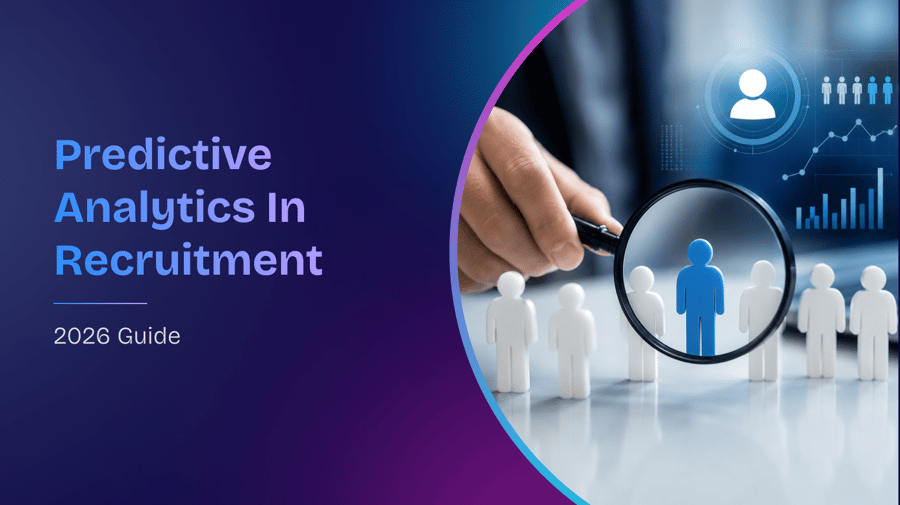


Table of content
Predictive Analytics in Recruitment: Why 2025 Is the Year to Start
Quick Answer: Predictive analytics in recruitment uses historical hiring data, machine learning, and statistical models to forecast future outcomes including candidate success, attrition risk, time to fill, and sourcing quality. It does not replace recruiter judgment. It gives recruiters better information before they make calls that are hard to reverse.
A recruiter opens their ATS on a Monday morning to 40 open requisitions, a dozen candidates in various stages, and no clear answer to which roles are actually at risk of slipping. The data to answer that question usually exists it's just sitting in application volumes, source of hire, time to fill, scattered across systems nobody's connected.
That's the gap predictive analytics is built to close: not generating more data, but turning what's already being tracked into something recruiters can act on before a requisition stalls or a strong candidate walks.
This guide covers what predictive analytics in recruitment actually does, where it delivers the most value, how to get started without a data science team, and what the failure modes look like when it's set up badly.
What is Predictive Analytics in Recruitment?
Predictive analytics sits at the third stage of a four-stage data maturity curve: descriptive (what happened), diagnostic (why it happened), predictive (what will happen), and prescriptive (what to do about it).
Most recruiting teams operate at the first two. They track time to hire and cost per hire. They review source-of-hire data at the end of a quarter. That is descriptive analytics. Useful, but retrospective.
Predictive analytics moves forward. Instead of telling you that offer acceptance dropped last quarter, it flags which active requisitions are trending toward a miss before the deadline arrives. Instead of reviewing first-year attrition, it identifies which candidates in the current pipeline show early signals of short tenure.
The gains from predictive analytics compound as the model learns from more data, with teams that close the feedback loop consistently seeing meaningful improvement in time to fill and sourcing quality within a few hiring cycles.
Why Traditional Recruitment Falls Short at Scale
The manual approach to recruitment works reasonably well at low volume. When a recruiter knows the role, the hiring manager, and the team, instinct and experience carry a lot of weight.
At scale, those conditions stop holding. A recruiter managing 30 open requisitions across three business units cannot build the same depth of context for each role. So they shortcut and the shortcuts show up as inconsistency: different recruiters weighing signals differently, similar candidates getting different outcomes, and no clear way to trace why.
That gap between ambition and execution isn't a people problem. It's a data infrastructure problem.
Predictive analytics doesn't fix everything. But it closes the one gap manual processes can't: making consistent, repeatable assessments across large candidate volumes without losing the signal in the noise.
What Predictive Analytics Actually Does in Hiring
There are four things predictive analytics does in a recruiting context. Each solves a distinct problem.
1. Predicts Candidate Success
The most common use case. A model trained on historical performance data, assessment scores, interview feedback, and role characteristics learns which combination of inputs correlates with strong outcomes in a given role type. New candidates are scored against that pattern before they advance.
The important qualification: this only works if the historical data is clean and the outcome label (performance) is actually being tracked. Quality of hire remains one of the least consistently tracked metrics in enterprise recruiting.
2. Forecasts Attrition Risk
Predictive models can identify candidates who are likely to leave early, based on patterns in their application history, interview responses, and role characteristics. This isn't about screening out job-hoppers on principle. It's about surfacing candidates whose profile signals a mismatch with the role or the team before you invest six months finding out.
The retention benefit compounds. Every avoided early departure removes a rehiring cycle from the queue.
3. Tracks Pipeline Velocity
A pipeline velocity model forecasts which open requisitions will close on time and which will slip. Inputs include role characteristics, pipeline shape, top-of-funnel volume, stage conversion rates, and recruiter activity. Output is a daily-updated close probability per requisition.
This shifts the TA leader's weekly conversation from "where are we?" to "which roles need intervention and why?" The difference is not cosmetic. One is a status update. The other is a decision.
4. Optimizes Sourcing Investment
Not all sourcing channels produce equally. Predictive analytics maps which channels produce candidates who convert at each stage, how long they take to progress, and what their first-year outcomes look like. Budget follows signal rather than habit.
The channels that look cheapest on a cost-per-hire spreadsheet aren't always the ones producing candidates who actually get hired or who stay.
Predictive vs Traditional Recruitment
| Traditional Recruitment | Predictive Analytics in Recruitment | |
|---|---|---|
| Candidate scoring | Manual screening, resume review | Data model scoring against proven success patterns |
| Attrition risk | Identified after the hire | Flagged during the evaluation process |
| Pipeline visibility | Status updates at review meetings | Real-time close probability per requisition |
| Sourcing decisions | Based on habit and volume | Based on stage conversion and quality-of-hire data |
| Outcome measurement | Time to hire, cost per hire | Quality of hire, first-year retention, performance correlation |
How to Get Started: A Practical Framework
Step 1: Audit Your Data Before You Do Anything Else
Predictive models are only as good as the data they are trained on. Before evaluating any tool, spend time on what you already have.
Check whether your ATS captures structured data consistently. If interview feedback exists in free-text fields with no standard format, the model has nothing to learn from it. If sourcing data is incomplete or inconsistently tagged, source-of-hire analysis will mislead rather than inform.
Clean data is not glamorous work. It is the rate-limiting step for everything that follows.
Step 2: Decide What You Are Trying to Predict
Different problems need different models. A team struggling with first-year attrition needs a different starting point than a team trying to reduce time to fill for volume roles. The KPIs you choose determine the data you need and the model you build.
A few metrics worth starting with:
| KPI | What it measures |
|---|---|
| Quality of hire | Performance and retention in the first 12 months |
| Time to hire | Days from first contact to accepted offer |
| Source quality | Stage conversion and quality-of-hire by channel |
| Offer acceptance rate | Ratio of offers extended to offers accepted |
| First-year turnover | Attrition within 12 months of joining |
| Cost per hire | Total recruitment spend divided by hires made |
| Interview to hire ratio | Number of interviews required per successful hire |
| Candidate drop-off rate | Stage-by-stage attrition in the pipeline |
Start with two or three. You'll get something actionable faster than if you try to measure everything at once.
Step 3: Integrate With Your ATS
Predictive analytics works best inside the tools recruiters already use every day. A separate dashboard just becomes one more tab nobody opens. An ATS that integrates with analytics tools lets you score candidates, track pipeline velocity, and measure sourcing quality without moving data between systems or asking recruiters to check a separate dashboard.
The integration question to ask any vendor: does predictive scoring happen inside the ATS in real time, or does it require a data export and a manual refresh?
Step 4: Build a Feedback Loop
Predictive models improve over time only if outcome data flows back in. When a hire who scored highly in the model leaves in three months, that outcome needs to inform the next version of the model. When a low-scored candidate turns out to be a top performer, that signal matters too.
Most teams set up the model and never close the loop. That is why the early gains stall. Regular calibration between the model and actual outcomes is what produces compounding improvement over time.
Step 5: Iterate Rather Than Optimize
The goal in the first six months is not a perfect model. It is a functioning loop where data goes in, predictions come out, outcomes are tracked, and the model improves. A team that iterates on an imperfect model consistently will outperform a team waiting for perfect data conditions that never arrive.
What to Watch out for
Predictive analytics works when it is set up well. Three things go wrong when it is not.
Bad data produces confident wrong answers
A model trained on biased historical decisions will replicate that bias at scale. If past hiring favored certain profiles for reasons unrelated to performance, the model learns to keep doing that. Auditing model outputs regularly, not just inputs, is the only way to catch this before it compounds.
Tracking the wrong outcome wastes everyone's time
A model predicting first-round interview pass rates is not the same as one predicting two-year retention. They will produce different shortlists. Decide what you are actually trying to forecast before you build anything.
Treating predictions as decisions is where most teams go wrong
A predictive score is one input. It does not capture cultural fit, communication style, or the context a recruiter picks up in a 20-minute conversation. A high score should prompt engagement. It should not trigger automatic advancement.
The model improves the decision. It does not make it.
Making It Easy to Implement
RippleHire is built around the constraint most teams face: getting predictive signal into recruiter hands without a data science team or a separate dashboard nobody opens.
The platform's analytics layer sits inside the ATS, so pipeline velocity, stage-level drop-off data, and early-warning flags for requisitions trending toward a missed deadline are visible in the same place recruiters work every day. The AI agents that run across sourcing, screening, and scheduling generate the structured data the analytics layer needs to improve over time. Sourcing quality is tracked by channel automatically.
Candidate scoring is based on skills and career progression rather than keyword matching. And because the agents log every action with reasoning, the feedback loop between prediction and outcome closes without requiring manual data entry.
The goal is not to automate hiring decisions. It is to give recruiters better information at the points where the decisions that matter are made.
Schedule a Demo
Frequently Asked Questions
What is predictive analytics in recruitment?
Predictive analytics in recruitment uses historical hiring data, machine learning, and statistical models to forecast future outcomes including candidate success, attrition risk, time to fill, and sourcing quality. It analyzes patterns in resumes, interview performance, assessment scores, and past hiring outcomes to identify which candidates are most likely to perform well and stay.
How is predictive analytics different from regular recruitment reporting?
Regular recruitment reporting is descriptive. It tells you what happened: how many candidates applied, what the time to hire was, which source produced the most applications. Predictive analytics is forward-looking. It tells you what is likely to happen: which requisitions will miss their close date, which candidates are at risk of early attrition, which sourcing channels will produce quality hires for a given role type.
Does predictive analytics replace recruiter judgment?
No. Predictive analytics gives recruiters better inputs before they make decisions. It surfaces patterns across large candidate volumes that no individual recruiter can track manually. The decision about who to advance, who to offer, and who to decline stays with a human. A prediction score is one input among several, not an automatic outcome.
What data do you need to start with predictive analytics in recruitment?
The most useful starting data includes structured interview feedback, assessment scores, sourcing channel tags, offer and acceptance records, and first-year performance and retention outcomes. The quality of the data matters more than the volume. A small set of clean, consistently structured data produces better model outputs than a large set of incomplete records.
What KPIs should we track once predictive analytics is running?
The most useful KPIs are quality of hire, first-year attrition rate, source-to-hire conversion by channel, interview-to-hire ratio, offer acceptance rate, and pipeline velocity by role type. Start with two or three that align with your current biggest hiring challenge rather than trying to measure everything at once.
How long does it take to see results from predictive analytics in recruitment?
Most teams see early directional signal within one to two hiring cycles. Meaningful model improvement typically takes six to twelve months because the model needs outcome data from actual hires to calibrate against. Teams that close the feedback loop consistently and iterate on their KPI selection tend to see results compound faster than those who set up the model and leave it unchanged.
Can predictive analytics introduce bias into hiring?
Yes, if the training data reflects historical bias. A model trained on past hiring decisions that skewed toward certain backgrounds will learn to replicate that pattern. Regular audits of model outputs, not just inputs, are the check against this. The model should be evaluated on the diversity of its shortlists and the correlation between scores and actual performance outcomes, not just its accuracy against historical data.
What is the difference between predictive analytics and AI in recruitment?
Predictive analytics is a specific application of data modeling focused on forecasting outcomes. AI in recruitment is a broader category that includes predictive analytics but also covers natural language processing for resume screening, generative AI for content creation, agentic AI for workflow automation, and conversational AI for candidate engagement. Predictive analytics is the data layer that makes many AI applications in recruitment more accurate over time.