
.svg) Product
Product

.png)


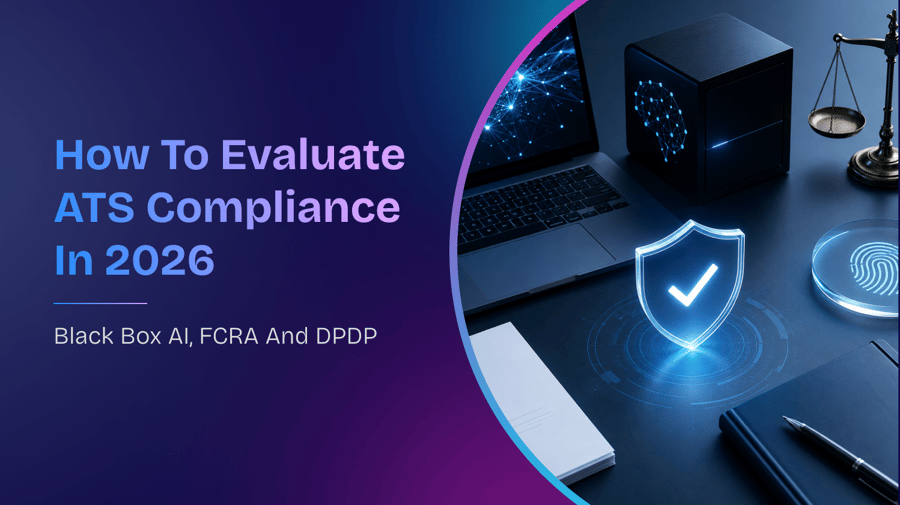


Table of content
For the last few years, the biggest question in recruitment technology was, "How fast can it hire?"
HR leaders wanted tools that could parse resumes instantly, schedule interviews automatically, and filter candidates while they slept.
But in 2026, the conversation has shifted. The most important question is no longer just about speed. It is about safety.
Recent industry discussions have highlighted a growing concern around "Black Box" AI tools, systems that rank or reject candidates using invisible criteria. Regulatory bodies across the world, from the US to India, are asking tough questions about how these algorithms make decisions.
For Talent Acquisition leaders, this is a moment to pause and evaluate. Are the tools in your stack empowering your recruiters, or are they quietly exposing your organization to compliance risks?
This guide breaks down the new rules of engagement for hiring technology. We will explore the "Black Box" risk, the key regulations you need to know (FCRA, GDPR, DPDP), and the simple guardrails you can put in place to hire with confidence.
What is black box AI in recruitment and why it's a compliance risk
To understand the risk, we first need to understand the difference between an "Assistant" and a "Gatekeeper."
An Assistant helps a recruiter work faster. It might organize resumes, highlight skills, or send emails. The recruiter is still the pilot; the AI is the co-pilot.
A Gatekeeper (or "Black Box" AI) takes over the decision-making process. It might look at a candidate’s profile and assign a hidden "fit score" or a personality label like "low potential." If the score is too low, the candidate might be rejected automatically without a human ever seeing their application.
The risk here is Transparency. If a candidate is rejected by a machine based on data they didn't provide (like scraped social media activity) or criteria they can't see, it creates a "trust gap." In many jurisdictions, it also creates a legal gap.
What this looks like in practice:
Consider a candidate who applies for a senior engineering role. They have the right skills, the right experience, and a strong portfolio. But an AI system trained on historical hiring data assigns them a low fit score because they attended a lesser-known university and have gaps in employment — neither of which was listed as a requirement for the role. No recruiter sees the application. The candidate never knows why they were rejected. The organization never knows what it missed.
Why This Matters Now
Three major legal frameworks are shaping how AI is used in hiring in 2026:
-
FCRA (Fair Credit Reporting Act) – The "Right to Know"
-
The Fact: While this is a US law, its principles are becoming a global standard. It generally states that if a third-party report (like an automated background score) is used to make an employment decision, the candidate has a right to know and a right to dispute it.
-
The Takeaway: If your software acts like a reporting agency by "scoring" people behind the scenes, you need to ensure you are notifying candidates properly.
-
-
GDPR (General Data Protection Regulation) – The "Human Rule"
-
The Fact: Under GDPR, individuals generally have the right not to be subject to a decision based solely on automated processing.
-
The Takeaway: Fully automated rejections are a high-risk activity. There should almost always be a human review step.
-
-
DPDP Act (Digital Personal Data Protection Act) – The "Purpose Rule"
-
The Fact: In India, this act mandates that data can only be used for the specific purpose the user consented to.
-
-
-
The Takeaway: If a candidate submits a resume for a specific job, that data cannot be used to train a global AI model or build a "shadow profile" without their clear, specific consent.
-
-
For a detailed breakdown of what the DPDP Act requires from TA teams specifically, read our complete guide here.
-
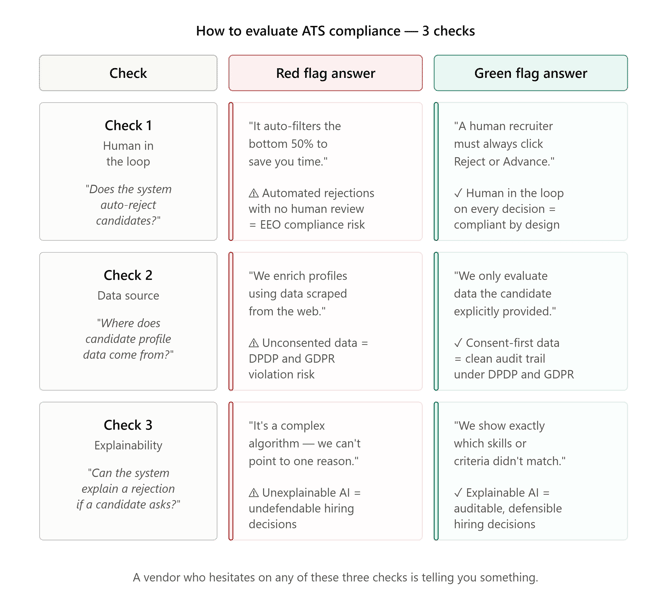
How to evaluate ATS compliance: 3 questions to ask the vendor
| Check | Question to ask | What you're testing |
|---|---|---|
| ✅ Check 1 Human in the Loop |
"Does this system automatically reject candidates based on a score?" | Whether humans remain in control of every hiring decision |
| ✅ Check 2 Data Source |
"Where does the data for candidate profiles come from?" | Whether candidate data is consented and accurate |
| ✅ Check 3 Explainability | If a candidate asks why they were not selected, can the system tell me? | Whether the AI can justify every decision it makes |
When you are speaking to a software vendor or auditing your current ATS, these three questions reveal more about their compliance philosophy than any product demo will.
Check 1: The "human-in-the-loop" test
Ask: "Does this system automatically reject candidates based on a score?"
-
Red Flag: "Yes, it auto-filters the bottom 50% to save you time."
-
Green Flag: "No. The AI highlights relevant skills and matches, but a human recruiter must always click 'Reject' or 'Advance'."
-
Why: Keeping a human in the loop is the single most effective way to ensure fairness and compliance with Equal Employment Opportunity (EEO) guidelines. No automated rejection should reach a candidate without a human reviewing it first.
Check 2: The data source test
Ask: "Where does the data for candidate profiles come from?"
-
Red flag: "We enrich profiles using data scraped from the open web and social media."
-
Green flag: "We only evaluate the data the candidate explicitly provided to you during the application process."
-
Why: Data scraped from the web is often inaccurate ("Third-Party Data"). Evaluating candidates based only on what they gave you ("First-Party Data") ensures consent and accuracy and protects you under DPDP and GDPR
Check 3: The explainability test
Ask: "If a candidate asks why they weren't selected, can the system tell me?"
-
Red flag: "It’s a complex algorithm, so we can't point to one specific reason."
-
Green flag: "Yes. We show you exactly which skills were missing or which criteria didn't match."
-
Why: You need Explainable AI. If you can't explain a hiring decision, you can't defend it in court, to a regulator, or to the candidate.
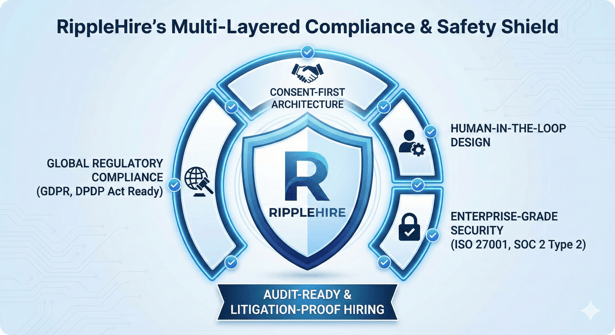
What compliant ATS architecture actually looks like
At RippleHire, we believe that the best technology is transparent. We don't build "Black Boxes"; we build "Glass Boxes."
We operate strictly as a Data Processor. You (the employer) are the Data Controller. This means you set the rules, you own the data, and you make the decisions. Our job is to make your process efficient, auditable, and safe.
Here are the four guardrails we use to protect our customers:
1. Consent-first architecture
We respect the "Purpose Limitation" principle of the DPDP Act.
-
How it works: We do not scrape the internet to build secret dossiers on candidates. RippleHire evaluates applicants only based on the information they provide to you.
-
The Benefit: You have a clean, compliant paper trail. Every data point used in the hiring decision has the candidate's consent attached to it.
2. Transparent insights (Not secret scores)
We believe in showing our work.
-
How it works: Instead of a mysterious "Fit Score," we provide clear Skill Matches. Our system highlights exactly which keywords, certifications, or experiences on the resume matched your job description.
-
The Benefit: Your recruiters can validate the AI's logic instantly. It builds trust instead of confusion.
3. The "human-in-the-loop" guarantee
We design for recruiter enablement, not replacement.
-
How it works: Our automation handles the repetitive tasks, parsing resumes, scheduling interviews, verifying documents. But the critical decisions ,shortlisting and offering are always triggered by a human user.
-
The Benefit: Every hiring decision is accountable and human-centric.
4. Enterprise-grade security
Safety isn't just about AI; it's about data security.
-
SOC 2 Type II & ISO 27001 Certified: These certifications prove that an independent auditor has verified our security controls over time.
-
GDPR & DPDP Ready: We have built-in features to handle "Right to be Forgotten" requests and data portability, ensuring you stay compliant with global privacy laws.
Building a hiring process that is fast, fair and auditable
The hiring landscape is maturing. The "Wild West" days of unchecked AI are ending, and a new era of Responsible AI is beginning.
This is a positive shift. It means that organizations are prioritizing trust trust with their candidates, trust with their data, and trust with their technology partners.
You don't have to choose between efficiency and compliance.
By asking the right questions and choosing partners who prioritize transparency, you can build a hiring engine that is fast, fair, and future proof.
Want to see how RippleHire supports DPDP and GDPR-compliant hiring for enterprise teams?
Schedule a Demo →
Frequently asked questions
1. What is a "Black Box" AI in recruitment?
Black-box AI in recruitment refers to automated systems where the internal decision-making logic is hidden from recruiters and candidates. These tools assign rankings or scores to candidates without explaining how the score was calculated, making it impossible to justify decisions or for candidates to understand why they were rejected. Under GDPR, FCRA, and India's DPDP Act, this lack of transparency creates significant legal exposure.
2. Why is "Human-in-the-Loop" important for compliance?
Human-in-the-loop means a human recruiter reviews AI recommendations before any final decision is made. This is critical for compliance with GDPR , which cautions against fully automated decisions that significantly affect a person's livelihood and with EEO guidelines that require fair, reviewable hiring processes. No automated rejection should reach a candidate without human sign-off.
3. Does RippleHire scrape data from social media?
No. RippleHire follows a "Consent-First" architecture. We process only the data candidates explicitly submit to your career portal or data you already legally hold. We do not scrape external websites or build shadow profiles from unconsented sources.
4. What is the difference between an "Assistant" and a "Gatekeeper" AI?
An Assistant AI (like RippleHire) helps recruiters by organizing data, highlighting skills, and automating admin tasks but leaves every final decision to a human. A Gatekeeper AI autonomously filters and rejects candidates based on its own criteria, acting as the decision-maker without human review. Enterprise teams should use the former and avoid the latter entirely.
5. How does the DPDP Act affect my hiring process in India?
The DPDP Act requires that you obtain specific consent from candidates for the data you collect and use it only for that stated purpose. You cannot use candidate data to train third-party AI models or build profiles beyond the original application without fresh, specific consent. Penalties for non-compliance range up to ₹250 crore per violation.
6. What certifications should I look for to ensure an ATS is safe?
Look for ISO 27001 (Information Security Management) and SOC 2 Type II (Operational Security). These certifications indicate that an independent auditor has verified the vendor's security controls over time not just at a single point in time.
7. Can AI help with diversity without introducing bias?
Yes, if it is "Explainable AI." When AI focuses strictly on objective skills and experience rather than names, locations, or educational pedigree and shows its logic, it can help recruiters make more consistent, unbiased decisions. "Black Box" models, however, can hide and perpetuate historical biases.
8. What is a "Data Processor" vs. a "Data Controller"?
In the context of hiring software: You (the Employer) are the Controller who decides why and how to hire. RippleHire is the Processor that handles the data on your behalf. This distinction is important because it means we do not "own" your candidate data or use it for our own benefit; we simply process it according to your instructions.