
.svg) Product
Product

.png)


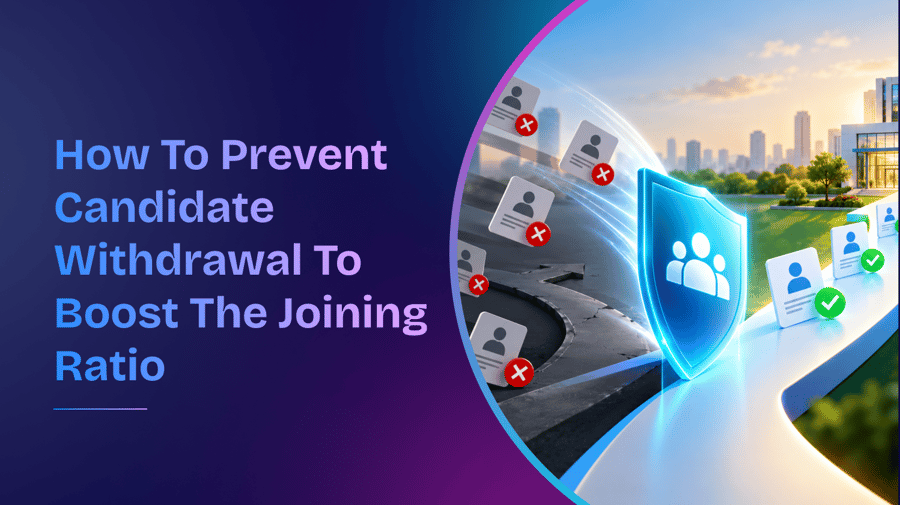


Table of content
“Due to unforeseen circumstances, I will not be joining.”
Every recruiter has read some version of this email after weeks of interviews, follow-ups, stakeholder alignment, and compensation discussions. By then, the role already looks closed on paper. Hiring managers plan project timelines around the new hire, while recruiters move on to filling the next critical opening.
Then the candidate drops out days before joining.
This creates far more than a hiring gap for businesses like professional services. Every late-stage drop-off drains revenue, overloads teams, and forces recruiters to rework everything after weeks of effort.
Counteroffers and market competition usually take the blame. But candidate withdrawal rarely starts at the end of the process. It builds quietly during the notice period.
That gap between offer acceptance and Day One, is where hiring teams lose control thinking the deal is done. On the other hand, candidates continue evaluating opportunities, speaking with peers, reconsidering trade-offs, and comparing options.
A Forbes report shows that 42% of candidates decline job offers because of the poor hiring process. In many cases, the experience breaks after the offer gets signed, not before.
Here is what drives candidate withdrawal and how hiring teams can improve joining ratios.
Why do candidates withdraw after accepting an offer?
Compensation matters, but it is not the only reason candidates back out. Here are some common reasons candidates turn down jobs after accepting it initially.
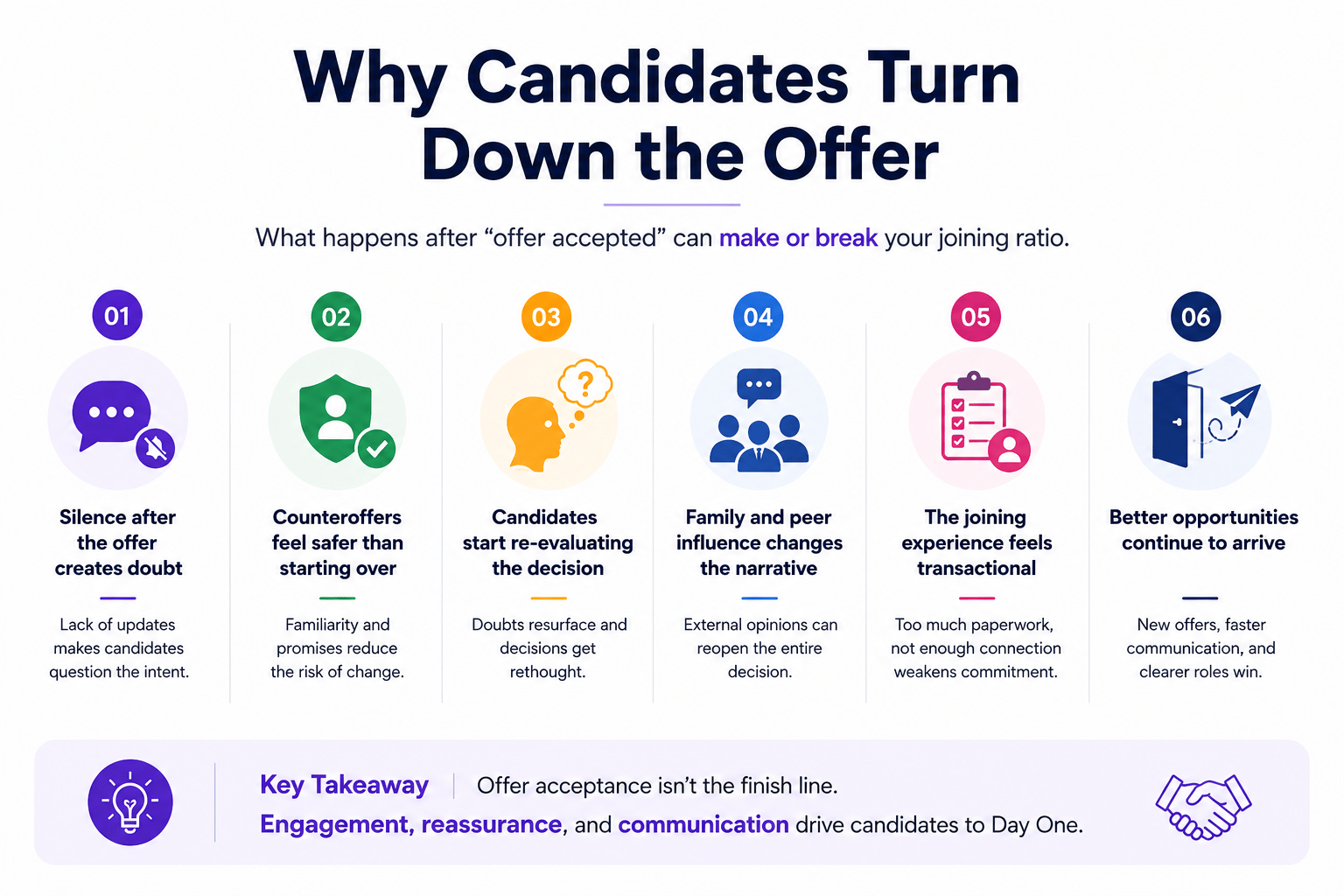
Silence after the offer creates doubt
Candidates hear from recruiters constantly during interviews. Calls happen quickly, updates arrive on time, and every stage feels urgent. The moment the offer gets accepted, that momentum often disappears.
Days pass with little communication beyond onboarding forms or background verification requests. A lack of impersonal post-offer experience makes candidates question whether the excitement during hiring was real or just part of closing the role.
Counteroffers feel safer than starting over
Changing jobs creates uncertainty even when candidates genuinely want to switch their job. A counteroffer from the current employer introduces something powerful at exactly the wrong moment, familiarity.
Existing managers might promise promotions, salary corrections, flexible work arrangements, or larger responsibilities. Candidates begin wondering whether staying might be easier than rebuilding credibility in a new environment.
Professional services firms see this often during long notice periods where retention offers reduce the psychological risk of change.
Candidates start re-evaluating the decision
Offer acceptance does not end decision-making. It restarts it.
Candidates replay interviews in their heads, compare competing opportunities again, revisit Glassdoor reviews, and rethink long-term career implications. Small doubts that seemed irrelevant during negotiations suddenly feel significant once the pressure of decision-making settles.
Talent behavioral psychology calls this post-decision dissonance. People naturally search for reassurance after making major decisions, especially career moves involving income and future growth.
This explains why candidates who sounded highly committed during negotiations can still disappear before joining.
Family and peer influence changes the narrative
Candidates rarely make career decisions alone. Friends, mentors, spouses, former colleagues, and managers all influence how candidates think after accepting an offer.
Research shows 82% of job seekers consider employer reputation before making career decisions. One negative comment about workload, culture, or leadership reputation, can reopen the entire decision.
This is especially common in professional services hiring, where reputation spreads quickly across industry circles. Candidates speak with ex-employees, peers already working at competitor firms, compare work-life expectations, and evaluate whether the move actually improves their long-term trajectory.
The joining experience feels transactional
Organizations unintentionally reduce candidates to a checklist after the offer gets signed.
Communication shifts from relationship-building to document collection. Every interaction becomes about forms, approvals, compliance steps, or onboarding tasks. Candidates stop feeling like future employees and start feeling like administrative entries inside a system.
That shift weakens emotional commitment quickly.
A candidate joining a firm wants assurance signals about the work and the company they are joining. Instead, they often receive automated reminders about policies and paperwork.
Better opportunities continue to arrive
Strong candidates do not leave the market after signing an offer.
Recruiters continue reaching out aggressively during notice periods, especially for high-demand roles of professional services. Candidates who update their LinkedIn profiles after resignation often attract even more inbound interest than before.
The recruitment team usually assumes the hiring process is complete but competing companies still treat the candidate like an active opportunity until Day One.
A candidate who receives faster communication, stronger leadership access, or better career positioning elsewhere may reconsider even without a major salary jump.
How hiring teams can reduce candidate drop-offs
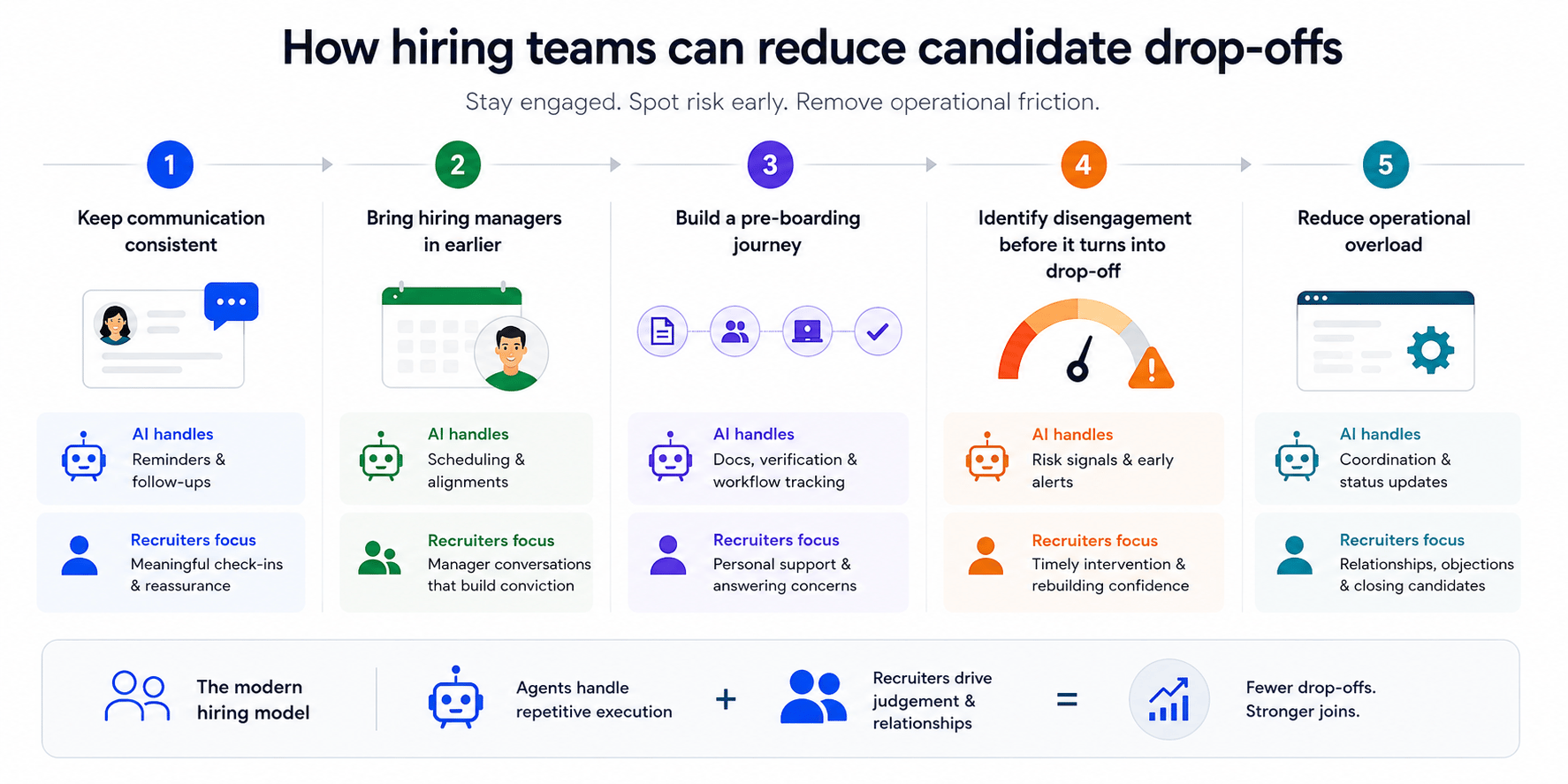
Candidate drop-offs will not disappear completely, especially in competitive hiring markets. But strong hiring teams reduce them by staying engaged during the notice period and identifying disengagement before it turns into a rejection.
That matters even more today because recruiters are handling far more coordination work than before. Generative AI has made creating resumes easier and faster, which means recruiters now deal with higher application volumes, similar-looking resumes, and longer follow-up cycles. As operational work increases, candidate engagement often suffers first.
This is where agentic AI changes the status quo. Instead of replacing recruiters, it handles repetitive coordination tasks so recruiters can focus on judgement, trust-building, and closing candidates successfully.
Keep communication consistent during the notice period
Candidates should not feel forgotten after signing the offer letter.
Structured touchpoints during the notice period create reassurance. Updates about onboarding timelines, team introductions, or even short check-ins help candidates stay emotionally connected to the role.
The challenge is consistency at scale. Recruiters often get pulled into new openings and urgent hiring demands. Agentic AI systems can help recruiters with interview management by coordinating schedules, managing follow-ups, and keeping stakeholders aligned. And recruiters get some breathing room to focus on complex tasks or where they need to step in for nuanced conversations with candidates.
The three touchpoints that reduce most dropout risk:
- Week 2: Call from the hiring manager not the recruiter covering responsibilities, projects, and career growth
- Week 4: Introduction to a peer on the team ,a message or brief call that makes the new organization feel real
- Week 6: Recruiter check-in specifically asking whether there are any concerns about the move
Bring hiring managers into the process earlier
Candidates trust hiring managers differently than recruiters. They associate them directly with growth, team culture, and the quality of work they will actually do.
A short conversation after offer acceptance can strengthen commitment significantly. Discussions around responsibilities, upcoming projects, or career growth make the opportunity feel tangible instead of theoretical.
AI supports this process operationally. Agentic systems can maintain continuity by handling reminders, nudges, and routine follow-ups automatically, allowing hiring managers to spend their time where it matters most, building conviction with the candidate.
Build a pre-boarding journey, not just an onboarding checklist
Many companies reduce pre-boarding to paperwork, compliance forms, and documentation requests. Candidates quickly stop feeling excited and start feeling processed.
Managing all of this manually becomes difficult when recruiters handle multiple open roles at once. This is where agentic AI supports recruiters in a more practical way. Agents can take over repetitive onboarding formalities like document collection, background verification, and workflow tracking in the background.
That gives recruiters more time for the moments that actually shape candidate confidence. Instead of chasing forms, recruiters can focus on thoughtful check-ins, answering concerns, and stepping in personally when candidates seem disengaged or stuck during the process.
Identify disengagement before the candidate drops out
Candidates rarely disappear without signals.
Response delays, incomplete tasks, reduced engagement, or sudden changes in communication patterns often appear weeks before the actual withdrawal. Recruiters usually notice these signals too late because they are buried under operational work.
Early warning signals to watch for:
- Responses to onboarding communication slow from 24 hours to several days
- Pre-joining tasks remain incomplete past agreed deadlines
- Enthusiasm in check-in conversations drops noticeably
- Sudden unavailability for scheduled calls or introductions
AI surfaces these risk patterns early. Recruiters gain visibility into which candidates may need intervention, reassurance, or manager involvement before disengagement becomes irreversible. The technology handles pattern detection. Recruiters handle the recovery conversation.
Reduce operational overload on recruiters
When operational tasks pile up, relationship-building is usually the first thing to slip. Agentic AI shifts recruiters from administrative tasks back to high-touch candidate engagement.
Agents can manage background tasks like scheduling interviews, onboarding workflows, candidate fraud checks, or flagging candidate engagement trends proactively.
With repetitive work off their plate, recruiters leverage their bandwidth for work that actually moves the needle: building relationships, handling objections, providing assurance, and keeping candidates committed through the final stage of hiring.
The candidate withdrawal risk by notice period stage
| Notice Period Stage | Candidate Mindset | Primary Withdrawal Risk | Recommended Hiring Team Action |
|---|---|---|---|
|
Week 1 to 4 (Early Stage) |
Processing resignation, informing their team, managing handovers | Low to Moderate Social pressure from current colleagues begins | Send formal offer confirmation, share onboarding timeline, and execute a peer intro |
|
Week 5 to 10 (Peak Risk Stage) |
Re-evaluating decision, counteroffers land, competing recruiters reach out | High to Highest Candidate drop-offs are heavily concentrated in this window | Schedule recruiter/hiring manager check-ins to address concerns; trigger AI intervention if engagement drops |
|
Week 11-12 (Final Transition) |
Mentally preparing for Day 1 and finalizing exit logistics | Low, Late-stage withdrawal is rare | Share first-week plan, confirm Day 1 logistics, and send final joining confirmation |
The joining ratio metric you should be tracking
Most ATS systems mark a role as filled at offer acceptance. The joining ratio tells a different story.
Joining ratio = (Candidates who joined on Day 1 / Offers accepted) x 100
A joining ratio below 80% means more than 1 in 5 accepted offers are not converting to hires. Every sunk recruiting cost sourcing, screening, interviewing, offering repeats for each lost candidate.
In Indian enterprise professional services, tracking joining ratio by:
- Seniority level -mid-to-senior dropout typically happens in weeks 6 to 10, not week 1
- Sourcing channel -referred candidates consistently join at higher rates than job board applicants
- Hiring manager -managers who engage candidates during the notice period show measurably better joining ratios than those who do not
The joining ratio is the metric that makes the business case for pre-boarding investment. When the cost of a single late stage dropout recruiter time, panel hours, project delay is calculated and made visible, the conversation changes from "should we invest in post-offer engagement" to "how do we do it at scale."
Stop candidate drop-offs before day one
Hiring today is far more complex than it was a few years ago. Recruiters juggle dozens of operational tasks across multiple open roles, all while being expected to maintain high candidate experience, move quickly, and protect hiring quality.
Most of the candidate withdrawal problem is not caused by poor recruiter judgment. It is caused by the operational load that prevents recruiters from staying present during long notice period.
That is where RippleHire comes in. It is designed as one platform where recruiters and AI agents work together, each owning the part of hiring they do best. Agents handle the coordination while recruiters focus on candidate relationship.
Create a hiring system where recruiters and agents work togetherHiring today is far more complex than it was a few years ago.
- AI Profile Recommendation Engine Identifies disengagement patterns and flags at-risk candidates early so recruiters can step in before receiving a withdrawal email.
- Omnichannel communication automation Schedules automated touchpoints over WhatsApp, SMS, and email to maintain momentum throughout the notice period.
- Interviewer Copilots and voice agents: Automate initial screenings and interview scheduling so recruiters spend less time playing phone tag and more time building trust.
- Proactive fraud and risk management: Scans for credential anomalies early, ensuring recruiters focus their effort on verified talent.
- Real-time predictive analytics: Highlights pipeline bottlenecks, giving talent leaders the insights needed to protect joining ratios at scale.
Book a demo today to see how RippleHire protects your joining ratio.
Frequently Asked Questions
What is the difference between offer rejection rate and candidate withdrawal rate?
Offer rejection rate measures candidates who decline an offer immediately during negotiations. Candidate withdrawal rate measures candidates who formally accept an offer but drop out later during the pre-boarding or notice period stage before their official start date.
How do you measure candidate drop-off rate across the hiring funnel?
Candidate drop-off rate is calculated per stage using this simple formula:
Candidate Drop-Off Rate = (Candidates Who Withdraw During Stage / Candidates Who Started Stage) × 100
For example, if 20 candidates accept job offers and 4 withdraw before Day 1, your post-offer drop-off rate is: (4 ÷ 20) × 100 = 20%
Tracking this metric from application to Day 1 helps recruiters pinpoint whether disengagement stems from slow response times, long notice periods, or poor pre-boarding communication.
Does automating candidate communication during notice period reduce the personal touch?
The opposite is true when done correctly. Automation handles routine coordination scheduling reminders, document follow-ups, and status updates. That frees recruiters to invest time in personal conversations, addressing concerns, and building trust with candidates who need it. The goal is not to replace human interaction but to ensure operational tasks do not consume the bandwidth recruiters need for relationship-driven engagement during the notice period.
What is the main reason candidates withdraw after accepting a job offer?
The primary driver of post-offer withdrawal is counteroffers combined with radio silence from the hiring team. When candidates enter a 30 to 90-day notice period with zero engagement, counteroffers from their current employer feel lower-risk than stepping into an unfamiliar environment.
How does AI help prevent candidates from dropping off during the notice period?
Agentic AI monitors candidate interaction signals (such as delayed form completion or missed check-ins) to flag early disengagement risks. It automates operational follow-ups over WhatsApp and email, freeing recruiters to intervene personally before a candidate sends a withdrawal email.