
.svg) Product
Product


.png)





Table of content
The decision to buy or keep an applicant tracking system almost always gets made inside talent acquisition. TA evaluates the demos, scores the features, and signs off on the renewal. The cost, though, does not stay inside TA. It travels downstream and shows up months later as higher headcount in recruiting, longer vacancies in revenue-generating roles, and compliance gaps that appear only when a regulator or a former employee comes asking. By the time the number is visible, it sits on a finance report with no obvious link back to the software that caused it. That disconnect is why the true cost of a bad ATS is so consistently underestimated, and why the license fee on the invoice is usually the smallest part of the bill.
Consider one signal of how fragile the modern hiring funnel has become. A Gartner survey of nearly 3,500 candidates in 2023 found that half of them accepted a job offer over a twelve-month period and then backed out before their start date (Gartner). Every one of those reversals restarts a process that already consumed recruiter hours, hiring manager time, and budget. A good system absorbs that shock. Weak ones pass the full cost downstream, where finance pays for it without ever seeing the cause.
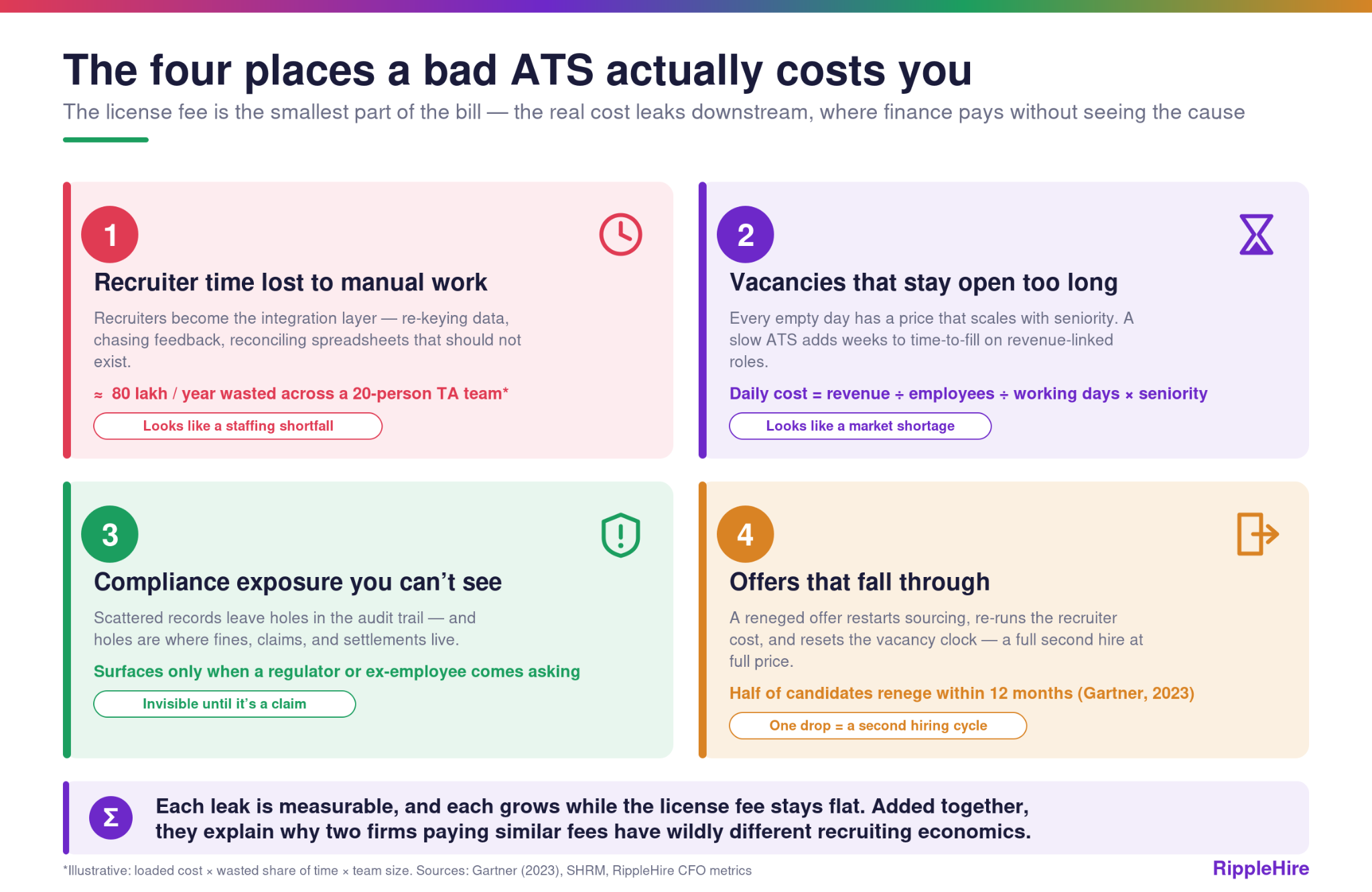
The four places a bad ATS actually costs you
A recruiter working around a clunky workflow looks like a capacity problem, so the answer becomes another hire. When a role stays open too long, it looks like a market shortage, so the business absorbs the lost output. Neither gets traced back to the tool.
For a CFO, this is the core issue. Spending you can see is easy to govern, while spending that arrives disguised as something else is almost impossible to control. The ATS line item is visible and small. Its downstream costs are large and scattered across recruiter salaries, business unit P&Ls, and legal reserves. To manage the real number, you first have to assemble it from the places it hides.
A useful way to size the problem is to break it into the four categories where the money leaks. Each one is measurable, and each one grows quietly while the headline software cost stays flat. Read together, they explain why two companies paying similar license fees can have wildly different recruiting economics.
1. Recruiter time lost to manual work
When a system does not move information cleanly between stages, recruiters become the integration layer. They re-key candidate data, chase interviewers for feedback, format reports by hand, and reconcile statuses across spreadsheets that should never have existed.
Put a number on it with a loaded cost rather than a salary. Take a recruiter whose fully loaded annual cost is around 12 lakh. If a third of the working week goes to coordination the platform should handle, that is roughly 4 lakh per recruiter per year spent on motion instead of hiring. Scale it across a twenty-person TA team and the figure approaches 80 lakh a year, none of which appears on the ATS invoice. The numbers above are illustrative, but the structure holds at any enterprise: multiply loaded cost by wasted share of time, then by team size.
What makes this cost treacherous is that it looks like a staffing shortfall. So the organization hires another recruiter to keep up, which raises the loaded cost base again and hides the original inefficiency one layer deeper.
2. The cost of a vacancy that stays open too long
Every day a role sits empty has a price, and it scales with seniority. RippleHire's CFO metrics framework expresses it cleanly:
Daily cost of vacancy = (annual revenue / number of employees / working days) × role seniority multiplier
Apply that to a senior position in a bank or an IT services firm. A revenue-linked role at a company like Axis Bank or LTIMindtree carries a daily vacancy cost well above the average, because its seniority multiplier is high and the output it would generate is real. If a slow ATS adds even three extra weeks to time-to-fill on that role, the lost contribution runs into several lakh before anyone has been hired. SHRM's benchmarking puts the average cost-per-hire at roughly 4,700 dollars, with executive and senior roles running several times higher (SHRM). That figure only counts the cost of filling the seat, not the value lost while it stays empty.
Junior, high-volume hiring carries the same logic in a different shape. One delayed offer in a campus or frontline drive matters little on its own, yet across thousands of seats the aggregate drag becomes a line finance can feel.
3. Compliance exposure you cannot see until it becomes a claim
Regulated employers carry an obligation that a weak ATS quietly undermines: the ability to prove how every hiring decision was made. When records live in scattered emails and disconnected tools, the audit trail has holes, and holes are where exposure lives.
Two scenarios make the cost concrete:
- A missing audit trail during a regulatory review. A BFSI employer facing a diversity or fair-hiring inquiry needs a complete, tamper-proof record of who was screened, scored, and rejected, and why. If the system cannot produce it, the cost is not just a fine but the management time and reputational drag of the investigation itself.
- A wrongful termination or discrimination claim. When a rejected or exited candidate challenges a decision, the defense rests on documentation. A consistent, time-stamped record of evidence-based decisions is what makes the case defensible. Its absence is what makes settlement the cheaper option.
Neither cost appears in any recruiting budget. Both land in legal reserves and management distraction, and both trace directly back to whether the hiring system kept a clean record.
4. Offers that fall through and the rehiring bill
An accepted offer is not a closed hire. As the Gartner data shows, candidate commitment has weakened across the market, and a process that handles offers poorly loses more of them. Nearly nine in ten candidates told Gartner they had abandoned a hiring process over a mismatch between what they wanted and what the employer offered, from compensation to flexibility to career pathing (Gartner).
Each drop forces a restart, and the restart is rarely cheap. The role goes back to sourcing, the loaded recruiter cost runs again, the vacancy clock resets, and the seniority-weighted cost of an empty seat keeps accruing. A system that gives recruiters no visibility into candidate engagement after the offer, no structured way to keep warm candidates close, turns a single reneged offer into a full second hiring cycle billed at full price.
Recruitment debt is the reason costs compound
Looked at individually, each of the four costs is manageable. Taken together, they behave like debt. Small inefficiencies you choose not to fix accrue interest, and the longer the wrong system stays in place, the more the organization pays just to service what it already owes.
Recruitment debt builds the same way technical debt does. A workaround that saves a week now creates a recurring tax later, because every new requisition runs through the same broken stage and every new recruiter learns the same manual habits. Switching cost gets used as the reason to wait, yet the ATS switching cost is a one-time, quantifiable number, while the cost of staying compounds every quarter. The honest comparison is not "migration is expensive." It is "migration is expensive once, and the current system is expensive forever." Framed that way, recruitment software ROI stops being a feature debate and becomes a question of how long finance is willing to keep paying interest on a decision TA made years ago.
How to put the real number in front of finance
Naming the problem is only useful if you can present it in terms the CFO already governs. That means converting scattered, disguised costs into a single figure built from numbers the business already trusts. The goal is not a louder argument but a defensible one.
Build the case in four moves:
- Start with loaded cost, not salary. Anchor recruiter-time waste to fully loaded cost per recruiter, then multiply by the share of time lost and the size of the team. Finance recognizes loaded cost instantly.
- Attach a vacancy cost to your top revenue roles. Use the cost-of-vacancy formula on your ten most senior open roles and show the daily figure. A daily number makes delay feel expensive in a way that "time-to-fill" never does.
- Quantify the compliance tail as risk, not certainty. Express exposure as the cost of one failed audit plus one contested termination, weighted by how often each realistically occurs. CFOs price risk for a living, so give them a risk number.
- Treat switching cost as a one-time line against a recurring one. Put the ATS switching cost on one side and the annualized cost of the four leaks on the other. The comparison usually makes itself.
Present these as one consolidated figure, not four anecdotes. When the hidden costs of an ATS across an enterprise are added into a single, sourced number, the conversation shifts from "the recruiting tool works fine" to "we are funding a problem we never priced." That is the moment the decision moves from TA preference to financial governance.
Close the four cost leaks with recruiters and agents on one platform
Enterprises that hire heavily all year round already run on it. Axis Bank, LTIMindtree, Tata Steel, Mphasis, and UST use RippleHire across their hiring funnels, and the platform processed 86 million candidate applications across 50+ countries in the last year alone, at a pace of roughly one hire every four minutes. Some of these are partnerships spanning eight years or more, with customers citing reduced time-to-fill and improved joining ratios.
RippleHire addresses the four cost categories directly:
- A skill-intelligent ATS with AI agents that handle coordination across demand, sourcing, screening, and scheduling, so recruiter time goes to hiring instead of manual work.
- Post-offer engagement that flags early drop-off signals and predicts likelihood to join, so fewer accepted offers turn into expensive restarts.
- Built-in fraud detection that catches candidate impersonation, fake university or employer claims, and rehire risks at the point of origin.
- Compliance management that follows multi-country hiring rules on autopilot and keeps an audit trail for every activity, backed by explainable AI that auditors will accept.
- Reporting and analytics that show what is working, what is not, and where hiring gets stuck, so problems surface before they scatter into other budgets.
Together these turn four hidden costs into one connected, visible system instead of four problems managed in isolation, which is what makes the real cost of a bad ATS controllable rather than invisible. Book a demo to see how RippleHire surfaces the full cost of your current ATS and closes all four leaks on a single platform where your recruiters and AI agents work as one team.
Frequently asked questions
What is the true cost of an applicant tracking system beyond the license fee?
The license fee is only the visible part. The larger cost comes from recruiter hours lost to manual work, revenue lost while senior roles stay open, compliance gaps that surface as fines or claims, and accepted offers that fall through and force a rehire. These costs land outside the recruiting budget, which is why they often go unmeasured until finance adds them up.
How do you calculate the cost of an unfilled position?
Divide annual revenue by the number of employees, then by working days in the year, to get a daily revenue figure per employee. Multiply that by a seniority factor, since senior roles generate more, and then by the number of days the role stays open. The result is a defensible daily cost of vacancy that makes hiring delays feel as expensive as they actually are.
Why does a recruiting tool decision become a finance problem?
Talent acquisition usually selects the system, but the consequences travel into areas finance owns: recruiter headcount, business unit output, and legal reserves. Because these costs arrive disguised as staffing shortfalls or market conditions, they rarely get traced back to the software. Finance ends up funding a problem it did not choose and cannot easily see.
Is the switching cost of changing recruitment software worth it?
Switching cost is real, but it is a one-time, measurable number. The cost of keeping a weak system is recurring and compounds every quarter through wasted time, longer vacancies, and growing risk. Weighed honestly, one migration expense sits against years of accumulated inefficiency, which usually favors the change once both numbers are on the table.
How can HR justify recruitment software ROI to a CFO?
Translate hiring problems into figures finance already trusts. Anchor recruiter waste to fully loaded cost, attach a daily vacancy cost to your top revenue roles, express compliance exposure as weighted risk, and set the one-time switching cost against the recurring cost of staying. Presented as a single consolidated number rather than separate complaints, the return becomes a governance decision instead of a feature debate.