

.svg) Product
Product


.png)





Table of content
For IT services firms, the upcoming implementation of India's four new Labour Codes represents a fundamental shift in business operations, not merely a legal update. If you manage 24/7 global delivery, complex bench-to-bill ratios, or high-volume attrition, the current operating model will likely require a complete overhaul to remain compliant.
While practical compliance will ultimately depend on the specific Rules notified by Central or State governments and their enforcement timelines, the operational direction for 2026 is clear. This blueprint outlines the critical changes across wages, industrial relations, safety, and social security that delivery heads and HR leaders must prepare for now.
The Wage Code: Financial Engineering in the 50% Era
Under previous regulations, many IT firms sought to minimize statutory outflows—such as Provident Fund (PF)—by maintaining "Basic Salary" at roughly 20% to 35% of the Total Cost to Company (CTC).
This strategy is no longer sustainable.
The "Deeming" Provision
While the law does not explicitly mandate that Basic Salary must be 50% of CTC, the new definition of "wages" strictly limits the proportion of total remuneration that can be allocated to "excluded allowances".
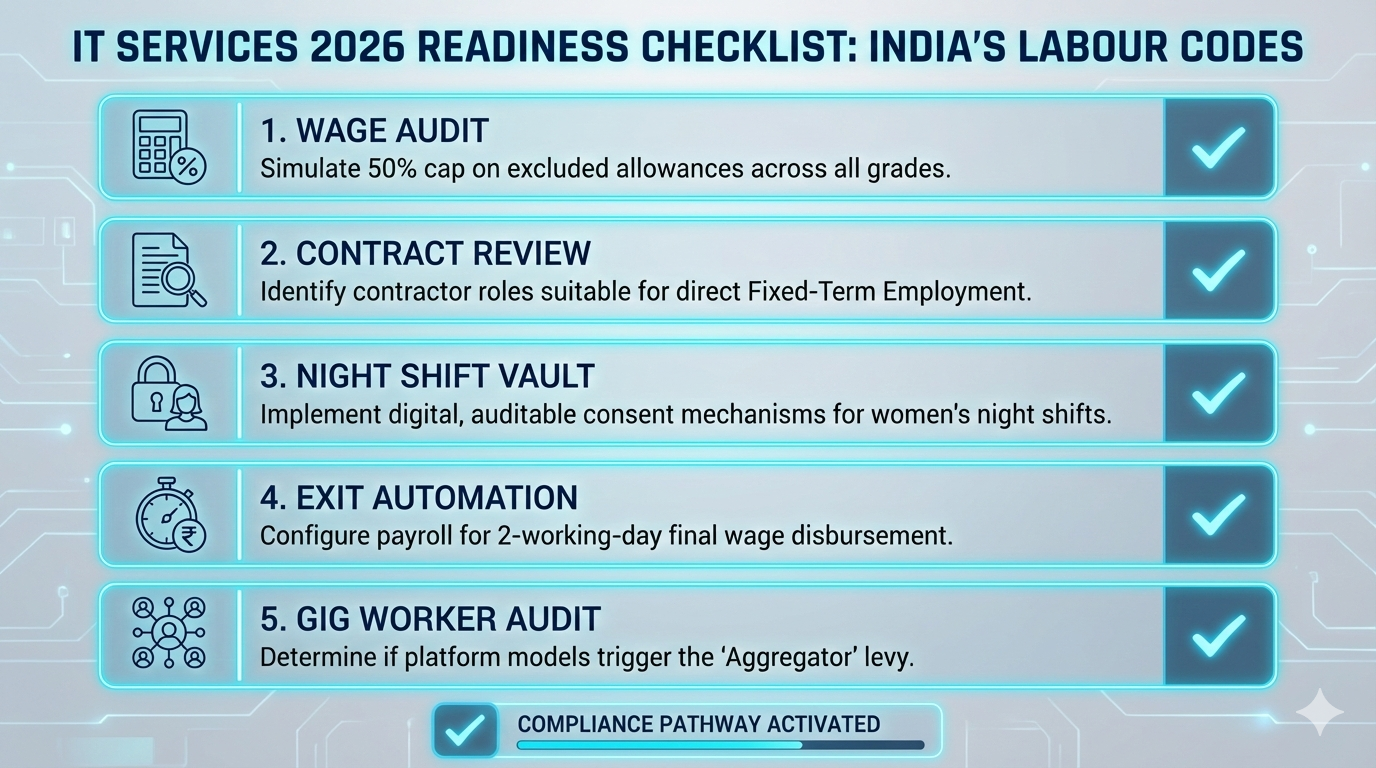
The Code establishes a practical floor for wages through a "deeming" provision. It caps excluded components (like House Rent Allowance or Conveyance) at 50% of total remuneration.
Here is the simplified rule mechanic: If (Total Remuneration - Excluded Allowances) is less than 50% of Total Remuneration, the excess number of excluded allowances is legally "deemed to be wages".
The Financial Impact on IT Operations
When allowances exceed the cap and are reclassified as wages, the base used for statutory calculations expands. This directly impacts:
Provident Fund (PF) contribution basis (depending on applicable rules and PF wage interpretation).
Gratuity computation base.
Leave encashment and other wage-linked payouts.
For a firm with 100,000 employees, even a marginal increase in the statutory cost base creates a multi-crore impact. Consequently, running a financial simulation of wage structures across all employee grades is a critical requirement for 2026.
Overtime (OT) at 2x Rate
IT service delivery frequently necessitates extended hours during critical project phases. Under the new regime, overtime is strictly payable at twice the normal wage rate.
This creates a new layer of complexity because overtime limits are defined by specific Central or State Rules. Firms can no longer rely on a standardized national figure for overtime caps. Instead, you must configure rule-based guardrails specific to each location and legal entity.
The Risk: Unmanaged utilization during delivery peaks now creates direct compliance liability. Enforcement is shifting from manual inspections to system-led, risk-based digital mechanisms, making violations easier to detect.
Industrial Relations: Fixed Term Employment
Industrial Relations – Fixed-Term Employment (FTE)
Industrial Relations – Fixed-Term Employment (FTE)
The Industrial Relations Code formalizes Fixed-Term Employment (FTE) as a statutory engagement model. For IT services, this establishes a clear legal mechanism to build a flexible workforce, allowing firms to align headcount with project lifecycles while maintaining regulatory compliance.
A New Model for Project Staffing
IT firms can now hire talent directly on Fixed-Term Employment for defined durations—for example, a 2-year SAP implementation—rather than relying heavily on high-margin staffing agencies. This reduces overdependence on vendors.
Statutory Parity and Gratuity
To prevent exploitation, the Code mandates that FTEs must receive the same wages and social security benefits as permanent employees performing similar work.
However, there is a major operational lever for talent acquisition: The Gratuity Advantage. FTE employees are eligible for pro-rata gratuity after just one year of service, unlike the conventional five-year requirement for permanent employees. This provision makes fixed-term roles significantly more attractive for high-skill lateral talent, giving firms a compliant "project staffing model".
Easing Restructuring Constraints
The statutory threshold requiring prior government permission for layoffs, retrenchment, or closure has increased to 300 workers. This provision removes regulatory bottlenecks for IT firms restructuring business units, simplifying the process for resizing delivery teams and consolidating functions.
The OSH Code: Safety Standards for the 24/7 GCC Model
The Occupational Safety, Health and Working Conditions (OSH) Code establishes the regulatory standards for Global Capability Centers (GCCs) and delivery hubs running 24/7 schedules.
Women in Night Shifts: Consent and Protocol
Women are legally permitted to work night shifts (typically 7 PM to 6 AM), but this is contingent upon strict adherence to safety mandates. For firms managing night-shift delivery, safety protocols must be integrated directly into policy, HR workflows, and vendor contracts.
Key operational requirements include:
Written Consent: This must be obtained in the prescribed manner. Many firms operationalize this through periodic refresh cycles.
Adequate Security: Mandatory security provisions at the workplace.
Safe Transportation: Arrangements for a secure commute, including lighting and security during the trip.
Workforce Wellness and Creche Facilities
The OSH framework pushes employers toward proactive workforce wellness.
Health Check-ups: Draft rules indicate a requirement for free annual health examinations for employees above the age of 40. For an aging IT workforce, particularly in middle management, this becomes a new budget line item to include in 2026 wellness plans.
Creche Obligations: Establishments with 50 or more employees must provide creche facilities. Draft rules further indicate that employers may be required to provide a "creche allowance" where physical facilities are unavailable, necessitating specific budget allocations.
Social Security and the "Gig" Developer
The Social Security Code introduces a classification for specific digital intermediaries known as "Aggregators". This regulation directly impacts IT firms that source gig developers or freelancers through platform-based models.
The Aggregator Contribution
Firms utilizing platform models to source gig talent face a statutory levy. The Code mandates a contribution of 1-2% of annual turnover (specific to the platform operations) to the Social Security Fund.
The Cap: This contribution is capped at 8% of the total amount paid or payable to gig and platform workers.
Action Item: Procurement teams must audit vendor contracts to determine if current engagements trigger this Aggregator classification. If confirmed, finance workflows must immediately factor this levy into cost projections to prevent unexpected margin erosion.
Exit Management: The Two-Working-Day Rule
Perhaps the most operationally demanding change for high-attrition sectors is the timeline for exit payments. The Code introduces a strict rule: Final wages must be disbursed within two working days of resignation, dismissal, or removal.
Distinguishing Wages from F&F
It is critical to distinguish "Wages" from the full "Full & Final" (F&F) settlement. This requirement applies specifically to 'wages' as defined by the Code.
Wages: Must be paid in 2 working days.
Settlement Components: Items like gratuity, reimbursements, and variable pay remain subject to their own respective statutory schedules and internal policies.
Operational Impact: For IT firms managing high attrition volumes, this timeline invalidates manual clearance processes. Compliance demands an automated Exit-to-Payroll workflow capable of decoupling immediate wage disbursement from the broader, often slower, asset recovery and clearance cycle.
The 2026 Readiness Checklist
To transition effectively, organizations must treat regulatory adherence as an operational asset rather than just a legal obligation. Integrating these codes into your operating model will secure optimized wage structures and verified workforce elasticity.
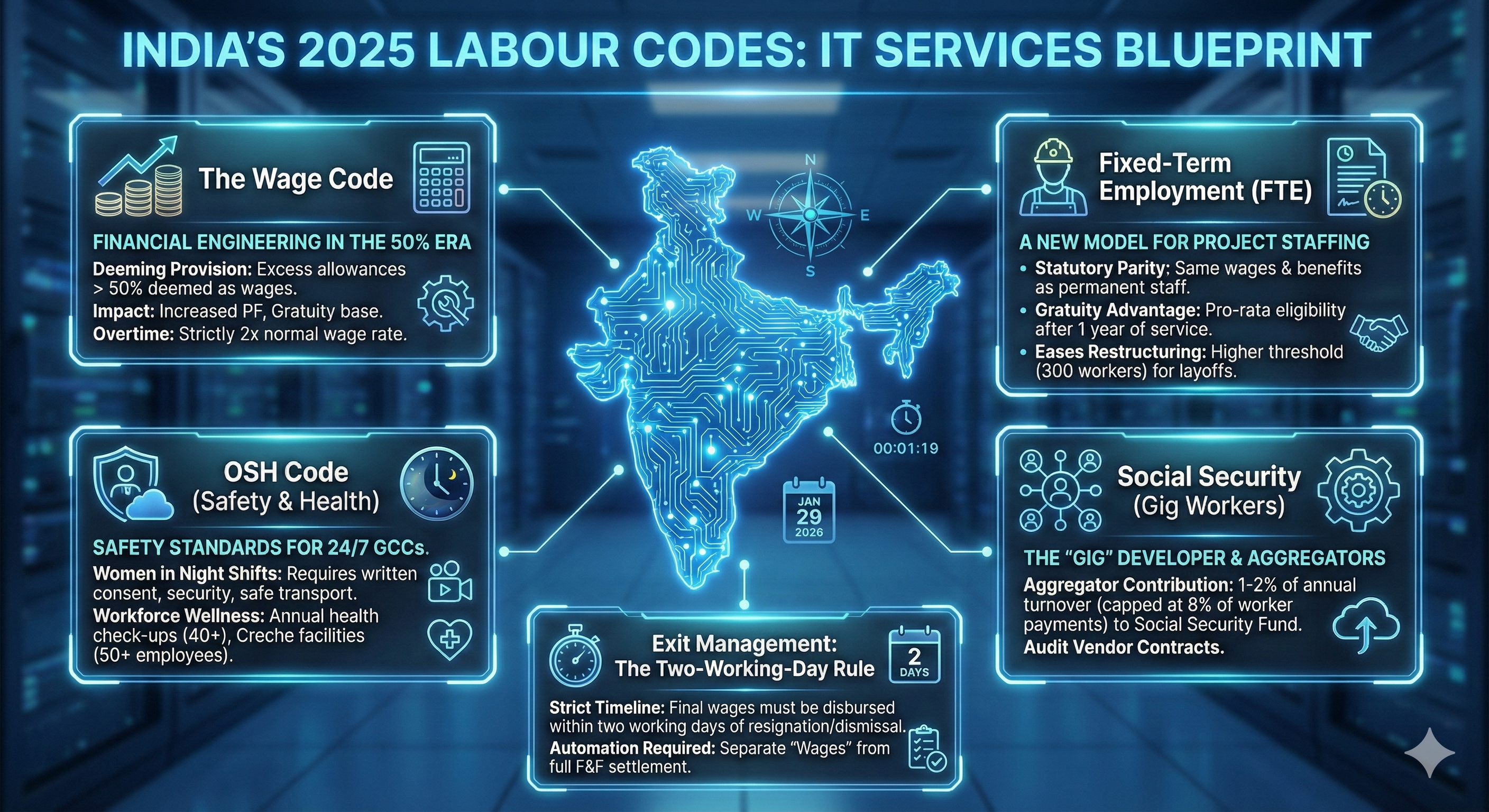
Use the following checklist to assess your readiness:
| Regulatory Area | Action Item for 2026 |
| Wage Audit |
Simulate the "50% cap on excluded components" rule across all grades. Adjust Special Allowances to prevent "Deemed Wage" spikes.
|
| Contract Review |
Review all Contractor agreements. Identify roles suitable for conversion to Direct FTE to potentially save 15%+ on vendor fees.
|
| Digital Onboarding |
Automate Appointment Letter issuance on Day 1, which is a statutory requirement for all employees.
|
| Night Shift Vault |
Implement a digital vault for Women's Night Shift consent documentation, managed as per prescribed rules and internal refresh cycles.
|
| UAN Hygiene |
Enforce Universal Account Number (UAN) validation at the Offer stage to ensure seamless Day-1 PF compliance.
|
| Exit Automation |
Set up a fast-track payroll trigger for 2-working-day final wage payments and automate downstream settlement components as per policy.
|
| Health & Wellness |
Identify employees aged 40+ and partner with diagnostic centers for mandatory annual check-ups.
|
| Overtime Tracker |
Configure HRIS to flag overtime consumption against rule-prescribed caps by jurisdiction. Set internal warning thresholds (e.g., at 70-80% of the cap) to prevent accidental breaches.
|
FAQs
1. How does the 2025 Wage Code’s "50% cap" affect IT salary structures?
The new Code on Wages introduces a "deeming" provision that fundamentally changes how salary structures are engineered. It caps "excluded allowances" (such as HRA or conveyance) at 50% of total remuneration. If your salary structure weights these exclusions above 50%, the excess amount is legally reclassified as "wages". This reclassification expands the base for statutory costs like Provident Fund (PF) and gratuity, potentially increasing the financial burden for IT firms. Financial simulation across all employee grades is recommended to manage this impact.
2. What are the new overtime payment rules for IT delivery operations?
Under the new regime, overtime is strictly payable at twice the normal wage rate. Unlike previous standardized national figures, overtime caps will now be defined by specific Central or State rules, meaning thresholds may vary by jurisdiction. For IT firms running 24/7 operations, this requires precise rule-based guardrails within HRIS systems to track utilization against location-specific limits and avoid compliance liability.
3. Can IT companies hire Fixed-Term Employees (FTEs) for specific projects?
Yes, the Industrial Relations Code formalizes Fixed-Term Employment (FTE) as a statutory engagement model, allowing IT firms to hire talent directly for defined project durations (e.g., a 2-year implementation). While FTEs must receive the same wages and benefits as permanent employees, they are eligible for pro-rata gratuity after just one year of service, rather than the conventional five years. This makes the model highly attractive for hiring lateral talent while reducing dependence on staffing agencies.
4. What is the "two-working-day" rule for employee exits?
The Code on Wages mandates that final "wages" must be disbursed within two working days of an employee's resignation, dismissal, or removal. It is important to distinguish this from the full "Full & Final" (F&F) settlement; the rule applies specifically to statutory wages, while components like variable pay or reimbursements may follow their own schedules. For high-attrition IT environments, this requires an automated Exit-to-Payroll workflow to ensure compliance without waiting for asset clearance.
5. What are the compliance requirements for women working night shifts in GCCs?
Women are legally permitted to work night shifts (typically 7 PM to 6 AM), provided the employer strictly adheres to safety mandates. Key operational requirements include obtaining written consent in a prescribed manner, ensuring adequate security at the workplace, and providing safe, secure transportation for the commute. These safety protocols must be integrated directly into HR workflows and vendor contracts.
6. How does the Social Security Code impact IT firms using gig workers?
The Social Security Code classifies platform-based intermediaries as "Aggregators," mandating a statutory contribution for those using gig talent. Aggregators must contribute 1-2% of their annual turnover (specific to platform operations) to the Social Security Fund. This contribution is capped at 8% of the total amount paid to gig workers. Procurement teams should audit vendor contracts to check if current engagements trigger this levy.
7. Are annual health check-ups mandatory under the OSH Code?
Yes, the OSH framework includes provisions promoting workforce wellness. Draft rules indicate that employers must provide free annual health examinations for employees above the age of 40. For IT firms with an aging workforce or significant middle management layers, this necessitates a new budget line item for wellness plans and diagnostic partnerships starting in 2026.
8. Has the threshold for retrenchment and layoffs changed for IT firms?
Yes, the statutory threshold requiring prior government permission for layoffs, retrenchment, or closure has been increased to 300 workers (up from 100). This higher threshold removes certain regulatory bottlenecks, simplifying the process for IT firms to resize delivery teams, consolidate functions, or restructure business units.