
.svg) Product
Product

.png)


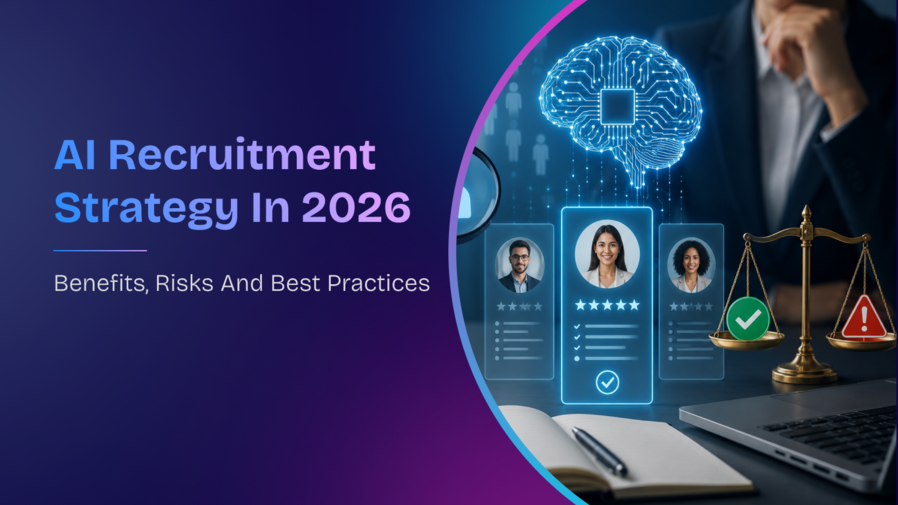


Table of content
How AI Can Change Your Recruitment Strategy in 2025
|
Quick Answer: An AI recruitment strategy is a structured plan for integrating artificial intelligence into hiring workflows, covering which tasks AI automates, where human judgment remains mandatory, how AI decisions are audited, and how performance is measured. The most effective AI recruitment strategies in 2026 treat AI as a decision-support system, not an autonomous hiring authority. |
AI in recruitment is no longer a buzzword. It’s the backbone of modern, efficient, and scalable hiring.
And while Hollywood might’ve made us think AI looks like a humanoid robot stealing jobs, the truth is far more useful (and far less dramatic).
In 2026, AI is helping recruiters' source smarter, screen faster, and engage better. According to Gartner, over 65% of talent acquisition leaders are already using AI tools in some form. But here’s the thing throwing AI into your workflow without understanding what it does (and doesn’t) do? That’s just noise.
Let’s explore how AI can actually change your recruitment strategy and what it takes to do it right.
What is AI in Recruitment?
At its core, AI in hiring refers to intelligent systems that help you make better decisions at speed. Think of tools that can:
-
Parse and rank thousands of resumes in seconds
-
Recommend the best-fit candidates for a role
-
Chat with applicants 24/7 to answer FAQs
-
Predict candidate drop-off or joining likelihood
-
Schedule interviews across time zones in minutes
Beyond task automation, the most significant shift in 2026 is the emergence of agentic AI systems that don't just complete individual tasks but coordinate end-to-end hiring workflows autonomously. It sources candidates, screens them, schedules interviews, generates scorecards, and flags anomalies all within a single workflow, with recruiter oversight at defined checkpoints.
See how agentic AI works in enterprise hiring →
You still make the final call. But AI clears the clutter so you can focus on what matters human judgment and business alignment.
Benefits of AI in Recruitment for Enterprise Teams
Automates the Busywork
AI can screen, shortlist, schedule, follow up, and even nudge hiring panels. What used to take days now happens in hours.
Improves Hiring Quality
AI learns from historical data to recommend candidates who are likely to succeed in the role based on skills, culture fit, and past patterns.
Reduces Bias
AI can reduce unconscious bias by standardizing evaluation criteria and removing irrelevant demographic signals from early screening. But this only holds when training data is clean and human reviewers stay in the loop , bias reduction is a design outcome, not a default feature.
Elevates the Candidate Experience
AI-driven systems provide instant updates, personalized interactions, and faster turnarounds keeping candidates engaged and reducing ghosting.
Cuts Hiring Costs
Faster decisions, fewer dropouts, less manual effort AI reduces the overall cost per hire. Period.
Challenges of AI in Recruitment and How to Address Them
AI sounds magical, but it’s not plug-and-play. You need to be aware of the landmines.
Garbage In, Garbage Out
If your historical data is biased or messy, AI will replicate it. Clean data is a non-negotiable.
Lack of Transparency
Not all AI tools explain why they made a recommendation. That black-box risk can impact trust and compliance.
Change Resistance
Hiring teams might resist switching from gut-based decisions to data-led suggestions. That’s why training and buy-in are critical.
Legal & Ethical Risks
AI use must align with DEI goals, GDPR, EEOC, and other legal standards. Ensure your tools are compliant and audit-friendly.
Overdependence
AI should support not replace your hiring team. Over-reliance can dehumanize the process and dilute employer branding.
AI Recruitment Strategy Best Practices
Here’s how to integrate AI into your hiring workflow the smart way.
Audit Your Hiring Data First
Clean up inconsistencies in job descriptions, feedback forms, and historical resumes before training AI on them.
Start with One Workflow
Don’t try to automate everything at once. Start with sourcing or resume screening and expand.
Train Your Team
Explain what the AI does, how it works, and where human judgment still matters.
Ask for Explainability
Use AI tools that offer transparency into their decision-making logic.
Test for Bias Regularly
Run periodic audits to check if your AI is disproportionately excluding candidates based on gender, race, or background.
Choose the Right Partner
Invest in AI solutions built for recruitment like RippleHire that are enterprise-ready, secure, and built to scale.
Measure AI Performance Quarterly
Track time-to-shortlist, candidate drop-off rates, offer-to-join ratios, and recruiter productivity every quarter.
Set Up Governance Before You Scale
Define What AI Owns vs What Humans Own
Map your hiring workflow and mark every step as either AI-assisted (AI recommends, human decides) or AI-automated (AI completes, human reviews).
Set Up an Audit Trail From Day One
Every AI recommendation, automated decision, and candidate interaction should be logged. This is not just good practice, it's a requirement under GDPR, DPDP, and EEOC frameworks.
The Future of AI in Recruitment
Enterprise hiring teams don't lack AI tools anymore . What most are still missing is a strategy for using them well. The winners won’t be the ones with the flashiest tools. They’ll be the ones that:
-
Balance AI speed with human empathy
-
Make decisions based on real business impact
-
Keep fairness, data privacy, and DEI at the core
AI doesn’t replace your recruiters. It amplifies them.
Where to Start With Your AI Recruitment Strategy
The organizations that get AI recruitment right, don't start with technology they start with clarity.
-
Which hiring problems are worth solving with AI?
-
Which decisions must stay human?
-
Which compliance frameworks apply?
Answer those three questions first, then evaluate the tools. The technology is ready. The strategy is what most teams are still missing.
Future-Proof Your Hiring Strategy with RippleHire
Ready to bring speed, accuracy, and empathy back to your recruitment process? Explore what RippleHire can do for your team.Discover why modern talent acquisition teams trust us to power their hiring workflows without losing the human touch.
Frequently Asked Questions (FAQs)
1. What is AI in recruitment?
An AI recruitment strategy is a structured plan for integrating artificial intelligence into your hiring workflows defining which tasks AI automates, where human judgment remains mandatory, how AI decisions are audited, and how performance is measured.
2. How does AI help in reducing hiring bias?
AI reduces unconscious bias by standardizing evaluation criteria and removing irrelevant demographic signals from early screening stages. However, this only works when the training data is clean, the criteria are objective, and human reviewers remain in the loop. AI trained on historically biased data will replicate that bias at scale bias reduction is a design outcome, not a default feature.
3. Can AI fully replace human recruiters?
No. AI is designed to support and enhance human decision-making, not replace it. Recruiters still play a critical role in assessing cultural fit, building relationships, and making final hiring decisions. The most effective AI recruitment strategies treat AI as decision-support, not an autonomous hiring authority.
4. What are the risks of using AI in hiring?
Key risks include biased training data, lack of transparency in decision-making, legal non-compliance under GDPR, EEOC, and India's DPDP Act, team resistance, and overdependence on automated recommendations. Regular audits, explainable AI tools, and human oversight at every decision checkpoint are essential to managing these risks.
5. What should I look for in an AI recruitment tool?
Look for explainable AI, strong data privacy features, integration with your existing ATS, configurable workflows, bias detection mechanisms, a transparent decision-making process, and a complete audit trail.
6. How can I get started with AI in my hiring process?
Start by identifying one repetitive workflow sourcing or resume screening and clean your historical data before deploying AI on it. Introduce tools gradually, train your hiring team on how the AI works and where human judgment still applies, and measure performance quarterly before expanding to additional workflows.