
.svg) Product
Product

.png)


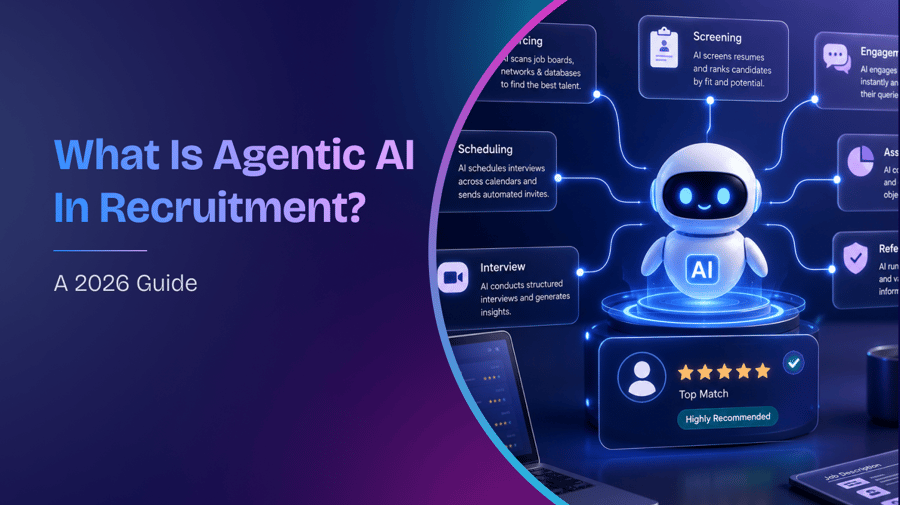


Table of content
For TA leaders at enterprises, the last two years have been a strange mix of pressure and promise. Roles are sitting open longer, candidate pipelines look fuller than ever, and recruiters are buried under applications that all sound suspiciously similar. According to Gartner, fewer than 5% of enterprise applications featured task-specific AI agents in 2025, but that number is projected to reach 40% by the end of 2026. Agentic AI in talent acquisition sits at the heart of this shift, promising to take real work off recruiters' plates rather than just helping them draft another email faster.
This article walks through what agentic AI actually is, how it differs from generative AI, whether it will replace recruiters, and where it fits inside an enterprise hiring funnel. It also covers how RippleHire approaches agentic AI for talent acquisition teams that hire heavily, year-round, across geographies and business units.
Quick Answer: Agentic AI in talent acquisition refers to AI systems that take action inside a hiring workflow screening candidates, scheduling interviews, detecting fraud, and engaging candidates between stages without a recruiter triggering each step manually. It differs from generative AI, which produces content for humans to act on. Agentic AI takes the action itself, with recruiters retaining oversight at defined decision points.
What is Agentic AI?
Agentic AI is best understood as software that does work, not just software that produces output. An agentic AI system can perceive a situation, decide what to do, take action, and learn from the result, all with a clear objective in mind.
Unlike a tool that needs to be opened, prompted, and supervised at each step, an agent is given a goal and a set of permissions, after which it carries out the work end to end. In a hiring context, that might mean filling a role, screening a batch of applicants, or following up with offer-stage candidates without a recruiter triggering each action manually.
The Key Building Blocks
Three things separate an agentic AI system from a regular AI feature:
- Goals. It understands the outcome it is working toward, not just the next task in a workflow.
- Autonomy. It can choose between several possible actions based on context, rather than running a fixed sequence.
- Tool Use. It can call other systems such as your ATS, calendar, communication channels, or assessment platforms to actually get work done.
When these come together inside a recruitment platform, the result is a software agent that can move a candidate from one stage to the next, send communications, schedule interviews, and flag issues for a human to review.
Agentic AI vs Generative AI: What is the Difference?
Generative AI and agentic AI are often used interchangeably in marketing copy, but they describe different things. The distinction matters for TA leaders evaluating tools, because it changes what your team has to do after the AI finishes its bit.
Generative AI is About Content
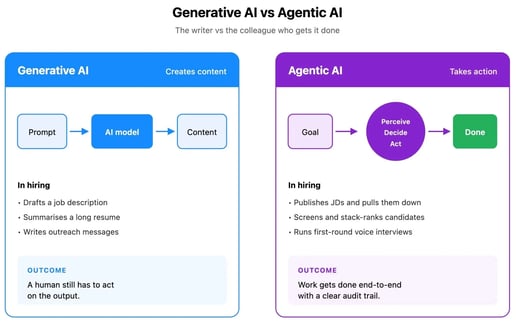
Generative AI creates text, images, code, summaries, and drafts. In a hiring workflow, that usually shows up as a feature that writes a job description from a few bullet points, summarizes a long resume into key highlights, or drafts an outreach message in your tone of voice. The output is content, and a human still has to decide what to do with it.
Agentic AI is About Action
Agentic AI uses generative models as one of its capabilities, but its purpose is different. Rather than producing a draft for you to act on, it takes the action itself. The same agent that drafts a job description can publish it across your career site and job boards, monitor the response, and pause publishing once enough qualified profiles have come in.
Generative AI is the writer, agentic AI is the colleague who writes, sends, follows up, and reports back.
Where they Overlap in Hiring
Generative AI handles the content layer (questions, descriptions, summaries, feedback notes), while agentic AI handles the decision and execution layer (when to act, what to act on, which system to call). A useful platform exposes both, with audit trails so TA teams can see why an agent did what it did.
Will Agentic AI Replace Recruiters?
This is the question that comes up in every TA leadership meeting, and the answer is: no, but the job will look different. Recruiters at large enterprises spend a significant share of their week on coordination work such as scheduling, reminders, status updates, and chasing feedback. Agentic AI fits that layer well.
What agentic AI handles less well is the human judgement that sits at the center of hiring. Deciding whether a senior candidate will get with the leadership team, telling a star candidate why your company is worth joining, navigating a tough negotiation with a counter-offer in play, or persuading a hiring manager to revisit a rejected profile: these are still recruiter skills.
According to Deloitte's 2025 Emerging Technology Trends study, only 11% of organizations currently have agentic AI systems actively in production, with the majority still piloting or exploring use cases. This is not a market where machines have taken over; it is a market that is just learning what to delegate.
In practice, TA teams that adopt agentic AI thoughtfully tend to see the role of the recruiter move up the value chain, from process operator to talent advisor. The work does not disappear, it shifts.
Where Agentic AI Fits in an Enterprise Hiring Funnel
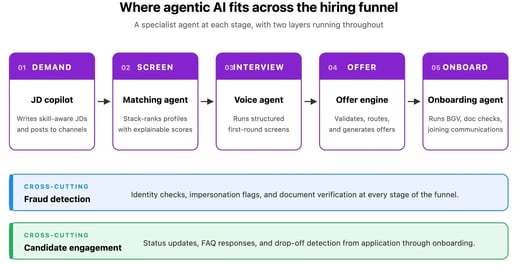
Agentic AI is not a single feature. It shows up at multiple stages of the hiring funnel, and the strongest implementations are the ones where agents work as a team, each focused on a specific outcome. Below are 5 areas where agentic AI is already producing results for enterprise TA teams.
Writing Job Descriptions and Posting Roles
The starting point of every hire is a job description, and it is also the step where most recruiters lose time. An agentic system can take a structured intake from a hiring manager (or pull from past roles) and produce a JD that is skill-tagged, compliant with local labor requirements, and aligned with your employer brand. From there, a publishing agent can decide where to post it, your career site, internal mobility portal, job boards, niche communities, based on the role and the urgency. When the role is filled or paused, the same agent pulls the listing down.
For a BFSI enterprise hiring across 200 branches, that single layer of automation can eliminate hundreds of micro-decisions a recruiter would otherwise make manually each month.
Screening at Scale
Screening is the stage most strained by generative AI on the candidate side. Resumes have become longer, smoother, and harder to differentiate. An agentic screening layer goes further than keyword matching, evaluating candidates on skill depth, role-relevant experience, notice period, location fit, and salary fitment, then stack-ranking them with explainable reasoning. A recruiter no longer needs to read 400 resumes. They can review a ranked shortlist with the reasoning attached.
Conducting First-Level Interviews
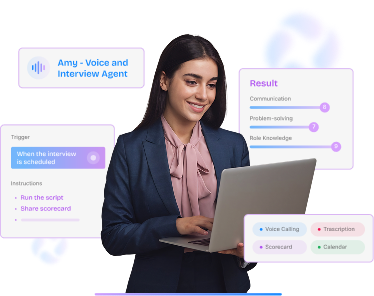
Voice and video agents are now mature enough to handle structured first-round conversations. These agents call candidates, verify intent and basic fitment, conduct a short competency-based assessment, and pass a transcript and score forward. The value is not just speed, although the speed is real. The bigger benefit is consistency: every candidate gets the same structured experience, asked the same kinds of questions, in their preferred language and time slot.
This pattern works particularly well for:
- Volume hiring in retail and BPO operations
- BFSI branch roles
- Entry-level technology positions
- Campus drives with thousands of applicants
Detecting Fraud and Impersonation
Hiring fraud has become a board-level conversation in Indian enterprises, especially in BFSI and IT services. Agentic AI can run continuous checks in the background:
- Cross-verify educational and employment claims against authoritative databases.
- Flag impersonation signals during live or recorded interviews.
- Detect candidates re-applying under altered identities.
- Surface duplicate or recycled answers across assessments.
Because these checks run at source, problems get caught before an offer is rolled out, not after a new joiner has access to customer data.
For enterprise teams in India, these checks also align with DPDP Act requirements around candidate data verification and audit trails. Read our DPDP compliance guide for TA teams for the full regulatory picture.
Engaging Candidates and Reducing Drop-Off
A frequent pain point for TA teams is the silence between stages. Candidates apply, hear nothing for a week, and quietly accept a competing offer. Agentic engagement bots can answer status queries, respond to FAQs about benefits and policies, send timely nudges before an interview, and follow up with offer-accepted candidates to detect drop-off signals early. When the agent senses hesitation (a delayed document submission, a slow reply, a question about working hours), it can escalate to the recruiter while there is still time to intervene.
How RippleHire Enables Agentic AI in Your Hiring Stack
Several platforms now claim agentic AI features. What sets the strongest implementations apart is the foundation. The foundation is the quality of the data the agents are trained on, the structure of the underlying ATS, and the controls available to enterprise teams. RippleHire has built its agentic AI layer with these enterprise realities in mind.
1. Built on a Deep Base of Hiring Data
The RippleHire ATS has processed more than 86 million candidate applications across thousands of positions and 50+ countries in the last year alone. That depth of data shapes how its agents behave: the matching engine, the voice agent, and the interview agent all draw on patterns from real hiring outcomes, not synthetic examples. For BFSI, IT services, and manufacturing organizations that hire across roles and geographies, this means agents arrive with context rather than starting from scratch.
2. Skill-Intelligent Across the Funnel
Skills are the connecting thread for hiring done right. RippleHire's ATS tags skills against every job, candidate, assessment, and interviewer, so its agents can write skill-aware JDs, run skill-mapped assessments, fill feedback forms with skill scoring, and recommend candidates against what actually matters for the role.
3. Story-Aware, Not Stage-Aware
Hiring tools typically treat each interview stage in isolation. RippleHire's agents carry context from the full candidate journey, what was asked in earlier rounds, how the candidate responded, and which skills are still untested. Interviewers do not repeat the same questions across rounds, and evaluation stays anchored in the full picture rather than the last conversation.
4. A No-Code Agent Builder
TA leaders rarely want to wait on engineering teams to build new automations. RippleHire's no-code agent builder lets recruitment operations design custom agents in three steps:
- Choose the action you want automated.
- Set the trigger that should start it.
- Hit deploy.
Whether the use case is moving candidates between stages, assigning tasks, or sending reminders, no engineering ticket is required.
How to Get Started With Agentic AI in Recruitment
For TA leaders thinking about an agentic AI roadmap, the strongest first move is not to deploy everything at once. Pick one stage where your team is losing the most time (often screening or scheduling for high-volume roles), pilot an agent there, and measure the impact in time saved, candidate experience, and quality of hire. Layer on additional agents as confidence grows.
A practical way to think about where to start:
- High volume, structured roles (BPO, branch banking, campus): start with the screening and first-level interview agent. The ROI is immediate and measurable.
- Lateral and niche hiring: start with the sourcing and engagement agent. The value is in the candidate experience layer and drop-off reduction.
- Senior and leadership hiring: start with the interviewer copilot and feedback agent. These roles need human judgment at every step, but consistency in how assessments are documented matters enormously.
Pick one. Measure it. Then expand.
For enterprises that hire at scale, the prize is not just faster hiring, it is hiring that is more consistent, more fair, and more defensible. Agentic AI in talent acquisition will give recruiters back the time and clarity to focus on the parts of hiring that only humans can do well.
Want to see how RippleHire's agentic AI layer works inside a real enterprise hiring workflow?
Book a Demo
FAQs
What is Agentic AI in recruitment?
Agentic AI in recruitment refers to software systems that can pursue hiring goals autonomously taking actions like screening candidates, scheduling interviews, sending communications, and detecting fraud without requiring a recruiter to trigger each step manually. Unlike tools that produce content for humans to act on, agentic AI executes the work itself, with recruiter oversight at defined checkpoints.
How do enterprises measure ROI from agentic AI in hiring?
ROI shows up in a mix of efficiency and quality gains. Look at time-to-hire reduction, the number of roles a single recruiter can handle, candidate experience scores, offer-to-join ratios, and reduction in first-year attrition. Cost per hire is useful, but can be misleading on its own. Strong programs also track the quality of decisions, such as the share of hires meeting performance expectations after six months, since efficiency without quality defeats the purpose.
Is agentic AI safe for regulated industries like BFSI?
Yes, when implemented correctly. Regulated industries should look for platforms with strong governance: explainable decisions, audit trails, configurable approval matrices, encryption, certifications such as ISO 27001 and SOC 2, and the ability to align with local labour and data protection laws. The technology fits well into regulated environments, but the controls around it matter as much as the model itself.
Does agentic AI introduce bias into hiring decisions?
Any AI system can inherit bias from its training data, which is why governance is critical. Ask vendors how their models are trained, whether outcomes are audited for adverse impact, and whether the system explains its reasoning. Good agentic AI platforms allow you to weight criteria, exclude protected attributes, and review outcomes by demographic segment so bias can be detected and corrected, rather than discovered after the fact.
How long does it take to deploy agentic AI for recruitment at an enterprise?
Timelines vary based on scope and the existing tech stack. A single agent layered onto an existing ATS can go live in a few weeks, while a full agentic suite across the hiring funnel typically takes a few months to roll out in phases. Most teams begin with one high-impact use case, validate the results, and then expand. The bottleneck is usually change management and integration design, not the AI technology itself.
What skills should TA teams build to work effectively with agentic AI?
TA professionals should focus on judgement and design skills. That includes designing intake processes that feed agents the right context, interpreting AI-generated insights critically, identifying when human intervention is needed, and building stronger relationships with hiring managers and candidates. Comfort with data, basic prompt design, and a clear understanding of compliance considerations will quickly become standard expectations for senior TA roles.