
.svg) Product
Product

.png)




Table of content
Hiring in banking, financial services, and insurance carries a weight that most industries never feel. Every offer letter sits on top of a regulatory obligation, a fraud risk, and a customer-trust promise, and the systems used to manage that hiring are rarely built for it. An ATS for BFSI has to do far more than move candidates through stages, yet most teams in the sector run on generic platforms that treat a bank the same way they treat a software startup. The cost of that mismatch shows up quietly. According to the Reserve Bank of India's RBI banking report, private sector banks averaged close to 25% employee attrition in FY2024, which means BFSI recruiters are not filling roles once but refilling them constantly, under compliance conditions that never relax.
That combination of high churn, heavy regulation, and zero tolerance for a bad hire is exactly where one-size-fits-all recruitment software starts to crack. This piece breaks down what BFSI hiring genuinely demands, where generic platforms fall short, and how to tell whether a system is actually built for the sector or simply configured to look like it is.
Why BFSI hiring is not like other hiring
BFSI recruitment operates under constraints that simply do not exist for most employers. A wrong hire in a customer-facing banking role can trigger regulatory exposure, financial loss, and reputational damage at the same time. Three pressures make the sector distinct, and each one reshapes what the hiring system has to support.
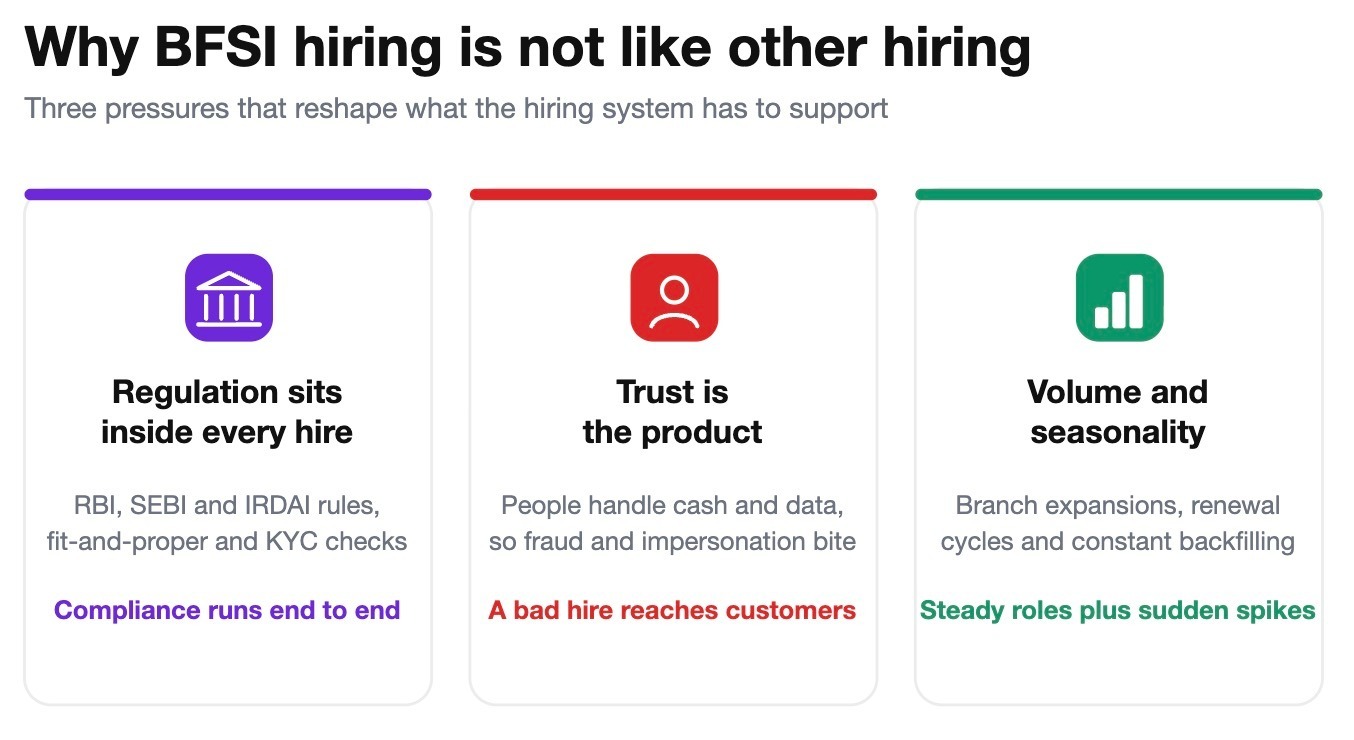
Regulation sits inside every hire
Banks, non-banking financial companies, and insurers answer to the RBI, SEBI, and IRDAI, and those regulators care about who gets hired. Fit-and-proper criteria, KYC-grade identity checks, and role-based eligibility rules apply before a candidate ever reaches the floor. A retail bank hiring a relationship manager has to verify identity, prior employment, and any regulatory flags, then keep proof of that diligence on record. Compliance is not a final gate in BFSI hiring. It runs through the entire process, from sourcing to appointment.
Trust is the product
Financial institutions sell trust, so the people they hire are the product as much as any account or policy. That raises the stakes on credential fraud and impersonation in a way few sectors experience. Consider a candidate applying for a branch role who handles cash and customer data on day one. The institution needs to know the person is exactly who they claim to be, with the qualifications they listed, before access is granted. When verification is weak, the risk does not stay inside HR. It reaches customers.
Volume and seasonality stretch the system
BFSI hiring swings between steady niche roles and sudden frontline surges. A typical pattern includes:
- High-volume branch and sales hiring tied to network expansion
- Seasonal spikes around insurance renewal cycles and quarter-end targets
- Continuous backfilling driven by frontline attrition
- Specialist hiring for risk, compliance, and technology functions
Each of these moves at a different speed and follows a different approval path, so the system managing them has to flex without breaking. A platform tuned for predictable, low-volume corporate hiring will struggle the moment a bank decides to open two hundred branches in a quarter.
Where generic ATS platforms fall short for BFSI
Generic platforms are built for the average customer, and the average customer is not a regulated financial institution. They handle the mechanics of recruitment well enough, yet the sector-specific demands tend to land in the gaps between features. Four shortfalls come up repeatedly when BFSI teams outgrow a general-purpose tool.
Compliance arrives as an afterthought
Most general platforms treat verification and documentation as add-ons that recruiters bolt on manually. That manual layer is precisely where things slip. Background check discrepancies in the BFSI sector rose to 10.4% in FY2023-24, an 18.1% increase over the prior year, according to the AuthBridge 2024 report. When compliance depends on a recruiter remembering to run a check rather than the system enforcing it, error rates climb exactly when hiring volume is highest.
Standard workflows do not map to BFSI approval chains
Approval in a bank rarely follows a straight line. A single hire might need sign-off from the hiring manager, a regional head, a compliance officer, and sometimes a risk committee, with the path changing by role, grade, and location. Generic platforms often force these layered chains into a flat workflow, which leaves recruiters managing approvals over email and spreadsheets. The system meant to speed hiring ends up sitting beside the real process instead of running it.
Audit trails rarely satisfy a regulator
When an auditor asks why a candidate was hired, "the system recommended them" is not an acceptable answer.
Regulators expect institutions to explain and evidence their decisions, including hiring decisions influenced by automation. A generic ATS can log activity, but it seldom captures the reasoning behind a screening score or a rejection in a form an auditor will accept. That gap turns audit season into a manual reconstruction exercise, with recruiters digging through records to prove that a hire followed policy.
Fraud and identity checks stay shallow
General platforms assume the resume is broadly truthful and the applicant is who they say they are. BFSI cannot make that assumption. Impersonation during remote interviews, fabricated employment history, and recycled credentials all surface more often in financial hiring, and a tool without built-in fraud detection pushes that burden onto already stretched recruiters.
What a BFSI-ready ATS actually needs to do
A platform built for the sector treats regulation, trust, and scale as design requirements rather than optional modules. Instead of asking recruiters to compensate for what the software lacks, it absorbs the sector's complexity into the workflow itself. The capabilities below separate a genuine BFSI hiring platform from a generic tool wearing a financial-services label:
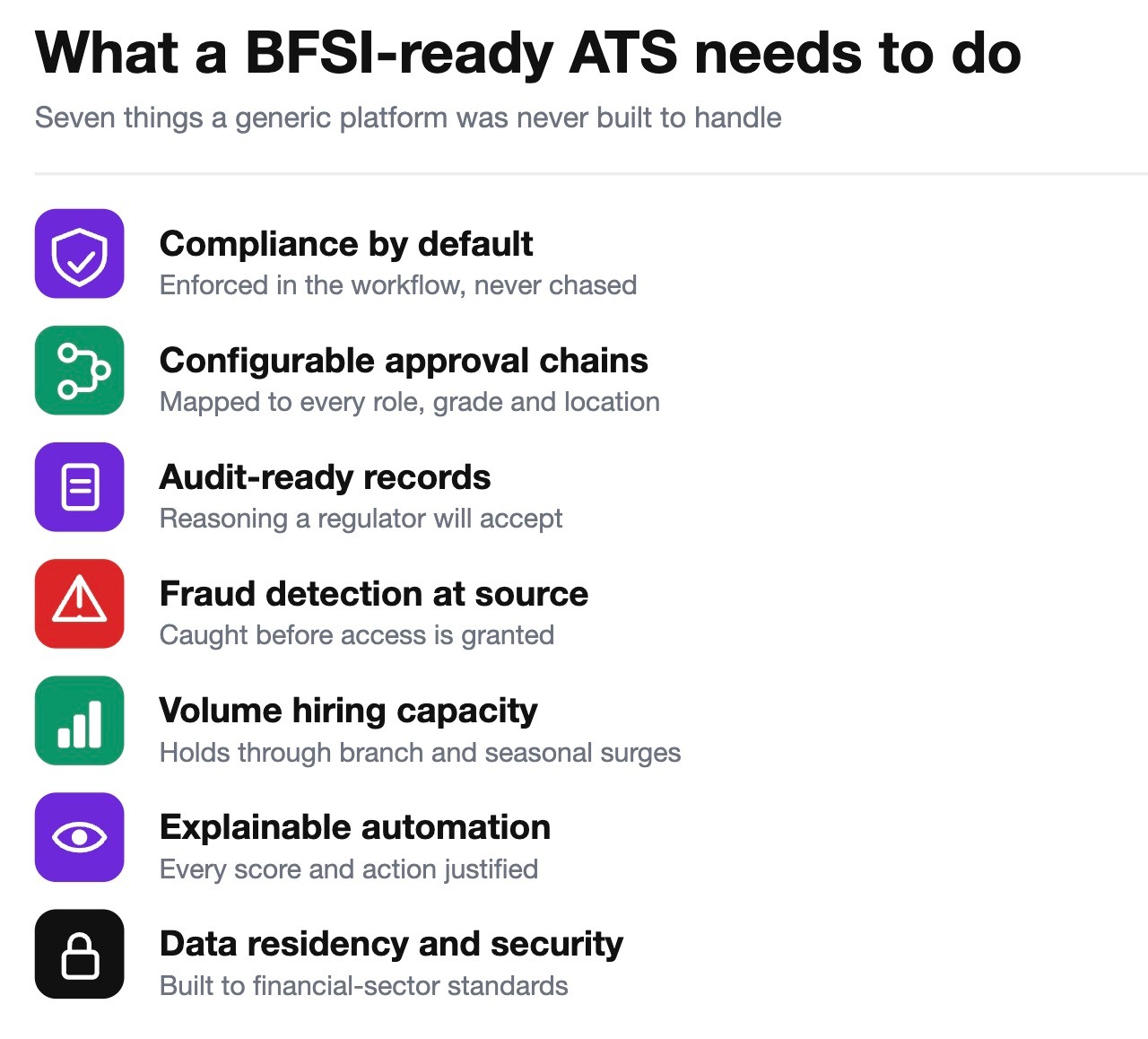
- Compliance by default: Verification, eligibility, and documentation run as enforced steps inside the workflow rather than reminders a recruiter has to chase. The system will not let a hire advance until the required checks are complete, which keeps compliance steady even when volumes spike.
- Configurable approval chains: The platform mirrors real BFSI hierarchies across roles, grades, business units, and locations. A frontline sales hire and a senior risk appointment follow different paths automatically, so approvals stay inside the system instead of scattering across email.
- Audit-ready records: Every decision, score, and action is captured with reasoning a regulator can actually review. When an audit lands, the institution can show what checks ran and why a candidate was selected, without reconstructing the trail by hand.
- Fraud detection at source: Built-in checks flag impersonation, fake employers, forged credentials, and rehire risks before a candidate is granted access. The burden of catching fraud shifts from the individual recruiter to the system itself.
- Volume hiring and frontline hiring capacity: The platform holds up during branch expansions and seasonal surges without degrading the candidate experience. Opening two hundred branches in a quarter should stretch the team, not break the software.
- Explainable automation: Any AI-assisted screening or scoring can justify its output in human terms. Recruiters and auditors both see the reasoning behind a recommendation, which is what makes automation usable in a regulated setting.
- Data residency and security: Storage, access, and certifications align with the standards financial institutions and their regulators require. Security stops being a question raised late in procurement and becomes a property the platform already satisfies.
A system that delivers these turns compliance from a recurring risk into a property of the process. A system that delivers only the first two ends up being a better-organized version of the same problem.
Generic ATS vs BFSI-ready ATS: a side-by-side view
The difference between the two is easiest to see across the dimensions BFSI teams actually get measured on. The table below contrasts how each approach handles the demands of financial-services hiring.
|
Dimensions |
Generic ATS |
BFSI-ready ATS |
|
Compliance |
Manual add-on, recruiter-dependent |
Enforced as a built-in step |
|
Approval workflows |
Flat, hard to configure |
Multi-layer chains by role, grade, location |
|
Audit trail |
Activity logs only |
Decision-level, regulator-ready reasoning |
|
Fraud and identity |
Limited or absent |
Detection at source across the funnel |
|
Volume hiring |
Strains under surges |
Built for branch and frontline scale |
|
Automation |
Opaque scoring |
Explainable, defensible outputs |
|
Data and security |
Generic standards |
Aligned to financial-sector requirements |
|
Configurability |
Org adapts to the tool |
Tool adapts to the org's policies |
A generic platform asks the institution to bend its regulated process around the software, while a BFSI-ready platform bends around the institution. For a sector where the process is dictated by law rather than preference, that direction matters.
How to evaluate an ATS for BFSI
Choosing the right system comes down to testing it against the sector's real conditions rather than a generic feature checklist. Before signing anything, pressure-test a platform on the questions that actually decide whether it will hold up in a regulated, high-volume environment.
- Ask how compliance and verification are enforced, and whether a recruiter can skip a step. If they can, the control is not real.
- Walk through a layered approval chain for a senior, customer-facing role and confirm the system handles it natively.
- Request a sample audit export and check whether it explains decisions or merely lists actions.
- Test fraud and identity capabilities against your highest-risk scenario, such as remote interview impersonation.
- Push the platform through a volume simulation that mirrors a branch-expansion surge.
- Confirm where data lives and which security certifications back it.
A vendor built for BFSI will welcome these questions because the answers are their advantage. A generic vendor will tend to redirect toward features that sound adjacent without addressing the regulatory core.
Choose RippleHire to hire for BFSI without trade-offs
By this point the gap is clear. BFSI hiring runs on regulation, trust, and scale, and a platform that treats those as afterthoughts leaves recruiters covering for the software during the exact moments hiring volume and compliance pressure peak. Closing that gap calls for a system designed around how financial institutions actually hire.
RippleHire is built for that reality.
It is an ATS where recruiters and AI agents work together, with the agents handling repetitive, high-volume work while recruiters stay focused on judgment and relationships. Because the agents operate inside an ATS built for regulated, enterprise-scale hiring, they carry the sector's context rather than working around it. For BFSI teams, that translates into:
- AI that provides reasoning behind every score and action, in a form humans understand and auditors will accept
- Fraud detection at source, flagging impersonation, fake employers, and rehire risks before they become a problem
- Configurable workflows and approvals that mirror your policies, compliance rules, business units, and reporting structures
- Volume and frontline hiring strength proven with enterprises that recruit heavily all year round
- Enterprise-grade security backed by ISO 27001 and SOC 2 Type 2 certification and GDPR compliance
Financial institutions including Axis Bank and TATA AIA Life already run their hiring on RippleHire, which is the clearest signal that the platform speaks the sector's language. If you want to see how compliance-by-default, audit-ready records, and agent-assisted volume hiring come together for a banking or insurance use case, request a demo and walk through your own highest-risk hiring scenario.
FAQs
What is an ATS for BFSI and how is it different from a regular ATS?
An ATS for BFSI is recruitment software built around the demands of banking, financial services, and insurance hiring. It treats regulatory verification, layered approvals, and audit-ready records as core functions rather than optional extras. A regular ATS manages candidate stages well but expects teams to handle compliance manually, which raises risk in a regulated sector where every hire must be documented and defensible.
Why do banks and NBFCs need specialized recruitment software?
Banks and NBFCs hire under regulatory rules that govern who can be employed and how decisions are recorded. They also face heavy frontline attrition and frequent fraud risk on customer-facing roles. Specialized software enforces verification, maps complex approval chains, and keeps an audit trail regulators accept. Generic tools leave those tasks to recruiters, which slows hiring and increases the chance of a compliance gap during high-volume periods.
How does an ATS help with compliance in financial services hiring?
A BFSI-focused ATS builds compliance into the workflow instead of relying on memory. It enforces identity and background verification, applies role-based eligibility rules, and records each decision with reasoning. When an auditor or regulator reviews a hire, the system can show what checks ran and why a candidate was selected. That turns compliance from a manual scramble during audits into a steady, evidenced part of everyday hiring.
Can AI in recruitment be trusted for regulated BFSI hiring?
AI can be trusted in BFSI hiring when it is explainable and auditable. The risk with general AI tools is opaque scoring that no one can justify to a regulator. A platform built for financial services provides clear reasoning behind every recommendation and keeps a record of it. The aim is not to remove recruiters but to handle repetitive work while keeping human judgment and accountability at the center of every decision.
How do I choose the right hiring platform for a bank or insurance company?
Start by testing each platform against your real conditions rather than a feature list. Check whether compliance steps can be skipped, whether layered approvals work natively, and whether audit exports explain decisions. Run a volume simulation that matches a branch-expansion surge, and confirm data residency and security certifications. A vendor built for the sector will answer these directly, while a generic one will redirect toward features that only sound relevant.