
.svg) Product
Product

.png)





Company Background
Freecharge Business Technology Services Limited is one of India's leading digital payments and financial services platforms, headquartered in Gurugram, Haryana. A subsidiary of Axis Bank, FreechargeBiz has built its platform on a mission to make financial services accessible, instant, and seamless for millions of users and merchants across India. Employing 2,500+ professionals, the organisation operates across digital payments, lending, and merchant solutions — serving a nationwide digital-first customer base.
In the hypercompetitive FinTech sector, the calibre and velocity of engineering and product talent directly determines the speed of platform innovation. FreechargeBiz's ability to ship new payments features, expand its lending product suite, and respond to regulatory changes depends on deploying the right technical talent at the right time. When the internal hiring process cannot match the pace of the business, the consequences are not measured in HR metrics — they are measured in delayed product releases and competitive disadvantage.
The Challenge: Four Stakeholders, One Fragmented Process
An internal audit of FreechargeBiz's legacy talent acquisition process revealed a recruitment infrastructure that was almost entirely manual — recruiters and hiring managers navigating a disjointed ecosystem of disconnected tools, relying on manual data entry to move candidates from initial application through to the final offer stage.
The TA Head's view: a team acting as data clerks instead of talent advisors
The Talent Acquisition team was spending the majority of its strategic bandwidth on administrative tasks that generated no candidate value. Recruiters were manually downloading assessment scores from the technical assessment platform, manually uploading them into internal trackers, manually routing offer approvals through email chains, and manually re-entering hired candidate data into the enterprise HRMS. The TA Head's central challenge was simple and structural:
- 8–10 hours of manual data entry per recruiter per week: every hired candidate triggered a data migration exercise between the technical assessment platform, internal trackers, and the enterprise HRMS — consuming recruiter time that should have been directed at building candidate relationships.
- No single recruitment interface: recruiters switched between multiple disconnected platforms for assessment management, offer approval, and HRMS data entry — creating a fragmented workflow that was error-prone and impossible to track consistently.
- No pipeline visibility: without a unified platform, the TA Head had no real-time view of the engineering hiring pipeline — sourcing channel performance, conversion rates, and time-to-stage benchmarks were estimated rather than measured.
- Offer turnaround averaging 73 days: the manual Maker-Checker approval process — routing through business heads and finance stakeholders via email — created an offer cycle that was losing premium fintech engineering talent to faster competitors before approvals could clear.
The CHRO's view: fintech talent walks to the fastest offer
In the fintech talent market, engineering candidates routinely hold multiple competitive offers simultaneously. The CHRO's concern was direct: a 73-day average offer turnaround was not a process inefficiency — it was a talent attrition mechanism. Candidates who had been warmly engaged throughout the interview process were walking away during the approval silence, choosing organisations whose internal processes could match the speed of the digital economy they were being asked to help build. The CHRO needed a recruitment process that reflected FreechargeBiz's own product values: fast, transparent, and seamless.
The CISO's view: governance risk embedded in the Maker-Checker process
FreechargeBiz operates with brand-specific compensation structures and strict Maker-Checker governance rules governing offer approvals. In the pre-platform state, this governance was managed through email chains — with no systematic validation that the correct approvers had been engaged in the correct sequence, no audit trail proving compliance with authorisation rules, and no automated enforcement of the financial controls embedded in the organisation's compensation banding parameters. For a subsidiary of Axis Bank operating under financial services regulatory standards, an email-based approval audit trail was structurally insufficient. Background verification was similarly manual — initiated through email with no encrypted data transmission and no automated status tracking.
The CIO's view: three platforms, zero integration
The CIO's assessment of the legacy architecture was straightforward: the technical assessment platform, RippleHire, and the enterprise HRMS were operating in complete isolation, connected only by manual data re-entry. The absence of API integrations meant every hire generated a data migration exercise. The absence of a unified data layer meant talent pipeline data could not be consumed by the organisation's broader data infrastructure. The CIO needed an event-driven integration architecture that would close the data loop from first candidate assessment to employee record creation — automatically, without human intervention.
The Solution: RippleHire as the Unified Recruitment Infrastructure
Freechargebiz partnered with RippleHire to completely rebuild its recruitment infrastructure — beginning not with technology, but with process alignment. The project team established a non-negotiable principle from the outset: automating a broken process only creates faster chaos. Before any system was configured, the team facilitated workshops that forced distinct business leaders, finance executives, and HR stakeholders to agree on a single, unified Offer Approval Matrix. This standardisation effort was the prerequisite for everything that followed.
For the TA Head: one interface, zero manual data movement
The platform delivered what the TA Head needed most: a single recruiter interface that connected assessment, hiring management, HRMS, and BGV without manual data movement between them. The Maker-Checker governance engine enforces the agreed approval rules automatically — the recruiter inputs the proposed compensation against established grade parameters, and the system autonomously routes the approval to the exact sequence of required business leaders. No email. No manual selection. No compliance risk.
A native API integration between RippleHire and the technical assessment platform means that when an engineering candidate completes an assessment, scores and evaluation reports are automatically pushed back into the RippleHire candidate profile — ending the manual download-upload cycle. The downstream HRMS integration means that when a candidate accepts an offer, an automated trigger packages the complete candidate record and pushes it directly into the enterprise HRMS.
The operational outcomes were structural and immediate:
- Offer turnaround time: reduced by 47% — from a 73-day average to a 39-day cycle — allowing the organisation to secure premium fintech talent weeks before competing firms could complete their internal approval process.
- Offer acceptance rate: reached 92% across the measurement period — materially above market for the fintech engineering talent segment.
- Recruiter capacity reclaimed: an estimated 160–200 hours of recruiter time per month returned from manual data entry and coordination tasks — immediately reinvested in candidate engagement and relationship-building.
- Agency dependency: held below 15% of total hires — with direct sourcing and employee referrals replacing paid agency channels as the dominant sourcing mix.
- Candidate experience: 4.9/5 CSAT — 29% above the fintech sector benchmark of approximately 3.8/5 — reflecting the direct impact of faster, more transparent, more professionally managed candidate interactions.
For the CHRO: a hiring process that reflects the product it is hiring for
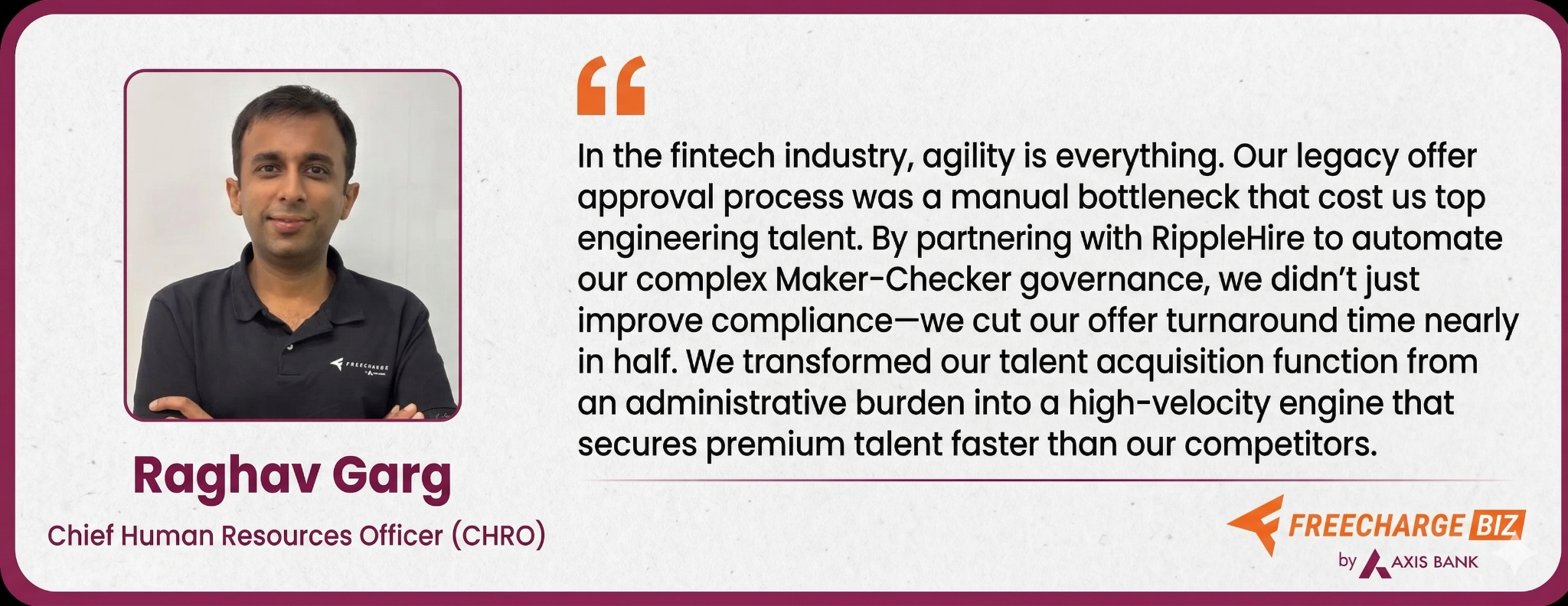
The 47% reduction in offer turnaround time eliminated the silence window in which competitor offers were being accepted. Recruiters freed from 8–10 hours of weekly manual data entry regained the bandwidth to maintain candidate relationships during the approval period — responding to queries promptly, providing personalised guidance during offer negotiations, and sustaining the human engagement that converts a strong candidate into a confirmed joiner. The 4.9/5 candidate experience score is the direct measurement of this reclaimed human bandwidth. It is not a technology outcome — it is a human outcome made possible by technology.
For the CISO: Maker-Checker governance by architecture, not administration
The Maker-Checker workflow engine built into RippleHire replaced the email-based approval audit trail with a systematic, automated governance architecture. No offer is ever released without every sequentially mandated digital approval being logged within the platform — creating a complete, unalterable audit trail for every hire, instantly accessible to financial controls, internal audit, and compliance functions. The BGV integration replaced email-based data handoffs with automated, encrypted data transmission — packaging the validated candidate data payload and transmitting it securely upon offer acceptance, with clearance status returned directly to the candidate profile. The platform is certified to ISO 27001 and SOC 2 Type II standards, with GDPR-compliant data handling applied across every candidate record.
For the CIO: event-driven integration across the full recruitment stack
RippleHire's API-first architecture connects the technical assessment platform, enterprise HRMS, and BGV systems through event-driven integrations that ensure data flows automatically across the recruitment stack without manual intervention. A master data synchronisation layer pulls approved roles, locations, and departments from the HRMS into RippleHire continuously — ensuring recruiters can only open requisitions against approved, budgeted positions. When a candidate accepts an offer, the automated HRMS trigger initiates employee record creation directly. The real-time analytics layer provides the CIO with structured talent pipeline data — sourcing channel attribution, conversion benchmarks, and time-to-stage performance — that can be consumed by the organisation's broader data infrastructure. The agentic AI roadmap extends this further: autonomous agents for JD quality assessment, candidate database screening, and interviewer briefing — completing the transition to a continuously operating, AI-governed hiring function.
Candidate Voice: Speed and Warmth at the Finish Line
The most meaningful validation of the transformation is the candidate experience it produced. The 4.9/5 CSAT score is drawn from a validated cohort of candidates who went through the new process — and their feedback articulates the shift from a slow, fragmented journey to a fast, transparent, professionally managed one.
|
“The hiring process is very fast. It took only 3 days to offer. It was a very good experience.” Candidate, FreechargeBiz (post-offer NPS survey) |
“The recruitment process was well-structured, with clear communication and timely updates, ensuring a seamless experience.” Candidate, FreechargeBiz (post-offer NPS survey) |
|
“Yakshani has been really helpful throughout the interview process and also in the generation of offer letters.” Candidate, FreechargeBiz (post-offer NPS survey) |
“It is a wonderful smooth onboarding process.” Candidate, FreechargeBiz (post-offer NPS survey) |
Deployment: Standardisation Before Automation
The platform was deployed in three phases — beginning with a high-volume pilot on the technology hiring team to validate the Maker-Checker matrices and offer generation workflows under real operating conditions. This was followed by expansion to all technology roles and key hiring managers, and finally full organisation-wide adoption across all non-tech functions. A comprehensive enablement programme — live training, interactive SOPs, and hands-on hypercare support during each phase — drove complete platform adoption. No recruiter reverted to an Excel tracker after the first month of live operation.
Recruiter adoption was driven by evidence rather than instruction. The change management team recognised that recruiters who had been managing data manually were initially sceptical that automated workflows could match their own accuracy standards. The solution was direct demonstration: recruiters tracked their own time savings in real time during UAT, watching the hours reclaimed from manual data entry redirected immediately into candidate conversations. Once the accuracy of the API integrations was confirmed through live operation, adoption was immediate and complete.
What the Transformation Delivered
Across each stakeholder dimension, the deployment delivered structural change that directly impacted the organisation's ability to compete for fintech engineering talent:
- TA Head: 47% reduction in offer turnaround time; 92% offer acceptance rate; 160–200 hours of recruiter capacity per month returned from manual data entry; single unified recruitment interface eliminating platform-switching; real-time pipeline analytics replacing anecdotal performance estimates; agency dependency held below 15%.
- CHRO: a candidate experience score of 4.9/5 — 29% above the fintech sector benchmark — reflecting the direct impact of faster, more transparent candidate interactions; a recruitment process whose speed and quality reflects FreechargeBiz's own product values; engineering talent secured weeks ahead of competitors' offer cycles.
- CISO: Maker-Checker governance enforced systematically by platform architecture — zero reliance on email-based approval audit trails;automated BGV triggering through encrypted data transmission, complete digital audit trail for every hire; ISO 27001 and SOC 2 Type II certified data handling; GDPR-compliant processing across every candidate record.
- CIO: event-driven API integration across the technical assessment platform, enterprise HRMS, and BGV systems — zero manual data movement in the entire recruitment-to-employee lifecycle; automated HRMS employee record creation on hire; real-time talent pipeline analytics for enterprise BI consumption; agentic AI roadmap extending autonomous intelligence across JD assessment, candidate screening, and interviewer briefing.
Road Ahead
- Post-offer follow-up automation (POFU): personalised, automated WhatsApp and email engagement sequences triggered immediately upon offer acceptance — keeping technical talent continuously engaged during their notice period and directly addressing post-acceptance attrition.
- Predictive pipeline analytics: forward-looking dashboards enabling the TA team to forecast engineering pipeline health and conversion rates before requisitions open — shifting the function from reactive to anticipatory hiring.
- Quality-of-hire closed-loop integration: quality-of-hire closed-loop integration: connecting post-joining performance data from the enterprise HRMS back into RippleHire — enabling correlation analysis between sourcing channel, interview score, and six-month performance rating, and completing the talent lifecycle loop from requisition to contribution.
- Agentic talent acquisition (FY2027): deploying RippleHire's AI agent builder to introduce autonomous agents for JD quality assessment, candidate database screening, and interviewer briefing — extending the automation philosophy from offer approvals into every stage of the hiring lifecycle.
Conclusion
FreechargeBiz's recruitment transformation demonstrates what becomes possible when an organisation refuses to accept manual complexity as a permanent operational constraint. A 47% reduction in offer turnaround time, a 92% offer acceptance rate, and a 4.9/5 candidate experience score — delivered by the same team, at greater throughput, without additional headcount — are not the product of a favourable market. They are the product of a process engineered with precision and governed with discipline.
By deploying RippleHire's Maker-Checker governance engine, full-stack API integrations, and mobile-first candidate experience design, FreechargeBiz converted its most significant operational liability, manual complexity — into a competitive advantage in one of India's most demanding talent markets. The result is a hiring process that earns the trust of every stakeholder it serves: the TA Head who can finally see the pipeline, the CHRO whose candidates feel valued, the CISO whose compliance trail is unbroken, and the CIO whose systems talk to each other without human intervention