

.svg) Product
Product


.png)





Company Background
Bahwan CyberTek (BCT) is a global technology services organisation headquartered in Muscat, Oman, with a presence across the Americas, MENA, APAC, and India. Employing 4,000+ professionals and serving 2,200+ clients across retail, government, healthcare, energy, and financial services, BCT delivers enterprise technology solutions across digital transformation, cloud, and managed services. The organisation's ability to staff complex, multi-geography client engagements depends directly on the speed, quality, and compliance of its global talent acquisition process.
For a technology services organisation of BCT's complexity — operating across four distinct regional employment frameworks, each with different compensation structures, approval hierarchies, and regulatory requirements — talent acquisition is not a centralised HR function. It is a globally distributed operational challenge that requires a platform capable of enforcing consistency without imposing uniformity.
The Challenge: Four Stakeholders, Four Regional Realities
Prior to its digital transformation, BCT's Talent Acquisition process was severely constrained by the complexity of its global operating model. Manual approval routing, fragmented regional systems, and offline tracking were creating bottlenecks that affected candidate experience, compliance integrity, and recruiter productivity simultaneously.
The TA Head's view: a 28-grade matrix that could not be managed manually
The Talent Acquisition team was navigating a hiring process of exceptional complexity: four geographies, each with distinct employment structures, compensation frameworks, and approval requirements, all managed through a 28-grade approval hierarchy that varied by region, business unit, and employment type. The TA Head's central challenge was operational — how to route offer approvals consistently, accurately, and at speed across this complexity without the errors, delays, and compliance gaps that manual routing inevitably produced:
- Manual approval routing: recruiters manually tracked offer approvals through email chains across India, Americas, MENA, and APAC — each with different approval sequences, different financial authorisation thresholds, and different compliance requirements. The probability of routing errors was structural, not incidental.
- No unified candidate communication: without automated status updates, candidates experienced communication gaps across the hiring journey — particularly pronounced in cross-regional hires where time zone differences compounded the manual coordination burden.
- Recruiter capacity consumed by administration: the majority of recruiter bandwidth was directed at approval chasing, offer letter drafting, and compliance document collection — leaving minimal time for the candidate relationship-building that drives offer acceptance.
- No global performance visibility: with recruitment data fragmented across regional systems and manual trackers, TA leadership had no unified view of global pipeline health, sourcing channel performance, or regional hiring efficiency.
The CHRO's view: a consistent candidate experience across all four regions
The CHRO's requirement was both simple and challenging: every candidate, regardless of which region they were hired into, should experience the same quality of engagement, the same transparency of communication, and the same professionalism of offer management. In a global organisation where employer brand reputation travels across geographies, inconsistency in one region creates perception risk for all. The CHRO needed a platform that could enforce experience consistency across four distinct operational realities without requiring four separate processes.
The CISO's view: multi-region compliance and data governance at enterprise scale
BCT's global hiring operation generates candidate data across four distinct regulatory environments — each with different data privacy requirements, different BGV standards, and different document retention obligations. In the pre-platform state, candidate data moved across email chains and regional spreadsheets with no centralised audit trail, no automated compliance validation, and no systematic enforcement of jurisdiction-specific rules. For an organisation whose clients include government agencies and financial institutions with stringent vendor compliance requirements, this fragmentation was a significant risk — one that the CISO needed to address structurally rather than through manual oversight.
The CIO's view: a single platform architecture for a four-region hiring operation
The CIO's expectation was that the recruitment platform must function as genuine enterprise infrastructure — not four separate regional tools that happen to share a vendor. A single platform with the backend intelligence to apply different conditional logic per geography, per business unit, and per employment type — without requiring parallel systems or manual interpretation — was the architectural requirement. The platform also needed to integrate with BCT's core HRIS, creating an automated data flow from recruitment to employee record that eliminated the manual data migration exercise that followed every hire.
The Solution: RippleHire as Global Talent Infrastructure
BCT deployed RippleHire as enterprise talent infrastructure — a single platform configured to encode the organisation's full global approval complexity into deterministic, automated logic. The deployment began with a comprehensive audit of BCT's global recruitment processes and approval hierarchies, facilitated through rigorous design workshops that forced the organisation to document, standardise, and resolve the ambiguities embedded in its legacy regional workflows. The resulting unified approval matrices became the definitive configuration blueprints for the platform.
For the TA Head: conditional routing that eliminates manual complexity
The platform's conditional routing engine evaluates three variables at the point of offer initiation — geography, business unit, and employment type — and autonomously determines the exact approval chain required. For India, the workflow distinguishes between full-time employment and contract engagements. For the Americas, the system separates staffing from non-staffing roles. For the UK and MENA regions, role-specific approval matrices route each offer to the correct Cost Centre Owners and Vertical Heads without recruiter interpretation. No offer is ever extended without every mandated approval being digitally logged within the platform — creating a governance layer that is simultaneously faster than the manual process and structurally more compliant.
The operational outcomes for the TA team were immediate and specific:
- Offer processing speed: time to generate, approve, and release offers reduced by 80% — from a multi-day manual cycle to a streamlined digital workflow.
- Platform adoption: exceeding the adoption target within the first 60 days of go-live across all four regional recruitment teams.
- Hiring manager engagement: above-target active usage from hiring managers within 60 days — driven by Interview Kit standardisation and mobile-first approval workflows.
- Candidate experience: 4.75/5 CSAT validated across the measurement period — the first unified global candidate experience baseline BCT had ever held.
For the CHRO: a consistent candidate experience across four regions
The platform delivered the experience consistency the CHRO required. Automated status update communications trigger at every pipeline stage — application acknowledgement, shortlisting, interview scheduling, offer release, and onboarding — ensuring that candidates across all four geographies receive the same quality of communication regardless of which regional team is managing their hire. Standardised Interview Kits, configured to specific job grades, legal entities, and business units, ensure that every candidate receives a structured, fair, and professionally executed evaluation regardless of geography. The AI-personalised Dream Offer Video extends the brand experience into the offer moment — replacing the transactional PDF offer letter with a personalised celebration of the individual candidate's selection.
For the CISO: multi-region compliance by architecture
RippleHire's compliance architecture addresses BCT's multi-region data governance challenge at the platform level rather than through manual regional oversight. The AI-driven duplication detection engine validates every candidate submission across all four regional pipelines — enforcing data integrity rules and preventing duplicate applications from contaminating the global database. Jurisdiction-specific compliance rules are enforced systematically: Indian contract flows are distinguished from full-time employment tracks, Americas staffing mandates are separated from non-staffing requirements, and UK and MENA roles receive region-specific documentation validated by the platform's compliance logic before reaching the candidate.
Background verification is triggered automatically when a candidate is moved to the offer stage — packaging the validated candidate data payload and transmitting it to the BGV vendor through a secure, auditable data transfer. Every approval, every document request, and every candidate status change is captured in an immutable digital audit trail accessible to leadership and internal audit across all four regions. The platform is certified to ISO 27001 and SOC 2 Type II standards, operating in full compliance with GDPR data handling requirements.
For the CIO: a single platform with four-region conditional intelligence
The platform's API-first architecture connects BCT's recruitment operation to its core HRIS through automated, event-driven integrations. When a candidate is moved to Hired status within RippleHire, an automated trigger packages the complete validated candidate record — personal data, compensation details, organisational mapping, and regional classification — and pushes it directly into the HRIS, initiating the employee record without manual re-entry. The monthly recruitment dashboard provides the CIO with a continuous, structured view of global talent pipeline performance across all four regions — sourcing channel efficiency, offer conversion rates, and pipeline health metrics — structured for business intelligence consumption.
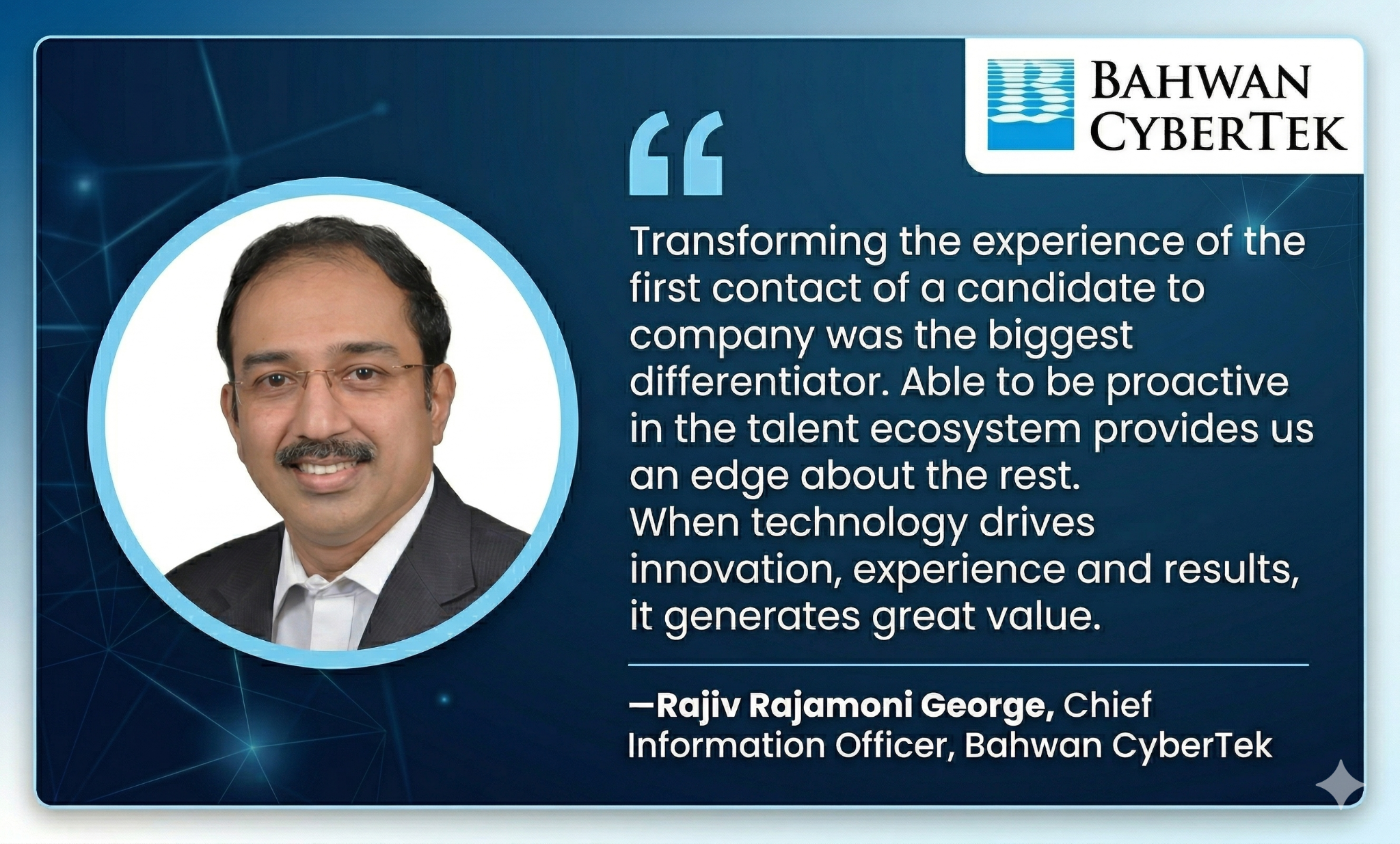
What the Transformation Delivered
Across each stakeholder dimension, the deployment produced outcomes that compounded across BCT's four-region hiring operation:
- TA Head: 80% reduction in offer processing time, above-target platform adoption across all four regions within 60 days, a unified global pipeline dashboard replacing fragmented regional trackers, and an offer acceptance rate that materially improved over the pre-platform baseline.
- CHRO: 4.75/5 CSAT — the first unified global candidate experience baseline in the organisation's history — validated across the full measurement period, with consistent scores across all four regions confirming that experience standardisation has been achieved without sacrificing regional relevance.
- CISO: ISO 27001 and SOC 2 Type II certified compliance architecture, automated multi-region BGV triggering, immutable digital audit trail for every global hire, AI-driven duplication detection across all four regional pipelines, and jurisdiction-specific compliance rules enforced systematically rather than managed manually.
- CIO: a single platform with four-region conditional routing intelligence, automated HRIS integration eliminating manual data re-entry, real-time global pipeline analytics, and an agentic AI roadmap that will extend autonomous intelligence into JD quality assessment, candidate database screening, and interviewer briefing across all four geographies.
Road Ahead
- AI-driven candidate screening and ranking: activating RippleHire's AI-powered screening capabilities to automatically rank candidates against role-specific requirements — reducing manual screening time and improving the quality of candidates advanced to interview across all four regions.
- Predictive pipeline analytics for strategic workforce planning: connecting real-time pipeline data with forward-looking workforce planning inputs — enabling the TA function to identify skill gaps and initiate sourcing before requisitions open across BCT's global client delivery operations.
- Agentic video interviewing to eliminate scheduling bottlenecks: deploying Amy — RippleHire's AI video interview agent — to conduct initial screening interviews autonomously across time zones, eliminating the scheduling coordination burden that compounds in multi-region hiring and ensuring every candidate receives a fast, fair, structured first engagement regardless of geography.
Conclusion
Bahwan CyberTek's global talent acquisition transformation demonstrates that organisational complexity — multiple geographies, a 28-grade approval hierarchy, distinct regional employment structures and compliance requirements — is not an inherent barrier to candidate experience excellence. It is a configuration challenge. And like all configuration challenges, it can be solved by the right platform architecture, deployed with the right process discipline.
By deploying RippleHire as enterprise talent infrastructure across India, Americas, MENA, and APAC, BCT converted its most significant operational liability — multi-region complexity — into a competitive advantage: a hiring process that is simultaneously faster, more compliant, and more candidate-centric than anything the manual approach could have achieved. The 4.75/5 candidate experience score, the 80% reduction in offer processing time, and the above-target adoption across all four regions confirm that when the right architecture is applied to the right problem, complexity stops being a constraint and starts being a differentiator.