
.svg) Product
Product

.png)




Company Background
Birlasoft Limited is a global IT services organization headquartered in Noida, India, employing 11,400+ professionals across the Americas, Europe, and Asia-Pacific. A CK Birla Group company, Birlasoft delivers digital transformation services across enterprise applications, cloud, data, and IoT for clients in manufacturing, life sciences, banking, and financial services. The organisation's hiring strategy reflects its service model: to deliver exceptional outcomes for clients, Birlasoft must attract and retain professionals who combine deep technical expertise with strong client-facing capability.
Click here to watch how Birlasoft went from duplicate applications to real time clarity with RippleHire
In an IT services market where talent is the primary competitive differentiator, the quality and efficiency of the talent acquisition process directly determine the quality of client delivery. Birlasoft's investment in a structured employee referral program was not a standalone HR initiative — it was a sourcing strategy with measurable implications for cost-per-hire, quality-of-hire, and the organization's ability to scale without proportional increases in agency spend.
The Challenge: Four Stakeholders, One Untapped Asset
Birlasoft had a cultural advantage that most IT services organizations spend years trying to build: a genuinely engaged workforce with strong professional networks in precisely the skill sets the organization needed to hire. The challenge was that this advantage was almost entirely unrealized — the referral program was informal, untracked, and incapable of generating consistent results at scale.
The TA Head's view: a channel with potential and no infrastructure
The Talent Acquisition team knew that referred candidates outperformed agency-sourced candidates on quality, joining probability, and early performance metrics. But the referral programme as it existed was a reactive, ad hoc process — dependent on individual recruiter relationships and occasional encouragement rather than a systematic activation architecture. The TA Head needed a platform that could turn the organization's cultural advantage into an operational reality:
- No activation mechanism: employees had no structured, easy way to refer candidates. The process required manual form-filling, email chains, and follow-up — creating friction that discouraged participation even among willing advocates.
- No visibility into referral pipeline: the TA team could not track which employees were referring, which roles were generating the most referral interest, or at which stage referred candidates were dropping out — making programme improvement impossible.
- No gamification or recognition: employees who referred candidates had no real-time visibility into their candidate's progress, no systematic recognition for successful referrals, and no incentive structure that rewarded advocacy behaviour rather than only hiring outcomes.
- Disproportionate agency dependency: because the referral channel was underperforming, the organization was relying heavily on external agencies to fill pipeline gaps — at a cost-per-hire that significantly exceeded the referral channel alternative.
The CHRO's view: culture as a sourcing strategy
Birlasoft's culture is one of the organization's most durable competitive advantages — a workforce characterized by long tenures, strong peer relationships, and genuine commitment to the organization's values. The CHRO's insight was that this cultural strength, if properly activated, could become the most powerful talent sourcing asset the organization possessed. Referred candidates arrive pre-qualified not only on technical skills but on cultural alignment — referred by someone who knows both the candidate and the organization well enough to make a credible match. The CHRO needed a program architecture that would honor this cultural dynamic rather than reducing it to a transactional bonus payment.
The CISO's view: candidate data integrity at referral scale
A referral program that activates thousands of employees to submit candidate profiles, upload CVs, and share personal data across social networks generates a significant candidate data management challenge. The CISO needed assurance that the referral platform was handling candidate submissions with appropriate data integrity controls — preventing duplicate applications, enforcing cooling-off rules, managing consent appropriately, and maintaining a clean, compliant candidate database rather than creating a fragmented, duplicate-laden data lake.
The CIO's view: a program with measurable ROI and structured data
The CIO's requirement was straightforward: the referral program must generate structured, attributable data — referral submission rates by department, conversion rates at each pipeline stage, cost-per-hire by sourcing channel, and engagement rates by campaign — that could be used to continuously improve program design and demonstrate return on investment to business leadership.
The Solution: RippleHire's Gamified Referral Platform
Birlasoft deployed RippleHire's gamified employee referral platform — transforming the referral program from an ad hoc channel into a structured, data-driven sourcing engine. The architecture was built around three design principles: make advocacy effortless, make progress visible, and reward the behaviour rather than only the outcome.
For the TA Head: a referral engine that generates quality pipeline at scale
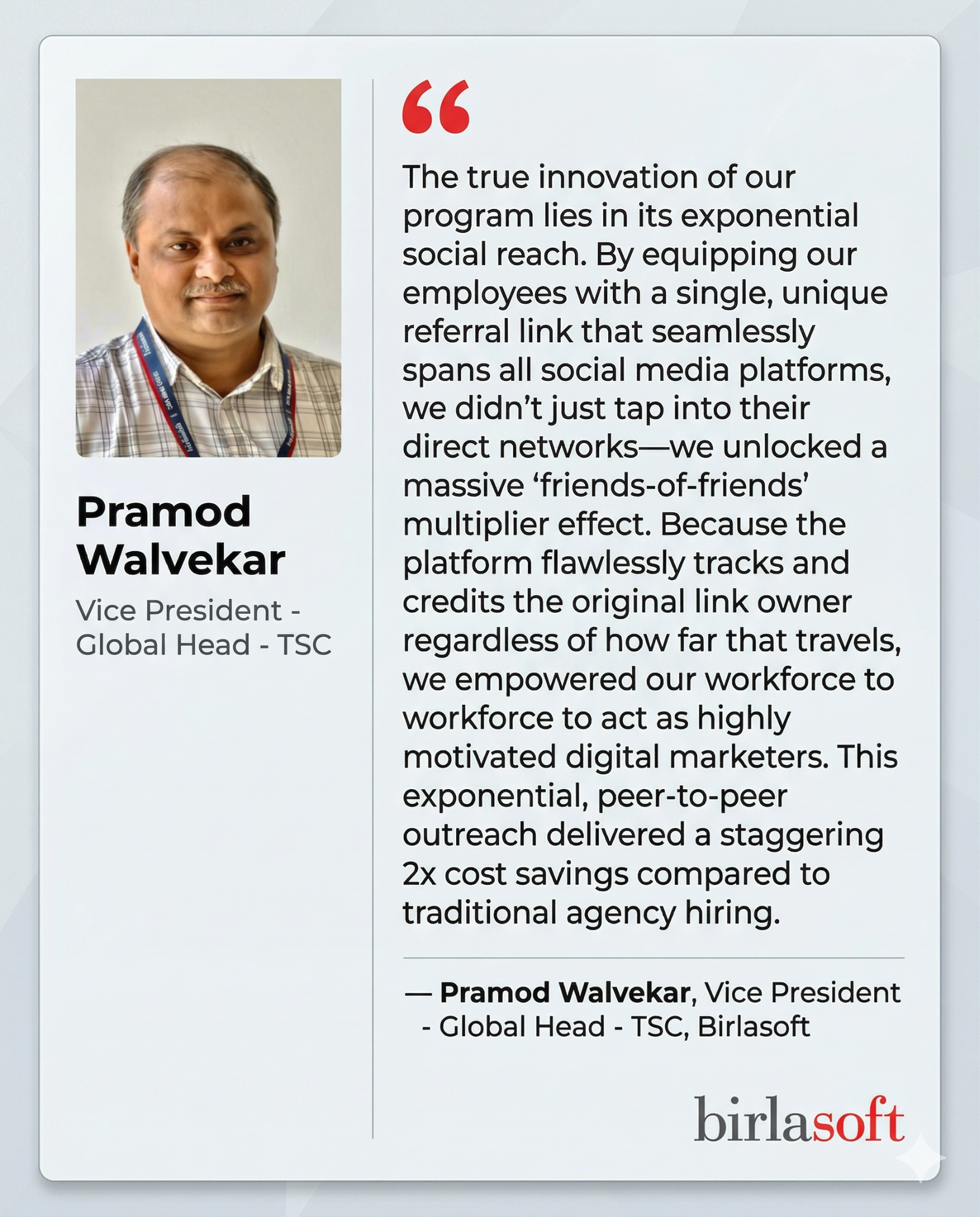
Employees across Birlasoft's global workforce are equipped with native social sharing capabilities — distributing open roles directly to LinkedIn, WhatsApp, and professional networks with a single tap. The Karma Points economy rewards every advocacy action: sharing a job post, generating a candidate click, submitting a referral profile, or advancing a referred candidate through the pipeline. Dynamic leaderboards surface top referrers by department and location, creating healthy competitive engagement across business units.
Time-bounded campaign activations — targeted at specific talent pools, geographies, or role categories — provide fresh reasons to engage throughout the year and allow the TA team to direct referral energy toward the roles where quality sourcing is most critical. The outcomes across the measurement period were significant:
- Total referral hires: 369 hires across a 15-month period — the largest referral hiring cohort in the organisation's history.
- Cost avoidance: by shifting hiring from external agency channels to employee referrals, the programme generated material cost avoidance — with referred hires costing significantly less than agency-sourced equivalents.
- Active workforce participation: more than 5,700 employees — representing over half the total workforce — participated as active referral advocates on the platform.
- Peak monthly referral contribution: employee referrals contributed more than 10% of monthly hiring for ten consecutive months — demonstrating sustained performance rather than initial-launch enthusiasm.
For the CHRO: culture-led advocacy, not transactional referral mechanics
The programme design reflects the CHRO's insight that referral quality depends on cultural alignment as much as technical skills. By rewarding the advocacy behaviour — sharing, clicking, referring — rather than only the hiring outcome, the Karma Points economy encourages employees to act as genuine brand ambassadors rather than transactional bonus hunters. The result is a referral pipeline populated with candidates who arrive pre-qualified on culture fit, referred by someone who knows both the candidate and the organisation well enough to stake their own professional reputation on the match.
For the CISO: clean data, automated compliance, zero-friction governance
RippleHire's AI-driven duplication detection engine validates every referral submission against the enterprise candidate database at the point of entry — preventing duplicate applications, enforcing cooling-off rules, and maintaining data integrity across the full referral pipeline without manual review. Candidate data submitted through the referral portal is handled within RippleHire's Privacy by Design framework, certified to ISO 27001 and SOC 2 Type II standards, with GDPR-compliant consent management applied to every candidate record. The platform maintains complete referral attribution data — linking every hire to the specific employee referral that sourced it — creating a transparent, auditable source-of-hire record for every referred candidate in the pipeline.
For the CIO: structured ROI data and an AI-powered analytics roadmap
The platform generates structured, attributable data across every dimension of the referral programme — submission rates by department, stage conversion rates, active referrer percentages, campaign performance by activation event, and cost-per-hire comparison by sourcing channel. This data is reviewed regularly by TA leadership and used to continuously improve programme design — increasing incentive weights for high-demand skill sets, launching targeted campaign activations for underperforming departments, and rebalancing programme investment toward the highest-converting referral mechanics. The agentic AI roadmap extends this intelligence further: autonomous agents that identify which employees have professional networks most likely to contain candidates for specific open roles and prompt them to share proactively — further increasing the quality and precision of referral sourcing.
What the Transformation Delivered
Across each stakeholder dimension, the program delivered outcomes that extended well beyond the referral channel itself:
- TA Head: 369 referral hires in 15 months, 5,700+ active workforce advocates, 10+ consecutive months at above-target referral contribution, material cost avoidance from reduced agency dependency — all with complete attribution data and real-time pipeline visibility.
- CHRO: a culture of talent advocacy activated at scale — employees participating not for transactional bonus incentives but because the programme made advocacy effortless and recognition visible. The referral programme has become a tangible expression of Birlasoft's commitment to its people and their networks.
- CISO: ISO 27001 and SOC 2 Type II certified data handling for all referral candidate records, AI-driven duplication detection enforcing data integrity at point of submission, GDPR-compliant consent management, and complete source-of-hire attribution for every referred candidate.
- CIO: structured programme performance data enabling continuous optimisation, cost-per-hire comparison by sourcing channel demonstrating ROI, and an agentic AI roadmap that will extend the referral programme from reactive advocacy to proactive, AI-prompted talent sourcing.
Road Ahead
- Precision referral mechanics and talent pool integration (FY2027): building structured talent pools of warm, referred candidates who are not yet aligned to a live requisition — enabling proactive outreach before a role opens and reducing time-to-fill for repeat skill categories.
- AI-powered advocate identification (FY2027): deploying RippleHire's AI capabilities to identify which employees have professional networks most likely to contain candidates for specific open roles — prompting targeted advocacy rather than relying on general programme participation.
- Agentic referral automation (FY2027): autonomous AI agents that proactively identify warm referred candidates in the talent community, re-engage them when relevant roles open, and advance them through the early pipeline stages without recruiter intervention — extending the referral programme's impact from sourcing to conversion.
Conclusion
Birlasoft's employee referral transformation demonstrates that an organisation's most powerful sourcing asset is already in the building. By deploying RippleHire to activate, gamify, and measure the referral channel at scale, Birlasoft converted a dormant cultural advantage into a structured, data-driven hiring engine — generating material cost avoidance, activating more than half the workforce as talent advocates, and building a pipeline of culturally pre-qualified candidates that no external agency can replicate.
The measure of a great referral programme is not the number of hires it generates in a single quarter. It is the culture of advocacy it builds — a workforce that consistently and genuinely recommends the organisation to the best people they know, because they are proud to work there. Birlasoft has built that culture, and the results compound with every hiring cycle.