
.svg) Product
Product

.png)




Table of content
Top 10 Enterprise Applicant Tracking Systems (ATS) in 2026
How we evaluated these platforms
We looked at more than 20 enterprise recruiting platforms before shortlisting ten. The criteria, in order:
- Recruiter productivity. Does it remove busywork, or add clicks?
- AI and agents that do real work including sourcing, screening, scheduling, and interviewing, not just a chatbot bolted onto a careers page.
- Candidate and hiring-manager experience, because a hire that does not join is not a hire.
- Scale and configurability for thousands of concurrent requisitions across volume, lateral, campus, and leadership hiring.
- Governance and compliance, including data residency and India's DPDP Act alongside GDPR, SOC 2, and ISO standards.
- Integration depth with your HRMS, sourcing, assessment, and background-verification stack.
Evidence is drawn from product documentation, analyst commentary, published customer references, and review platforms.
A note on where we stand: RippleHire is on this list. We held ourselves to the same questions we asked of every other platform, and we have named where we are strong and where another platform may fit you better.
What counts as an enterprise ATS in 2026
An enterprise applicant tracking system manages the full hiring lifecycle including demand creation, sourcing, referrals, screening, interviews, offers, and onboarding handoff, at the volume, governance, and compliance depth that organizations hiring hundreds or thousands a year actually need.
The enterprise bar is higher than the mid-market one. It means multi-level approval chains, role-based visibility, SSO provisioning, audit-ready reporting, fraud controls at the point of entry, and two-way sync with your HRMS. A tool that handles fifty hires a month rarely survives five thousand.
A quick vocabulary note: a standalone (recruiting-first) ATS is built around hiring and integrates with your HR system. An HCM-embedded module lives inside a larger HR suite. Neither is automatically better. Which one fits depends on whether your real pain is recruiting depth or data fragmentation.
Quick-scan comparison
|
Platform |
Best for |
Type |
AI and agents |
Standout strength |
|
Complex enterprise hiring (500+ a year), India and global |
Recruiting-first |
Amy (AI interview agent), AI Voice Agent, agentic sourcing, fraud detection |
Recruiter productivity, referrals, fraud controls built for enterprise scale |
|
|
Darwinbox |
Enterprises wanting recruiting inside one HRMS |
HCM-embedded |
AI screening, candidate matching |
Single platform from hire to payroll |
|
Workday Recruiting |
Large enterprises already on Workday |
HCM-embedded |
Paradox and HiredScore |
Recruiting tied to workforce and finance planning |
|
SAP SuccessFactors Recruiting |
Global enterprises on the SAP stack |
HCM-embedded |
SmartRecruiters AI |
Localization Tion across 60+ countries |
|
iCIMS |
High-volume, multi-location hiring |
Standalone suite |
Agents and Apli Frontline AI |
Deep integration marketplace, high-volume engine |
|
Greenhouse |
Teams optimising for quality-of-hire |
Standalone |
AI screening, scorecard analytics |
Structured hiring methodology |
|
Oracle Recruiting (Taleo) |
Large Oracle HCM estates |
HCM-embedded |
Basic automation |
Vast installed base, complex workflows |
|
Avature |
Multi-brand, multi-region global TA |
Standalone CRM and ATS |
Configurable AI workflows |
Deep customisation, campus and CRM |
|
Phenom |
Candidate experience and internal mobility |
Standalone platform |
AI matching, personalisation |
Talent experience layer |
|
PageUp |
APAC-centred enterprises |
Standalone platform |
AI screening, predictive |
Regional depth, integrated talent suite |
RippleHire
A recruiting-first, high-performance ATS built for the reality of enterprise hiring: volume, lateral, campus, and leadership roles running at once, where agents handle the coordination and recruiters handle the closing.
Why it is on this list
RippleHire started in 2012 by fixing one broken thing, employee referrals, and grew into a full enterprise platform now serving over a million users across 50+ countries. It processes roughly one hire every four minutes for its customers. The platform has stayed deliberately recruiting-first while most of the market chased suite consolidation, and that focus shows up in recruiter throughput.
Where it is strong
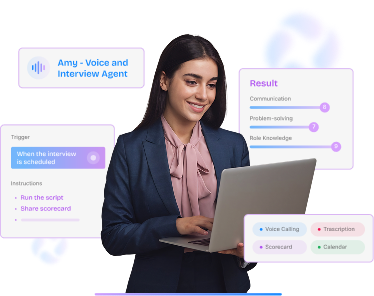
- Agents that do real work. Amy, the AI interview agent, and the AI Voice Agent handle screening and scheduling conversations end to end. Agentic sourcing surfaces and ranks profiles so recruiters spend their time on shortlists, not searches.
- Referrals as a real channel, not a checkbox. RippleHire's referral engine is the category it pioneered: structured, gamified, and measurable, turning employees into a consistent source of quality hires.
- Fraud caught at the door. Candidate and document fraud is detected at the point of entry, which matters in BFSI and IT services hiring.
- Built for enterprise governance. Multi-level approvals, role-based visibility, and audit-ready reporting at scale, backed by ISO 27001, SOC 2 Type II, and GDPR, with DPDP-aligned data handling for Indian enterprises.
- A track record enterprises can verify. Axis Bank reports a 4.8/5 candidate experience score. Mphasis has run talent acquisition across 25+ countries on RippleHire over an 8+ year partnership. LTM, UST, Tata Steel, and Aditya Birla Group are among the references that hiring leaders can speak to directly.
Best for
Enterprises hiring 500+ a year, especially in IT services, BFSI, professional services, and GCCs, that want recruiting depth, referrals, and agent automation without re-platforming their entire HR stack.
Worth weighing
RippleHire is a recruiting-first platform, not a full HCM suite. If your priority is running payroll and performance on the same system as hiring, you will integrate RippleHire with your HRMS rather than replace it. For most large recruiting teams, that is the point. But it is a fit question worth asking up front.
Darwinbox
A unified, AI-native HRMS with recruiting built in as a module, running on the same platform as core HR and payroll.
Why it is on this list
Darwinbox has earned strong analyst recognition and a large enterprise customer base across Asia and the Middle East. For organizations that want recruiting, onboarding, and payroll on one record with no integration in between, it is a serious contender.
Where it is strong
- One platform from candidate to employee, with no middleware handoff at offer acceptance.
- AI-assisted screening and candidate matching inside the suite.
- Configurable approval chains and hiring modes for enterprise scale.
Best for
Enterprises with 1,000+ employees that want recruiting embedded in a single HRMS and are buying the suite as a whole.
Worth weighing
Recruiting is one module of a larger suite. Teams that want the deepest recruiting-specific capability including referrals, agent-led interviewing, and sourcing depth sometimes find a recruiting-first platform that goes further on those dimensions.
Workday Recruiting
Recruiting embedded in Workday's HR and finance suite, strengthened in 2025 by the Paradox and HiredScore acquisitions.
Why it is on this list
Workday is an entrenched leader among the largest global enterprises, and its 2025 deals gave it conversational AI for frontline hiring through Paradox and AI-driven talent discovery through HiredScore. For organizations already standardized on Workday, the pull is clear.
Where it is strong
- Requisitions inherit position and financial data from Workday HCM and Finance natively.
- Paradox brings conversational AI for high-volume candidate engagement.
- Hiring data flows directly into workforce and headcount planning.
Best for
Large enterprises with 5,000+ employees already running Workday HCM.
Worth weighing
The value is concentrated in existing Workday estates. Off the Workday stack, the native advantage disappears, and the Paradox and HiredScore integrations are still consolidating into a single experience.
SAP SuccessFactors Recruiting
Recruiting within SAP's HCM ecosystem, reshaped by the September 2025 SmartRecruiters acquisition.
Why it is on this list
SAP is a global HCM leader, and SmartRecruiters brings genuine recruiting depth and AI-driven candidate experience to the SuccessFactors suite. For global enterprises already invested in SAP, recruiting now sits inside the same architecture as the rest of HR and ERP.
Where it is strong
- SmartRecruiters AI for candidate matching and recruiter efficiency.
- Localizations and compliance across 60+ countries.
- Hiring data flowing into SAP for workforce cost and headcount modelling.
Best for
Global enterprises with 5,000+ employees committed to the SAP stack.
Worth weighing
The SmartRecruiters and SuccessFactors integration is early. Enterprises should map the migration path carefully and budget for implementation complexity.
iCIMS
A standalone enterprise talent-acquisition suite built for high-volume, multi-location hiring, with one of the largest integration marketplaces in the category.
Why it is on this list
iCIMS holds a large share of the enterprise ATS market, and its September 2025 Apli acquisition added conversational AI for frontline and high-volume roles via text, WhatsApp, and web chat.
Where it is strong
- A high-volume engine that scales to tens of thousands of concurrent requisitions.
- A large marketplace of pre-validated integrations.
- Frontline AI through Apli for mobile-first, conversational candidate engagement.
Best for
Large enterprises running high-volume, multi-location hiring with complex compliance needs.
Worth weighing
As a standalone suite it needs HRMS integration for employee data. Reviewers note the interface feels dated next to newer platforms, and the Apli integration is still maturing.
Greenhouse
A standalone ATS built around structured hiring: standardized scorecards, calibrated interview kits, and hiring analytics.
Why it is on this list
Greenhouse popularized the structured-hiring approach that many enterprises now treat as the standard for reducing bias and improving quality-of-hire, and it consistently rates well with users.
Where it is strong
- Structured scorecards and interview kits that make decisions consistent and auditable.
- A large library of pre-built integrations.
- Strong reporting on funnel quality and interviewer performance.
Best for
Mid-market to enterprise teams with 500 to 10,000+ employees where quality-of-hire is the headline metric.
Worth weighing
It is recruiting-first and needs HRMS integration for onboarding and employee data. High-volume frontline hiring is less of a strength than iCIMS or a referral-led platform.
Oracle Recruiting (Taleo)
Legacy enterprise recruiting within the Oracle HCM ecosystem, built for complex approval workflows and global compliance.
Why it is on this list
Taleo has one of the largest installed bases in the category. For organizations with established Taleo workflows and deep Oracle HCM investment, the switching cost often outweighs the case for change.
Where it is strong
- Complex multi-level approval and requisition routing at scale.
- Native data flow into Oracle HCM, finance, and planning.
- Broad jurisdictional compliance reporting.
Best for
Large enterprises with 10,000+ employees already standardized on Oracle HCM.
Worth weighing
The experience is dated, AI capability is basic relative to newer entrants, and Oracle is steering customers toward Oracle Recruiting Cloud as the long-term path.
Avature
A highly configurable CRM-plus-ATS for complex, multinational talent acquisition.
Why it is on this list
Avature is the platform of choice for global enterprises with multi-brand, multi-region hiring that need configuration well beyond a standard ATS, and it is well regarded for campus recruiting and candidate relationship management.
Where it is strong
- Deep customization of workflows, data models, and candidate journeys.
- Strong campus and event recruiting tooling.
- Talent pipelines linked to long-term workforce planning.
Best for
Large global enterprises with 5,000+ employees with complex, highly customized TA operations.
Worth weighing
Configurability brings implementation effort and a steeper learning curve. It is an enterprise-tier investment and more than most teams that value simplicity actually need.
Phenom
A talent-experience platform spanning career sites, CRM, ATS, and internal mobility on a shared intelligence layer.
Why it is on this list
Phenom positions itself as the experience-led alternative to a traditional ATS, with personalized career sites and AI matching across both external hiring and internal moves, and it rates strongly on candidate experience.
Where it is strong
- AI matching across external and internal opportunities.
- Personalized career sites that adapt to the visitor.
- Internal mobility and career-pathing built in.
Best for
Mid-to-large enterprises with 1,000+ employees prioritizing candidate experience and internal mobility.
Worth weighing
Its strength is the experience layer; complex approval-heavy ATS configuration is less developed than iCIMS or Avature, and it needs HRMS integration.
PageUp
An enterprise recruitment and talent-management platform with particular strength in the Asia-Pacific region.
Why it is on this list
PageUp offers regional compliance and localization depth that global-first platforms can lack, with recruiting connected to onboarding, learning, and performance.
Where it is strong
- APAC compliance, language, and market-specific configurations.
- An integrated talent suite beyond recruiting.
- AI-assisted screening and predictive analytics.
Best for
Mid-to-large enterprises with 500 to 10,000+ employees anchored in APAC.
Worth weighing
Presence outside APAC is limited, and scalability for the very largest hiring volumes is worth validating against your specific needs.
How to choose the right ATS for your enterprise
How to choose the right ATS for your enterprise
Skip the feature checklist for a moment. The platforms above all tick most boxes. The decision comes down to a handful of questions that actually predict whether you will hire better next year.
1. Recruiting depth or data fragmentation: which is your real pain?
If your recruiters are drowning in busywork, missing on quality, and losing offers, your pain is recruiting depth, and a recruiting-first platform will move the needle fastest. If your pain is that hiring data never reaches the rest of HR, an HCM-embedded module solves that, at the cost of recruiting specialization. Name the pain before you shortlist.
2. Do the agents do real work?
There are three tiers of AI. Basic automation covers parsing and scheduling. Intelligent matching scores candidates against criteria. Agents run full workflows including screening, interviewing, and voice conversations with a human in the loop. Ask for a live demo on your roles, not a slide.
3. Does the integration actually flow both ways?
An API is not an integration. Ask for certified, two-way connectors with documented field mapping for requisitions and new-hire data, and a reference customer running it on your HRMS.
4. Can it stand up to your compliance reality?
For Indian enterprises that now means the DPDP Act alongside GDPR and SOC 2. Validate audit-ready exports and data-residency handling for every jurisdiction you hire in. This is non-negotiable at enterprise scale.
5. Will quality hires actually join and stay?
Time-to-fill is beside the point if the offer is declined or the new hire leaves in ninety days. Look at candidate experience, joining ratios, and fraud controls. A hire that does not join was never a hire.
The platform that wins your evaluation should be the one that pays down your Recruitment Debt, not the one with the most boxes ticked.
FAQs
The talent is rare. Your process should not be.
The ATS that wins is the one that quietly pays down your Recruitment Debt, quarter after quarter, where agents coordinate and recruiters close.
If that is the system you are trying to build, let us talk.
FAQs
What are the top enterprise ATS platforms in 2026?
RippleHire, Darwinbox, Workday Recruiting, SAP SuccessFactors Recruiting, iCIMS, Greenhouse, Oracle Recruiting (Taleo), Avature, Phenom, and PageUp. The right fit depends on whether you need recruiting-first depth or recruiting embedded in your HR suite, and on the hiring volume and compliance reality you are solving for.
What changed in the ATS market in 2025?
Three acquisitions accelerated consolidation: SAP completed its purchase of SmartRecruiters in September 2025, Workday completed its roughly $1 billion purchase of Paradox in October 2025, and iCIMS acquired Apli, announced in September 2025. Standalone recruiting tools are increasingly being absorbed into HR suites, which makes the standalone versus embedded choice a live decision for buyers again.
What is the difference between a standalone ATS and an HCM-embedded recruiting module?
A standalone (recruiting-first) ATS is built around hiring and integrates with your separate HRMS. An HCM-embedded module runs inside a broader HR suite that also handles payroll and performance. Standalone platforms typically go deeper on recruiting; embedded modules reduce the integration overhead. Choose based on whether your priority is recruiting capability or one-platform data flow.
Which ATS is best for high-volume hiring?
High-volume hiring rewards conversational AI for candidate engagement, automated scheduling, strong referral channels, and the ability to run thousands of requisitions without manual bottlenecks. Platforms with agent-led screening and interviewing, and a referral engine that brings in quality at the top of the funnel, tend to hold up best at volume.
Does RippleHire offer an enterprise ATS?
Yes. RippleHire is a recruiting-first, high-performance enterprise ATS used by over a million users across 50+ countries. It covers the full hiring lifecycle including demand creation, sourcing, referrals, AI-led screening and interviewing through Amy and the AI Voice Agent, offers, and onboarding handoff, with fraud detection at the point of entry and ISO 27001, SOC 2 Type II, and GDPR backing.
What ATS features matter most for Indian enterprises in 2026?
DPDP Act-aligned data handling, fraud detection during application and screening, strong referral capability, WhatsApp and text-based candidate engagement, and integration with the HRMS you already run. Compliance and candidate experience matter as much as raw automation.