
.svg) Product
Product

.png)




Table of content
Hiring now runs on software that touches more sensitive data, and makes more consequential decisions, than almost any other system in the business.
An applicant tracking system holds identity documents, salary history, background-check results, and interview notes for thousands of people, and increasingly it lets AI agents act on that data without a recruiter in the loop. That shift is exactly why enterprise ATS governance features have moved from a nice-to-have on the procurement checklist to the first thing security and compliance teams ask about.
Gartner predicts that by 2027, 40% of enterprises will demote or decommission autonomous AI agents because governance gaps only surfaced after a production incident (Gartner). Recruiting is one of the places those gaps show up first.
The people who carry those risks, your CISO, your data-protection officer, your compliance lead, and the external auditors they answer to, all want the same thing from your hiring platform, which is proof that every action it took was authorized and explainable.
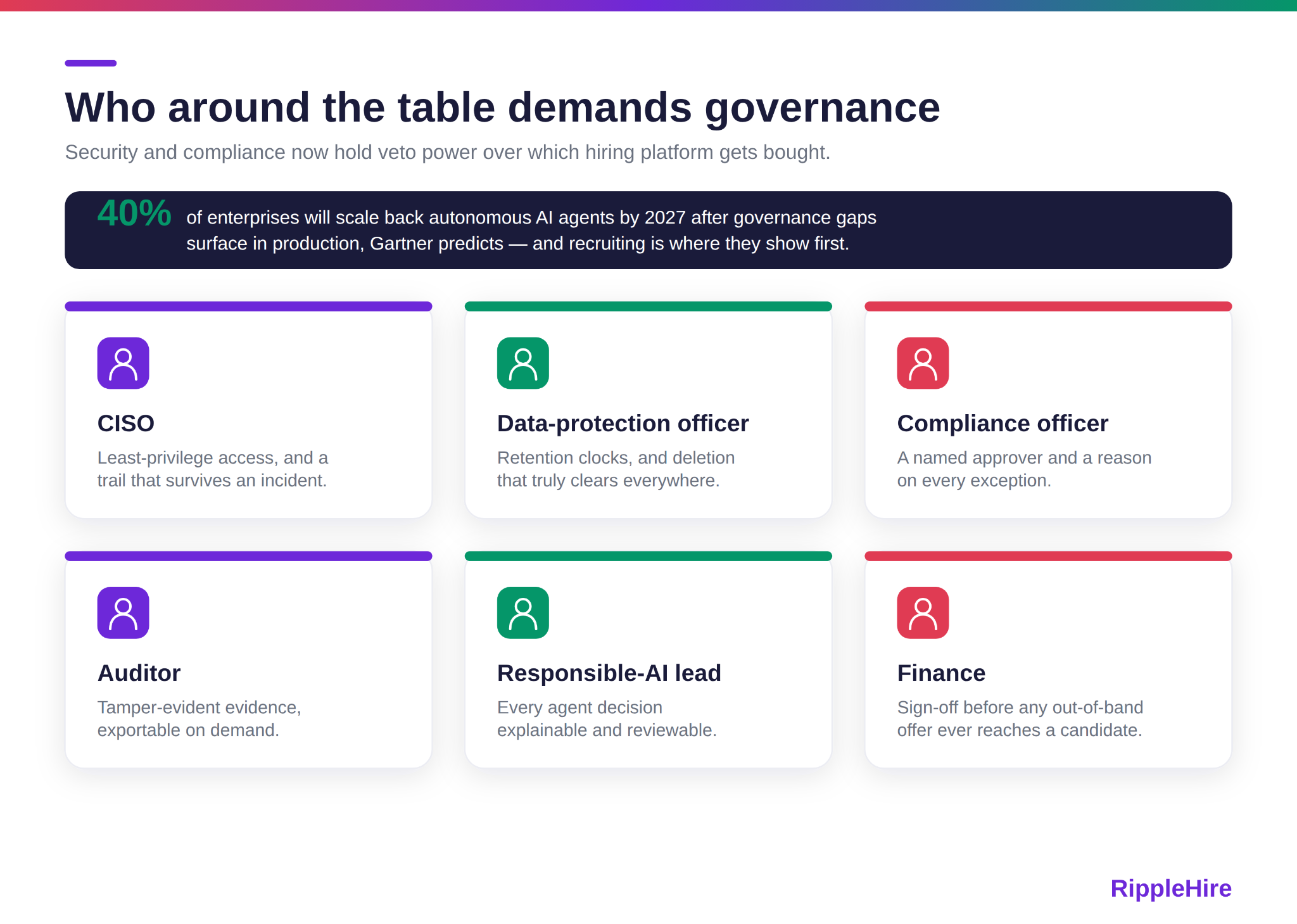
This article walks through the 7 features that provide that proof, the specific risk each one closes, and who around the table will ask for it. A short checklist at the end turns the list into questions you can put to any vendor before you sign.
A quick overview of the 7 enterprise ATS governance features
|
Feature |
Risk it closes |
Who asks for it |
|
Immutable audit trail |
Disputes you cannot reconstruct |
Auditor, CISO |
|
Role-based access control |
Over-broad access and internal leaks |
CISO, data-protection officer |
|
Data retention and deletion controls |
Holding data past its lawful window |
Data-protection officer |
|
Approval workflows for exceptions |
Unauthorized offers and check gaps |
Compliance officer, finance |
|
Bias and fairness monitoring |
Discriminatory outcomes |
Compliance and responsible-AI leads |
|
Agent action logs |
Unexplainable automated decisions |
CISO, responsible-AI lead, auditor |
|
Exportable compliance reports |
Failed or delayed audits |
Compliance officer, auditor |
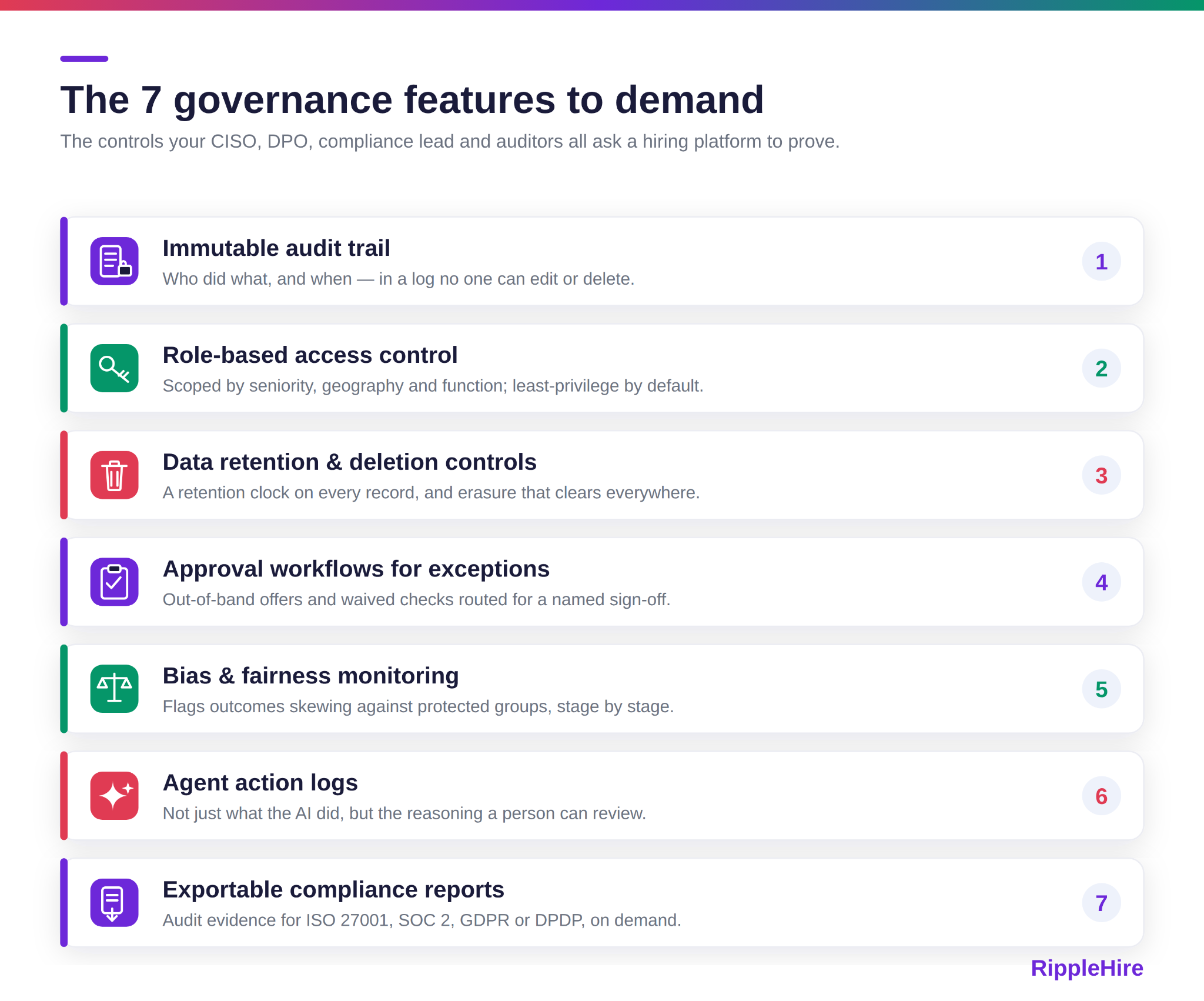
The 7 enterprise ATS governance features to put on your shortlist
Regulators tightened data-protection rules across India, Europe, and the United States, and AI agents started making or shaping hiring decisions that used to sit with a person. As a result, the security and compliance functions now hold real veto power over which platform gets bought, and they evaluate it against a different question than the recruiting team does.
The 7 features below are how a platform answers yes.
1. An immutable audit trail of every recruiter and agent action
An audit trail records who did what, to which record, and when, in a log that no one can edit or delete afterward. The word that matters is immutable. If a recruiter can change a rejection reason after the fact, or an administrator can scrub an entry, the log stops being evidence.
Strong audit trail recruitment software captures the actor, the action, the timestamp, and the before-and-after state, and it treats AI agents as actors in their own right rather than folding their work into a human's account.
The risk it closes: Disputes and investigations where you cannot reconstruct what happened. When a rejected candidate alleges unfair treatment, or an auditor asks how a specific offer was approved, an editable or incomplete log leaves you unable to answer.
Who asks for it: The auditor first, because a tamper-evident trail is what turns a claim of compliance into something they can sign off on. The CISO asks a close second, since the same log is how a security investigation traces access after an incident.
2. Role-based access control by seniority and geography
Not everyone who touches the hiring system should see everything in it. Role-based access ATS controls let you scope what each person can view and do by their level and their location, so a recruiter in one region cannot open candidate files governed by another region's privacy law, and a junior coordinator cannot export a full salary-history report.
Good access control usually works along three axes at once:
- Seniority: a coordinator schedules interviews, a recruiter manages a pipeline, a hiring manager sees only their own requisitions, and an administrator configures the system.
- Geography: access follows data-residency lines, so records collected under one jurisdiction stay visible only to people cleared for that jurisdiction.
- Function: finance sees offer and compensation data, the background-check vendor sees only what its task requires, and neither sees the full candidate history.
The risk it closes: Over-broad access, which is the cause of most internal data leaks and a frequent audit finding. When every recruiter can see every record, a single compromised login exposes the whole database.
Who asks for it: The CISO owns this one, because least-privilege access is a core security principle. The data-protection officer reinforces it wherever cross-border data rules apply.
3. DPDP and GDPR-aligned data retention and deletion controls
A data retention hiring platform does more than store records. It knows when each record is due to be deleted, and it can honor a candidate's request to be forgotten without an engineer running a manual database query.
India's Digital Personal Data Protection Act and Europe's GDPR both require that you keep personal data only as long as you have a lawful reason to, then remove it. Recruiting data is unusually sticky, because a candidate you rejected this year might reapply in two years, so teams tend to keep everything forever, which is exactly what the rules forbid.
Consider what compliant retention looks like in practice.
A rejected applicant's data carries a defined retention clock, the system flags or purges the record when the clock runs out, and a candidate who asks for deletion gets it across the platform rather than in one module while copies linger in another. That completeness is the hard part, and it is what auditors probe.
The risk it closes: holding personal data past its lawful window, and failing to fulfill deletion requests, both of which draw regulatory penalties and erode candidate trust.
Who asks for it: the data-protection officer, squarely. This is the feature they will test most aggressively, often by submitting a deletion request during the trial and checking whether it truly clears everywhere.
4. Approval workflows for offer and background-check exceptions
Standard decisions in hiring follow a familiar path, and the governance risk lives in the exceptions.
Approval workflows force a defined sign-off before anyone overrides a rule, such as an offer above the approved salary band, a waived background-check step, or an expedited start date that skips a verification. The workflow routes the exception to the right approver, records the decision, and blocks the action until someone with authority signs off.
Picture an offer that comes in ten percent above the band for a hard-to-fill role. With a workflow in place, the system holds the offer, routes it to finance and the hiring lead, and logs the approval before the candidate ever sees it. Without one, a recruiter sends the offer, and the finance team discovers the exception weeks later when the numbers do not reconcile.
The risk it closes: unauthorized exceptions that create financial exposure, inconsistent treatment of candidates, and a background-check gap that surfaces only after a bad hire starts.
Who asks for it: the compliance officer, who needs every exception to have a named approver and a reason on record. Finance leaders ask alongside them wherever money and headcount policy are involved.
5. Bias and fairness monitoring on interview scoring
When interviewers and AI agents score candidates, the scores need watching. Bias and fairness monitoring checks whether outcomes skew against protected groups at any stage, from resume screening to interview ratings to final selection, and surfaces the pattern so you can investigate before it becomes a legal problem. The point is not to accuse any individual interviewer.
The point is to catch a structural drift, such as one screening step that consistently filters out a particular group, early enough to fix it.
This matters more as scoring gets automated. Half of business leaders in PwC's 2025 Responsible AI survey named the difficulty of turning AI principles into operational, day-to-day processes as their top barrier (PwC), and fairness monitoring is one of those processes that sounds simple in a policy and proves hard in a live system.
Fairness you cannot measure is fairness you cannot defend. A monitor that flags disparate outcomes turns a principle into evidence.
The risk it closes: discriminatory outcomes, whether from a human pattern or an AI model, that expose the company to complaints and regulatory action under equal-opportunity law.
Who asks for it: the compliance officer and, in many companies, a dedicated responsible-AI or legal function that now reviews any system making decisions about people.
6. Agent action logs that show what the AI did and why
An agent action log is different from a human audit trail, and the difference is the word why.
When an AI agent screens a resume, ranks a shortlist, or drafts an offer, the log should capture not only what it did but the reasoning behind it, in terms a person can read and an auditor will accept. A record that an agent rejected a candidate is not enough. You need the factors it weighed and the logic it applied, so a human can review the decision and stand behind it.
This is the fastest-moving governance requirement of the seven, and it maps directly to the Gartner finding above: enterprises that cannot explain what their agents did are the ones scaling those agents back. Explainability is what keeps an autonomous agent in production rather than shut off after the first incident.
The risk it closes: unexplainable automated decisions that you cannot defend to a candidate, a regulator, or a court, and that leave you unable to tell a good agent decision from a broken one.
Who asks for it: the CISO and the responsible-AI lead together, with the auditor close behind. Anyone who has to certify that the company's AI is under control needs this log to do it.
7. Exportable compliance reports for audit season
Audit season should not mean a scramble. Exportable compliance reports let you generate the evidence an auditor wants, such as access logs, retention status, exception approvals, and agent decisions, in a clean format on demand rather than assembling it by hand across systems. Mature ATS compliance features include pre-built report templates mapped to the frameworks you answer to, whether that is ISO 27001, SOC 2, GDPR, or DPDP.
The difference this makes is measured in weeks. A team without exportable reporting spends the run-up to an audit pulling screenshots and reconciling spreadsheets, while a team with it runs a report and moves on. That gap is the clearest sign of whether governance is built into the ATS platform or bolted on afterward.
The risk it closes: failed or delayed audits, and the staff time lost to manual evidence-gathering every cycle.
Who asks for it: the compliance officer and the auditor, who together decide what evidence counts. The CISO relies on the same reports for security certifications.
Ask your ATS vendor to show you these seven things live
The cheapest time to test governance is during the demo, while the vendor is still trying to win you and every claim is easy to check against a live screen. Do not accept a slide that says a feature exists. Ask to see it work, on real configuration, with your own reviewers watching. Run through this list before you commit.
- Audit trail: Perform an action, then try to edit or delete the log entry. It should refuse.
- Role-based access: Log in as a junior coordinator and as a recruiter in another region, and show what each one cannot see.
- Deletion request: Submit one, then prove the record is gone everywhere, not just in the main view.
- Exception approval: Push an out-of-band offer and show the workflow holding it until the right person signs off.
- Fairness report: Display how the system surfaces disparate outcomes across a hiring stage.
- Agent's reasoning: Have an AI agent make a decision, then show the log that explains why it decided that way.
- Audit export: Generate a compliance report for one framework and hand it over as the file an auditor would receive.
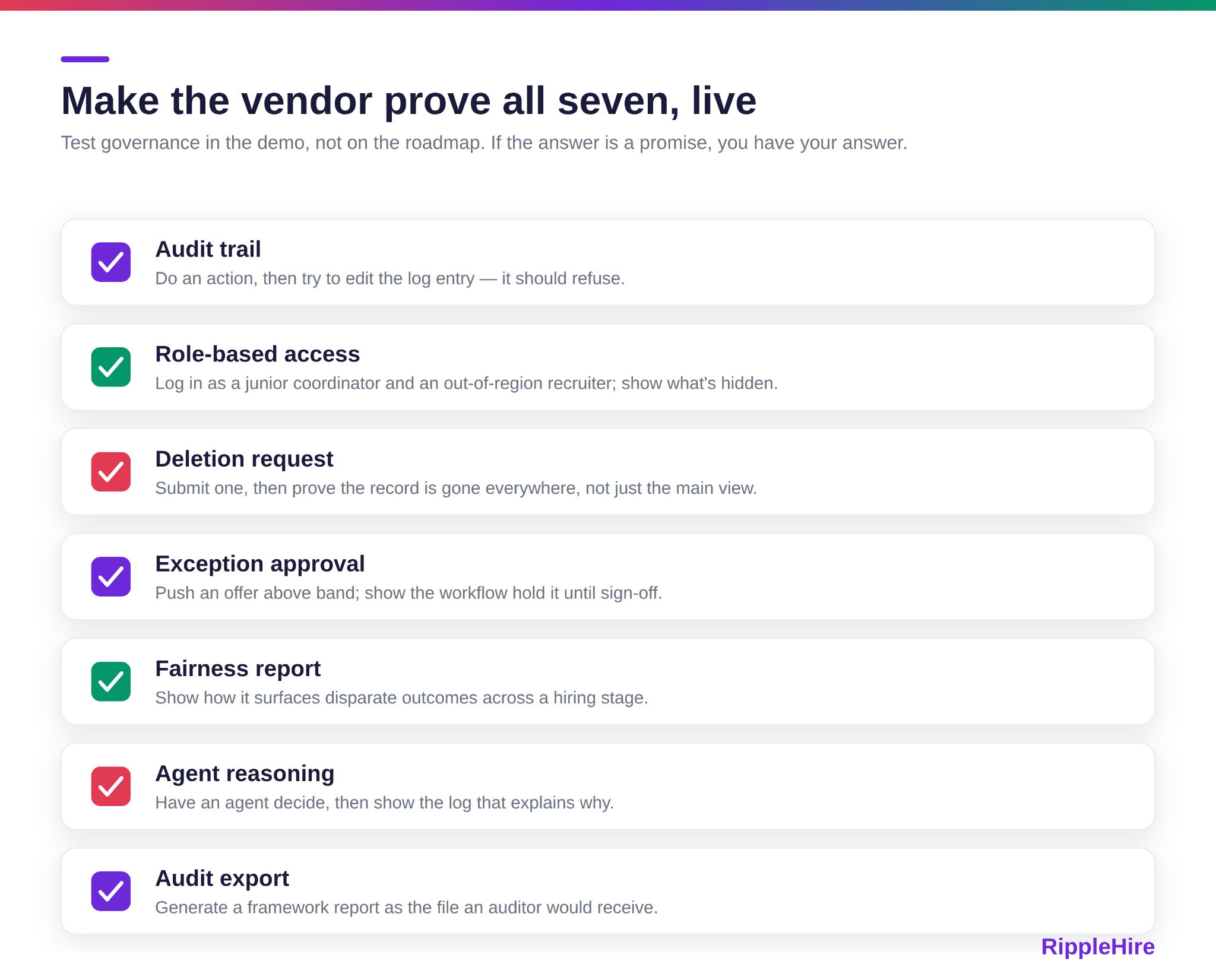
If a vendor can walk your CISO, your data-protection officer, and your compliance lead through all seven live, governance is built into the product. If the answers turn into promises about the roadmap, you have your answer too.
Choose RippleHire for AI hiring your auditors will trust
Choose RippleHire for governance that is built in, not bolted on
The seven features above share one theme, which is that governance has to be part of the platform from the start rather than something you assemble around it later. That is where RippleHire is built to fit.
- Hosted on Google Cloud and AWS, with AES-256 encryption at rest and TLS 1.2 in transit.
- Certified to ISO 27001 (since 2016, audited annually by BSI) and SOC 2 Type II, with GDPR compliance since 2018 and CCPA support.
- Role-based access control, mandatory MFA, and SAML 2.0 single sign-on, so what a junior coordinator can see and what a recruiter in another region can see are enforced by the system, not by policy.
- Comprehensive audit logging and full session logging across the platform, so every action carries a record.
- Configurable data retention and erasure controls, plus a defined data-subject-request process, so a deletion request is honored across the system rather than in one view.
- Responsible-AI controls: agents avoid sensitive attributes like gender, ethnicity, and age, every recommendation carries explainable logic a human can review, and the AI systems are audited periodically.
RippleHire is the place where recruiters and agents work together, each owning the part of hiring they do best, and the governance covers the whole system rather than one corner of it. Recruiters keep human judgment and accountability, while every control of your compliance and security functions require stays in force underneath.
But if governance is what stands between you and a modern hiring stack, the useful next step is to see the controls yourself. Book a RippleHire demo and put these seven features in front of your own security and compliance team before you shortlist a platform.
Frequently asked questions
What are enterprise ATS governance features?
They are the controls that let a large employer prove its hiring system is used safely and lawfully. This includes audit trails, role-based access, data retention rules, approval workflows, fairness monitoring, logs of what AI agents did, and exportable reports for audits. Recruiting teams focus on speed, while security and compliance teams focus on these controls. Together they decide whether a platform is safe to buy and run at scale.
Why does an ATS need an audit trail?
An audit trail records who did what to each candidate record and when, so you can reconstruct any decision later. Without one, you cannot answer a rejected candidate's complaint or an auditor's question about how an offer was approved. The trail also needs to be tamper-evident, meaning no one can edit or delete entries. That is what turns your record from a claim into evidence a regulator or auditor will accept.
How long should a company keep candidate data?
Only as long as there is a lawful reason to hold it, then it should be deleted. Data-protection rules in India, Europe, and elsewhere require defined retention periods rather than keeping records forever. Many teams over-retain because rejected candidates sometimes reapply, but that habit creates legal exposure. A good hiring platform assigns a retention clock to each record and can honor deletion requests completely, across every module, not just the main view.
Is role-based access control really necessary for hiring software?
Yes, and skipping it is a common audit finding. When every recruiter can see every candidate file, a single compromised login exposes the entire database, and cross-border privacy rules get broken by accident. Role-based access limits what each person sees by their seniority, location, and function, so people only reach the records their job requires. It is a core security principle, and reviewers treat its absence as a serious gap rather than a minor inconvenience.
How do you govern AI agents used in recruiting?
Start by treating each agent as an actor that must log its actions and the reasoning behind them, in terms a person can review. Set the level of oversight to match how much the agent can do on its own, and keep a human accountable for consequential decisions like rejections and offers. Test the explainability before you deploy, not after. Agents that cannot explain their decisions are the ones companies end up switching off once problems appear.