
.svg) Product
Product

.png)


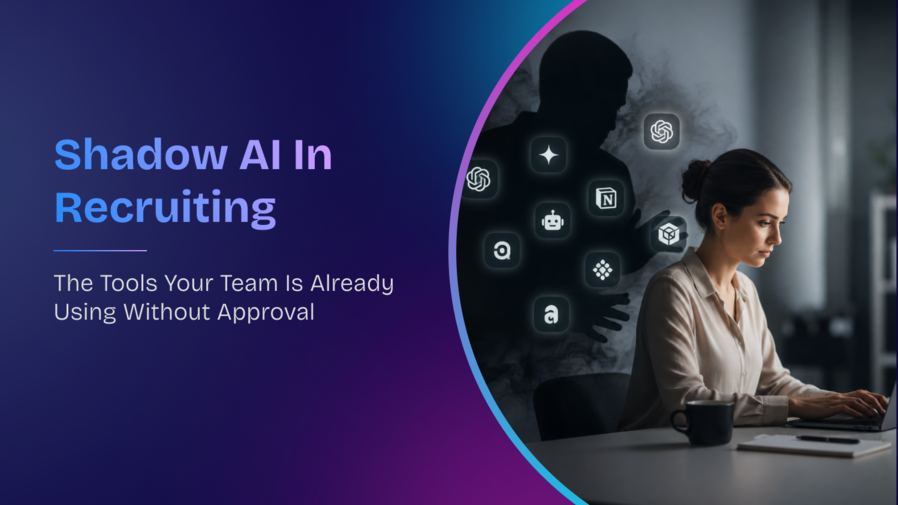


Table of content
Recruiters are already using AI that your organization never approved. Some of it is a free chatbot rewriting a job description at 9pm before a hiring manager's deadline, and some of it is a browser extension summarizing an interview recording. Shadow AI in recruiting describes that whole layer: real work, on real candidate data, in systems your security and legal teams have never seen. Research by KPMG and the University of Melbourne, covering more than 48,000 people across 47 countries, found that 57% of employees hide their use of AI at work, and that only 40% say their workplace has any policy on generative AI.
None of this is a rogue-employee story. Recruiters reach for these tools because the approved stack moves slower than the requisition, or because it does not cover the task. Ban them and the usage moves further out of sight; offer something better and the layer loses its reason to exist.
What shadow AI in recruiting actually looks like
The phrase sounds dramatic and the reality is mundane. It is a recruiter with a deadline, a browser tab, and no reason to think twice. The same few patterns recur across almost every enterprise talent team.
- Pasting a candidate CV into a public chatbot for a summary or a shortlist rationale
- Generating job descriptions, outreach sequences, and offer letters in a consumer writing tool
- Running interview recordings through a free transcription or note-taking app
- Asking a chatbot to score a batch of applicants against a role
- Installing an unvetted sourcing extension that reads the ATS in the browser
Every task there is legitimate and done in good faith, and none of them leave a record in your system of record. That is what keeps the layer invisible until something goes wrong. Even the widely shared lists of ChatGPT prompts for recruiters assume a tool few TA functions have assessed.
Why unapproved AI tools spread faster than approved ones
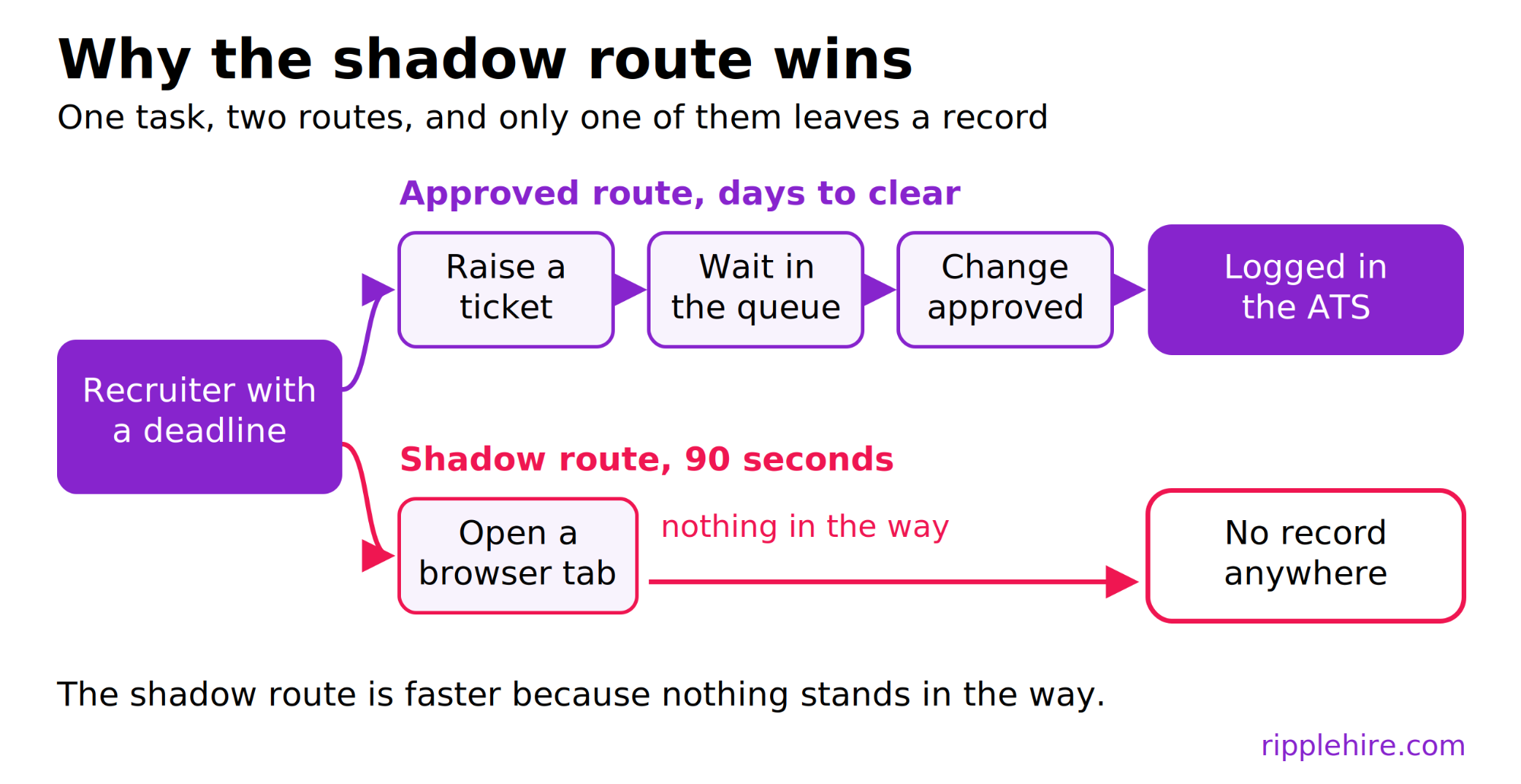
Shadow AI grows for structural reasons rather than cultural ones. Every case traces back to a gap between what a recruiter must do today and what the sanctioned toolset lets them do. Four gaps cover nearly all of it.
The approved tool is slower than the deadline
A hiring manager wants a shortlist by end of day. The official workflow needs a configuration change, which needs a ticket, which needs a queue. Moving that work onto the platform does win hours back on screening and scheduling, but the shift takes a quarter and the requisition is open now.
The approved tool does not cover the task
Plenty of daily recruiting work has no official equivalent anywhere in the stack:
- Rewriting a technical job description for a non-technical audience
- Turning forty minutes of interview notes into a structured summary
- Translating a role brief into three languages for a regional drive
No policy covers these, because no tool covers these.
Nobody ever said no clearly
Ask a recruiter whether consumer AI is allowed and you get one of three answers:
- "IT never blocked it, so I assumed it was fine."
- "There is a policy, but it does not mention my situation."
- "My manager uses it, so it must be acceptable."
Ambiguity reads as permission.
Shadow IT in talent acquisition has a template
Personal file-sharing accounts once held candidate documents, and spreadsheets on personal drives tracked whole hiring drives. Shadow IT in talent acquisition never spread because people wanted to break rules. It spread because the sanctioned path cost more than the work was worth, and AI has made that route far more capable.
Four risks that shadow AI creates in hiring
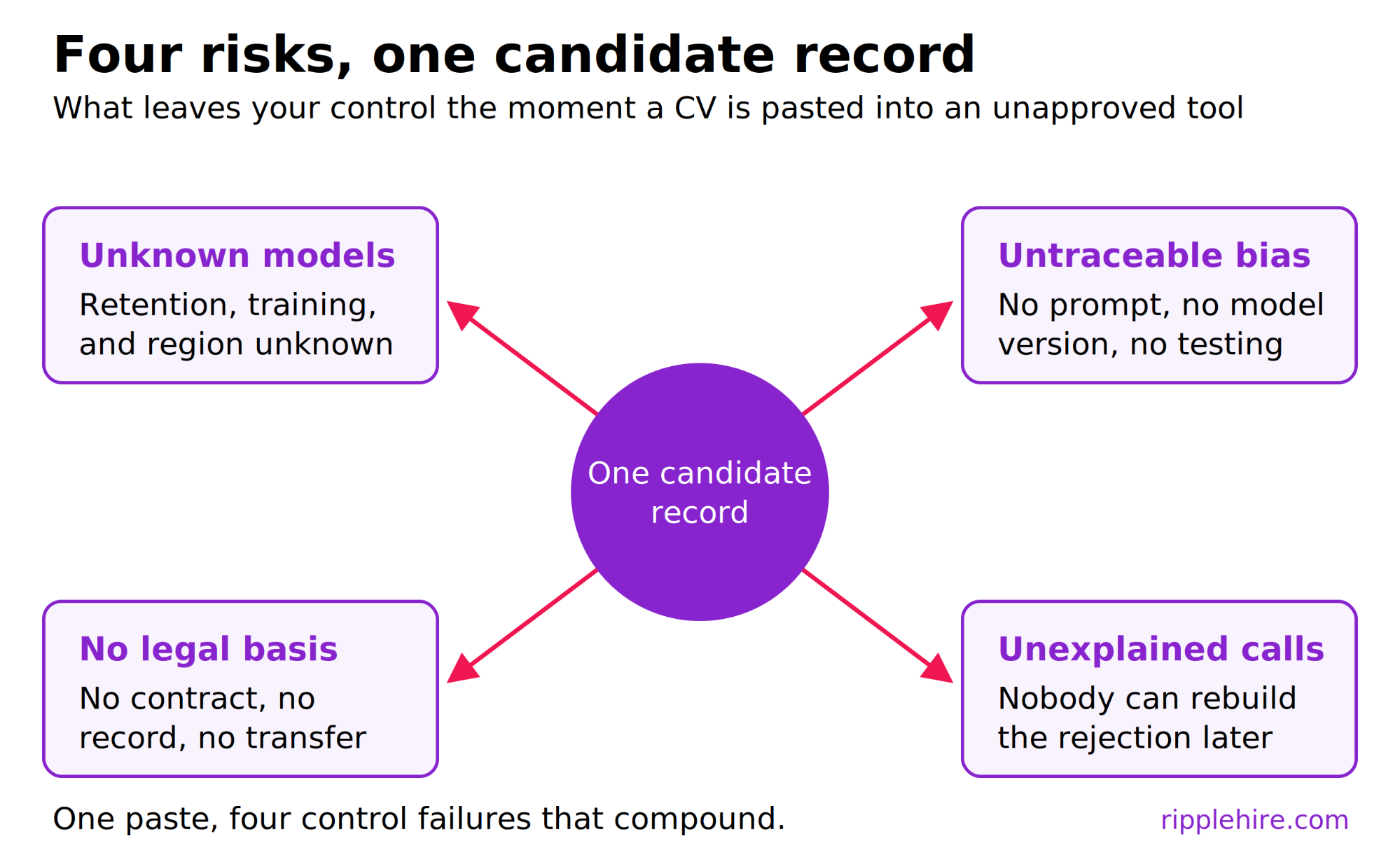
The exposure runs wider than the data leak teams name first. Shadow AI touches how candidate data travels, how decisions get made, and whether you can explain either later. These risks compound, and the fourth surfaces in a tribunal or an audit.
Candidate data lands in models you never assessed
A pasted CV carries the candidate's name, contact details, employment history, and sometimes salary expectations into an environment nobody in your organization has reviewed. You do not know the retention period, whether the content trains a future model version, or where the servers sit. Free tiers carry the weakest data commitments, and free tiers are what a recruiter reaches for at 9pm.
Bias arrives with no audit trail
Consumer models are trained for general use rather than lawful hiring, and they carry the correlations of their training data into any ranking you request. That is manageable in a governed system, unmanageable in a browser tab:
- No record of the prompt that produced the shortlist
- No record of the model version, which changes without notice
- No way to test outcomes across gender, age, or region
- No way to show a regulator or a works council how a candidate was scored
Structured interviewing and unconscious bias in recruitment work spent a decade making hiring decisions inspectable. An ungoverned chatbot undoes that in one step.
DPDP and GDPR exposure when candidate data crosses unauthorized systems
Regulators draw no distinction between a system you chose and a system your recruiter chose. Three obligations break at once:
- Purpose and consent. Processing candidate data through an undisclosed third party sits outside the purpose the candidate was told about.
- Processor governance. GDPR expects a written contract with anyone processing personal data on your behalf, plus a record of it. A personal consumer account has neither.
- Cross-border transfer. If the tool's infrastructure sits outside your approved regions, nobody has answered the transfer question.
India's position sharpened recently. Parliament enacted the Digital Personal Data Protection Act in August 2023, and the government notified the DPDP Rules on 14 November 2025 with an eighteen-month phased compliance period, per the Press Information Bureau. Its highest penalty, up to ₹250 crore, applies to failures of reasonable security safeguards. Treat DPDP Act obligations and your GDPR duties in talent acquisition as one problem, not two regional ones.
AI-specific hiring rules sit on top of that, and each one asks you to declare what touched the decision. New York City's Local Law 144 has required a bias audit and candidate notice for automated employment decision tools since enforcement began in July 2023. The EU AI Act classifies recruitment and candidate-selection systems as high risk under Annex III. Application dates for the AI Act's high-risk duties have moved more than once, so confirm the current position with your counsel rather than with any article, including this one.
Hiring decisions you cannot reconstruct
Six months after a rejection, a candidate asks why. Your recruiter used a tool that no longer retains the conversation, on a model version since replaced, with a prompt nobody saved. That absence becomes the finding once a compliance breach gets investigated.
Consistency suffers before compliance does. Two recruiters using two consumer tools on one requisition apply two different standards, and your hiring bar becomes whatever each chatbot emphasized that week.
How to find the shadow AI already in use
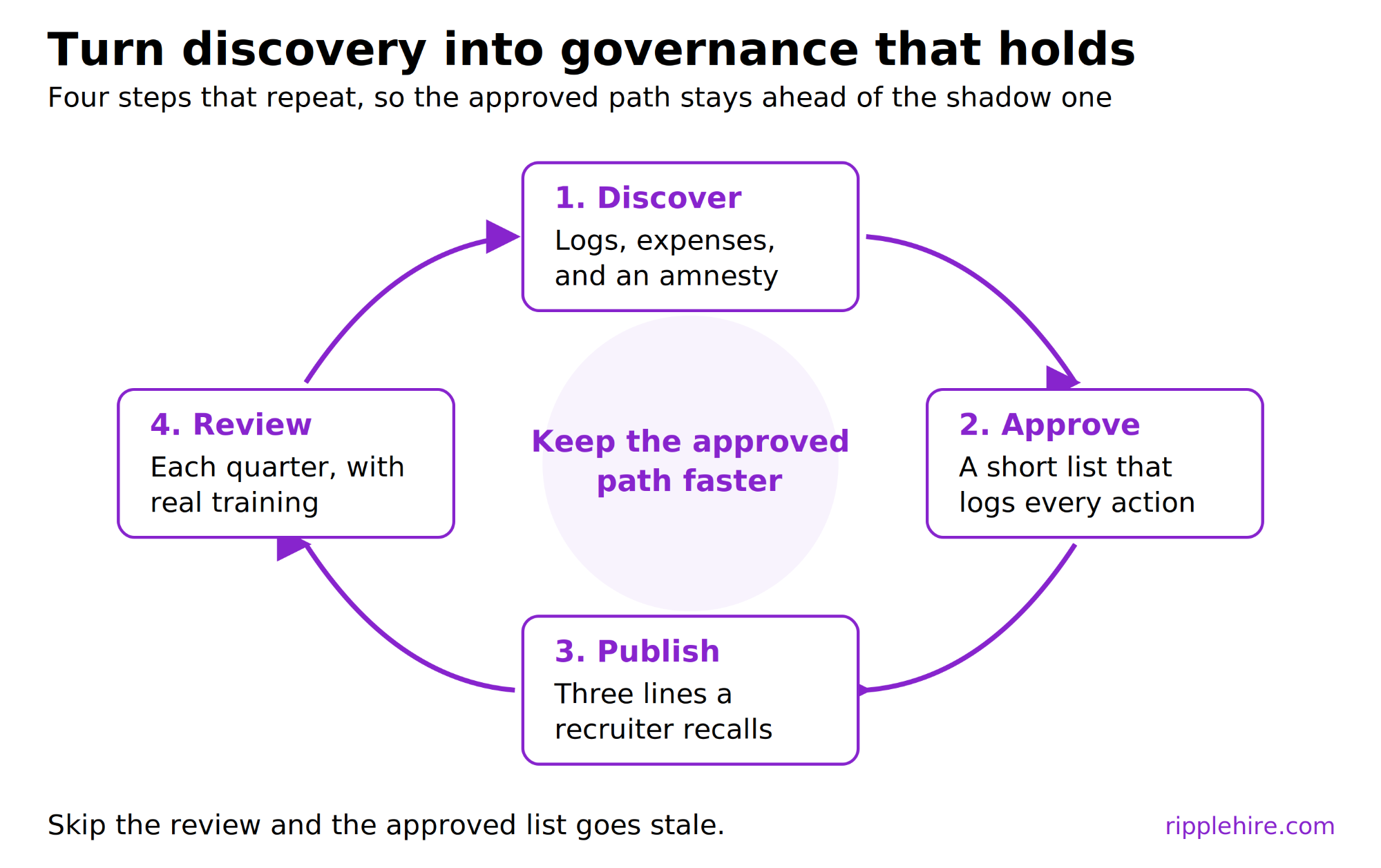
Governing what you have not measured is guesswork, and asking "is anyone using unapproved tools?" in an all-hands returns a silent room. Discovery works better when it draws on records people are not thinking about. Run these together over two to three weeks.
- Expense and card data. Search reimbursement claims for AI vendor names and small recurring charges, usually under twenty dollars and coded as software.
- Single sign-on and OAuth grants. Pull the third-party applications connected to your identity provider, email, and calendar. Browser extensions that read the ATS surface here.
- Network and proxy logs. Ask security for outbound traffic to known AI domains, filtered to the TA function.
- Content forensics. Review job descriptions and outreach templates for tonal uniformity. Sudden consistency among recruiters who never wrote alike is a signal.
- Meeting apps. Look for note-taking bots joining interview calls. They appear in attendee lists.
- A no-blame amnesty window. Give people two weeks to declare what they use, with a commitment that nobody gets disciplined for answering.
- Agency attestation. Ask every staffing partner in writing which AI tools touch your candidates.
Treat the amnesty window as the most valuable of the seven. Logs tell you which tools people use, and only people tell you why. That answer becomes your roadmap for what to approve, and it drives upskilling your recruiters.
Where agencies and RPOs fit into the picture
Discovery stops at your own perimeter, and much of enterprise hiring happens outside it. Staffing agencies, RPO partners, and offshore sourcing teams handle your candidates on their infrastructure, under their tool choices. A candidate you protect internally can still pass through three unapproved models before their CV reaches your ATS.
Put the obligation in writing rather than in a conversation:
- Require a declared list of AI tools used on your account, refreshed at each renewal
- Prohibit uploading your candidates' data into consumer or free-tier AI services
- Require disclosure on the submission when AI assisted the screening
- Extend breach notification and audit rights to cover AI tooling
Enterprises already track sourcing-partner quality through attribution. Extending that scrutiny to how a partner builds a shortlist does more to reduce compliance risk than another training module for your own team.
Build AI governance in recruiting that people actually follow
Governance fails when it is written as a prohibition and enforced as a hope. It works when the approved path runs faster than the shadow path, when the rules name real recruiting tasks, and when it protects recruiter control and candidate trust, the pair shadow tools trade away first.
Approve a short list of tools that log what they do
Every approved tool should produce a retrievable record: which candidate, which action, which user, which timestamp. That is the difference between a governed system and a chatbot, and why agentic AI in talent acquisition belongs inside the platform rather than beside it.
Write a policy that names permitted consumer uses
Blanket bans read as unreasonable, and recruiters route around them within a week. A workable policy draws three lines:
- Permitted. Non-candidate work, such as rewriting a public job posting or brainstorming interview themes
- Allowed with conditions. Candidate-adjacent work in an enterprise account with retention controls and training disabled, logged afterward
- Never. CVs, contact details, interview recordings, feedback, or salary data in a consumer tool
Publish the reasoning beside each rule. Someone who understands why the third line exists will hold it at 9pm.
Review the list on a fixed schedule
AI capability changes faster than annual policy cycles, and a stale approved list rebuilds the shadow layer on its own. Run a quarterly review on three questions: what did people ask for and not get, where has the approved set failed, and what changed in the tools.
Skills are the constraint here, not intent. Gartner research published in October 2025 found that only 8% of HR leaders believe their managers have the skills to use AI effectively. Pair each review with training, or approved tools sit unused while shadow tools keep working.
Replace shadow tools with AI agents built into your hiring system
Recruiters do not need fewer AI capabilities. They need the ones they already use to sit inside a system that logs, governs, and stands behind them. Shadow AI in recruiting is a symptom of an approved stack that cannot keep up, and when the AI lives where hiring happens, the fastest path and the compliant path become one.
RippleHire is the place where recruiters and agents work together. It is a high-performance AI ATS for global enterprises, running at one hire every four minutes across more than 50 countries, with enterprises including LTIMindtree and Mphasis hiring on it across multi-country operations.
What that gives a TA function facing this problem:
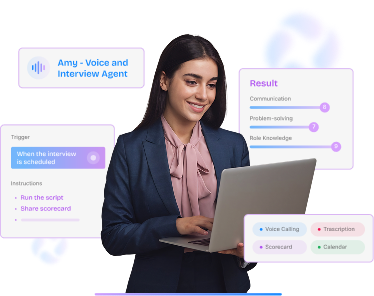
- Amy, the built-in AI interview agent, which automates level one interviews, runs AI proctoring in real time, and returns structured reports with scores and red flags
- Interviewer Copilot inside Microsoft Teams and the feedback page, preparing role-specific questions from the job description, resume, and prior rounds
- An AI Voice Agent that handles pre-screening calls around the clock and returns structured summaries to recruiters
- A tamper-proof audit trail of edits, uploads, approvals, and interview changes, the timestamped record consumer tools cannot produce
- Compliance management that follows multi-country hiring rules on autopilot, backed by SOC 2 Type 2, ISO 27001, GDPR compliance, and privacy by design
Book a demo and see how RippleHire's built-in AI agents replace the need for shadow tools.
Frequently asked questions
What separates shadow AI from ordinary shadow IT in a hiring team?
Shadow IT covers any unapproved software, such as a personal file-sharing account or a messaging group used for interview feedback. The AI version is a subset with sharper consequences, because the tool does not merely store candidate information, it interprets it. A ranked shortlist produced outside your systems influences who gets hired, and that influence leaves no record anyone can inspect later.
How should we respond when we discover a recruiter using an unapproved tool?
Separate the discovery from the discipline. Your first conversation should establish what task the tool solved, how long it has been in use, and which candidate records passed through it. Handle the data exposure through your existing incident process. Then treat the underlying need as a product gap, because punishment without a replacement guarantees the same behavior returns within a month.
Who should own AI governance for recruiting, HR or security?
Neither one alone. Security owns tool assessment, data flows, and the approval mechanism, because that work already exists for every other system. Talent acquisition owns the task inventory, the policy language recruiters read, and adoption of whatever gets approved. Legal owns the disclosure and retention questions. Name a single accountable owner in TA anyway, or the review slips whenever quarter-end hiring pressure arrives.
What should an audit trail for AI-assisted hiring decisions contain?
At minimum it records which candidate was assessed, which system assessed them, which version ran, what inputs it received, what it returned, and which person reviewed the output before acting. Timestamps and user identity matter as much as the result. The test: could you reconstruct that decision for a regulator or the candidate a year later without relying on memory?
What do we do about candidate data that has already gone into a consumer tool?
Work backwards from the account, not the person. Establish which tool, which tier, and what its retention settings were at the time, then submit a deletion request and disable chat history and training on any account that stays. Ask legal whether the exposure meets your breach reporting threshold. Prepare an answer now for the data subject request that arrives later, because someone will ask.