
Amy carries the busywork
Screening, scheduling, reminders, and follow-ups run automatically. See a live interview agent handle the work that buries your team.
.png)
Recruiters keep the wheel
Every action is visible, auditable, and reversible. Your team sets the guardrails and stays accountable for the call.
.png)
Your Recruitment Debt, mapped
We walk your current process and surface where manual handoffs, stale data, and slow stages are quietly costing you hires.


.svg) Product
Product
 Core Modules
Extended Modules
Experience
RippleHire AI
Core Modules
Extended Modules
Experience
RippleHire AI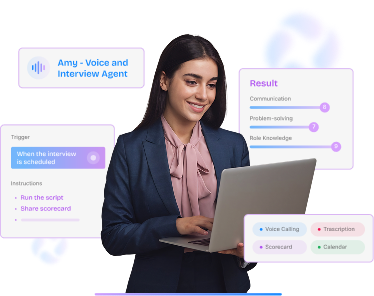 Meet the agents
How the platform works
Responsible AI & Governance
Solution
Meet the agents
How the platform works
Responsible AI & Governance
Solution.png) By Role
By Industry
By Hiring Type
Customers
By Role
By Industry
By Hiring Type
CustomersWatch our new season Podcast - TS Talks!
 Customer Stories
Proof & Community
Resources
Customer Stories
Proof & Community
ResourcesUnlock groundbreaking insights into people, culture, and talent acquisition.
 Download
our Exclusive Ebook
Download
our Exclusive Ebook
Advanced thinking in talent science and culture Actionable frameworks for HR leaders Case studies and results from industry pioneers
Talent science
Comparisons
Company
Talent science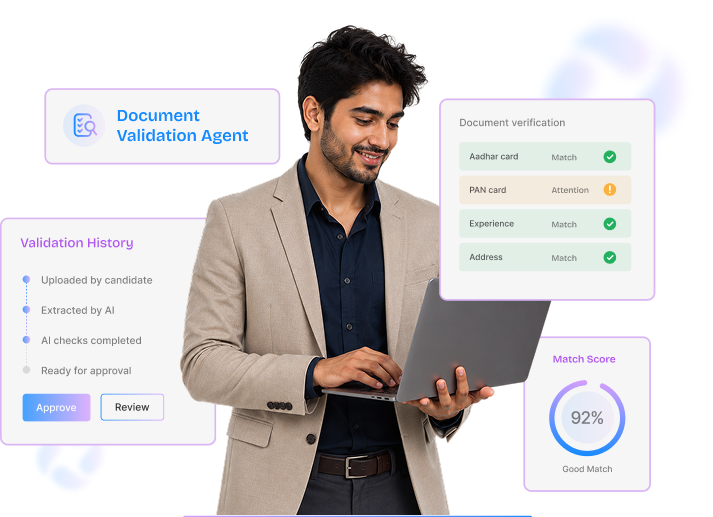
AI has made hiring worse.
Here is how to fix it.
More applications. More fake
profiles. Flat teams. New compliance requirements. AI has amplified every problem in enterprise
hiring without solving the one that matters: getting the right recruiter in front of the right
candidate at the right moment.
The answer is not more automation. It is the right division of labour. Agents handle systematic
grunt work. Recruiters make decisions and close.

Gen AI has created a perfect storm. Every candidate looks qualified on paper, and all the keywords match. But your time-to-hire has worsened because you are drowning in false positives. Stop interviewing your way to the truth. Start with AI that can assess competence and depth upfront.
Sudarsan Ravi
Founder and CEO, RippleHire

Four forces that changed the math behind enterprise hiring.
These are not predictions. They are forces every enterprise TA leader is already managing. Together, they
have made the old model of
recruiting unworkable.
3 to 5x
Application volume
LLM-assisted applications have turned every requisition into a firehose. Top of funnel has tripled in 18 months. The recruiter reviewing applications has not.
1 in 4
Profiles are flagged
Fake resumes, deepfake interviews, vendor-submitted synthetics. The screening layer that worked for the last decade was not built for this.
Flat
TA headcount
CFOs have frozen TA hiring while requisitions and hiring processes expand. The gap between work and workforce keeps widening. Pushing the existing team harder burns them out.
New Bar
AI scrutiny
Hiring decisions made by AI are now expected to be explainable, auditable, and defensible. The compliance bar has moved faster than most enterprise ATS platforms.
The bind: hiring more recruiters is too expensive. Pushing the
existing team harder burns them out.
Enterprise TA is out of moves — which
is why agents and recruiters must work together.
What agents handle. What recruiters handle. At every stage.
The real cost of the old model is not wasted hours. It is unlogged decisions, unenforced
Recruiters stop being coordinators. They go back to being closers. This
is what the division of labour looks like across the full hiring funnel.
Stage
Agent handles
Recruiter handles
 Demand

Determine job quality, assign team and agents, auto-publish externally across channels.

Drive clarity and set expectations with hiring managers and stakeholders.
 Source

Surface best-match profiles from internal and external pipelines. Rank by skills, availability, and location.

Review shortlisted candidates. Decide who progresses to the next step.
 Screen

Review applicant volume, surface best matches, run phone screens, skill tests, and fraud checks.

Focus on high-potential candidates. Review exceptions and edge cases.
 Interview

Auto-record and transcribe. Generate role-specific questions. Pre-fill feedback forms. Flag inconsistencies.

Focus on candidate quality and hiring fit. Make the evaluation decision.
 Offer
Offer

Validate documents. Route approvals through the correct chain. Generate offer letters within configured salary bands.

Close the right candidates. Manage negotiation and candidate relationships.
 Onboard

Run background verification, validate documents, automate joining communications by window.

Make sure the right person shows up on Day 1.
This is not an efficiency problem.
It is a
governance problem.
The real cost of the old model is not wasted hours. It is unlogged decisions, unenforced
policies, and audit trails that cannot survive a regulator.
No deterministic policy execution
Same candidate. Two recruiters. Two different outcomes. No rule enforced. No record of why. Agents apply the same logic every time, with no variation.
No auditability at scale
When a regulator asks for records, most enterprise ATS setups produce email trails and gut feel — not timestamped logs of every decision. Agents generate that trail by default.
Offer policy enforced by trust
Salary band breaches and skipped approvals are discovered during audits, not before the offer reaches the candidate. Agents enforce policy at the point of action.
The question is not: can we automate this? It is: who controls the rules, who audits the decisions, and who is accountable when something goes wrong?
Sudarsan Ravi
Founder and CEO, RippleHire
Why RippleHire's agents work differently from every other platform.
Any AI agent is only as good as the hiring context it operates in. Generic AI tools do not have
what
RippleHire has built over 14 years.
14 years
DomainBuilt from real-world enterprise recruiting needs, not retrofitted from a general HR system. Every agent reflects how enterprise recruiting actually works.


86M
Candidates processedTrained on real hiring data across 50+ countries and hundreds of job types. That is the depth of signal generic AI models do not have.
12M
Interviews capturedProduction-grade orchestration built on real interview data, not a raw language model. Agents that understand hiring, not just language.


What enterprise
teams achieve with
RippleHire AI:
-
 40% lower time-to-hire
-
 3 to 5x hires per recruiter
-
 60% fewer no-shows
-
 4.7/5 candidate experience
How this compares to the alternatives.
Two other categories claim to solve enterprise hiring with AI. Neither gets the balance right.
Traditional ATS
- Workflow rules only, no native agents.
- No audit trail on AI-influenced decisions.
- Generic compliance, not hiring-specific.
- Slow to adopt AI without breaking existing workflows.
AI-first platforms
- Black-box scoring with no explainable reasoning.
- Designed to replace humans, not work alongside them.
- Hard to audit when decisions are challenged.
- High adoption risk without recruiter buy-in.
RippleHire Agent Builder
- Agents and recruiters working together, not one replacing the other.
- Hiring-native primitives built from 14 years of enterprise TA data.
- Stringent operating modes — Assisted, Semi-autonomous, Autonomous.
- Native execution logs for every agent action and human decision.
- Admin-only configuration with recruiter-controlled outputs.
- Five agent categories live in production today.
Thirty minutes. On your data. You leave with a working agent.
Book a demo and we will configure a live agent against your own hiring data. Not a product tour — a working session.