

.svg) Product
Product


.png)


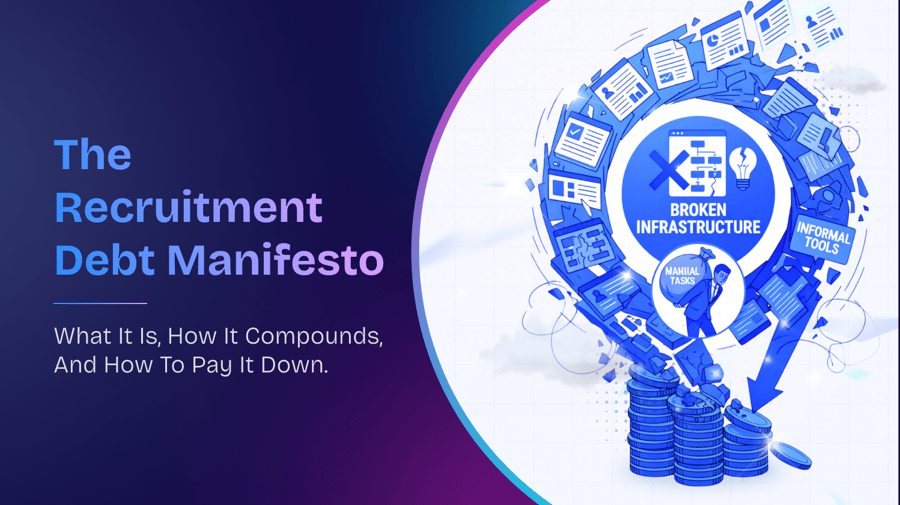


Table of content
There is a recruiter somewhere whose Tuesday looks like this.
At 8:30 AM she has not spoken to a single candidate. She is chasing three hiring managers for feedback on last week's shortlists. Two have not responded. One replied "looks good" without naming which candidate.
Between messages, she re-enters candidate information that already exists in the previous system into the current one, because the integration between the two was never built.
At noon, an offer letter she generated last week is still sitting in the approvals chain. The hiring manager signed it. The department head is traveling. HR operations are waiting on a legal sign-off on a single clause. The candidate has been waiting nine days. He has another offer on the table.
At 3 PM she is scheduling interviews for twelve candidates, cross-referencing the availability of four panel members. Two members have a conflict. She starts again.
At 5 PM she receives an agency call for a role that was filled three weeks ago. Nobody informed the agency. She apologizes and hangs up. The retainer continues.
At no point in that day was this recruiter bad at her job. She is organized, detail-oriented, and genuinely skilled at the parts of recruiting that require a human: reading a candidate's hesitation in a conversation, navigating a salary negotiation where both sides have room to move, convincing a strong candidate that this role is worth choosing over the competing offer that arrived the same week.
The problem has nothing to do with the person running the process. It has everything to do with the process itself.
There is a name for what is happening. Most organizations have been living with it for years without one.
Naming the problem
In 1992, a software engineer named Ward Cunningham gave a name to something the technology industry had been living with for years. He called it technical debt.
The concept was precise. When engineers write code under pressure, taking shortcuts to ship faster, those shortcuts accumulate. They work today. Six months later, the team is spending more time managing the old mess than building new things. Features that should take a week take three. The system works, but barely, and every addition makes it harder.
What Cunningham contributed was not the observation. Engineers had felt this for years. What he contributed was the name. Once you could call it debt, you could measure it. Once you could measure it, you could make the case for paying it down.
The same accumulation has been happening in hiring for over a decade. Recruiters build workarounds for approval flows that do not work. TA teams maintain shadow trackers in spreadsheets because the official system does not do what they need. Agencies become the default answer to any sourcing problem because internal channels were never properly invested in. Every quarter, the workarounds multiply.
Recruitment Debt is the accumulated operational and financial cost of shortcuts, manual work, and disconnected tools in a company's hiring process. Like technical debt in software, it compounds silently, slowing hiring, burning out recruiters, and inflating cost-per-hire, until it is paid down through systemic automation and intelligence, not more tools.
We just did not have a name for it.
The four pillars of Recruitment Debt
Recruitment Debt does not accumulate in a single place. It builds across four distinct areas of a hiring operation, each with its own compounding logic, each doing damage that stays largely invisible until an organization reaches significant hiring volume or hits a moment of pressure that makes the underlying fragility visible.
Pillar 1: Process Debt
The cost of how hiring is run.
Process Debt is what accumulates when a team's hiring execution is held together by workarounds rather than structure. It is the most visible type of Recruitment Debt and the most normalized. Teams live with it long enough that they stop noticing it is there. It becomes the job rather than an obstacle to the job.
It looks like recruiters spending hours cross-referencing panel availability for every batch of candidates, resending when conflicts emerge, starting over when schedules change. It looks like offer letters that take five to eight days to complete a process that requires no deliberation. It looks like hiring manager feedback collected over WhatsApp because the official feedback module was set up poorly and retrained nobody.
Self-diagnostic: how many hours per week does your team spend on work that should not require a human?
Pillar 2: Data Debt
The cost of institutional knowledge that lives nowhere useful.
Data Debt means every hire is more expensive than it needs to be because the organization keeps relearning things it already knew. A strong second-place candidate from eight months ago is never found when a similar role opens. A hiring manager's preferences are discovered only after three rounds of misaligned submissions. A successful sourcing experiment is never recorded and is run again a year later by someone who did not know it had been tried.
Every recruiter who leaves takes a piece of the institution's candidate knowledge. The team that replaces them does not inherit the knowledge. They inherit the vacancy.
Self-diagnostic: if your top recruiter resigned today, what would you actually lose?
Pillar 3: Experience Debt
The cost of how candidates and hiring managers feel.
Experience Debt is the hardest type to quantify and the easiest to underestimate. It lives in the gap between how a hiring process looks from the inside and how it is experienced from the outside.
From the inside, things are under control. The team is working hard. Cases are moving.
From the outside, a candidate finished a two-hour assessment and three weeks later still has no word. A hiring manager submitted a requisition six weeks ago and has received two status updates and no timeline. An employee referred someone they vouched for personally, never heard what happened, and will not refer again.
Experience Debt compounds through reputation. The candidate who received no response tells the story. Not loudly, not in a public forum, but in the way professionals talk about employers in their circles. In sectors where talent brand is a direct input to business performance, Experience Debt does not stay in HR. It migrates into revenue.
Self-diagnostic: what does a candidate who did not get the job say about your company to their professional network?
Pillar 4: Sourcing Debt
The cost of how talent is found.
Sourcing Debt accumulates when a hiring organization becomes structurally dependent on expensive external channels because the internal and lower-cost ones were never properly built. The clearest indicator is agency spend that scales with requisition volume rather than declining as internal capability matures.
The referral program is where Sourcing Debt is most quietly wasteful. Companies with functioning referral programs hire faster, retain better, and spend less per hire. Most large enterprises know this. Most large enterprise referral programs rely on manual tracking, inconsistent payout processes, no mechanism to remind employees the program exists, and no visibility for the referring employee into what happened to their candidate.
The result is not a referral program. It is a referral intention that produces almost no referrals.
Self-diagnostic: what percentage of your hires last year came from sources you do not pay for?
Why it gets worse: the compounding mechanism
Understanding each type of Recruitment Debt separately is useful. Understanding how they interact and amplify each other is where the urgency comes from. Three mechanisms drive the compounding.
The interest effect
Process Debt slows the hiring cycle. A slower cycle means stronger candidates, typically the ones with multiple options, accept offers from organizations that move faster. To compensate for the reduced yield, the team increases agency engagement. Higher agency spend raises cost-per-hire. A higher cost-per-hire erodes the business case for investing in TA infrastructure. The infrastructure stays unchanged. The cycle repeats, slightly more expensive each quarter.
The debt service payments — more recruiter hours, higher agency fees, longer time-to-fill — get mistaken for the cost of hiring. They are actually the cost of not having addressed the process years earlier.
The normalization effect
The most dangerous thing about Recruitment Debt is that it becomes invisible. Recruiters stop flagging that something is broken because this is simply how things work here. New team members are onboarded into the existing workarounds and learn them as standard operating procedure. Process Debt stops feeling like debt. It starts feeling like the job.
The normalization effect is why internal reviews rarely surface the full picture. The people with the clearest view of how hiring actually runs have been inside it long enough that what is broken no longer registers as broken. It looks like work. And because it looks like work, the instinct is to do more of it rather than question whether it should exist at all.
The scale problem
Debt that is manageable at fifty hires a year becomes a serious operational problem at five hundred.
The most common response to a significant increase in hiring volume is to add headcount to the TA team. What it actually does is distribute the debt across more people without changing the underlying load. Every new recruiter joins and inherits the manual processes, the disconnected tools, the informal workarounds their predecessors built.
More people inside a broken system do not produce a better system. They produce a larger broken system.
Paying it down: three principles
The most common instinct when a hiring operation is under strain is to buy something. Another sourcing tool. An interview scheduling platform. A new assessment layer. The instinct is understandable. The outcome is usually more debt. Adding a new point solution to a fragmented process does not reduce the fragmentation. It adds another system to integrate, another vendor relationship to manage, another data silo that needs to be reconciled with the others.
Buying more tools is not paying down debt. It is taking out a new loan.
Paying down Recruitment Debt requires a different approach, built on three principles that address the underlying causes rather than layering solutions on top of symptoms.
Principle 1: Automate the routine. Free the recruiter for the relationship.
Screening logistics, interview scheduling, status updates to candidates and hiring managers, offer letter generation, panel coordination — these tasks are important, they must happen accurately and on time, and none of them require human judgment.
The purpose of automation in hiring is not to remove the human from the process. It is to return the human to the parts of the process where they are genuinely irreplaceable: reading a candidate's hesitation in a conversation, navigating a complicated negotiation where both sides have constraints that are not fully stated, convincing a strong candidate to choose this role over the competing offer that arrived the same week.
Automation does not diminish the recruiter's role. It restores it.
Principle 2: Build institutional memory, not just records.
Every candidate interaction, every hiring manager preference, every sourcing experiment and its result is knowledge. Most organizations store it somewhere. The information is recorded. It is not retrieved, not synthesized, and not applied.
Institutional memory means the second time you hire for a role, you start from what you learned the first time. A recruiter who joins the team in month seven has access to the accumulated judgment of the recruiters who joined in month one. The candidate who was a strong second eight months ago is surfaced when a similar role opens, without anyone having to remember to look.
The difference between records and institutional memory is the difference between a filing cabinet and a thinking system. Records tell you what happened. Institutional memory tells you what to do next.
Principle 3: Measure debt, not just speed.
Time-to-hire is a useful metric. It tells you how long the process took. It does not tell you which steps added no value, where candidates disengaged, what drove the variation between fast hires and slow ones, or how much the process actually cost.
Teams serious about paying down Recruitment Debt measure the inputs: how many manual touchpoints does each hire require; what is the agency dependency ratio this quarter compared to last year; what is the referral conversion rate; what do candidates report about the experience at the stages where drop-off is highest?
These are debt metrics. They reveal where the interest is being charged and at what rate. Without them, any improvement initiative is guesswork.
Where to start
Recognizing Recruitment Debt and knowing how much you carry are two different things. Most TA leaders who read this recognize the patterns immediately. The morning that looked like that recruiter's Tuesday. The approvals chain that held an offer for nine days. The referral program nobody uses. The agency spend that has not declined in three years.
The harder question is what this is actually costing you. Not in the abstract, but in the specific. In hours, in rupees, in attrition within the TA team, in offers declined because the process moved too slowly, in hires made through agencies that could have come through referrals.
That question has a number. It lives in your time-to-hire data, your cost-per-hire reports, your agency spend ratios, your offer-to-join rate, and the referral conversion numbers your team may not be formally tracking yet.
Before you fix it, you need to know how much you are carrying.
How RippleHire thinks about this
RippleHire is the AI ATS where recruiters and agents work together. Agents coordinate. Recruiters close.
That is a specific claim about how the platform is designed. Agents handle the systematic work at every stage of the hiring cycle — screening, scheduling, sourcing, offer generation, compliance, and coordination. Recruiters focus on the decisions and relationships that produce the outcomes an enterprise actually needs.
In practice, this maps directly to each pillar of Recruitment Debt. Amy, RippleHire's AI screening agent, handles first-contact screening and candidate communication across the top of the funnel. Recruiters receive a qualified shortlist rather than a raw pile of applications. The manual coordination that builds Process Debt is removed, and recruiters recover the hours that coordination was consuming.
Talent Memory creates a unified candidate record that persists across roles and hiring cycles. When a recruiter leaves the organization, the knowledge stays. Data Debt stops compounding the moment institutional memory starts working.
The referral management module turns a program that exists on paper into one that produces results. Automated nudges remind employees the program exists. Clear payout visibility means employees trust their referrals are being tracked. Sourcing Debt begins to shrink quarter over quarter rather than growing with requisition volume.
The Agent Builder allows TA teams to automate the coordination workflows specific to how their organization runs hiring: approval routing, panel scheduling, offer letter generation, status communications.
Together, they are the infrastructure for debt-free hiring.
If you want to start the conversation, our team runs Recruitment Debt audits for enterprise TA teams. It is a structured diagnostic session, not a product demonstration. You leave with a four-pillar assessment, a clear view of where your debt is compounding fastest, and a practical starting point for addressing it.
Book a Recruitment Debt Audit at ripplehire.com or write to ask@ripplehire.com.
Want the full framework?
This blog covers the core ideas from the RippleHire Recruitment Debt Manifesto. The full document goes deeper on each pillar, includes the self-diagnostics for your own operation, and introduces the Recruitment Debt Calculator currently in development.
[Download the Recruitment Debt Manifesto]
FAQs
What is Recruitment Debt?
Recruitment Debt is the accumulated operational and financial cost of shortcuts, manual work, and disconnected tools in a company's hiring process. Like technical debt in software, it compounds silently over time, slowing hiring cycles, burning out recruiters, and inflating cost-per-hire until it is addressed through systemic automation and intelligence.
What are the four types of Recruitment Debt?
The four types are Process Debt (the cost of how hiring is run, including manual scheduling and approval workarounds), Data Debt (the cost of institutional knowledge that lives nowhere useful), Experience Debt (the cost of how candidates and hiring managers feel about the process), and Sourcing Debt (the cost of over-dependence on expensive external channels because internal ones were never built).
How does Recruitment Debt compound?
Three mechanisms drive the compounding. The interest effect is where Process Debt slows hiring, which increases agency spend, which raises cost-per-hire, which reduces the business case for fixing the infrastructure. The normalization effect is where broken processes start feeling like the job and stop being flagged as problems. The scale problem is where debt that is manageable at low volume becomes a serious operational crisis when hiring volume grows.
Why does adding more tools increase Recruitment Debt rather than reducing it?
A new point solution added to a fragmented process does not reduce the fragmentation. It adds another system to integrate, another vendor to manage, and another data silo to reconcile. The candidate record that lived in three systems now lives in four. The recruiter has more tabs open and less clarity about which one is right. Buying more tools is not paying down debt. It is taking out a new loan.
How does RippleHire help enterprises pay down Recruitment Debt?
RippleHire is the AI ATS where recruiters and agents work together. Agents handle the coordination work that creates Process Debt: scheduling, screening, status updates, offer generation, and sourcing management. Institutional memory through Talent Memory addresses Data Debt by persisting candidate and hiring knowledge across cycles. The referral management module builds Sourcing Debt down by turning a referral intention into a referral engine. And because everything runs inside one platform rather than across disconnected tools, the fragmentation that drives all four types of debt is addressed at the root.