RippleHire vs a staffing-first ATS · Updated October 2026

Their AI gets you to a hiring decision. Our recruiting harness gets the candidate to Day 1. Agents coordinate. Recruiters close.

Before comparing AI features, check who the product was built for. Several applicant tracking systems (ATSs) that market themselves as agentic grew up serving staffing agencies and RPO firms, and they generally say so on their own websites. An agency platform is built for a fast submission to a client. An in-house enterprise TA team is measured on a person who starts. With these products, your team cannot build or change its own agents. RippleHire is a recruiting harness that stitches humans and agents together, from requisition through Day 1. In Agent Builder, your team adds new agents and sets different rules in each country. Agents coordinate the flow. Recruiters close joiners.

A staffing-first ATS: built for staffing and RPO

Success is a fast, high-quality submission to a client. Their own product pages use this language.

  • Submissions, requisition turnaround, recruiter productivity
  • Multi-level hiring hierarchies and gig workflows
  • Tracking one candidate across submissions to many clients, then billing for placements
  • Breadth across many mid-market employers

RippleHire: built for enterprise hiring at volume

Success is a person who starts on Day 1 and stays.

  • Offers accepted, then joiners confirmed
  • One workforce, many countries and business units, each with its own rules
  • Referral share, panel load and drive throughput
  • Depth in enterprise hiring

Check it yourself in two minutes. Open any shortlisted vendor's site and read their solutions pages and demo FAQ. If the product is described as ideal for staffing agencies and RPO firms, that is the workflow it was designed around. Many of these products are strong and carry major enterprise logos. They are still built to place candidates with clients, and your goal is employees who join. Ask for blind reference checks with customers you choose.

Three things to bring to the demo

Their AI works. These three points are about which hiring stages it covers, and what your team still does by hand after the interview.

10 agents
Published, mostly before the hiring decision

A typical staffing-first suite publishes around ten named agents: job creation, sourcing, matching, engagement, pre-qualification, conversational interviews, insights, scheduling, question generation and skill intelligence. Nearly all of them work to get you to a decision; autonomous orchestration through offer and onboarding is claimed. Ask what runs after the decision, and what predicts a drop-off.

RippleHire runs agents through offer, pre-join and Day 1.
2 weeks to
3 months
Where accepted hires drop out

The window between offer acceptance and Day 1 is when candidates serve notice, field counter-offers and go quiet. All of that loss happens after the interview is scored. Faster screening does not reduce those drop-offs, so you still miss the hiring plan.

RippleHire agents score drop-off risk and follow up until the candidate joins.
Agent #11
The agent that is not on the list

A vendor's published list of agents covers the processes the vendor planned for. Your campus drive, a client-specific approval chain or a new AI rule in one country will eventually need an agent that is not on it. Ask who builds that, and how long it takes.

Agent Builder: your team builds it, without waiting for a vendor.

The agent coverage map

Both products put named agents on the hiring timeline. Their published agents concentrate on sourcing, screening and interviewing. The last three stages, offer, pre-join and Day 1, are the ones worth testing side by side in a demo.

A STAFFING-FIRST ATS · PUBLISHED AGENTS RIPPLEHIRE Requisition AI job creationSkill definition Job assignmentApproval routingBudget checks Sourcing Sourcing agentMatching, rankingEngagement Sourcing agentReferral engineDedup and fraud Screen & interview Pre-qualificationAI interviewsScheduling, insights Amy runs L1Voice pre-screenPanel and drives Offer Not published,ask for a demowhich agent chasesan approver? Offer validationApproval chasingDream Offers Pre-join window Not published,ask for a demowhat predicts adrop-off? Drop-off scoringCheck-in agentCompeting-offer flags Day 1 and beyond Not published,ask for a demowhat confirms thejoining? Joining confirmationOnboarding handoffNo double entry THE THREE STAGES WORTH TESTING SIDE BY SIDE Agent coverage by hiring stage, based on each vendor's published agents as of 15 September 2026.
Their strength sits early in the funnel: around ten published agents that help you identify a candidate faster. Offer and onboarding exist as modules, and autonomous orchestration across them is claimed, so ask to see it running.
RippleHire covers the same ground, then keeps going with named agents through offer validation, the pre-join window and Day 1, with drop-off prediction and follow-up actions in addition to status tracking.
ScreenagentFollowupScheduleagentApproveflowComplyagentOfferagent Agent Builder
The recruiting harness

Your process will need agents the vendor didn't build. A harness lets you build them yourself.

A vendor's published agents cover the processes the vendor planned for. At enterprise scale your process differs: campus intake behaves nothing like lateral hiring, and a Germany requisition follows different rules from an Australia one. Agent Builder is the business-friendly face of the RippleHire harness: it connects specialised agents and your recruiters in one workflow, based on region, internal requirements and constraints, and lets your team add the agents your process needs.

  • Your TA ops team builds and changes agents with no code and no engineering ticket
  • A platform you configure: rename labels, change fields and reshape workflows yourself, where a fixed product gives you only what it ships with
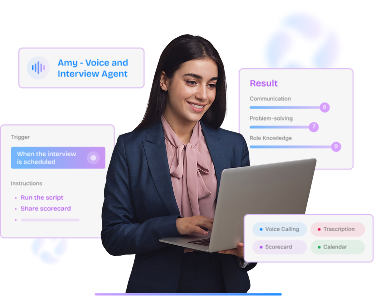
  • Amy runs Level-1 video interviews around the clock and returns scored reports
  • An AI voice agent handles pre-screen calls and flags AI-written resumes
  • Agents for offer validation, approval chasing, pre-join check-ins and compliance
  • Set the rules once per geography: an Australia agent and a Germany agent play by different rules, and any agent can be switched on or off per business unit or requisition type
  • Three operating modes, set per region, business unit or job family: Assisted, Semi-autonomous and Autonomous
  • Agents coordinate, recruiters close: agents run the systematic work, recruiters make the decisions
Ask any vendor to show you an agent a customer built without vendor involvement. If the answer is the same ten agents from the website, you can only run the processes they planned for.

Read: ATS is dead. Harness is what you need for the next decade.

Different markets need different AI controls

Rules for automated hiring decisions vary by country and they keep moving. Your legal and compliance teams will decide what is allowed where. Your ATS has to execute that decision without a re-implementation.

What this means in practice. You need agent-level control by geography: which agents run, which pause for a human, what gets disclosed to the candidate, and who signs off. RippleHire treats that as configuration inside one tenant, so an EU requisition can require human sign-off on the same day a drive in another country runs with more autonomy. Ask any vendor whether AI behaviour and autonomy can be configured and audited by country, business unit or workflow. Then ask what the audit trail records: which agent acted, under which scope, following which version of the rule.

Ten requirements, side by side

Both products are strong on the first three. Each of the last seven can be checked in a demo. Where it says “not published, ask for a demo”, we found no published capability, so ask the vendor to show it.

DimensionRippleHireA staffing-first ATS
AI sourcing, matching and screeningStrongStrong
Conversational AI interviews and voiceStrongStrong
Security and privacy certificationsStrongStrong
Agents through offer, pre-join and Day 1Prediction and interventionNot published, ask for a demo
Customer-built agents with per-country rulesAgent Builder, no codeNot published, ask for a demo
Configurable platform: labels, fields and workflowsConfigured by your team, no codeNot published, ask for a demo
Regional workflow depthDifferent rules per geography in one tenant, plus regional job boards and LinkedIn RSC (premium tier)Per-country privacy policy; ask for a demo of workflow and agent rules
Fraud and impersonation controlsShield, including deepfake checksNot published, ask for a demo
Referral participationGamified engine, automatic payoutsNot published, ask for a demo
Drive and panel management at volumeFills slots through 50% no-showsNot published, ask for a demo

Seven capabilities to test in the demo

Most of these come after the hiring decision, where vendors publish fewer agents. Ask each vendor to show them working.

What a staffing-first ATS does well

These strengths hold up in an evaluation, and you should weigh them.

Front-of-funnel depth, compliance posture and analyst recognition

Their agent stack from sourcing through interview is broad and it ships: conversational AI interviews and WhatsApp engagement, AI-generated interview questions, and, as they report it, voice engagement and interview summaries from Teams and Meet. If your problem is that recruiters spend their week screening and scheduling, they will fix a large part of that, and they will demo it well.

On compliance they display SOC 2 and ISO 27001 badges alongside GDPR and India DPDP claims, plus per-country privacy policy configuration. They also carry Everest Group PEAK Matrix recognition (Major Contender, permanent TA) and G2 awards.

Our claim is narrow. If your hiring problems come before the interview and your volumes are mid-market, they are a fair choice and you should look hard at them. If you lose candidates after the offer, ask whether the system predicts drop-offs and acts before they happen. Ask both vendors to start the demo at the offer stage and decide from what you see.

Five questions to ask before you sign

Ask every shortlisted vendor the same questions, including us.

  1. What share of your customers are staffing agencies, and what share are enterprises?

    The answer tells you who the product is built for, and whose requests shape the roadmap.

  2. Can we run blind reference checks with customers we choose?

    References a vendor picks will say good things. Customers you find yourself, through their careers pages, will tell you what the product delivers today.

  3. What is your candidate experience score, and how do you measure it?

    Then apply for a job on one of their customers' careers sites and see it for yourself.

  4. How far does AI automation continue after the interview?

    Ask them to name each agent that runs past the interview and show it working: offer validation, approval chasing, pre-join check-ins, joining confirmation. Offer and onboarding modules exist; ask which agents act inside them.

  5. Can our team build its own agents and set different rules per country?

    Ask to see an agent a customer built without vendor involvement, and ask how its scope and autonomy are set per country as regulations change.

The recruiting harness enterprise IT services runs on

LTIMindtree, Mphasis, Birlasoft, Bahwan Cybertek and 50+ enterprises run RippleHire, making tens of thousands of hires a year across global markets. Our agents are built for that volume.

40%Lower time-to-hire
3 to 5xHires per recruiter
60%Fewer no-shows
4.7/5Candidate experience
4.5/5Recruiter experience
86M+Candidate applications processed
12MInterviews captured, 50+ countries
31Brandon Hall awards

Ask us for the Harvard Business Publishing case study on how this platform was built.

Give us 45 minutes. We will start the demo at the offer stage.

Bring your offer-to-join numbers and we will start with the weeks between offer and joining.

Schedule the comparison demo