
.svg) Product
Product

.png)

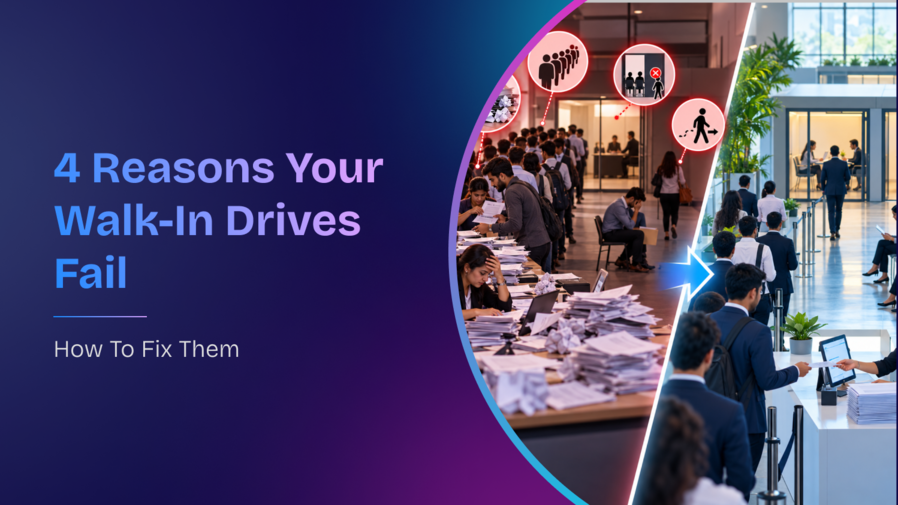


Table of content
4 Reasons Your Walk-In Drives Fail And How To Fix Them
Quick answer : Walk-in hiring drives fail for four fixable reasons: job ads that mislead candidates about the role, poor crowd management at the venue, delayed offers instead of same-day decisions, and regular ATS software that breaks under 200+ same-day applicants. Fix all four and a walk-in drive can genuinely deliver same-day hires instead of a chaotic day that ends with a stack of resumes and no offers.
Walk-in drives fail for predictable reasons. The venue gets overwhelmed. The panels run late. The right candidates give up waiting and leave. The wrong candidates consume the interview time. Offers require approvals that are not present on the day. The ATS crashes at 11 AM.
By the end of the day, the recruiting team is exhausted. The result does not match the effort.
Here's what goes wrong and how to fix it.
Reason 1: The Job advertisement attracted the wrong candidate
The failure starts before the drive opens.
A generic job advertisement written to maximize application volume produces a crowd of candidates who are unsuitable for the role. By the time they arrive at the venue, the mismatch is already done. Interview time is consumed by people who will never accept the actual job requirements. Candidates who could do the role spend three hours waiting in a queue alongside candidates who cannot.
For example, A sales position that mentions "dynamic environment" and "growth opportunities" sounds appealing until candidates discover the role requires 25 days of field travel per month. Customer service roles attract office workers who then learn the position involves handling inbound complaints over phone calls for eight hours. Neither candidate was dishonest. The job description did not tell them the truth.
The fix: Write the job ad as a filter, not a magnet
The advertisement needs to disqualify unsuitable candidates before they travel to the venue. Every unsuitable candidate who self-selects out saves 30 minutes of panel time.
Lead with the deal-breakers. If the role requires extensive travel, state the specific number of days per month in the first line. If the work involves night shifts, weekend work, or physical requirements, mention them in the opening paragraph , not at the bottom of the page in fine print.
Use specific job titles. "Telecalling Executive Outbound Sales Calls" is a different advertisement from "Sales Executive." The first attracts candidates who know what they are applying for. The second attracts everyone. "Field Sales Representative FMCG Distribution" reaches a different candidate than "Sales Representative." The specificity is the filter.
State the work environment clearly. Office-based, factory floor, retail outlet, field work, hybrid , candidates need to know where they will actually be working. This eliminates a significant percentage of unsuitable applications before the drive opens.
A walk-in drive with 80 qualified candidates and a smooth process produces more hires than one with 300 candidates, 250 of whom were never right for the role.
Reason 2: No crowd management plan
When 300 candidates arrive between 9 and 11 AM, the entry area becomes a bottleneck within 20 minutes. Candidates who cannot find where to go start asking each other. The reception desk becomes the screening desk and the help desk simultaneously. Qualified candidates who traveled an hour to get there stand in the parking lot and decide to leave.
The damage extends beyond the immediate chaos. Qualified candidates form lasting impressions about the organization's competence from how the drive is managed. A candidate who waited for 90 minutes in an unorganized queue remembers that when deciding whether to accept the offer.
The fix: Design the flow before the drive opens
Stagger arrival times. Send candidates specific 30-minute windows rather than a broad "10 AM to 2 PM" instruction. Candidates with surnames A to G arrive at 10:00 to 10:30. H to M arrive at 10:30 to 11:00. This distributes the crowd across the day and eliminates the morning bottleneck.
Create three lanes at entry:
- High-fit candidates with complete documents move directly to interview panels.
- Borderline candidates go to a five to ten minute initial screening before being triaged.
- Candidates with missing documents or queries go to a dedicated help desk ,not the main queue.
Staff the registration separately from the screening. One person cannot manage document verification and crowd guidance simultaneously. A drive expecting 200 candidates needs one staff member per 15 to 20 candidates , dedicated to their assigned function, not pulled between tasks.
Put signage at every decision point. From the building entrance to the registration table to the waiting area to the interview zones. Candidates should never need to ask where to go.
A well-organized venue communicates organizational quality to every candidate who walks through the door. That impression affects offer acceptance rates at the end of the day.
Reason 3: Offers require approvals that are not present at the drive
Walk-in drives are premised on speed. Candidates attend specifically to get hired that day rather than going through a two-week process. When they leave without an offer or with a "we will get back to you in two to three days" the premise of the drive fails entirely.
The typical breakdown: interviewers can evaluate but cannot decide. Final approval sits with a hiring manager or HR head who is not in the room. Salary decisions need finance sign-off. The offer letter requires legal review. The candidate who performed well in the interview goes home, receives a call from another organization with an immediate offer, and takes it.
The fix: Pre-approve everything that can be pre-approved
Senior decision-makers must be physically present. The hiring manager, team lead, or whoever has final approval authority needs to be in the room, not available by phone, not approving via WhatsApp. Their presence is the prerequisite for same-day offers.
Fix salary bands before the drive. Define the range for each role by level. A junior sales executive receives a specific amount. A senior executive receives a specific higher amount. No case-by-case discussions that push decisions into the next day. Pre-approved bands eliminate the most common reason offers get delayed.
Prepare offer letter templates before the drive opens. Standard terms, joining dates, and role descriptions should be settled in advance. On the day, fill in the candidate name, role, and salary. An offer letter should take ten minutes to produce, not two days.
The best walk-in drives end with candidates holding offer letters. Candidates who leave with business cards and "we will call you" promises treat the drive as a screening round and continue exploring other options in the meantime.
Reason 4: Standard ATS platforms break down at drive volume
Most companies try to manage walk-in drives using their existing ATS or recruitment software. These systems work fine for regular hiring, where you process 10-20 applications per week. During walk-in drives, you need to handle 200+ candidates in a single day, and regular systems simply break down.
Problems with using normal recruitment tools:
- Registration systems crash under heavy traffic
- Slow candidate search and filtering options
- No bulk processing capabilities for offers or rejections
- Interview feedback forms are designed for detailed reviews, not quick decisions
- No real-time candidate tracking across different stages
Many companies end up maintaining Excel sheets alongside their fancy ATS, defeating the purpose of having technology in the first place.
The fix: Use technology that is built for walk - in drives
High-volume walk-in drives require platforms built for speed at scale, not adapted from systems built for something else.
Registration that completes in under 60 seconds. A mobile-first form capturing only what is needed for triage name, contact, basic eligibility criteria, document check. Not a full candidate profile.
Real-time candidate status visible to all team members simultaneously. When a panel interviewer marks a candidate as selected, the offer generation team sees it immediately. No phone calls between stations asking who has moved to the next stage.
Bulk processing for post-drive communication. Selected, waitlisted, and rejected candidates need communications that go out the same day. Bulk tools that send 200 messages simultaneously replace the manual effort that otherwise consumes the evening after a drive.
Instant offer letter generation. A hiring decision triggers an offer letter that is generated, reviewed, and available for printing or digital signing within minutes , not routed through a separate administrative process the next morning.
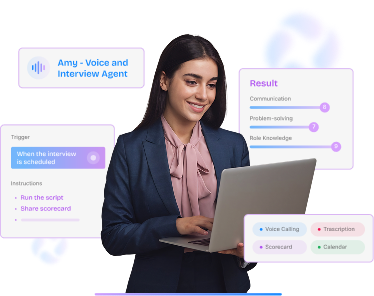
Drive Management gives TA heads real-time visibility across every active drive candidate volumes by stage, panel utilization, slot fill rates, and offer conversion so bottlenecks surface while the drive is still running. Amy handles structured first-round screening at scale so panels receive pre-filtered shortlists rather than raw walk-in traffic. Offer Agent generates offer letters automatically once decisions are logged and routes them for parallel approval all offers from a drive day go out within hours.
What the same drive looks like when these four are fixed
| Failure mode | What happens without the fix | What happens with the fix |
|---|---|---|
| Generic job ad | 300 candidates arrive, 250 unsuitable. Panels waste the day on mismatches. | 100 candidates arrive, 80 qualified. Panels close 40 hires. |
| No crowd plan | Entry chaos. Qualified candidates leave after 90 minutes of waiting. | Staggered arrivals, three-lane triage. Drive runs to schedule. |
| Offers require absent approvals | Candidates leave with "we will call." Accept other offers within 48 hours. | Decision-makers present. 40 offer letters printed and signed by 5 PM. |
| Standard ATS at drive volume | System slows. Paper forms appear. Evening spent manually updating records. | Real-time tracking across all stages. Bulk communications sent before the team leaves. |
Getting walk-in drives right requires the right partner
Walk-in drives fail consistently not because organizations lack intent or investment. They fail because coordination at drive volume cannot run on individual effort and standard tools.
That is where RippleHire comes in. It is the AI ATS where recruiters and agents work together ,agents handle the registration flow, real-time tracking, interview scheduling, offer generation, and bulk candidate communication so recruiting teams can focus on the decisions and conversations that require judgment.
Rajkamal Vempati, CHRO at Axis Bank:
"Atmos by RippleHire has been central to driving digital transformation in our recruitment. It delivered a candidate experience score of 4.8 out of 5 and set a new benchmark for stakeholder experience."
Axis Bank processes over 45,000 hires annually. A 4.8 out of 5 candidate experience score at that volume requires a system that keeps every candidate informed and every drive stage visible in real time not individual recruiter effort managing two hundred people simultaneously.
Book a RippleHire demo to see how walk-in drives run when the process failures are removed.
Frequently asked questions
What are the most common mistakes that cause walk-in drives to fail?
The four biggest mistakes include poor venue planning that creates crowd chaos, inadequate staffing for the expected volume, unclear communication about requirements and process, and a lack of proper screening criteria that leads to hiring the wrong candidates.
What is the most common reason candidates leave walk-in drives without offers?
The most common reason is that decision-makers are not present at the venue. Interviewers can evaluate but cannot approve. Salary decisions require sign-off from someone in an office. Offer letters require administrative processing that takes days. Pre-approved salary bands, pre-prepared offer templates, and the physical presence of hiring managers with final authority remove each of these delays.
How do we communicate effectively with walk-in drive candidates?
Provide clear information about eligibility criteria, required documents, dress code, and process timeline before the event, across multiple channels. Send reminder messages 24 hours ahead with specific reporting instructions, and keep candidates informed about wait times during the event itself.
What screening criteria work best for walk-in recruitment?
Simple, consistent pass/fail criteria that can be applied quickly, focused on must-have requirements like experience level, specific skills, and availability rather than nice-to-have qualities. Standardized evaluation forms that interviewers can complete in 10–15 minutes per candidate keep decisions fast and fair.
What follow-up is needed after walk-in drives?
Communicate results within 48–72 hours while the event is still fresh for candidates. Send personalized next-step messages to selected candidates, polite rejections to others, and consider keeping promising non-selected candidates in a talent database for future roles.