
.svg) Product
Product


.png)





Table of content
Ask a talent acquisition team how their funnel is performing and you will get a confident answer up to the offer stage. Applications, screening ratios, interview conversion, offer release, all tracked and reported.
Then ask what is happening with the 40 candidates who accepted offers last month and are due to join over the next eight weeks. The answer usually arrives as a spreadsheet, a recruiter's memory, and a WhatsApp thread.
This is the part of hiring that talent ops owns and almost nobody instruments. It is also the part where a loss costs the most, because every rupee and every hour of the preceding process has already been spent.
Why the post-offer window goes unmanaged
The offer-to-joining period has three properties that make it hard to run well.
It is long, and the length is not under your control. In markets with 60 or 90 day notice periods, you are asking a candidate to stay engaged with your company through two to three months of continued employment somewhere else, while their current employer has every opportunity to change their mind.
It has no system-generated events. A candidate moving from interview to offer generates a record. A candidate quietly deciding to stay put generates nothing at all until the day they do not arrive.
And it sits between two owners. Recruiters consider the role closed at offer acceptance. Onboarding and HR operations pick the candidate up at joining. The weeks in between belong to whoever remembers to check.
The result is that drop-offs feel like surprises when they are almost never sudden. The signals were there; nothing was set up to catch them.
| What goes wrong | Why it happens | What it costs |
|---|---|---|
| Drop-off discovered on joining date | No structured check-ins during notice period | Full cost of the hire, restarted |
| Follow-up notes as free text | No taxonomy, so nothing aggregates | No early warning, no learning |
| Follow-up depends on one recruiter | Not assigned, dated, or tracked | Coverage collapses when they are on leave |
| Counteroffers found out too late | Nobody asked directly | Lost a candidate who was winnable |
Build a reason taxonomy, not a status field
The single highest-leverage change most teams can make is to stop recording follow-up as free-text notes and start recording it as a structured reason.
"Spoke to candidate, seems fine" tells you nothing next week and nothing in aggregate. "Counteroffer, 22% above our offer, made on the 14th" tells you what to do today and, across 200 candidates, tells you which competitors are targeting your offers and by how much.
A workable taxonomy maps each reason to a rolled-up risk color, so the recruiter records the specific thing and the system derives the alert level. A model worth adapting:
.png?width=1520&height=1546&name=Offer%20Risk%20Table-selection%20(3).png)
Two design points matter here.
The reason should be chosen, and the color derived. If recruiters can set the risk level directly, the levels drift. One recruiter's amber is another's red, and your pipeline view becomes an opinion. Let the reason determine the color and keep the color non-editable.
Structured fields beat comments. Capturing a counteroffer amount as a number rather than inside a sentence is what lets you answer, at quarter end, whether your offers are being beaten and by what margin. That is a compensation conversation you cannot have from free text.
Know which signals actually predict a drop
Not all amber is equal. A few signals deserve immediate escalation rather than a scheduled call.
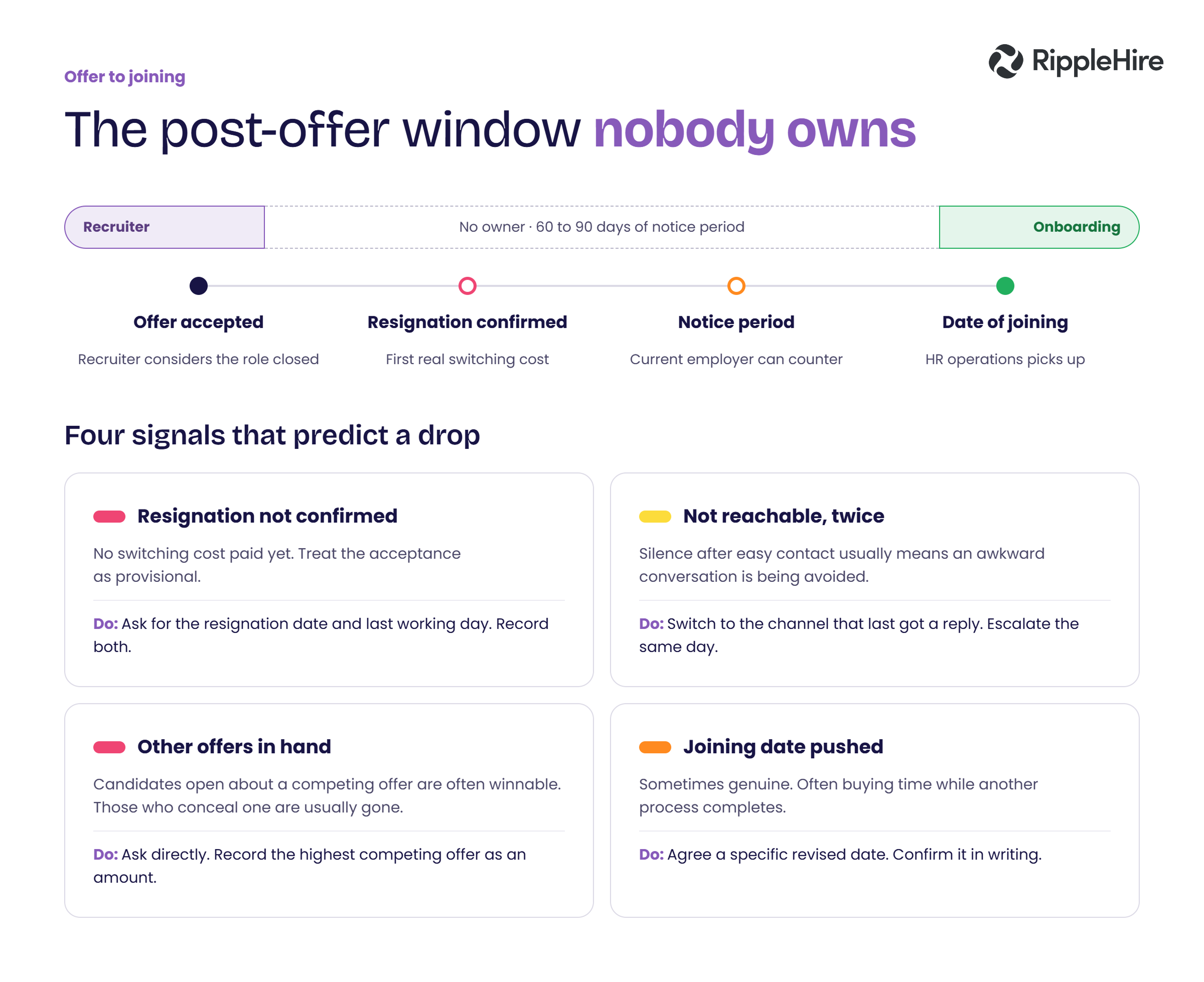
Resignation not confirmed. This is the most underrated red flag in the list. A candidate who has accepted but not resigned has not yet paid any switching cost. Until you have a resignation date and a last working day on record, treat the acceptance as provisional. Ask for the date explicitly and record it.
Not reachable, twice. A single missed call means nothing. A pattern of unresponsiveness after a period of easy contact usually means the candidate is avoiding a conversation they expect to be awkward.
Other offers in hand. Worth asking about directly rather than hoping. Candidates who are transparent about a competing offer are frequently still winnable; candidates who conceal one are usually gone. Record the highest competing offer, not just the fact of one.
Requests to push the joining date. Sometimes genuine. Often a way of buying time while another process completes. The response is the same either way: agree a specific revised date and confirm it in writing, rather than leaving it open.
Some risk is also structural rather than behavioral, and can be estimated before anything goes wrong. Two inputs do most of the work: the candidate's current employer, since some organizations retain aggressively and your own history with them is predictive, and the offered location against the candidate's current location, since relocation carries a materially higher drop rate. Scoring a joining probability on these two dimensions lets you weight your follow-up effort before the first check-in.
Make follow-up an assigned task, not a good intention
A post-offer program that depends on recruiters remembering will work for the first three weeks and degrade after that. The fix is unglamorous: every follow-up becomes a task with an owner and a due date.
That means three things in practice.
Each candidate has a named owner for the notice period, which may or may not be the recruiter who closed them. Many teams hand post-offer candidates to an onboarding pod rather than leaving them with a recruiter who is already working the next requisition.
Each interaction records its channel and timestamp — phone, email, WhatsApp, SMS — so the next person picking up the candidate can see what has actually been tried. A candidate who has ignored four emails and answered one call should be called.
Activities are created ahead of time, not logged after the fact. The distinction matters. A follow-up plan created at offer acceptance, with tasks dated across the notice period, survives a recruiter going on leave. A log of past interactions does not tell anyone what to do next.
This is also where the small human touches belong, scheduled rather than improvised: a note before a festival, a call from the future manager, a courier a week before joining. These work, and they only happen reliably when someone owns them on a date.
Design the pre-joining engagement calendar
The candidate's experience during notice period is mostly silence punctuated by document requests. That silence is what your competitors' recruiters are filling.
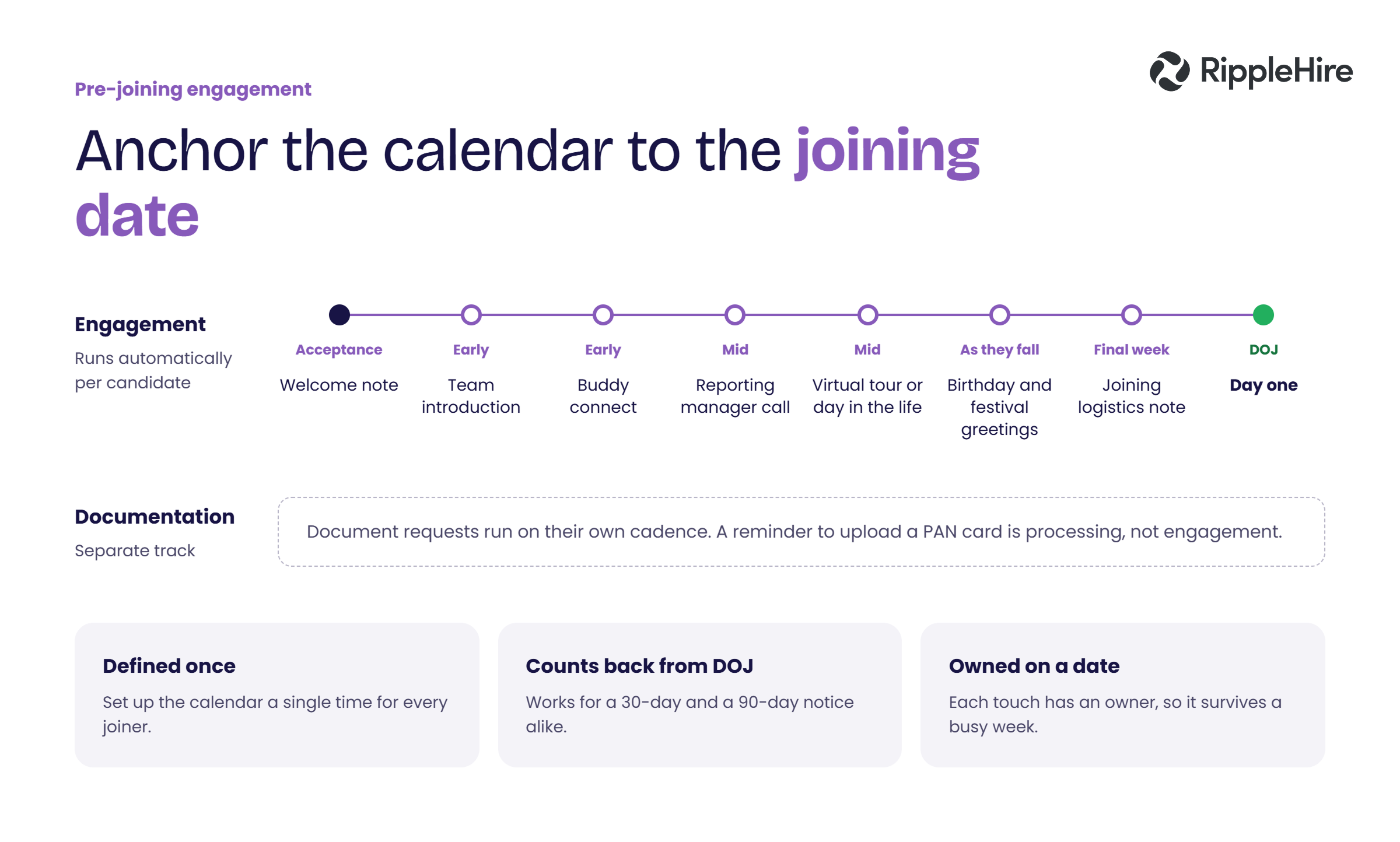
A reasonable calendar, anchored to the joining date rather than the acceptance date, includes:
- A welcome note and company introduction shortly after acceptance
- An introduction to the immediate team
- A buddy connect, pairing the joiner with a peer they can ask unofficial questions
- A conversation with the reporting manager, separate from any HR contact
- A virtual tour or a day-in-the-life piece
- Birthday and festival greetings falling before the joining date
- A joining logistics note in the final week, covering the practical things people worry about
None of this is elaborate. The point is that it is defined once, runs automatically against each candidate's date of joining, and does not depend on anyone's bandwidth in a given week.
Keep document collection on a separate track from engagement. A candidate whose only contact from you is a reminder to upload a PAN card has not been engaged, they have been processed.
Instrument it
If the post-offer window is going to be managed as a program, it needs numbers of its own. The ones worth tracking:
- Offer-to-joining ratio, sliced by business unit, location, recruiter, and current employer. The slices are where the insight sits.
- Drop reasons, aggregated. This is what the taxonomy buys you. If a third of your losses are compensation-related, that is a pricing problem, not a follow-up problem.
- Days from acceptance to confirmed resignation. A leading indicator, available weeks before the joining date.
- Follow-up coverage. What proportion of candidates due to join in the next 30 days have had a recorded interaction in the last 10 days. Most teams discover this number is lower than they assumed.
- Counteroffer margin. Where competing offers are recorded as amounts, the median gap between your offer and the one that beat it.
A setup checklist for talent ops
- Define the taxonomy before configuring anything. Agree the reason list and the risk mapping with recruiters, not for them.
- Decide who owns the notice period. Recruiter, onboarding pod, or hiring manager, but named.
- Set your escalation rules. Which reasons trigger a same-day conversation and who joins it.
- Build the engagement calendar against DOJ, not against acceptance date, so it works for a 30-day and a 90-day notice alike.
- Separate engagement from documentation. Different tracks, different cadence.
- Review drop reasons monthly. The taxonomy only pays off if someone reads the aggregate.
- Instrument follow-up coverage first. It is the fastest way to find out whether the program is actually running.
Where a system helps
Most of this is program design rather than tooling, and a disciplined team can run a version of it on a spreadsheet. What a spreadsheet cannot do is derive risk consistently, notify the right people when a status turns, hold the engagement calendar against each candidate's own joining date, and keep a history that survives a recruiter changing roles.
In RippleHire, post-offer follow-up is built into offer management rather than sold as a separate module, so it runs on the same workflow as offer creation, approval routing, and delivery. It follows the structure described here: configurable reasons that roll up to a derived risk status, joining probability tracked through the notice period, activities that are assigned and dated rather than logged after the fact, and a pre-joining engagement calendar that runs against each candidate's date of joining.
Explore RippleHire Offer Management and post-offer engagement →
If your offer-to-joining ratio is a number you report but cannot explain, the gap is usually structure rather than effort. Talk to our team about how other organizations have set this up.
Frequently asked questions
What is post-offer follow-up?
It is the structured management of candidates between offer acceptance and their first day, covering engagement, risk tracking, documentation, and joining confirmation. It exists because the period is long, generates no system events of its own, and frequently falls between the recruiter who closed the candidate and the onboarding team who will receive them. Run well, it materially improves the offer-to-joining ratio. Run informally, it produces drop-offs that feel unpredictable but rarely were.
How often should we contact a candidate during notice period?
There is no universal cadence, but coverage matters more than frequency. A useful working standard is a recorded interaction at least every 10 days, with more contact in the first fortnight after acceptance and in the final two weeks before joining. Weight effort toward candidates carrying known risk signals rather than spreading it evenly. What you want to avoid is a candidate going three or four weeks with no contact, which is when competing processes do their work.
What are the strongest predictors that a candidate will not join?
An unconfirmed resignation is the most reliable one, because a candidate who has not resigned has not yet committed anything. Beyond that: a disclosed or suspected counteroffer, a sudden change in responsiveness, repeated requests to defer the joining date, and unresolved compensation or designation concerns. Structural factors help too, particularly the candidate's current employer and whether the role requires relocation.
Should post-offer follow-up sit with recruiters or with onboarding?
Either works, provided it is explicitly assigned. The common failure is assuming it is shared, which in practice means it belongs to nobody. Many teams move candidates to an onboarding or talent operations pod at acceptance, on the grounds that recruiters are immediately pulled onto the next requisition. If you keep it with recruiters, protect the time for it and measure coverage, or it will lose to whatever is more urgent.
How do we measure whether our post-offer program is working?
Offer-to-joining ratio is the headline number, but it is lagging and too coarse to act on. Pair it with follow-up coverage, which tells you whether the program is actually running; days from acceptance to confirmed resignation, which gives you weeks of warning; and aggregated drop reasons, which tell you whether you have a follow-up problem or a compensation problem. The last one is the most commonly skipped and the most useful