
.svg) Product
Product

.png)


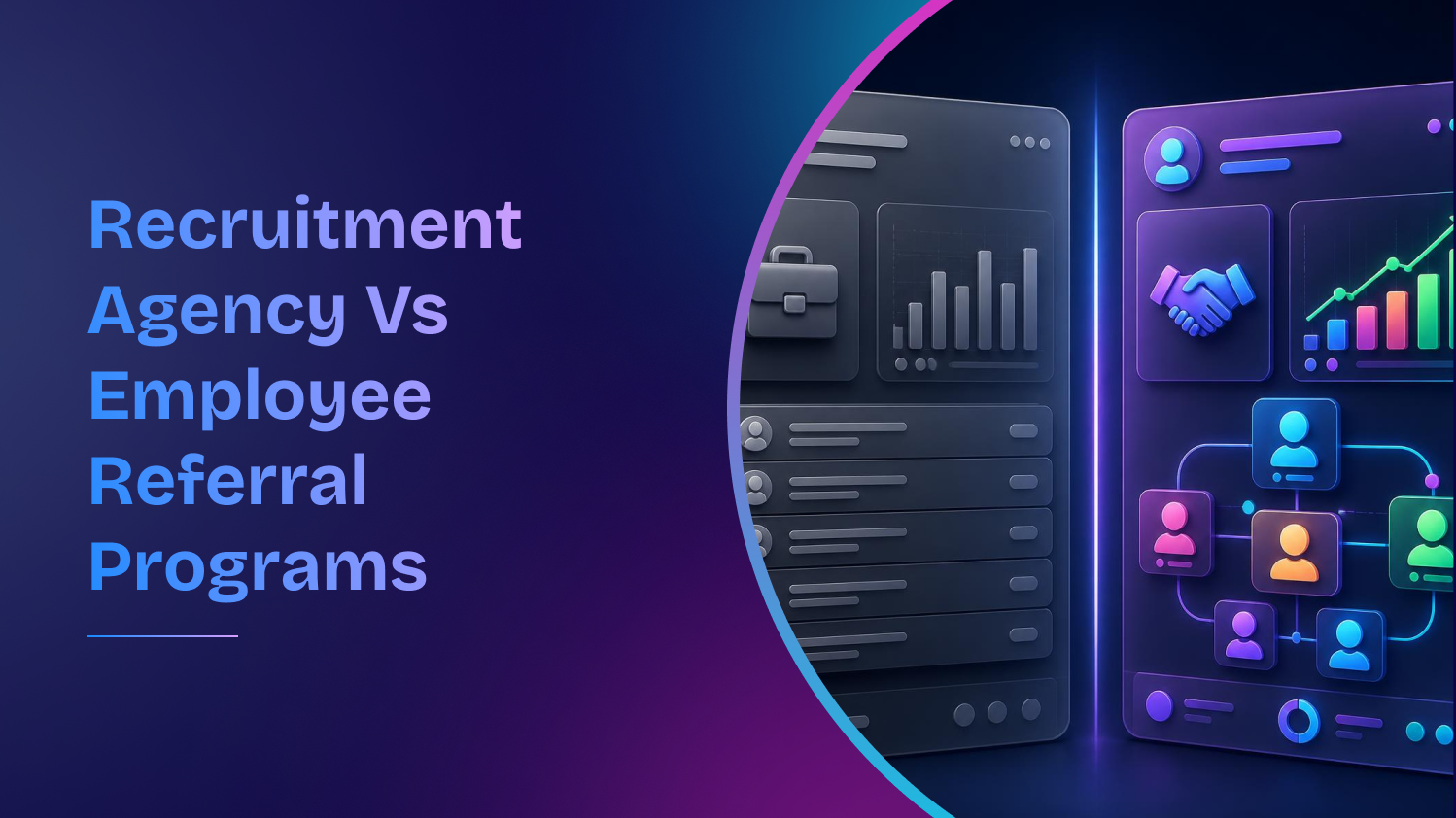


Table of content
Recruitment agencies and employee referral programs solve the same problem filling roles faster but through opposite mechanics: agencies give you speed and reach into talent you can't access yourself, at a real cost per hire, while referrals give you higher-quality, better-retained hires at a much lower cost, but only as fast as your employees' networks allow. Neither one wins outright; the right call depends on the role, the urgency, and how deep your internal network actually runs.
This guide breaks down where each method holds up, where it falls short, and how to decide which one or what mix of both fits your next hiring push.
What is the difference between a recruitment agency and an employee referral program?
A recruitment agency is a third-party firm that sources, screens, and presents external candidates for a fee, typically 15–25% of the hire's first-year salary for contingency search. An employee referral program is an internal channel where current employees recommend people from their own network, usually in exchange for a bonus once the referral is hired. Agencies buy you reach and speed; referrals buy you trust and retention, at a much lower cost.
Speed, Quality, and Retention: Recruitment Agency vs Employee Referral Program
| Metric | Recruitment Agency | Employee Referral Program |
|---|---|---|
| Time to fill | Fast for urgent or high-volume hiring; varies significantly by role difficulty and market | 29 days on average vs 39 days for non-referral channels |
| Long-term retention | Not consistently tracked post-placement | 45 to 46% retained long-term vs 25 to 33% for job board hires |
| Job performance | Not typically benchmarked by agencies | Referral hires show approximately 33% higher job performance than non-referred hires |
| Employer-rated quality | Varies by agency and brief quality | 88% of employers rate referrals as their most effective source of quality candidates |
| Culture fit | Limited , agencies screen on brief, not organizational context | Strong , existing employees informally pre-screen for culture |
Source: SHRM 2025-2026 Benchmarking Report and National University 2026 Hiring Statistics.
Pros of hiring through recruitment agencies
Better access to different talent pools
Most recruitment agencies are expert headhunters and resume-miners. With years of specialized experience behind them, they know where to look for, whether it be LinkedIn, job portals, job fairs, or even social media. Recruitment agencies are constantly on the lookout for talent and their reach is wide.
Especially in cases where you are looking to hire a lot of employees in a short span of time, going through a recruitment agency is much faster.
Higher quality of preliminary screening
Recruitment agencies know what to look for in a resume and how to judge whether it is worth a second glance. They are also acutely aware of the value of the company HR’s time, and hence do their best in the preliminary screening. They are extremely efficient at filtering out resumes of candidates, interviewing who would be a waste of the company HR’s time and energy.
Reduced sourcing workload on the internal team
The sheer effort of looking up resumes through various channels like job boards, LinkedIn, amongst others is energy-sapping. And then there is the process of matching the resumes against the job description and evaluating the skills by reading through multi-page CVs. And once that is attended, the real interviewing starts. So all the preliminary work done by the recruitment agency reduced the workload on the already overburdened company HR.
Cons of hiring through recruitment agencies
Agencies provide same candidate to multiple organizations
Agencies thrive on presenting the same candidates to a number of organizations and that is how they go about increasing the chances of having their candidates shortlisted. And in fact, candidates approach agencies because they want to be visible to more recruiting organizations. So as a company you are never sure that you own the candidate’s profile, and exclusivity is not guaranteed.
Limited visibility to the kind of candidates required
Sure, recruitment agencies are good at screening resumes and filtering out candidates. But to put it candidly, they don’t really share the company’s vision. Why exactly is the company hiring a given candidate?
Do all the personnel at the recruitment agency understand that, especially those filtering resumes? There is always the possibility that the quantity of screening is high, but the quality of candidates is below par, simply because the recruitment agency does not understand what value the company is looking to extract from the recruited candidates.
So don’t get carried away by the reputation and past performance of the recruitment agency, and evaluate the candidate without that positive prejudice.
Higher recruitment costs
The cost of recruiting through a hiring agency is often high, even though it saves time. If you compare it with internal hiring, well, there is quite a difference. Sure, you can cover this to some extent with clauses related to payment of the fees to the agency depending on how long the candidates stay. But if the candidates do not work out well or leave abruptly, there is nothing to cover the training costs. And the salaries paid to such candidates cannot be recovered either.
Lack of end ownership
All said and done, the responsibility of getting the best out of the candidates lies with the company itself. No amount of high quality screening can guarantee that the hired candidate will be a good culture fit or perform well. So in that sense, the additional recruitment costs are not always value for money.
And if the recruitment agency intentionally or accidentally violates any laws related to providing equal and unbiased opportunities, the organization may find it very difficult to detach themselves from the recruitment agency’s actions.
Pros of hiring through employee referrals
Higher offer-to-joining conversions
The referred candidates are already looking forward to working with your organization because their friends already work there. So if they are selected, the chances of them backing out at the last minute are next to nil. They will join not only eagerly but also quickly. So the speed to hire is better as well, assuming that they are satisfied with the compensation and other terms of employment on offer.
According to Zippia's 2026 analysis referred employees stay 70% longer on average. 47% of referral hires remain with the organization for more than three years -compared to roughly 25% of job board hires at the same tenure mark, according to At enterprise scale, a 41% reduction in turnover-related hiring costs compounds into material savings that dwarf the referral bonus investment.
Strong culture alignment
According to Gitnux's 2026 verified statistics ,referred candidates are three times more likely to be a top performer than job board hires and show 25% higher engagement with the organization's brand.
The candidates that are referred through existing employees are likely to be not too different from each other. And this to a large extent, mitigates the risk of recruiting someone who will not fit into the company culture or struggle to align himself with the company’s work ethics and policies.
And besides, the new employees are coming in with a decent impression about the company and will probably find it easy to adjust.
Faster time to fill
Referral hires move through the process faster because candidates arrive pre-informed and pre-engaged. They have already had the organization described to them by someone they trust. They arrive at the first interview with context about the team, the culture, and the role that a job board candidate builds over weeks of interviews. That head start compresses every stage from initial screening to offer acceptance because the candidate is ready for each step before it begins.
Lower cost per hire
Hiring through an employee referral program has only one additional cost: the incentive for the referring employee. When compared with the costs involved in hiring through a recruitment agency, this is a clear winning strategy.
According to Zippia's 2026 analysis, companies save over $7,500 per hire by avoiding agency fees through referrals, and referral programs reduce cost per hire by over $3,000 on average versus other sourcing channels. Referral hires also generate 25% more profit for companies than non-referred hires meaning the cost advantage compounds into a revenue advantage, not just a sourcing budget saving.
Cons of hiring through employee referrals
Volume without filtering can overwhelm the screening team.
A well-promoted referral campaign generates high application volumes that are not pre-screened by a third party. The internal team absorbs the screening cost.
Risk of incentive-driven poor recommendations
At times it can happen that the referring employee recommends a candidate simply out of the expectation of the incentive attached. Or they might refer candidates who would not be a great fit culturally, in spite of knowing it, because of their own unhappiness with the company.
This can make the work atmosphere toxic and the new hires will be extremely difficult to train, motivate and manage.
Program management requires ongoing internal effort.
A referral program launched once and left to run without communication, campaigns, and governance stalls within months. Maintaining above 30% employee participation requires consistent awareness investment, feedback loops, and recognition that most TA teams underestimate.
According to Gitnux research only 15% of employees actively participate in their company's referral program at any given time, according to. Separately, 48% of employees say they would refer more candidates if the submission process were easier which points to friction rather than motivation as the primary barrier to participation. A program that removes submission friction before running awareness campaigns produces measurably better participation rates than one that runs campaigns without addressing the portal experience.
Which one should you choose?
Hiring through recruitment agencies has its risks, is quite expensive, and does not guarantee great hiring decisions. But it also gives you access to a bigger talent pool, reduces the workload on the internal HR, and saves time.
On the other hand, going through an employee referral program is highly affordable, improves chances of a good culture fit, and increases employee engagement. But it also has its pitfalls, and there is the additional burden of internally managing the employee referral program.
Our verdict: Referral once established generates results over and over. Hiring through agencies results in higher attrition.
In the long run, it really depends on your company’s vision and mission. If you are going for bulk recruitment in short spans of time, then recruiting through a hiring agency might serve you well. But if you are looking for better employee engagement and optimized profits, we would strongly recommend that you go for an employee referral program.
Enterprises hire at scale generally, and the value of implementing sustainable best practices cannot be underestimated. Employee referrals will help bring quality talent at a much lesser cost. So if you opt for a well planned and well executed employee referral program, you are on the victory path, especially if you are looking for scalability.
Where employee referral programs break down and how to fix it
Referral programs fail less often because employees don't want to refer people, and more often because of three recurring problems: low awareness (in many organizations, fewer than 30% of employees know the program exists), clunky ATS referral portals that create friction, and weak program branding that makes referring feel like an afterthought.
This is where the "additional burden of managing the program" limitation shows up in practice. Someone has to drive awareness, fix the portal experience, run campaigns, and keep the program visible year-round.
That is where RippleHire comes in. It is the AI ATS where recruiters and agents work together and the Employee Referral module handles program management end to end: automated nudges to keep the program visible, a frictionless mobile submission flow, status updates at every stage, and dashboards that show which employees and channels are driving quality hires. The program compounds instead of quietly going stale.
Book a demo to see how RippleHire makes referral program management as scalable as any other sourcing channel.
Frequently asked questions
What is the difference between hiring through recruitment agencies and employee referral programs?
Recruitment agencies provide access to large external talent pools and reduce internal workload, while employee referral programs use internal networks to attract candidates who are typically better aligned with company culture, at meaningfully lower cost.
How do I know which hiring method suits my company?
If you need fast hiring across a wide, unfamiliar talent pool, an agency can help. For long-term, cost-effective hiring with stronger retention, a well-run employee referral program is generally the more sustainable choice.
What are the drawbacks of recruitment agencies?
Higher cost, limited candidate exclusivity since agencies often present the same candidates to multiple companies, and a weaker understanding of your specific hiring needs compared to an internal team.