
.svg) Product
Product

.png)


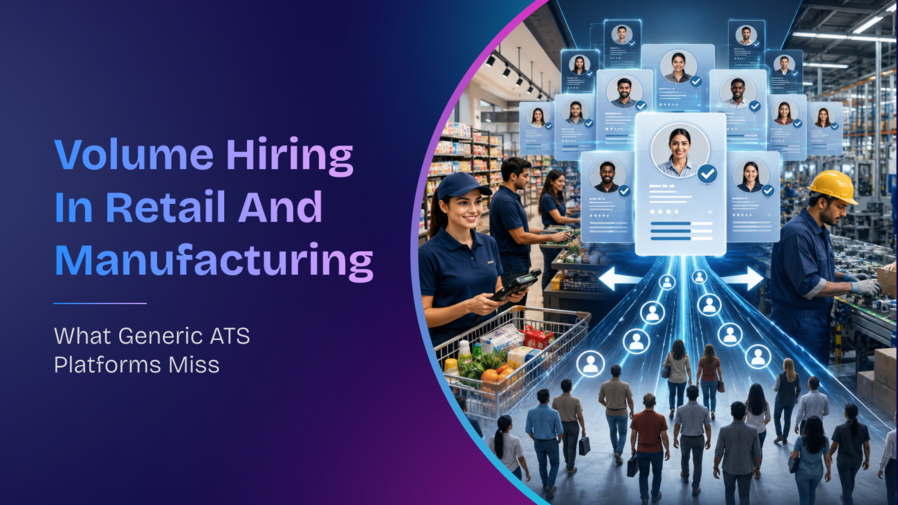


Table of content
Retail and manufacturing hiring looks almost nothing like the corporate hiring that most recruitment software was built to handle. A single store launch can call for eighty associates in three weeks. A new production line can need three hundred operators before the shift pattern even stabilises.
During the festive run-up, manufacturing employers add temporary staff at a scale white-collar recruiters rarely see: staffing firms estimated between 600,000 and 700,000 seasonal jobs across industries in a single recent season, with e-commerce and logistics alone seeing a 30 to 35 percent year-on-year rise. An ATS for retail and manufacturing hiring has to move at that pace, across dozens of locations, without buckling.
The gap here is not about brand or budget. It comes down to design assumptions. Generic platforms took shape around white-collar hiring, where a recruiter manages a handful of specialized roles, candidates apply from a laptop, and interviews get booked over email across a few calm weeks.
Frontline hiring inverts nearly every one of those assumptions. Applications arrive from a phone at a factory gate or on a shop floor, no-shows and post-offer drop-offs run high, and scheduling depends on which location and which shift a candidate can actually reach. When a volume hiring ATS ignores those realities, recruiters end up patching the gaps with spreadsheets, WhatsApp groups, and manual follow-up calls.
The hidden cost of running volume hiring on workarounds
When a platform cannot handle frontline volume, the work does not disappear. It moves into spreadsheets, WhatsApp groups, and the recruiter's own phone, where it drains time and money. The cost rarely lands on a single line item, which is exactly why it goes unmanaged for so long.
Consider what the manual layer actually absorbs across a large intake:
- Recruiter hours spent copying walk-in data from paper forms into a system, day after day, instead of engaging candidates
- Offers lost to faster competitors while a document check crawls through email
- Duplicate and inconsistent records when three coordinators track the same drive in three separate sheets
- Store and plant managers chasing status updates by phone, because reporting refreshes too slowly to trust
Each of these looks minor on its own. Together they add up to slower joins, a higher cost per hire, and vacancies that linger through the exact weeks a business can least afford them. A counter that stays unstaffed through a festive weekend does not just cost one salary, it costs the sales that counter would have rung up. Across a full seasonal cycle and dozens of locations, this workaround tax becomes one of the largest and least visible lines in the frontline hiring budget. Naming it is usually the first step a TA team takes toward removing it.
5 requirements generic ATS platforms were never built for
To see why general-purpose tools struggle, it helps to look at what frontline hiring demands day to day. Three traits define it: sheer volume, relentless speed, and a workforce that is deeply local. None of these are edge cases in retail or manufacturing. They sit at the centre of the job.
Once you accept that frontline hiring runs on volume, speed, and location, five specific requirements follow. Each one is routine in retail and manufacturing, and each one is where a standard platform tends to show its seams. The sections below walk through all five and why the usual toolset falls short.
Mobile-first, loginless applications
Frontline candidates apply from a phone, often on a patchy connection, frequently while standing outside a store or a plant gate. They will not create an account, verify an email, and work through a ten-field form to apply for a packing role. Every extra step sheds applicants who were ready to join. Generic platforms usually assume a desktop candidate with a resume file and the patience for a login flow, so their application journeys run the wrong way round for this audience.
A frontline hiring software that suits retail and manufacturing lets someone apply in under a minute, with no login, no resume upload, and fields that make sense for a wage role rather than a salaried one. Picture a quick-commerce dark store advertising picker roles on a poster at its entrance. If the QR code opens a lengthy account-creation screen, most walk-past interest never converts, and the drop-off surfaces later as an empty shift rather than a lower number on a dashboard.
Location and shift-aware scheduling at volume
Scheduling is where volume and geography collide. A corporate ATS treats an interview as a calendar invite between two people. Frontline scheduling has to reason about places and shifts across many candidates at once, and it must do so without a recruiter hand-coordinating each slot. The interview scheduling layer needs to handle:
- Routing candidates to the nearest hiring location rather than a single head-office address
- Batching walk-in and interview slots so a hiring manager can process many people in one morning
- Respecting shift patterns, so a night-shift applicant is never booked into a day-only assessment
- Rescheduling at scale when a drive gets rained out or a venue changes at short notice
Manufacturing adds another layer, because a plant running three rotating shifts needs candidates matched to the pattern they can actually work, not just to a date. Generic tools can technically send an invite, yet they cannot orchestrate this the way a plant or a regional retail cluster needs. Recruiters rebuild the logic by hand in spreadsheets, which breaks the moment volume climbs.
Background verification built into the workflow
Verification cannot sit at the end as an afterthought when you are hiring hundreds of people who need to start quickly. If a document or background check takes a week and runs outside the system, joining dates slip and candidates accept other offers in the meantime. A workflow suited to volume hiring folds verification into the pipeline itself:
- Document collection happens at the point of application, not after selection
- Checks trigger automatically once a candidate clears the interview stage
- Status stays visible to both the recruiter and the hiring manager in one place
- A cleared candidate moves to offer without a manual handoff to a separate vendor portal
Generic platforms usually leave verification as a disconnected step. That is manageable for a few senior hires, but it falls apart across a festive intake where speed to join decides whether the candidate is still available by the time the paperwork clears.
Interview-day and walk-in support at scale
Walk-in drives remain the backbone of frontline hiring in India. A retailer opening ten stores in a city will run mass walk-ins where hundreds of candidates arrive in a single day. The system has to support that physical reality with quick check-in, on-the-spot data capture, instant status updates, and a path that moves a candidate from queue to interview to provisional offer within the same visit.
Consider a warehouse ramp before a big sale. A regional team might screen four hundred candidates across two days at three sites. A generic ATS designed for scheduled one-to-one interviews has no concept of this format, so the team falls back on paper forms and manual entry, then burns two more days keying it all in. That lag is the difference between staffing the sale and missing it.
Real-time fill-rate visibility by location
Regional operations leaders think in terms of fill rate by location, not in terms of a single global funnel. A west-zone cluster head needs to know, right now, which of forty stores are fully staffed, which are two associates short, and where a drive is falling behind. Corporate ATS reporting tends to roll everything up to the org level and refresh slowly, which hides exactly the local gaps that matter most.
The number an ops leader actually wants is simple: open roles against filled roles, per site, updated live. Without that view, staffing problems surface only when a store manager escalates, by which point the shortfall has already cost sales. A frontline-ready platform turns fill rate into a live, location-level metric that regional leaders can act on the same day.
Generic ATS behaviour versus frontline hiring needs
Laid side by side, the mismatch becomes hard to miss. The table below maps each frontline requirement against how a general-purpose platform typically behaves and what volume hiring needs instead.
|
Requirement |
How a generic ATS behaves |
What frontline hiring needs |
|
Application |
Desktop-first, login and resume upload expected |
Mobile-first, loginless, under a minute to apply |
|
Scheduling |
One-to-one calendar invite |
Location and shift-aware batching across many candidates |
|
Verification |
Separate step after selection |
Checks built into the pipeline, triggered automatically |
|
Interview day |
Scheduled individual interviews |
Mass walk-in check-in and on-the-spot capture |
|
Reporting |
Slow, org-level aggregation |
Live fill-rate visibility per location |
Read as a whole, the right column is not a wish list. It is the operating baseline for any retailer or manufacturer that hires at volume, and it explains why manufacturing recruitment technology and retail hiring tools increasingly get judged on how well they handle scale, speed, and geography rather than on feature counts.
Bring recruiters and AI agents together for frontline hiring at scale
The pattern across all five gaps is the same. Frontline hiring breaks when a platform expects a recruiter to do volume work by hand. Closing the gap means giving recruiters a system that carries the repetitive load at scale while they focus on judgement and candidate experience.
That thinking sits behind RippleHire, a talent acquisition platform where recruiters and AI agents work together across the hiring journey, from demand through to appointment. For high-volume frontline hiring in retail and manufacturing, that partnership shows up in practical ways:
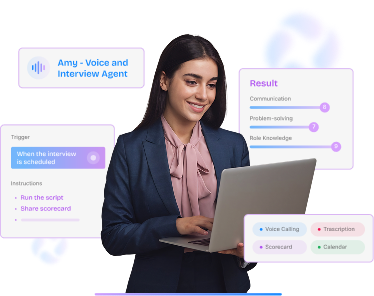
- An AI voice agent that calls hundreds of candidates in parallel to check interest, basic fitment, and availability, then hands recruiters a clear transcript and evaluation, so screening keeps pace with a festive or ramp intake.
- Candidate matching that stack-ranks on proximity alongside skills and notice period, which suits location-bound frontline roles where distance to the store or plant often decides who can realistically join.
- Follow-up bots that stay in touch from application through joining and flag drop-off signals early, so no-shows and post-offer fade become visible before they turn into empty shifts.
- A no-code agent builder that lets your team mirror your own locations, shifts, and approval steps, rather than forcing frontline hiring into a white-collar template.
- Built-in fraud checks for candidate impersonation and fake employment or education history, which matter when you onboard people quickly and in bulk.
All of this runs on an enterprise-grade footing, with ISO 27001, SOC 2 Type 2, and GDPR compliance, so scale never arrives at the cost of trust or auditability.
Book a demo to see how RippleHire supports high-volume frontline hiring across your own locations, shifts, and seasonal peaks.
FAQs
How important are walk-in drives in retail and manufacturing hiring?
Walk-in drives remain one of the most effective ways to hire frontline staff at scale, especially in India. A common misconception is that digital hiring has replaced them, but in practice the two work together. Walk-ins bring in local candidates quickly, while the right tools make check-in, data capture, and same-day offers faster. The format is not outdated, only the paper-based way of running it.
How do we move frontline hiring off spreadsheets and WhatsApp?
Start by mapping where manual work happens now, from application to joining. Pick one high-volume location or drive as a pilot rather than switching everything at once. Move application, scheduling, and status tracking into one system first, then add verification and reporting. Train coordinators on the format they will actually use on the day. A staged rollout lets teams build confidence before a seasonal peak, when there is no room for surprises.
How can we reduce no-shows in high-volume hiring?
No-shows fall when candidates stay engaged and scheduling fits their lives. Confirm interviews close to the date, route people to the nearest location, and match slots to the shift someone can actually work. Automated reminders and quick follow-up help candidates who lose track. Watching drop-off signals early, rather than after an empty shift appears, gives recruiters time to re-engage or line up backups before the gap becomes a staffing problem.
How can one ATS support both corporate and frontline hiring?
It works only if the platform treats frontline hiring as its own model rather than a stripped-down version of corporate hiring. Look for configurable workflows that let volume roles use mobile apply, batch scheduling, and location-level reporting, while specialized roles keep their own process. A single system that flexes to both avoids running two tools, as long as it was designed for scale and geography, not just office roles.
How should retailers and manufacturers plan hiring for seasonal peaks?
Plan backward from the peak date. Estimate headcount per location, not just a national total, and start drives early enough to absorb no-shows and verification time. Line up walk-in venues and coordinators in advance, and set a live view of open versus filled roles per site so gaps show up while there is still time to act. Building a buffer for drop-off is safer than assuming every offer converts.