Your ATS already knows the answer. Your recruiters can't see it.

Talent intelligence turns a decade of hiring activity into signals your recruiters can act on today, and your agents can act on automatically. Built into RippleHire's ATS.

Group 1171275259
image (8)

Most enterprises re-source people they've already met

A requisition opens. The recruiter opens a blank search. Somewhere in the same system sits a candidate who cleared three rounds for a near-identical role eleven months ago, a referral from a top performer, and four applicants whose skills map cleanly to the brief. None of it surfaces. That's Sourcing Debt: the compounding cost of an organisation that hires constantly and remembers nothing. It shows up as agency spend you didn't need, job board budget you'd already paid for once, and cycle time you can't explain to the business. Talent intelligence is how RippleHire pays that debt down.

An Intelligence that sits where the work happens

No separate analytics tool, no export to a BI dashboard, no data team in the loop. The intelligence surfaces inside the requisition, the pipeline, and the candidate record your recruiters already work in.

Talent Memory Every candidate your organisation has ever touched, unified and searchable. Applicants, referrals, silver medallists, agency submissions, campus cohorts.
Rediscovery before sourcing The moment a job goes live, matched candidates from your own database surface first, ranked and ready to contact.
Skills-based matching Candidates matched on capability and adjacency, not keyword overlap with the JD.
Pipeline health at a glance Where a requisition is stalling, which stage is leaking, and which roles will miss their date. Visible while you can still act on it.
Source and channel quality Which sources produce hires, not just applications. Cost, conversion, and quality by channel, role family, and location.
Integrity signals from Shield Duplicate identities, resume inconsistencies, and proxy patterns flagged before they reach an interview panel.

Intelligence a recruiter can read. Intelligence an agent can execute.

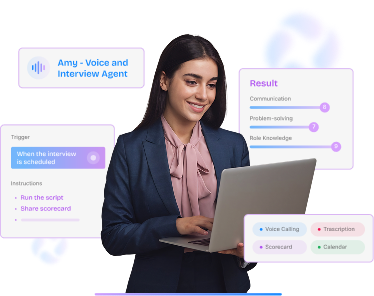
Insight that stops at a dashboard changes nothing. In RippleHire, the same signals that inform a recruiter's judgement are what the agents run on. Amy knows who to screen first. The Sourcing Agent knows which past candidate to reopen. The Engagement Agent knows who's gone quiet and why it matters.

Agents coordinate. Recruiters close.

Signals flow straight into Agent Builder workflows, no handoff step

Recruiters see the reasoning behind every ranked recommendation

Every agent action writes back to Talent Memory, so the system gets sharper with each requisition

image (9)

What changes when the system remembers

1-img
Lower cost per hire

More hires from candidates you already paid to attract

2-img
Shorter time to shortlist

Day-one slates instead of week-two ones

3-img
Fewer surprises

Stalled pipelines and integrity risks surfaced early

Talent intelligence runs under the whole of RippleHire's High-Performance AI ATS.

The same intelligence layer powers demand creation, sourcing, interviews, offers, and onboarding. Trusted by LTIMindtree, Axis Bank, Tata AIA, UST, Mphasis, Tata Steel, HDFC Bank, and ICICI Prudential — across 86M+ candidates, 1M+ users, and 50+ countries.

PRODUCT-IMG

FAQs

1. What is talent intelligence?

Talent intelligence is the practice of using an organisation's own hiring data — candidates, pipelines, sources, outcomes — to make better recruiting decisions. In RippleHire, it operates as a layer inside the ATS rather than a separate reporting product, so the insight reaches recruiters and agents at the point of decision.

2. How is talent intelligence different from recruitment analytics?

Analytics tells you what happened last quarter. Talent intelligence changes what happens on the requisition open in front of you: which candidates to contact, which pipeline is about to slip, which source to stop paying for.

3. Do we need a separate talent intelligence platform?

Standalone platforms sit outside the ATS, which means someone has to move data between systems and then move insight back into a recruiter's workflow. RippleHire's intelligence lives where the hiring happens, so nothing depends on that round trip.

4. What is Talent Memory?

Talent Memory is RippleHire's unified record of every candidate your organisation has engaged with, across every channel and every year. It's what makes rediscovery, skills matching, and agent decisioning possible.

5. Can talent intelligence reduce agency and job board spend?

Yes. Most enterprises hold a large silver-medallist and past-applicant pool they never search. Surfacing matched internal candidates before external sourcing begins is the fastest reduction in external spend available to most TA teams.

6. How does talent intelligence work with AI agents?

The intelligence layer is what the agents run on. Screening order, sourcing recommendations, and re-engagement triggers all draw on the same signals a recruiter sees, and every agent action feeds back into Talent Memory.

7. Is candidate data handled securely and in line with privacy regulation?

Yes. RippleHire is built for regulated enterprises, with consent management, retention controls, and data residency options aligned to DPDP and GDPR requirements. Details are in our Trust Center.

8. How long before we see results?

Rediscovery value shows up as soon as historical data is loaded, typically in the first hiring cycle. Source quality and pipeline forecasting sharpen over the first two to three quarters as the system accumulates outcome data.