Unlock groundbreaking insights into people, culture, and talent acquisition.

Download
our Exclusive Ebook
Advanced thinking in talent science and culture Actionable frameworks for HR leaders Case studies and results from industry pioneers
RippleHire vs an SAP-Backed Enterprise ATS · Updated October 2026
Their ATS is one product in an SAP suite. Ours is a recruiting harness. Agents coordinate. Recruiters close.
An AI agent is a model plus a harness. Models will keep changing; the harness, which holds your approval chains, compliance rules and hiring context, is what you need to go AI-native. RippleHire is a recruiting harness that stitches humans and agents together to deliver hiring outcomes. With Agent Builder, each region, type of hiring or business unit runs under its own rules. We also differ in approach. An SAP-backed ATS answers with one AI companion that assists across the workflow. RippleHire believes in specialised agents for different tasks: we provide agents for voice screening, Level-1 interviews, job publishing, offers and approvals. Agents handle the systematic work. Recruiters make the decisions and close.
Nine requirements at a glance
Three RFP answers that need a follow-up question
A suite rarely answers "no." It answers "AI-powered," "available" and "covered." Each can be true and still hide a gap, an extra bill or work your team absorbs later. Each card has the follow-up question to ask.
Their AI is a single companion that assists recruiters across the workflow. Ask which hiring tasks have their own dedicated agent, whether you can run different agents in different countries, and whether your team can build or change one without the vendor. Then ask how AI usage is priced: with consumption-based pricing, the bill grows with your hiring volume.
On an RFP, "available" can mean native product, a paid add-on, or a partner app plus an implementation project. All three read the same in the response, and only one of them is included in the price you were quoted.
3 months
Offer letters, e-signature and onboarding tasks are covered. The weeks between acceptance and Day 1, while the candidate serves notice and fields counter-offers, are where accepted hires drop out. Ask what tells you a candidate is at risk before they fail to show up.
Offer letters and Day-1 onboarding are covered. The weeks between them are where hires drop out.
Their offer management and onboarding products both work, and onboarding tasks can start at the offer-accepted stage. Ask what spots an accepted candidate who is about to drop out: one who has stopped replying, has a long notice period to serve, or has received a counter-offer.
Both products have referrals. Ours is built to get more employees referring.
Referrals are usually your fastest source of good hires, and referred hires tend to join and stay. Both products have the feature. The difference is how many employees keep referring.
What keeps employees referring
Moving referrals from 20% to 30% of hires comes down to participation. Employees have to keep referring, month after month, without being chased for it. Gamification gives them a reason to keep going.
- Leaderboards, badges, points and rewards that get employees referring
- One-click sharing of open roles to employee networks
- Source credit and payouts tracked automatically, so finance stops arbitrating disputes
- Referral analytics by employee, team and business unit, including quality of hire
- Vendor tiers and throttling, so agencies cannot dump profiles into your pipeline
Models will change. The harness is what you need to go AI-native.
One global agent forces every country to run at the pace of its strictest regulator. Rules on automated screening, candidate consent and data retention differ by country, and they keep changing. Ask whether you can run different agents in different regions, connect them to each other and to your recruiters, and change them yourself when the rules change. Agent Builder is the business-friendly face of the RippleHire harness: it stitches recruiters and agents into any hiring workflow, based on region, internal requirements and constraints, and stays model-agnostic as models are replaced or repriced.
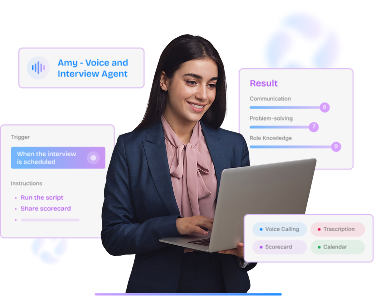
- Specialised agents for each task: an AI voice agent for pre-screening calls, Amy for Level-1 video interviews, and agents for scheduling, follow-ups, approvals, offers and compliance checks
- Set the rules once per geography: an Australia agent and a Germany agent play by different rules, inside one tenant
- Three operating modes, set per region, business unit or job family: Assisted, Semi-autonomous and Autonomous
- Agents coordinate, recruiters close: agents run the systematic work, with a human step wherever your policy or local law requires one
- Built and changed by your TA ops team in a no-code builder, without engineering or a vendor ticket
Read: ATS is dead. Harness is what you need for the next decade.
Nine requirements, side by side
They are stronger on the first row. The second is a difference in design. Each of the other seven can be checked in a demo. Where it says “not published, ask for a demo”, we found no published capability, so ask the vendor to show it.
| Hiring requirement | RippleHire | An SAP-backed enterprise ATS |
|---|---|---|
| Enterprise platform breadth and ecosystem | Hiring depth, open integrations, SAP via RHConnect | Strong, and an advantage |
| AI in the hiring workflow | Recruiting harness: specialised agents per task, connected in Agent Builder | One AI companion across the workflow |
| Level-1 interviews and voice screening | Amy and the AI voice agent, core product | Agentic interviewing announced 2026, ask if core product or marketplace |
| Customer-built agents with per-country rules | Agent Builder, no code | Not published, ask for a demo |
| Fraud and impersonation controls | Shield, in production | Fraud detection announced 2026; ask for a demo |
| Post-offer and pre-join intelligence | Prediction and intervention | Offer and onboarding, ask what predicts a drop-off |
| Referral participation | Gamification, rewards, automatic payout | Referral workflows, ask how participation is lifted |
| Drive and panel management at volume | Fills slots through 50% no-shows | Not published, ask for a demo |
| Regional workflow depth | Different rules per geography in one tenant, plus regional job boards and LinkedIn RSC (premium tier) | Not published, ask for a demo |
Where RippleHire goes deeper
Six capabilities built for high-volume enterprise hiring. Ask each shortlisted vendor to show them working in a demo. A tick on an RFP response does not show how deep a capability goes.
Agent Builder, the harness
Agent Builder connects specialised agents and your recruiters in one workflow. Your TA ops team builds and changes agents without code, and sets each one's scope, autonomy and rules per country, so the same process can run differently in Germany and Australia.
Ask to see an agent a customer built unaided.
Amy and the AI voice agent
Amy runs Level-1 video interviews around the clock and returns scored reports. The voice agent handles pre-screening calls and flags AI-written resumes before a recruiter reviews the profile.
Ask whether L1 interviews are core product or a marketplace add-on.
Offer-to-join management
Automated check-ins across the pre-join window, competing-offer flags, drop-off prediction scoring, buffer offers for high-risk candidates, and offer expiry to create urgency. Stock agents cover the mechanics: pre-warning a candidate before their offer expires, flagging offers stuck in draft, escalating delivery-approval stalls, and a WhatsApp nudge as the joining date approaches.
Ask what predicts a drop-off between offer and Day 1.
Shield fraud detection
Detection of duplicate applications, fake resumes, identity mismatches, deepfakes and agency double-submissions, plus interview proctoring. It also catches fake companies and universities at source, before background checks begin.
Ask how mature their fraud detection is today.
Drive and panel management
Run hiring drives that fill every panel slot even at 30% panel and 50% candidate no-shows, with live interviewer availability by skill and gamified attendance tracking.
Ask what happens when half the panel drops out.
Dream Offers
A branded offer microsite with role highlights, a team intro, an AI-personalised leader video using the candidate's name and role, and one-click acceptance.
Ask to see the offer a candidate receives.
What an SAP-backed ATS does well
These advantages hold up in an evaluation, and you should weigh them.
Suite alignment, ecosystem and analyst standing
If you already run SAP for core HR and payroll, sitting your ATS inside the same suite is a serious advantage: one vendor, one contract, one support path, and a data model your HR systems team already knows. Their partner marketplace is large and their enterprise footprint is proven. Procurement will find that easy to approve. They also carry serious analyst standing, including Leader placement in the Gartner Magic Quadrant for talent acquisition suites in both 2025 and 2026 and a 2026 Fosway Strategic Leader placement. The SAP acquisition closed in September 2025, and since March 2026 the ATS embeds into the suite's core HR product with a single login.
Our claim is narrow. An SAP-backed ATS integrates with an SAP enterprise stack better than anyone. What to compare is how much hiring depth you get once it is deployed, and how much work it still leaves to your recruiters. RippleHire connects into SAP bi-directionally with no-code RHConnect, so you keep the ecosystem benefit either way.
Then ask which of these capabilities is core product today, which is a paid add-on, and which needs a marketplace integration or a services engagement.
Three questions to ask before you sign
Each one can be answered in a live demo.
Which of these is core product, and which is an add-on or a partner app?
Ask them to mark every requirement in your RFP with one of the three. L1 interviews, referrals, fraud, drives and offer-to-join are where the answers tend to change, and where the quoted price does too.
What happens between offer accepted and Day 1?
Offer management and onboarding are two capable products with a window between them. Ask what detects a candidate going quiet, and what acts on it before the no-show.
Can you run different agents in different countries, and can we change them ourselves?
Every enterprise ATS now has an AI companion. Ask which tasks have their own dedicated agent, whether your own team can build or change an agent, and how its rules are set per country as regulations change.
The recruiting harness enterprise IT services runs on
LTIMindtree, Mphasis, Birlasoft, Bahwan Cybertek and 50+ enterprises run RippleHire, making tens of thousands of hires a year across global markets.
Bahwan Cybertek runs one compliant candidate journey across four regions on RippleHire. Ask us for the case study.
Give us 45 minutes. We will answer all three, live, next to your shortlisted ATS.
Bring your requirements, your SAP setup and your hardest questions. We will run the comparison against your requirements.
Schedule the comparison demo