
.svg) Product
Product

.png)




Table of content
AI-generated applications have made it trivial for one candidate to submit twenty tailored resumes in the time it once took to write a single one, while the screening system underneath was designed for the opposite economics.
LinkedIn's 2025 Future of Recruiting report found that 37% of organizations are actively integrating or experimenting with generative AI in their hiring process. The report also found that 93% of talent acquisition professionals believe accurately assessing candidate skills is crucial for improving quality of hire.
None of this is a candidate problem. Anyone job hunting today has access to tools that produce a polished, keyword-matched application in under a minute, and using them is a sensible response to a market where everyone else is doing the same.
What broke is the assumption sitting underneath every screening funnel built before 2023, which is that effort spent on an application signals interest, and that quality of writing signals quality of thinking. Both proxies have collapsed, and the metrics and interview questions resting on them stopped working without anyone deciding to change them.
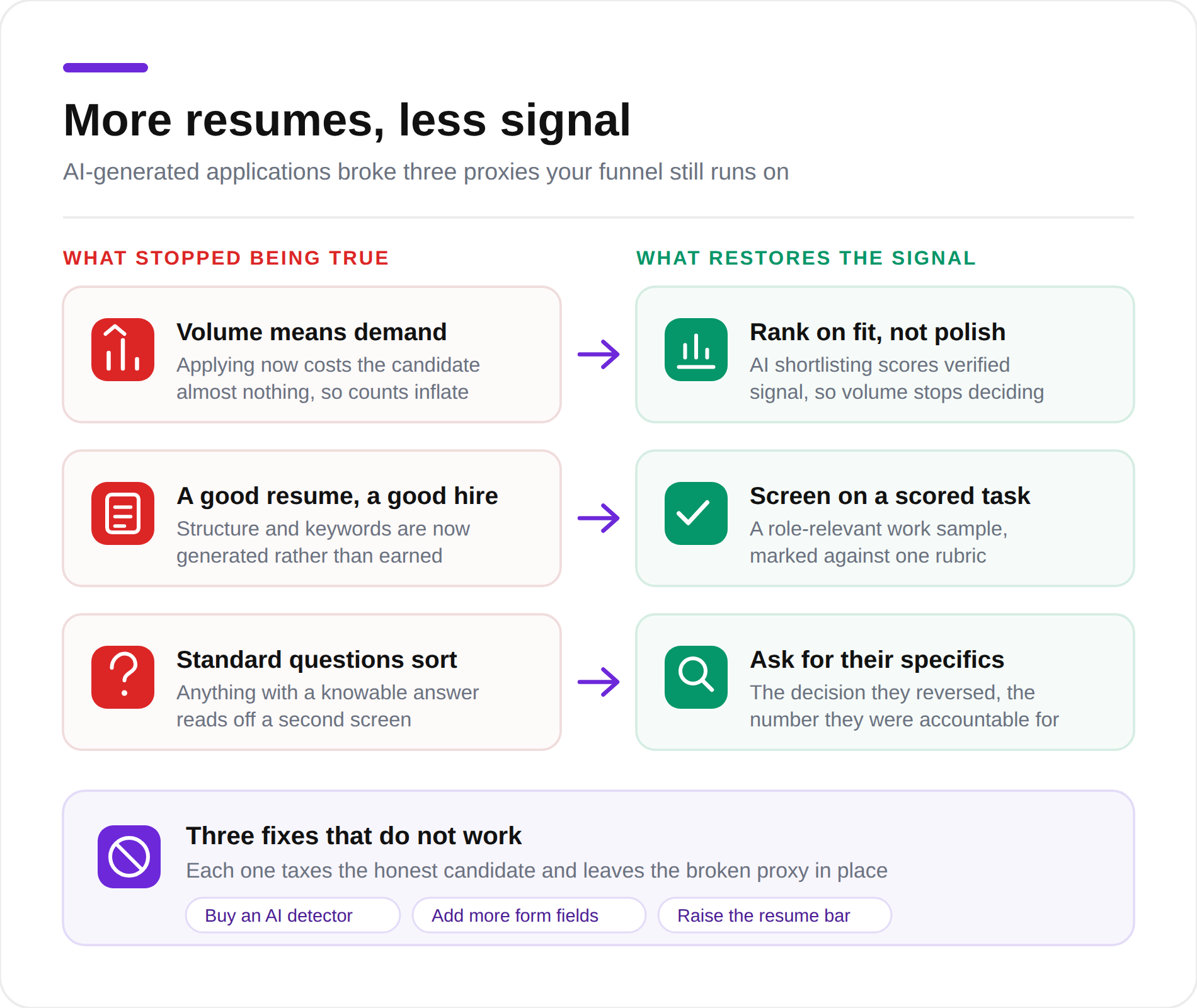
Three assumptions that stopped being true
Before fixing anything, it helps to name precisely what changed, because the instinct across most TA teams is to treat this as a capacity problem and throw more screening hours at it. The shift is not in the size of the funnel. It sits in what each stage of that funnel is actually telling you.
Volume is no longer a proxy for demand
A jump in applications used to mean something real. It told you the role was attractive, the compensation band was competitive, and the job description landed with the right people. That reading no longer holds, because the cost of applying has fallen close to zero for the candidate while staying flat for the recruiter reviewing them.
Managing large applicant volume becomes a triage exercise rather than evidence of pipeline health.
Three readings that used to be safe and are not any more:
- A high application count means strong employer brand pull for that role
- A low application count means the package or the location is wrong
- Applicant-to-interview ratios are comparable quarter over quarter
Teams that track requisition health on raw counts will read growth where there is only noise. Separating reach from genuine intent in the funnel metrics you already monitor stops a spike in submissions from masquerading as a spike in interest.
Resume quality is no longer a proxy for candidate quality
Recruiters have spent years using the resume as a rough sorting instrument. Clean structure, quantified achievements, and language that mirrors the job description all correlated loosely with candidates who had thought carefully about their careers. Generative tools now supply all three to anyone who asks, which means the top of your shortlist increasingly sorts on prompt quality rather than on capability.
The harder version of this problem is not polish, it is accuracy. When a model writes the experience section, it optimises for fit with the posting, and inflated or fabricated credentials slip in without the candidate necessarily intending to deceive. For a BFSI or IT services employer hiring at scale, a screening miss of that kind turns into downstream liability, because the cost of a bad hire lands on the team, on the client engagement, and in regulated functions, on the audit trail.
The questions that used to differentiate candidates no longer do
First-round screens have historically leaned on questions with knowable answers. Explain the difference between two frameworks. Walk through how you would structure a credit assessment. Describe your approach to stakeholder management. Any of those can now be answered fluently by a candidate reading from a second screen.
If a question can be answered well by someone who has never done the work, it has stopped being a screening question and become a vocabulary test.
What survives are questions anchored in a candidate’s own specifics: the decision they reversed, the number they were accountable for, the constraint that made the obvious solution unworkable. Details like those cannot be retrieved, only recalled.
What not to do about it
The reflexive responses to this problem are worth naming, because each one either fails quietly or makes the funnel worse. All three come from a reasonable instinct, and all three treat the symptom instead of the broken proxy underneath.
- Buy an AI-detection tool: Detection accuracy on short professional text is unreliable, false positives fall hardest on candidates writing in a second language, and someone who used AI to tidy their grammar is not the risk you are trying to catch. You will reject good people and still miss the fabricated profiles.
- Make the application form longer: Extra essay fields and screening questions tax the honest candidate far more than the automated one, since a model fills a fifteen-field form as easily as a three-field one. Completion rates drop fastest among the senior, currently employed candidates you most want to reach.
- Raise the resume bar: Filtering harder on a signal that has already degraded simply concentrates your shortlist on the best prompters. Sharpening the job description does more good, because it improves who applies rather than how they write.
Three responses that restore signal
Restoring signal means moving the real evaluation to places where AI assistance either does not help the candidate or does not matter to your decision. Each of the three responses below works on a different stage of the funnel, and they compound when you run them together rather than picking one and hoping it holds.
Structured, skills-based screening
Move the first genuine judgment away from the document and onto a task. A short, role-relevant work sample or scored assessment measures what a candidate can do under defined conditions, and it produces a comparable score across everyone in the pipeline instead of a subjective read on presentation. For teams that have discussed skills-based hiring for years without changing their funnel, this is the practical entry point.
What makes a task-based screen hard to game:
- Scoring runs against a rubric tied to the role, never against writing quality
- Every candidate faces the same conditions, so the comparison actually holds
- Time-bounded and monitored formats limit outside help without accusing anyone
- Results stay auditable, which matters when a hiring decision gets challenged later
Campus and drive-based teams already understand the role of assessments at volume. The shift worth making is applying that same rigour to lateral and experienced hiring, where the resume has carried too much weight for too long.
First-round screening calls that test depth, not knowledge
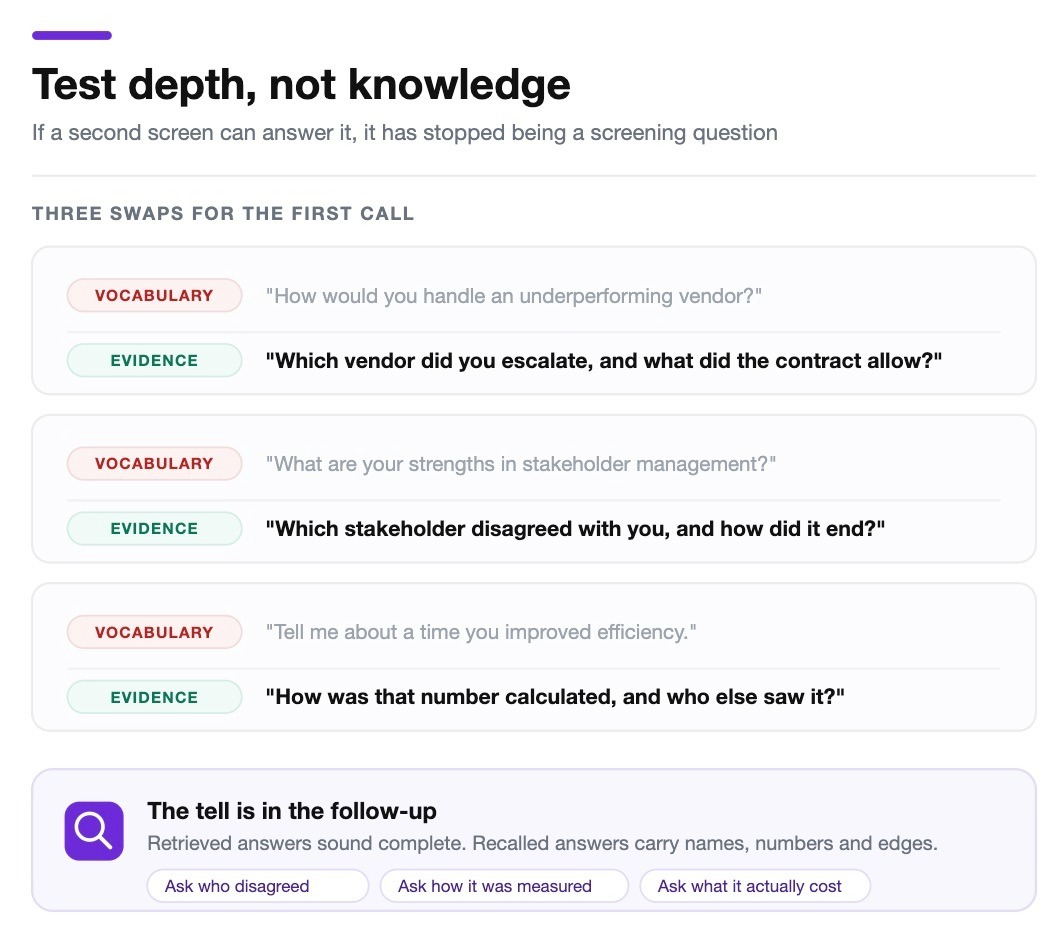
Redesign the first call around evidence the candidate personally holds. The aim is not to catch anyone out, it is to reach the layer of detail that only lived experience produces. A follow-up probe on a specific claim separates the person who did the work from the person who read about it that morning, and no amount of preparation closes that gap.
A few swaps that change what a screen measures:
- Rather than “how would you handle an underperforming vendor,” ask which vendor they actually escalated and what the contract allowed
- Rather than “what are your strengths in stakeholder management,” ask which stakeholder disagreed with them last quarter and how it ended
- Rather than accepting a stated number, ask how it was calculated and who else in the business saw it
Consistency matters as much as the questions themselves. Running these calls as structured interviewing, with the same core questions and a shared rubric for every candidate on the role, converts better questions into comparable data. Identity deserves attention at this stage too.
AI-assisted shortlisting that scores fit signals, not application quality
The third response puts AI on your side of the table, where it remains badly underused. A screening agent that reads the full candidate record rather than the resume alone can score against role requirements, prior stage outcomes, and verified history, so the ranking reflects fit instead of formatting.
Signals worth scoring, in rough order of how hard each is to fake:
- Assessment and work-sample results
- Verified employment and education history
- Depth and consistency of answers across stages
- Skill adjacency to the role, drawn from actual project detail
- Stated experience on the resume
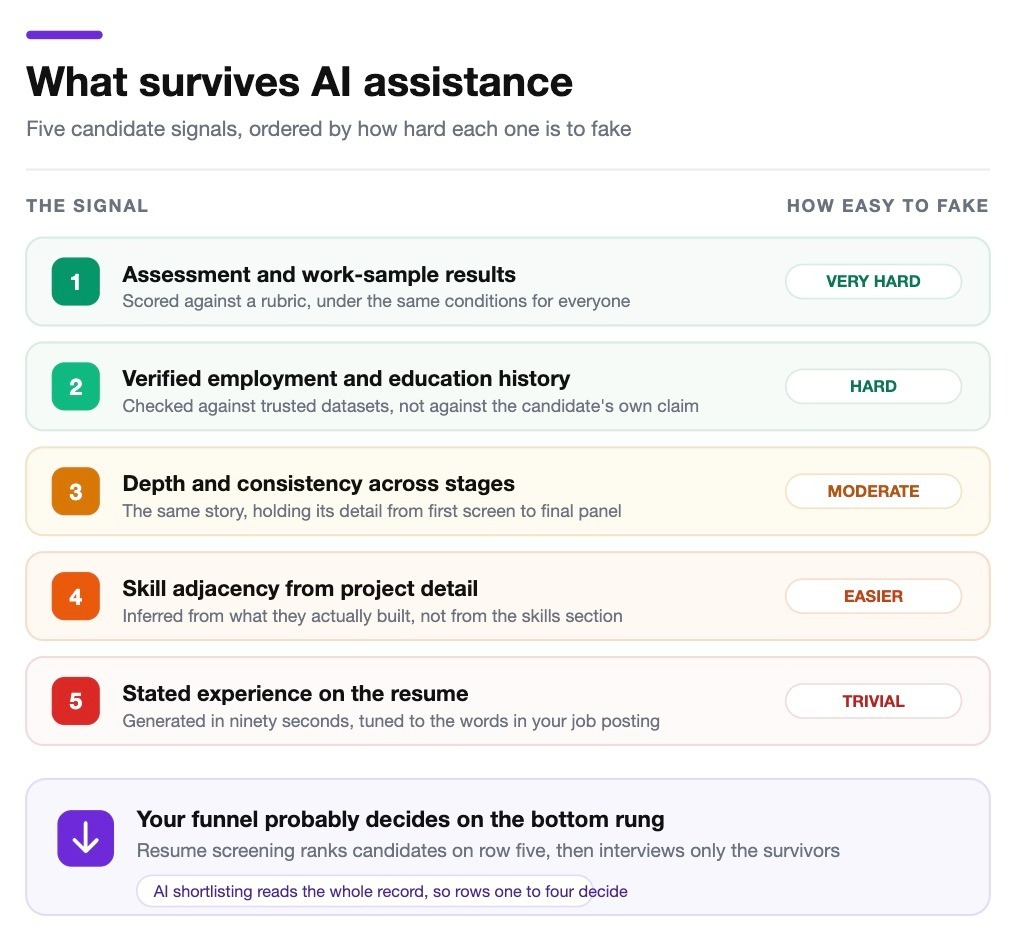
Well-built AI-driven candidate screening inverts the order most funnels run on today, where the last item on that list decides who gets seen at all. Coverage improves as a side effect, because the same model reviews every applicant rather than the first two hundred. Strong candidates who write poorly stop dropping out at stage one, and candidate matching starts working on demonstrated capability rather than keyword overlap.
How RippleHire surfaces real candidate quality
AI-generated applications are making the old definition of screening less useful. Recruiters need a system that can process volume while creating better evidence for the decisions that still require human judgment.
That is where an AI-powered ATS can connect screening, assessment, interviews, and shortlisting in one workflow.
RippleHire brings recruiters and AI agents together across the hiring process. Its screening capabilities include:
- AI Voice Agent for automated first-round pre-screening, with structured summaries and scoring for recruiter review.
- Amy, the AI Interview Agent for structured Level 1 interviews, including technical, behavioral, communication, and coding assessments.
- AI Profile Recommendation Engine that matches candidate profiles against role requirements and ranks them according to configurable criteria.
- Interviewer Copilot that provides role-specific questions and a structured evaluation framework using the job description, candidate resume, and interview context.
- Built-in fraud and identity safeguards that can flag issues such as cloned resumes, inflated experience, fake credentials, and interview impersonation for recruiter review.
The goal is not to automate the hiring decision. It is to make sure recruiters reach that decision with stronger evidence.
Book a demo to see how RippleHire's AI screening agents surface real candidate quality.
FAQs
How can recruiters identify AI-generated resumes during screening?
Recruiters should avoid treating writing quality as evidence of candidate quality. Instead, use the resume to establish an initial hypothesis and then test the underlying claims through structured skills assessments and targeted interviews. Ask candidates to explain specific decisions, trade-offs, projects, and outcomes from their experience. Consistency across the resume, assessment, and interview provides a stronger signal than the style or polish of the application itself.
What should a first-round interview test in an AI-heavy hiring environment?
A first-round interview should establish whether the candidate has the relevant knowledge, experience, reasoning ability, and practical judgment required for the role. Questions should go beyond rehearsed behavioral responses and explore how candidates reached decisions, handled constraints, and responded when their original approach did not work. A consistent scorecard helps interviewers evaluate these signals against the same role requirements.
How does skills-based screening reduce the impact of AI-generated applications?
Skills-based screening moves evaluation away from how convincingly a candidate describes their experience and toward what they can demonstrate. A structured assessment, work sample, technical exercise, or role-specific interview can test capabilities directly. AI can still help candidates prepare, but the hiring team receives additional evidence that is harder to establish through a polished resume alone.
Should recruiters stop using resumes because candidates can use AI?
No. Resumes remain useful for understanding a candidate's career history and identifying areas worth exploring. The problem occurs when recruiters treat resume quality as a strong indicator of candidate capability. In an AI-assisted application environment, resumes work best as an entry point into evaluation. Recruiters should combine resume information with skills evidence, structured interviews, and other role-relevant signals before making a decision.
How can enterprise TA teams handle higher application volumes without lowering screening quality?
Enterprise teams need to separate volume processing from human judgment. AI can handle repetitive tasks such as profile matching, pre-screening, interview coordination, and structured reporting. Recruiters can then focus their attention on candidates who meet defined fit criteria and require deeper evaluation. The key is to automate against a clear hiring framework so that higher throughput does not simply mean moving more low-signal applications through the funnel.