
.svg) Product
Product

.png)


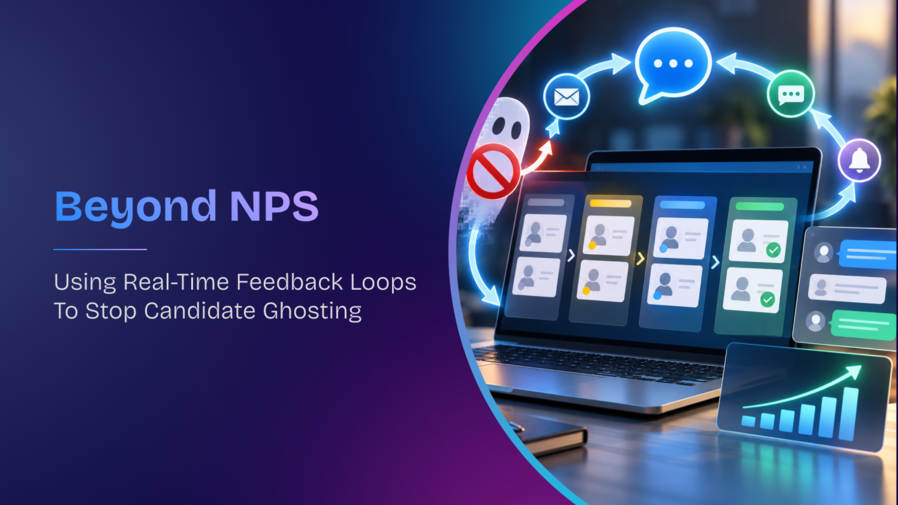


Table of content
Quick answer: Post-rejection NPS emails arrive too late to act on and get ignored by most candidates global response rates for candidate-experience surveys sit around 24% on average, and post-rejection surveys typically land well below that. Real-time feedback loops fix this by capturing signal the moment it happens: tracking exactly where candidates drop off in your application, collecting instant ratings over WhatsApp instead of email, and using AI to flag negative sentiment immediately so a recruiter can step in before a candidate ghosts you or posts a public review.
The old playbook for measuring candidate experience went something like this: You interview a candidate. You reject them. Three days later, you send an automated email asking, "How likely are you to recommend us to a friend?"
In 2026, that playbook is not just outdated, it's actively working against you .
By the time that email lands in an inbox (if it doesn't hit spam first), the candidate has often already stopped responding to you, left a review on Glassdoor or AmbitionBox, and mentioned the experience to their network on LinkedIn.
Survey fatigue is real.
People are asked to rate every food delivery order and cab ride, and generic post-process surveys increasingly get ignored as a result. General survey-industry benchmarks — SurveyMonkey's 2026 benchmark data puts email-based NPS response rates at roughly 20–30% and a cold "how likely are you to recommend us" email sent to someone you've already rejected tends to land well below even that baseline.
If you want to "attract top-notch talent" this year, you need to stop asking for feedback and start intercepting it. You need to move from Passive Listening (NPS surveys) to Active Signal Detection (Drop-off analysis and Sentiment AI).
This guide will walk you through the new science of Feedback Loops: how to use WhatsApp, Agentic AI, and behavioral data to save your employer brand before the damage is done.
The loudest feedback is silence (Analyzing drop-offs)
Before you ask a single question, your candidates are already giving you feedback. They give it with their feet.
In 2026, a drop-Off is not just a lost applicant; it is a data point screaming that your process is broken. If a candidate spends 10 minutes on your career page and then leaves without clicking "Submit," they have given you a 1-star review without typing a word.
The drop-off zones that matter most
Most ATS dashboards show you how many people applied. But do they show you how many started but didn't finish?
| Drop-Off Zone | What happens | Typical loss |
|---|---|---|
| The Login Wall | Candidates required to create a username and password before viewing the job | Up to 40% of traffic lost before a single application begins |
| The Resume Parsing Trap | System asks candidates to upload a resume and then manually retype their work history | 60% of mobile users abandon the process here |
| The Assessment Wall | 90-minute coding test sent before any human screening | Senior talent refuses to do unpaid work before a conversation |
The fix for each of these is a system that detects the drop-off in real time.
An agentic AI watchdog sitting on the career site can detect that drop-off rates at the "Upload Cover Letter" stage have spiked 15% this week and flag it to the TA Head immediately rather than waiting for a recruiter to notice low application volume at the end of the month.
WhatsApp as the feedback channel
Why are you still sending feedback forms via email?
-
Email Open Rate: ~20%
-
WhatsApp Open Rate: ~98%
In markets like India, Southeast Asia, and LATAM, WhatsApp is not just a messaging app; it is the operating system of daily life. Expecting a Gen Z developer to open an Outlook email to rate an interview is a strategy designed to fail.
The "micro-feedback" loop
Stop sending 10-question surveys. In 2026, feedback must be conversational and instant.
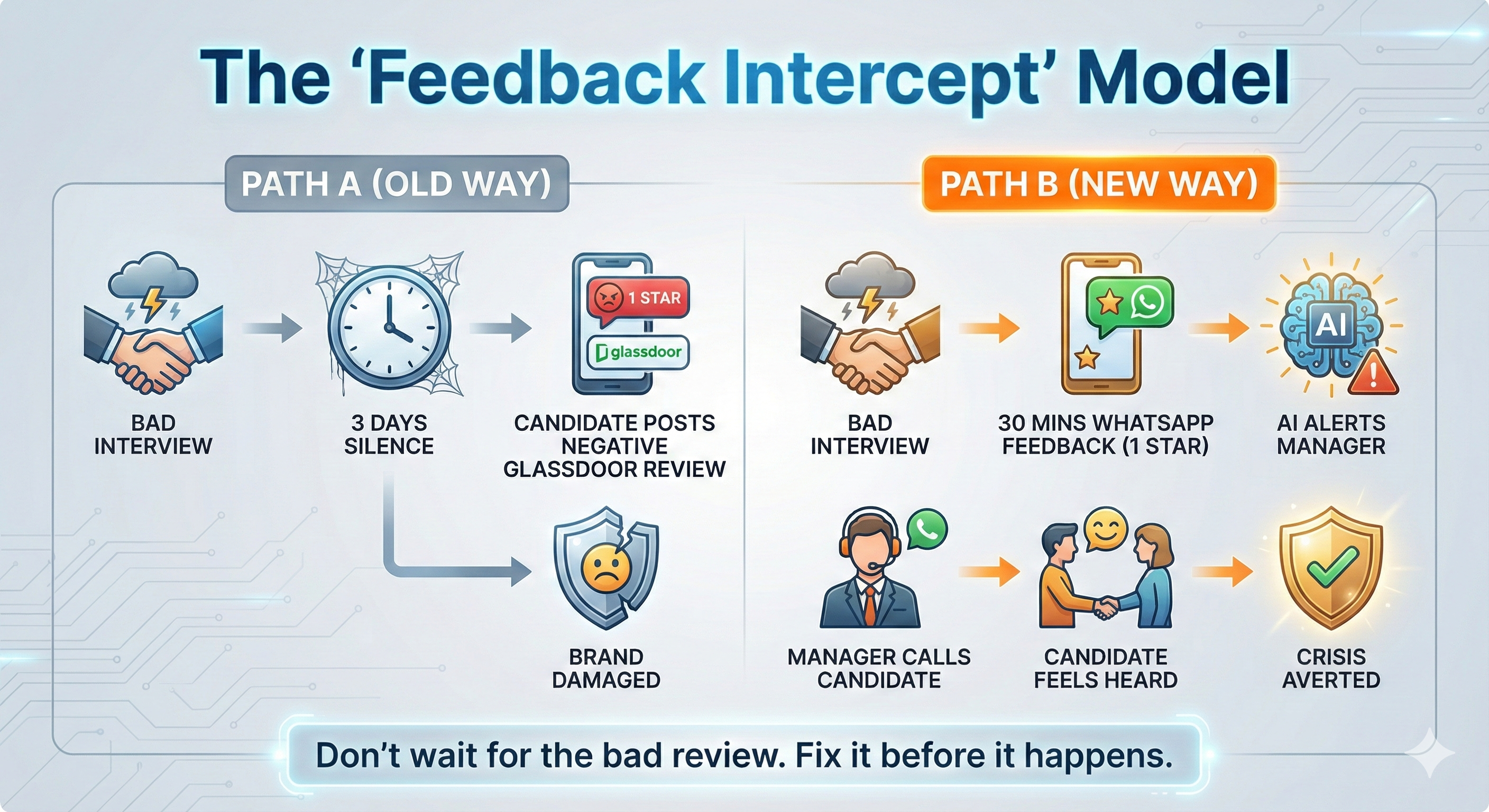
Integrate a WhatsApp bot (via the WhatsApp Business API) with your ATS. Configure it to trigger a message 30 minutes after an interview ends.
The message:
“Hi [Name], thanks for chatting with [Interviewer Name] today! Quick question: On a scale of 1-5, how would you rate the conversation? (Reply with a number).”
Why this approach produces more data:
-
Low Friction: It takes 2 seconds to type "5".
-
High Volume: You get 5x more data points than email.
-
Real-Time: You know today if an interviewer was rude, not next month.
The WhatsApp Business API with a verified green tick also addresses the professionalism concern. Banks, airlines, and enterprises use it as a standard verified channel. Candidates see WhatsApp communication from a verified enterprise account as responsive rather than informal.
Catching detractors before they go public
The most dangerous feedback is the one you don't see until it’s public.
A candidate has a poor experience. The interviewer was late, unprepared, or dismissive. The candidate leaves angry. Two hours later, they post a one-star review on Glassdoor: "Disrespectful Time Wasters." That review stays there permanently.
The intercept strategy catches that anger internally before it becomes external.
The workflow
-
The trigger: Candidate rates the interview "2/5" on your WhatsApp bot.
-
The alert: The AI Agent doesn't just log the score. It instantly pings the Talent Acquisition Manager on Slack/Teams: “⚠️ Alert: Negative Candidate Experience detected for [Role]. Candidate [Name] gave a 2-star rating.”
-
The intercept: The Manager calls the candidate within 2 hours.
-
“Hi [Name], I saw you didn’t have a great experience today. I’m the Hiring Manager, and I wanted to personally apologize and hear what happened.”
-
The result: Most candidates are shocked that a human actually called. That anger turns into appreciation.
-
Best case: They re-enter the process.
-
Good case: They don’t post the bad review because they felt "heard."
-
Great case: They post a 5-star review saying, "Interview was tough, but the company really cares about feedback." which is net positive for employer brand
You cannot fix a bad interview, but you can fix a bad feeling. Speed is your only weapon.
cNPS 2.0: Measuring sentiment by segment
Candidate Net Promoter Score (cNPS) has been the gold standard for years.
The formula : (% Promoters) - (% Detractors) = cNPS.
But a raw average number is misleading without segment context.
-
A score of +40 is great for a "Withdrawn" candidate.
-
A score of -14 is actually normal for a "Rejected" candidate.
Averaging both together produces a number that explains nothing.
The 4 segments you must track:
| Segment | Who they Are | Why they matter | Benchmark |
|---|---|---|---|
| The black hole | Applicants who applied but never spoke to a human | Their score reflects the automated response quality or the absence of it | Usually low , improve with automated status updates |
| The silver medallists | Final-stage rejected candidates | Most critical brand ambassadors, loved the company but did not get the offer | Aim for 0 to +10. Below -20 signals a toxic rejection process |
| The offer declines | Candidates who received but declined an offer | Feedback here reveals whether the loss was compensation or process | Invaluable for identifying process problems disguised as compensation problems |
| The hires | Candidates who accepted and joined | High scores are expected ,do not let them mask the experience of the rejected majority | Measure separately, never average with other segments |
AI sentiment analysis beyond the score
Reading 500 open-text comments manually is not feasible. AI sentiment analysis scans comments and surfaces patterns: "The word 'arrogant' appears in 40% of reviews related to the Engineering panel."
That insight points to a specific interviewer problem not a company-wide culture problem. The fix is targeted and actionable.
Candidate ghosting in India: Mirror behavior, not random rudeness
India has one of the highest "No-Show" and "Ghosting" rates in the global recruitment market.
Why? Because candidates apply to 50 jobs at once and rarely hear back from 48 of them.
Ghosting is a feedback loop. When a candidate ghosts you, they are mirroring your behavior. If your company takes 14 days to reply to an application, you have taught the candidate that silence is acceptable.
The "zero-ghosting" promise: To boost your employer brand in India, make a radical promise: "No ghosting."
-
Use AI to send automated (but polite) rejection updates to every single applicant.
-
Even a rejection is better than silence.
Agentic AI as a feedback watchdog: Zero-touch signal detection
We keep mentioning "Agentic AI." What makes it different from a chatbot?
-
Chatbot waits for a candidate to complain.
-
Agentic AI proactively monitors the health of your funnel and surfaces patterns before they are raised
Imagine an AI that acts as a "Feedback Watchdog."
-
It notices that Video Interviews are getting lower ratings than Face-to-Face interviews.
-
It checks the logs and finds that the video platform is lagging on 4G networks.
-
It suggests a switch to a lighter video tool for mobile users.
This is Zero-touch feedback. The candidates didn't complain about the lag; they just rated the experience lower. The AI connected the dots between "Technical Latency" and "Candidate Satisfaction."
Feedback is fuel, not just data
In 2026, collecting feedback is easy. Acting on it is hard.
The companies winning the talent war aren't the ones with the highest salaries; they are the ones who treat candidates like customers. They understand that every rejected candidate is a potential future customer, a potential referrer, or a potential future hire.
Your action plan for this week:
-
Audit your Drop-Offs: Where exactly are people quitting your application form?
-
Test WhatsApp: Send one post-interview feedback message via WhatsApp instead of email and compare response rates.
-
Build the intercept: Define what happens the moment someone leaves a 1-star rating who calls them, and how fast.
Don't let your employer brand be defined by the reviews you ignored.
Start intercepting the signal today.
FAQs
What is a good cNPS score for rejected candidates?
A positive score is rare and not the realistic bar. General benchmarking data shows most companies' candidate NPS falls somewhere between -20 and +50, with rejected-candidate NPS running meaningfully lower than hired-candidate NPS as a matter of course. The goal isn't to hit a positive number here; it's to track the gap between your hired and rejected scores over time and catch when a specific stage or interviewer is dragging rejected-candidate sentiment down further than that gap alone would explain.
How can we reduce candidate ghosting in India?
Ghosting tends to run both directions. The most effective lever is increasing your own speed and transparency: shorten the hiring process wherever possible, use faster channels like WhatsApp for scheduling and updates, and make sure every applicant not just the ones who make it to interview receives some kind of status update rather than silence.
Is WhatsApp feedback professional for corporate hiring?
Yes, when done through a verified WhatsApp Business Account. The WhatsApp Business API is now used by banks, airlines, and large enterprises as a standard, verified communication channel, and candidates increasingly read it as "responsive" rather than "informal" provided it's clearly an official business account, not a personal number.
How does negative feedback improve employer branding?
Negative feedback is an opportunity for "Service Recovery." When a company publicly responds to a negative review with empathy and facts (not defensiveness), or privately calls a candidate to apologize, it demonstrates humility and culture. Candidates trust companies that own their mistakes more than companies that appear "perfect" (which looks fake).
What is the "Negative Feedback Intercept"?
It's a workflow where a real-time negative rating (for example, a 1-2 star interview score submitted via WhatsApp) triggers an immediate internal alert, so a recruiter or hiring manager can reach out to the candidate directly ideally within a couple of hours before frustration turns into a public review or social post.