
.svg) Product
Product

.png)




Table of content
Recruiter burnout has been discussed in roughly the same terms since 2022. The workload is too high, the market is unforgiving, and the recommended response involves wellness budgets, mental health days and firmer boundaries. What has changed underneath that conversation is the composition of the work itself, and the interventions have not caught up.
One finding reframes the whole problem. Gartner research published in March 2026, drawn from a July 2025 survey of 114 HR leaders, found that only 7% of organizations give employees any guidance on what to do with the time AI frees up. Tools now remove hours from a recruiter's week at enterprise scale, and almost no one has decided where those hours should go. Left undirected, they refill with whatever arrives next, which in talent acquisition is nearly always more coordination.
This article covers four shifts the 2026 evidence supports: the AI paradox, the morale cost of no-shows, the whiplash created by freeze and thaw cycles, and the gap between what recruiters are asked to be and what they spend their day doing. Each section closes with fixes that address the shift rather than the symptom.
Why the 2022 playbook stopped working
The standard diagnosis treats burnout as a volume problem. Too many requisitions, too many applications, too few recruiters. That reading was accurate three years ago and it produced a sensible response, which was to treat recruiter burnout as a systems problem rather than a wellness problem and automate the load.
Something more specific is happening now. Volume has stopped being the main variable, because a large share of it is already absorbed by tooling. What predicts exhaustion in 2026 is the type of work sitting in a recruiter's day, how visible that work is to the people setting targets, and how often the plan behind it changes. A team can carry fewer requisitions than it did in 2022 and feel considerably worse.
Gartner's Emily Rose McRae makes the point precisely in the firm's 2026 future of work trends, arguing that the best CHROs will focus on saving employees effort rather than time, and that effort is the more reliable indicator of where technology delivers real value. Hours and effort are not the same measure, and burnout tracks the second one.
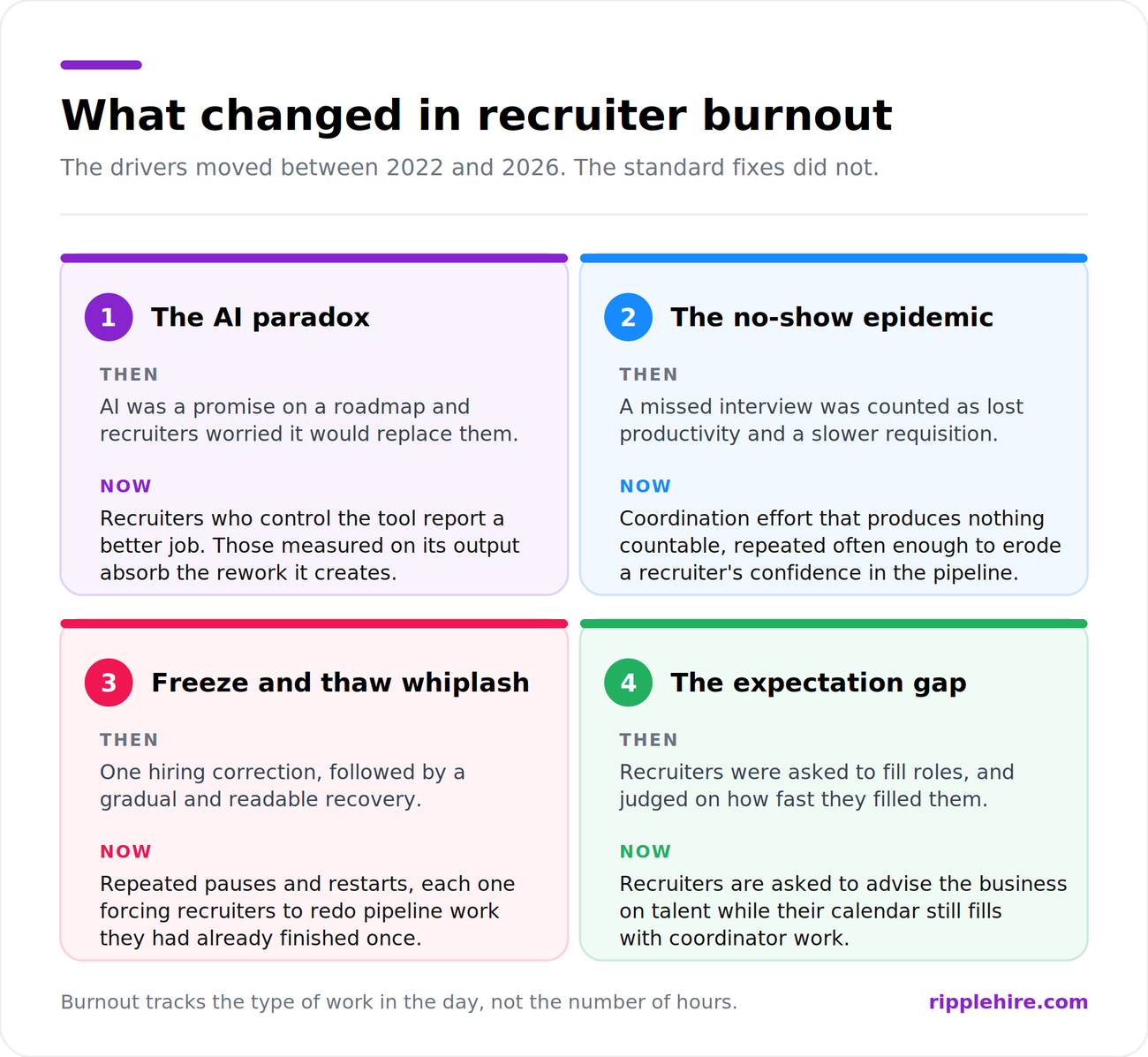
What changed in recruiter burnout between 2022 and 2026
Shift one: the AI paradox
AI now sits on both sides of the burnout ledger, which is why the conversation about it tends to go in circles. Recruiters who use these tools with genuine control over them generally report a better job. Those measured on what the tools produce report a worse one. Both statements come out of the same year of research.
Where AI genuinely improves the job
Adoption is not the problem, and the sentiment data does not support the idea that recruiters resent these tools. Gartner found that 65% of employees are excited to use AI at work. Korn Ferry's TA Trends 2026, based on 1,600 talent leaders, found that TA leaders using AI are more likely to have influence in the C-suite, at 85% against 70% for those who do not.
Agency explains most of that difference. A recruiter who chooses when to use an agent, reviews what it produces and keeps the hiring decision experiences it as leverage. Teams that deploy AI interview agents without giving up recruiter control tend to land on this side of the line.
Where it turns into rework
The other side of the ledger has a name now. Research from BetterUp Labs and Stanford, published in Harvard Business Review, found that 41% of workers have encountered AI-generated output that looks finished but lacks the substance to move work forward, costing nearly two hours of rework for each instance. Gartner expects this category of output to become the single largest productivity drain organizations face in 2026.
In a hiring context it shows up as:
- Screening summaries that read well and cannot be traced back to anything in the resume
- Interview notes generated from a transcript that miss the reason a candidate was rejected
- Sourcing lists long enough to hit a target and shallow enough to need re-qualifying
- Job descriptions that pass review, attract the wrong applicants, and raise screening load two weeks later without anyone connecting the two
Each of these lands on a recruiter as a second pass over work that was reported as complete.
The metric that causes the damage
Measure a recruiter on output an agent produces, and you have built a system that rewards volume and hides rework.
Targets are where the paradox becomes a burnout risk. When profiles sourced, candidates screened or messages sent become the headline number, AI inflates every one of them instantly. The reported picture improves, the underlying quality does not, and the correction work falls to the same recruiter who is now expected to hit a higher baseline next quarter. Gartner found that 88% of HR leaders say their organizations have not realized significant business value from AI tools, and it puts part of that gap down to workflows that were never adapted to the way AI changed the work. An activity metric that AI can inflate is one version of a workflow nobody adapted.
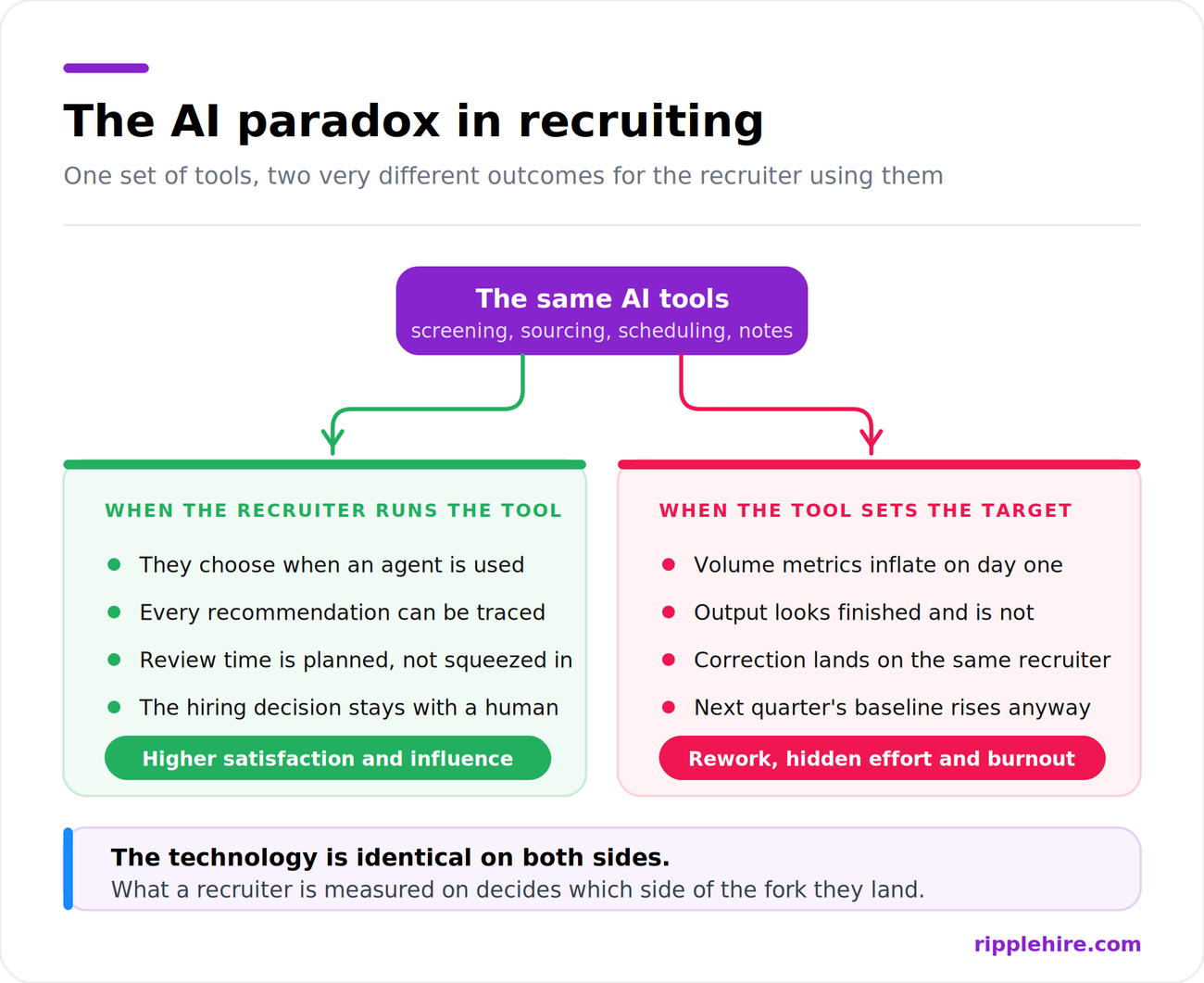
One set of tools, two outcomes
What to fix
- Move recruiter targets from output to outcome. Count qualified candidates who reached a hiring manager and progressed, not profiles touched. An agent can inflate the first measure and cannot inflate the second.
- Put review time in the plan. If an agent screens 400 applications, someone still validates the shortlist. Treat that as scheduled work with a name against it rather than something absorbed between meetings.
- Require traceability on every AI output. Recruiters who can see why a candidate was ranked will trust the ranking. Those who cannot will redo the work manually, and the efficiency case disappears without anyone reporting it.
- Decide where saved time goes before you deploy. Name the work that will fill the gap, whether that is hiring manager calibration, pipeline building or candidate conversations. Otherwise coordination will claim it.
Shift two: no-shows drain morale before they drain the funnel
Interview no-shows are usually costed as a productivity problem, which understates them. SHRM's 2025 Talent Trends research found that 41% of organizations report candidates ghosting them during the interview process. For a recruiter, the damage is not only the empty slot.
Why a no-show lands differently on a recruiter
Coordination is invisible work with a visible failure mode. Booking a panel means chasing availability across two or three senior people, negotiating a slot with the candidate, confirming the link and answering questions the night before. None of that appears in a report. All of it disappears when the candidate does not arrive, and the recruiter then explains the gap to an interviewer who gave up an hour of delivery work.
The morale mechanics
- Effort spent on a no-show produces nothing measurable, so it never counts toward the recruiter's numbers
- The recruiter absorbs the interviewer's frustration despite having done the job correctly
- Repeat cycles teach the team that careful coordination and careless coordination end the same way
- Late-stage no-shows carry an extra sting, because they usually mean a competing offer landed and nobody saw it coming
That last effect matters most. A recruiter who is surprised by a withdrawal starts to distrust their own read of a pipeline, and confidence erodes faster than energy does.
What to fix
- Shorten the gap between invitation and interview. The interval is the strongest predictor you can act on, and it is set by your scheduling process rather than by the candidate.
- Watch engagement between stages instead of at stages. Reply latency, portal activity and reschedule requests move before attendance does, which is what makes post-interview candidate engagement a leading indicator rather than a courtesy.
- Make rescheduling take one tap. Candidates disappear partly because asking to move a slot feels harder than going silent, and a self-serve path converts a no-show into a rebooking.
- Report attendance as a process metric. Publishing interview attendance rate by stage and source moves the conversation off candidate attitude and onto the parts of the process you control. Automating the booking itself, as covered in three steps to improve your interview scheduling, removes the coordination cost of the rebooking loop.
Shift three: freeze and thaw cycles have created whiplash
The labor market itself changed shape, and TA teams are absorbing that change directly. Hiring has slowed without a corresponding rise in separations, which produces a market that moves in stops and starts rather than in trends.
What the labor data shows
US Bureau of Labor Statistics JOLTS data for June 2026 puts the hires rate at 3.4% and the layoffs and discharges rate at 1.1%. The Federal Reserve Bank of Cleveland describes this as a low-hire, low-fire labour market, noting that hiring sits well below the rates seen in earlier expansions while layoffs stay unusually low.
Headcount decisions have also outrun their own evidence. Gartner reports that only 1% of layoffs in the first half of 2025 resulted from AI increasing productivity, which means most reductions were made in anticipation of returns rather than because of them. Plans built on an expectation get revised when the expectation does not arrive.
How whiplash shows up inside a TA team
For recruiters, the effect is not one freeze. It is a sequence of them, each with a different explanation.
- Pipelines built over six weeks are paused, then restarted with the same candidates approached again
- Requisitions reopen with new approval layers, so the work is repeated rather than resumed
- Recruiters reassigned during a freeze return to their own roles behind schedule
- Sourcing relationships go cold and have to be rebuilt from the beginning
- Forecasts stop being credible internally, which weakens the recruiter's standing with hiring managers
Work that gets done twice is the most reliable burnout driver in this list, and freeze cycles guarantee it. Teams that handle talent acquisition during layoffs well tend to plan for the restart while the freeze is still running.
What to fix
- Keep pipelines warm rather than dormant. A paused requisition should still have a communication track running, so a restart begins with candidates who know where they stand.
- Separate demand readiness from time to fill. Measuring demand readiness against time to fill shows leadership how much of a delay was created upstream of the recruiter, which protects the team when a cycle turns.
- Give freezes a defined shape. A stated review date and a named restart owner turn an open-ended pause into a plan, and recruiters can hold a plan.
- Configure the process, not the people. Approval routing and drive structures should change without a project, so a thaw does not become six weeks of manual rework before the first interview.
Shift four: the expectation gap
Recruiters are asked to operate as strategic advisors to the business. Their calendars still fill with coordinator work. This gap has widened as the advisory expectation has become explicit while the administrative load has stayed where it was.
The gap in numbers
Korn Ferry's research across 1,600 talent leaders found that 59% of TA leaders feel shut out of strategic business decisions, even though 83% report having some influence with the C-suite. Influence exists, the seat at the decision does not, and that combination is a recognized driver of exhaustion because it pairs high responsibility with low control.
Where the coordinator work actually sits
Ask a recruiter to log a week honestly and the pattern is consistent across enterprises:
- Chasing interview availability and rebooking slots
- Rekeying candidate data between systems that do not talk to each other
- Reformatting feedback so a hiring manager will read it
- Rebuilding trackers the reporting layer should already produce
- Following up on documents, approvals and joining formalities
None of this requires recruiting judgment. All of it requires a recruiter, because no one else has visibility of the whole process.
What to fix
Give the advisory role real inputs. A recruiter cannot advise a hiring manager on market realities without salary benchmarks, funnel conversion by source and a clear view of where candidates drop out. Provide the data before you set the expectation.
Then remove the work that blocks it. Every hour of coordination is an hour not spent on calibration, and the two compete directly. Upskilling recruiters to work alongside AI and automation fails when the day still ends with a scheduling backlog.
Protect the shift with structure. Blocked calibration sessions, a standing role intake meeting and a written hiring manager agreement convert advisory work from something recruiters do when they get time into something the process requires.
Burnout in 2026 is workload misalignment, not workload volume
Read the four shifts together and a single pattern emerges. The AI paradox is a misalignment between what recruiters are measured on and what they actually do. No-shows create effort that produces nothing countable. Freeze cycles make people repeat work they have already finished. The expectation gap asks for judgment from someone whose day is booked with coordination.
None of these is fundamentally about hours. Each one is about the fit between the work and the person doing it, which is exactly the distinction Gartner draws between saving time and saving effort. A recruiter carrying forty hours of judgment work finishes the week tired. Twenty-five hours of coordination, rework and repeat work leaves that same person depleted, and no wellness programme changes the arithmetic.
The practical conclusion is uncomfortable for the standard technology pitch. Shrinking the workload is not the objective. Changing its composition is. Work that is repetitive, rules-based, high in volume and low in judgment belongs with agents that run screening and scheduling. Anything that calls for reading a hesitation in a candidate's voice, telling a hiring manager their expectations are unrealistic, or deciding between two credible finalists belongs with recruiters. Most TA operating models still split these two categories the wrong way round, which is the real reason the burnout conversation has not moved since 2022.
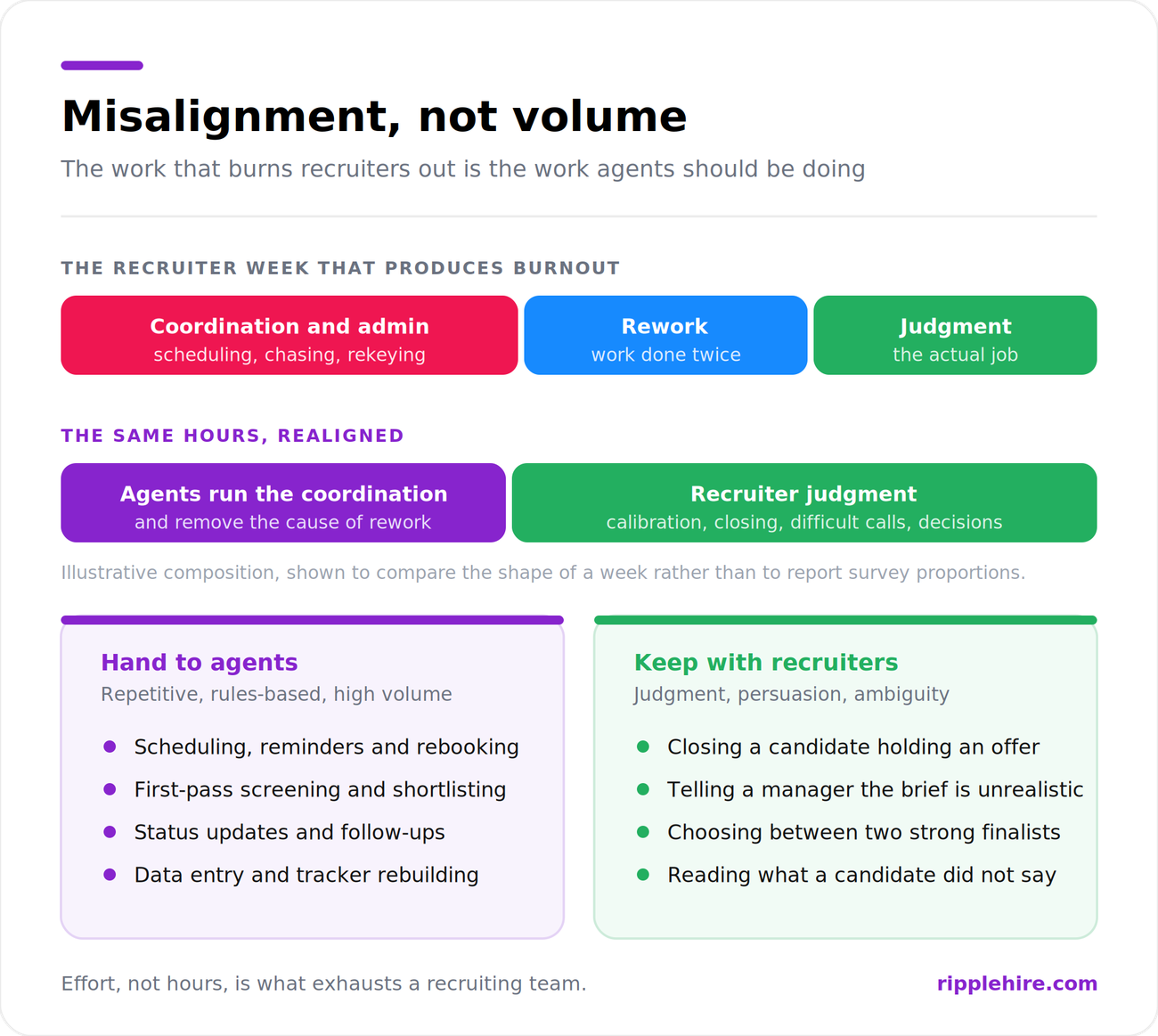
Give recruiters back the work only they can do
Fixing misalignment means changing what sits in a recruiter's day, and that is an operating model decision rather than a wellbeing one. Coordination, follow-up, scheduling and first-pass screening need somewhere else to live before advisory work has room to exist. Building that division of labour into the platform where hiring already happens is what makes it hold when the next cycle turns.
RippleHire is the ATS where recruiters and agents work together. Agents coordinate while recruiters stay focused on hiring, across sourcing, screening, scheduling and follow-ups. The platform runs at a hire every four minutes across more than a million users in over 50 countries, and customers report candidate experience scores above 4.5 out of 5.
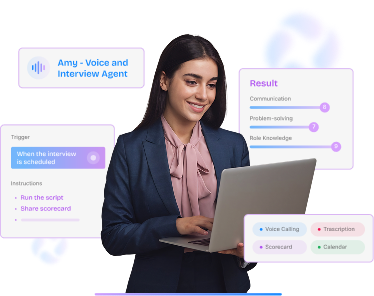
- Amy, the built-in AI interview agent, runs level one interviews around the clock and returns structured reports with scores, red flags and recommendations, so recruiters review judgments rather than conduct first screens
- An AI voice agent that handles pre-screening calls at any hour and delivers structured summaries back to the recruiter
- Interview management that removes calendar-hopping, with panel management tracking availability, show rates and feedback turnaround
- Post-offer engagement with early drop-off warnings and likelihood-to-join prediction, so withdrawals stop arriving as surprises
- Reporting and analytics that expose funnel bottlenecks, which lets you measure recruiters on outcomes instead of activity
Book a demo to see how RippleHire gives recruiters back the time for work that matters.
Frequently asked questions
How do you tell the difference between a busy recruiting team and a burnt out one?
A busy team is stretched but still moving forward. Burnt out teams repeat themselves. Watch for work being redone rather than progressed: candidates re-sourced, notes rewritten, schedules rebuilt. Cynicism about hiring managers and candidates is the second signal, and it usually arrives before anyone raises workload directly. Volume alone tells you very little, because two teams carrying identical requisition loads can be in completely different states.
What should a TA leader do first when a hiring freeze lifts?
Start with the pipeline you already built rather than a fresh sourcing push. Candidates who engaged before the pause are the cheapest and fastest route to a first interview, provided someone kept them informed.
Confirm the approval path next. Restarts stall when routing changed during the freeze and nobody tested it, which turns week one of a thaw into administrative cleanup instead of hiring.
How should recruiter performance be measured when AI does part of the work?
Shift the measure to the point where human judgment enters. Qualified candidates who progressed past a hiring manager, offer acceptance, and quality of hire all resist inflation because an agent cannot manufacture them. Activity counts such as profiles sourced or candidates contacted lose meaning entirely once tools generate them, and continuing to report those numbers creates pressure on recruiters without telling leadership anything reliable.
What work should stay with a human recruiter when agents handle coordination?
Anything involving persuasion, judgment under ambiguity or a relationship that has to survive a difficult conversation. Closing a candidate who has a competing offer, telling a hiring manager the brief is unrealistic, and choosing between two strong finalists all sit here.
Agents should own scheduling, reminders, status updates, data entry and first-pass filtering, where consistency matters far more than nuance and the volume makes human handling impractical.
How do you keep recruiters engaged during a hiring freeze?
Give the pause a purpose and an end point. Pipeline building for known future roles, hiring manager calibration, process cleanup and interviewer training all create value that pays out the moment hiring resumes. Recruiters cope with a freeze far better when the work has a visible destination. Silence is the corrosive part, so a stated review date matters more than most leaders expect.