
.svg) Product
Product

.png)


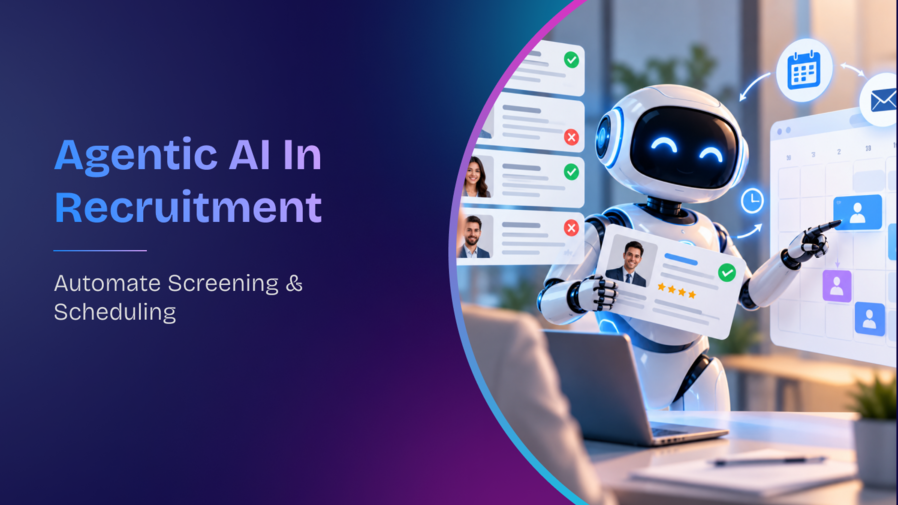


Table of content
Quick Answer: Agentic AI speeds up candidate screening by evaluating applications against defined role criteria and surfacing a ranked shortlist with reasoning attached. It speeds up scheduling by coordinating availability across candidate and interviewer calendars and sending confirmations automatically. In both cases, the recruiter reviews the output and makes the decisions. Agentic AI handles the coordination work that previously consumed hours of the recruiting team's day.
Ask any recruiter where their week goes and the answer is rarely what they expected when they took the job.
Not relationship building. Not meaningful conversations with strong candidates. Not strategic conversations with hiring managers.
Most of it goes to coordination. Reviewing applications that should have been filtered earlier. Chasing panel availability for a role that needed an interview booked three days ago. Following up with candidates who applied two weeks back and have not heard anything.
None of this requires a recruiter's judgment. All of it takes a recruiter's time.
Agentic AI closes that gap. Not by replacing the recruiter's role in the process, but by handling the coordination layer so recruiters can spend their time where it actually matters.
This guide covers what agentic AI does in screening and scheduling, where it fits in an enterprise hiring workflow, and what the recruiting team's role looks like when the coordination work is handled for them.
What is agentic AI in recruitment screening and scheduling?
Agentic AI refers to software that coordinates multiple steps toward a defined goal, rather than waiting for a human to trigger each action individually.
Most recruiting tools are reactive. A recruiter opens a tool, runs a search, reviews results, and moves to the next step. At every stage, the recruiter is managing the process as well as making the decisions.
Agentic AI is different. It takes a defined goal, such as screening 300 applications against a set of role requirements, and works through the steps to get there. The recruiter sets the parameters. Agentic AI runs the coordination. The recruiter reviews the output and decides what happens next.
The distinction that matters for screening and scheduling is not about what agentic AI can do autonomously. It is about where recruiter time goes before and after agentic AI is in place.
Before: recruiters spend significant portions of their week on application review, interview coordination, and follow-up communication.
After: that coordination is handled by agentic AI. Recruiters start their day with a ranked shortlist, a scheduled interview calendar, and a set of decisions to make rather than tasks to complete.
For a full explanation of how agentic AI works across the full talent acquisition process, read What is Agentic AI in recruitment.
What recruiters do with the time agentic AI returns
Before covering how agentic AI works in screening and scheduling, it is worth being clear about what the time savings actually enable. This is where most implementations succeed or quietly disappoint.
Time savings
Screening and scheduling together account for a significant share of a recruiter's administrative workload. When agentic AI handles both, that time does not just disappear from the calendar. It shifts to the work that produces better hiring outcomes.
Recruiters who have that time back tend to spend it on:
- Substantive conversations with candidates who are genuinely in consideration, not just inbox-ready
- More frequent and more useful conversations with hiring managers about what the role actually needs
- Reviewing the quality of shortlists and calibrating the criteria that produced them
- Following up with candidates at risk of dropping off before an offer is made
None of these activities can be automated. All of them directly affect whether the best candidate accepts the offer.
Screening quality
Manual screening at volume produces inconsistent results. A recruiter reviewing application number 280 at the end of a long day is not applying the same standard as they were at application number 12.
Agentic AI evaluates every application against the same criteria regardless of volume. The shortlist it produces reflects the role requirements, not the recruiter's energy levels at the point of review.
The output is not a decision. It is a ranked list with reasoning attached. The recruiter reviews it, challenges it where the ranking does not match their read of the role, and decides who advances. The quality gain comes from consistent first-pass evaluation, not from removing the recruiter's judgment from the process.
Speed as a differentiator
Strong candidates move fast. A recruiter who spends Tuesday morning clearing an application backlog and Thursday afternoon chasing calendar slots is responding to a candidate's application four to five days after it arrived.
In competitive hiring markets, that lag has a cost. Agentic AI moves the first response to within hours of application. Interview slots are proposed the same day. The candidate's experience of the organization starts with responsiveness rather than silence.
This matters most in BFSI and IT services hiring in India, where strong candidates at the right level are receiving multiple approaches simultaneously. Speed of process is often the differentiator when compensation and role are comparable.
Where agentic AI Fits in screening and scheduling
There are four specific points in the screening and scheduling workflow where agentic AI produces measurable results. Each one targets a coordination problem that currently costs recruiter time without requiring recruiter judgment.
Resume screening
Most enterprise roles attract more applications than any recruiter can meaningfully review. A role in a BFSI organization during a growth quarter might receive 400 applications in the first 48 hours.
Manual screening at that volume means either a recruiter spending two full days on first-pass review, or most applications receiving a few seconds of attention. Neither produces a reliable shortlist.
Agentic AI evaluates each application against the role requirements. It looks at skill depth rather than keyword presence, considers project history and career trajectory, and identifies transferable experience across technology ecosystems or domain backgrounds. The output is a ranked shortlist with the reasoning behind each ranking visible to the recruiter.
The recruiter does not receive a filtered list with no explanation. They receive a ranked view with the logic attached, which they can challenge, reorder, or override based on context that the AI criteria did not capture. A candidate whose application ranked lower because of a gap year the recruiter knows was spent in a relevant field can be moved up. A candidate ranked highly whose background the hiring manager has flagged as a poor culture fit can be reviewed accordingly.
The recruiter makes those calls. Agentic AI handles the first pass across all 400 applications so those calls are what the recruiter is doing with their morning, not manual application review.
For volume hiring in retail, BFSI branch operations, or GCC scaling scenarios, this shift is significant. A recruiting team managing 1,000 applications a week does not scale by adding headcount. It scales by handling the coordination layer differently.
Skills verification
Standard skill assessments have a structural problem. The same test goes to every candidate regardless of what they claimed on their application. A candidate who listed five years of Python experience and a candidate who listed one year both receive the same questions.
This produces two failure modes. The experienced candidate finds the assessment too basic and disengages. The less experienced candidate has been coached for generic assessments and passes without demonstrating the depth the role actually requires.
Agentic AI generates assessment challenges based on the specific claims each candidate made. A candidate who listed Python and PostgreSQL receives challenges built around the technologies and project types they described. The difficulty calibrates to the experience level claimed. When a candidate responds, the next challenge adapts based on what they demonstrated rather than moving to the next item on a fixed list.
The hiring manager does not receive a score. They receive a picture of what the candidate demonstrated under adaptive conditions, with the patterns in their responses surfaced for review. The manager decides what those patterns mean for the specific role, the team, and the context that no assessment can fully capture.
For technical hiring in IT services and GCC environments, this distinction matters. The goal is not to pass or fail candidates. It is to give the hiring manager enough signal about demonstrated capability to make the interview conversation more productive.
Interview scheduling
Scheduling a multi-round interview for a senior role across four interviewers, a recruiter, and a candidate who is currently employed involves a coordination problem that has nothing to do with recruiting judgment.
Manual scheduling for this scenario typically involves multiple emails, a few rounds of "does this time work," at least one reschedule, and a recruiter spending 45 minutes on a task that adds no value to the hiring decision.
Agentic AI accesses the calendars of all participants, identifies available slots that work across the group, proposes options to the candidate, and sends confirmations when a slot is selected. When a panel member needs to reschedule, agentic AI identifies the next available slot and updates all parties without the recruiter managing each change individually.
The recruiter does not hand over control of the schedule. They set the parameters: which interviewers are involved at which stage, what notice period candidates need, which time blocks are reserved for interview activity. Agentic AI works within those parameters and surfaces exceptions when something cannot be resolved automatically.
For campus hiring and large-scale lateral drives, this matters at a different scale. Coordinating 200 first-round interviews across a two-week window is not a scheduling problem a recruiter can solve manually without that work consuming most of their capacity for the period.
Volume hiring
Campus hiring and volume recruitment for branch operations, BPO, and retail introduce a scheduling challenge that is qualitatively different from standard lateral hiring.
The goal is not to find one slot for one candidate. It is to create interview blocks that maximize interviewer utilization across the largest possible candidate group simultaneously.
Agentic AI collects availability across the candidate pool, identifies the time blocks where the greatest number of candidates can participate, schedules interviewers for those blocks, and groups candidates into efficient batches.
For a BFSI organization running BFSI hiring drives across 20 branch locations, this means the coordination of what would otherwise be hundreds of individual scheduling conversations is handled at the start of the process rather than one conversation at a time.
Recruiters review the proposed batches, confirm the interviewer assignments, and handle the exceptions that agentic AI flags for human input. The campus drive that previously required a dedicated week of scheduling coordination runs alongside the team's regular hiring workload.
The compliance context TA teams cannot ignore
Screening and scheduling decisions in India carry a regulatory dimension that most agentic AI guides written for a global audience do not cover.
Under India's DPDP Act, candidate data used in screening must be processed only for the stated purpose it was collected for. Agentic AI that evaluates applications, generates assessments, or coordinates scheduling must operate within a consent-first framework. Every automated action must leave an auditable trail that the HR team can access.
This is not a separate compliance project. It is a product question to ask any agentic AI vendor before deployment: does the platform operate on consented data by default, and does every automated screening or scheduling action generate a complete audit log?
Platforms built with this architecture satisfy the efficiency goal and the compliance requirement simultaneously. Platforms that were not built this way require manual governance processes that partially defeat the time-saving purpose.
Read our full DPDP compliance guide for TA teams for the complete picture.
How to measure what agentic AI actually changes
The most common mistake in measuring agentic AI is tracking only efficiency metrics. Time-to-fill drops, hours saved on screening increase. Both look good. Neither tells you whether the quality of hiring improved.
Establish a baseline on these metrics before any implementation:
Efficiency metrics:
- Average time spent on first-pass application review per role
- Hours per week spent on interview coordination
- Time between application received and first contact made
- Candidate drop-off rate between application and first interview
Quality metrics:
- Interview to offer ratio by role type
- Offer acceptance rate
- Hiring manager satisfaction with shortlisted candidates at interview
- First-year retention rate for roles where agentic screening was used
Measure both sets at 30, 60, and 90 days after implementation. Efficiency gains tend to appear quickly. Quality improvements take longer to show up because they depend on outcome data from hires who need to be in role long enough to demonstrate performance.
The most useful early signal is not a metric. It is what recruiters are doing with their time. If the hours saved from screening and scheduling are going to more substantive candidate conversations and better hiring manager briefings, the implementation is working. If they are being absorbed into other administrative work, the implementation has succeeded technically but not operationally.
Your AI evolution path from Ripplehire to agentic recruitment
How RippleHire powers agentic AI screening and scheduling
The roles that need filling fastest are the ones where coordination problems hurt most.
A senior analyst role that attracted 400 applications needs a shortlist by Friday. The hiring manager has three slots next Tuesday before a client trip. Two panel members are in different time zones.
Getting from 400 applications to a confirmed Tuesday interview takes significant recruiter time and none of that time goes toward identifying the right candidate. It goes toward pre-filtering that could have been automated, calendar emails that should not require manual effort, and confirmations that do not need a person to send them.
That time does not disappear from spare capacity. It comes from the conversations that would have produced a better brief, a warmer candidate, a more considered offer.
That is where RippleHire is built to land. It is designed as one platform where recruiters and AI agents work together agents handle the coordination, recruiters handle the decisions.
- AI Profile Recommendation Engine returns a ranked, explainable shortlist so recruiters start with reviewed candidates not an unread queue
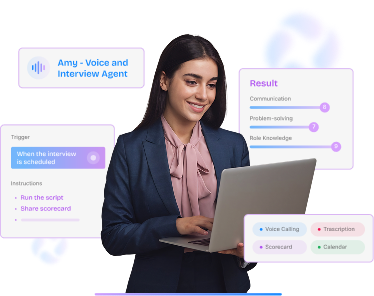
- Amy runs structured first-round screening conversations at scale and returns scored output before any shortlisting decision is made
- Interview Management coordinates availability across panels and time zones recruiters set the parameters, agents handle the scheduling
- Multi-channel communication keeps candidates updated at every stage without manual recruiter effort
All of this operates within a framework that maintains a complete audit trail for every automated action, supporting DPDP and GDPR compliance requirements for enterprise hiring teams in India and globally.
Rajkamal Vempati, CHRO at Axis Bank: "Atmos by RippleHire has been central to driving digital transformation in our recruitment. It delivered a candidate experience score of 4.8 out of 5 and set a new benchmark for stakeholder experience."
Connect with our team to discover how RippleHire can help your enterprise thrive through intelligent hiring.
Frequently Asked Questions
What is Agentic AI in recruitment screening?
Agentic AI in recruitment screening refers to software that evaluates candidate applications against defined role criteria, ranks them based on demonstrated skill and experience fit, and surfaces a shortlist with reasoning attached for the recruiter to review. Unlike keyword matching, agentic AI evaluates the depth of experience across different technology ecosystems, project types, and career trajectories. The recruiter reviews the shortlist output and decides who advances.
How does agentic AI speed up interview scheduling?
Agentic AI accesses the calendars of all interview participants simultaneously, identifies available slots across the group, proposes options to the candidate, and sends confirmations when a slot is confirmed. When changes occur, it identifies the next available option and updates all parties. Recruiters set the parameters for which interviewers are involved at which stage and which time blocks are available. Agentic AI works within those parameters and flags exceptions that require a human decision.
What is the difference between AI screening and manual screening?
Manual screening applies different standards depending on who is doing the reviewing, when they are doing it, and how many applications they have already reviewed that day. Agentic AI applies the same criteria to every application regardless of volume. The shortlist it produces is more consistent, not necessarily more accurate, which is why recruiter review of the output is essential before any candidate is moved forward or rejected.
Will agentic AI replace recruiters in screening and scheduling?
No. Agentic AI handles the coordination work in screening and scheduling that does not require recruiter judgment. The decisions about who advances, how to interpret a candidate's background in the context of the role and team, and how to handle an edge case that the criteria did not anticipate, those stay with the recruiter. The time agentic AI returns is best spent on the conversations and decisions that only a person can make well.
How does agentic AI work for high-volume hiring in India?
For volume hiring scenarios such as campus drives, BFSI branch recruitment, and BPO operations, agentic AI handles the coordination at a scale that manual processes cannot match. It collects candidate availability, creates interview batches that maximize interviewer utilization, and coordinates scheduling across hundreds of candidates simultaneously. Recruiters review and confirm the proposed batches rather than managing each scheduling conversation individually.