

.svg) Product
Product


.png)




Table of content
The 90-Day Battle: A Playbook for Engaging Candidates During Notice Periods
The longest gap in your hiring process
For most hiring teams, the hardest part of recruitment doesn’t end when the offer is accepted. That’s actually when the real risk begins.
Between offer acceptance and Day 1, long notice periods (30, 60, or 90 days) leave candidates in a high-risk transition window. Left in silence, candidate doubts grow, counter-offers surface, and competing recruiters reach out.
Notice-period drop-offs are rarely caused by a change of heart overnight; they happen because post-offer waiting time is treated as a pause rather than an extended decision window. This guide outlines a structured, three-phase framework to maintain connection, build trust, and secure candidates through Day 1.
Why candidates drop off during notice periods
When candidates disengage during notice periods, it’s easy to blame changing priorities or counter-offers. In reality, most drop-offs follow predictable patterns tied to how the post-offer phase is handled.
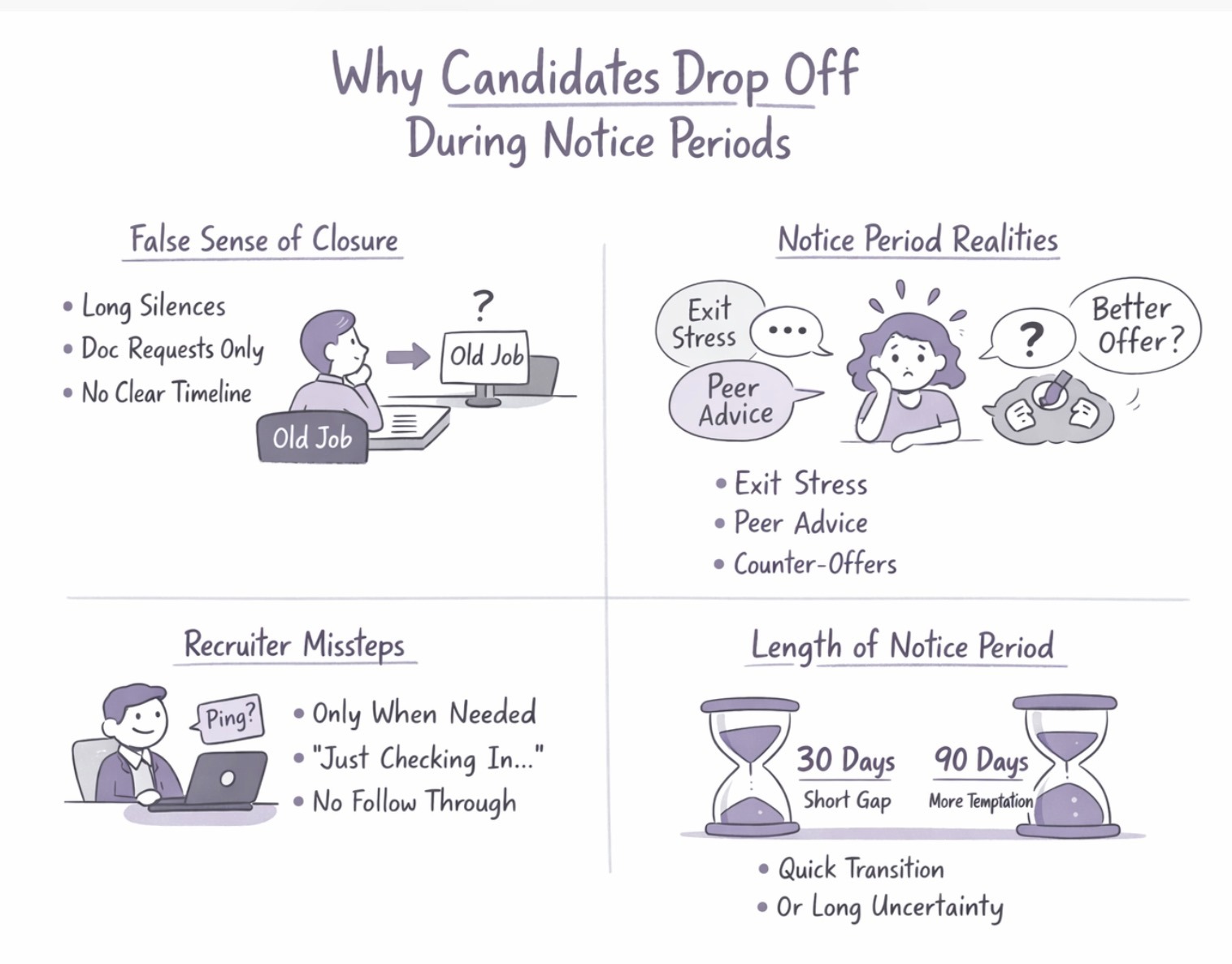
Let's break down those patterns:
1. The false sense of closure after offer acceptance
Once a candidate signs the offer letter, most teams mentally mark the role as “done.” The pressure lifts. The recruiter moves on to the next open position. Follow-ups slow down. Communication becomes transactional.
But from the candidate’s side, nothing has really ended yet.
They haven’t joined. They haven’t met the team. They haven’t started the work. All they’ve done is make an early commitment while still standing in their old job. Treating this moment as closure creates a gap where expectations quietly drift apart.
Common signals of this gap:
- Long silences after offer acceptance
- Messages only when documents are needed
- No clear sense of what happens between now and joining
None of this feels alarming in isolation. But over a few weeks, it creates distance. The candidate doesn’t feel rejected, just forgotten. And forgotten is often enough to reopen conversations with other companies.
The drop-off here isn’t emotional or dramatic. It’s gradual. It happens because the process assumes commitment is complete, while the candidate still feels mid-transition.
2. The noise of leaving a job
The notice period is not downtime. It’s a noisy phase, just not visible to recruiters.
Candidates are wrapping up projects, having exit conversations, and dealing with mixed reactions at work. Some managers respond with pressure. Some colleagues offer advice. Some suggest alternatives the candidate hadn’t considered earlier.
If you don't reach out with thoughtful message regularly, this silence creates space for doubt in the candidate's mind:
- Will the role actually be what was discussed?
- Will the team be supportive?
- Is this company still invested in me?
Most candidates won’t ask these questions directly. They wait. They slow down. They become less responsive. The decision doesn’t flip overnight. It erodes quietly when there’s no signal coming from your side.
3. Recruiter communication anti-patterns
Most notice-period drop-offs aren’t caused by big mistakes. They come from small, well-intentioned habits that add up.
Some common ones:
- Reaching out only when something is needed
- Sending “just checking in” messages with no real update
- Sharing no timeline beyond “we’ll connect closer to joining”
- Assuming silence means everything is fine
From the recruiter’s side, this feels efficient. From the candidate’s side, it feels uncertain.
Let's take an example. A candidate accepts an offer with a 60-day notice period. Week one has a welcome call. After that, there’s nothing for three weeks. Then a message asking for documents. No context. No update. No sense of progress.
Candidates don’t expect constant attention. They do expect clarity. When communication has no substance, it doesn’t reassure them. It just reminds them they’re still waiting.
4. Notice period length and exposure
A 30-day notice period and a 90-day notice period behave very differently.
Shorter notice periods are about momentum. If communication drops early, candidates feel the gap immediately. There’s less time to recover.
Longer notice periods come with a different problem: exposure. Over 60 or 90 days, candidates are more likely to:
- Receive counter-offers
- Hear mixed opinions from peers
- Re-evaluate priorities like location, role scope, or stability
Longer time doesn’t mean more comfort. It often means more variables.
This is where many teams make a quiet mistake. They use the same engagement approach for every notice period. One welcome message. One reminder. One pre-joining email.
That works sometimes for 30 days. It rarely holds at 90.
Longer notice periods need pacing. Different touchpoints. A sense that things are moving, even if joining is far away.
The three phases of candidate engagement during the notice period
The notice period isn’t one flat stretch of time. What a candidate needs in the first few days after accepting an offer is very different from what they need a month later, or right before joining.
When engagement stays the same throughout, it starts to miss the mark. Early reassurance turns into noise. Long silence turns into doubt. And last-minute outreach feels rushed instead of helpful.
This is why thinking in phases matters. It gives structure to an otherwise vague period and helps recruiters stay relevant without hovering or disappearing. Next, we’ll break the notice period into 3 phases and show you what to do in each phase to keep candidates engaged.
Phase 1: Right after offer acceptance
The first few days after a candidate accepts your offer are deceptively quiet. On paper, the decision is done. In reality, the candidate has only crossed the first mental checkpoint. They haven’t joined yet. They haven’t met the team. Their current job still occupies most of their day.
This phase usually spans the first 7–10 days after offer acceptance, and it plays a bigger role than most teams realize. What happens here shapes how the candidate interprets everything that follows.
What candidates need most in the first few days
Right after accepting an offer, candidates are not looking for excitement or reassurance about how great the company is. They are looking for stability.
They want to know:
- That someone is clearly owning the next steps
- That there is a structure between now and joining
- That nothing important is being decided without them knowing
When these signals are missing, candidates don’t immediately panic. Instead, they start holding questions quietly. They re-read the offer details. They replay interview conversations. They wonder what’s supposed to happen next.
What good engagement looks like in Phase 1
Strong engagement in this phase is not about frequency. It’s about clarity.
A candidate should come out of the first week with a basic understanding of:
- What the overall notice-period journey looks like
- When they will next hear from someone
- What, if anything, is expected from them right now
This can often be handled in one or two thoughtful touchpoints. A short call or message that acknowledges acceptance, outlines the broad timeline, and names a clear point of contact does more than multiple casual check-ins.
The goal here is simple: remove ambiguity early, before it has time to grow. When Phase 1 is handled well, the rest of the notice period becomes easier to manage. Candidates are more responsive, delays feel less risky, and small issues don’t immediately trigger doubt.
Common missteps that weaken this phase
One common mistake is front-loading too much information. Sending long policy documents, benefit breakdowns, and onboarding paperwork immediately can feel overwhelming when the candidate is still mentally transitioning out of their current role.
Another mistake is disappearing after an initial welcome. A single congratulatory message followed by weeks of silence creates a sense that engagement dropped off the moment the offer was signed.
There’s also a tendency to treat this phase as purely administrative. When every interaction is about documents, forms, or compliance, the relationship starts to feel transactional very quickly.
Phase 1 Communication schedule
| Timing | Purpose | What to Cover |
|---|---|---|
| Day 0 to 1 | Acknowledge acceptance and clarify next steps | Confirm the offer, name the point of contact, outline the broad timeline |
| Day 3 to 5 | Set expectations for the coming weeks | Explain the notice period structure, what the candidate can expect |
| Day 7 to 10 | Light check-in to reinforce structure | Confirm all is clear, invite questions without creating urgency |
Here are email templates you can edit and use for this phase 👇
Day 0–1: Acknowledge offer acceptance + clarify next steps
Subject: Welcome — here’s what happens next
Hi ,
Thanks for confirming your acceptance. We’re glad to have you joining us.
I wanted to quickly outline what the next few weeks will look like so you have a clear picture. There’s nothing urgent you need to act on right now. Over the notice period, we’ll stay in touch and share context as we get closer to your joining date.
For now, I’ll be your main point of contact. If you have questions or anything feels unclear, feel free to reach out anytime.
I’ll check in again in a few days with more details on what to expect next.
Best,
Day 3–5: Set expectations for the coming weeks
Subject: Quick note on the notice period plan
Hi ,
Just wanted to follow up and share how we usually stay connected during the notice period.
There won’t be frequent messages, but you can expect a few planned touchpoints so you’re never guessing what’s happening. As we get closer to joining, we’ll also share more context around the team and role.
If there’s anything specific you’d like clarity on in the meantime—joining logistics, team structure, or timelines—happy to cover that.
More soon.
Best,
Day 7–10: Light check-in to reinforce structure
Subject: Checking in — all set on your end?
Hi ,
Just checking in to see how things are going on your side.
There’s nothing new you need to do at this stage. I mainly wanted to make sure everything feels clear and that you know what to expect over the next few weeks.
If anything has come up—questions, changes, or even just something you’re unsure about—feel free to let me know. We’ll be in touch again as planned.
Best,
Phase 2: The long middle (weeks 2-8)
If Phase 1 is about settling the decision, Phase 2 is about preventing drift.
This is usually the longest stretch of the notice period. It might last a few weeks in a 30-day notice, or well over a month in a 60–90 day one. On the surface, nothing seems to be happening. The joining date feels far away. Urgency is low on both sides.
Why the middle phase is risky
Unlike the first few days after acceptance, candidates in this phase aren’t actively questioning their decision. They’re simply living in between. Work at their current company continues. New conversations happen. Other recruiters sometimes reappear.
When there’s too much space between touchpoints, candidates slowly stop thinking of the role as “next.” It becomes something scheduled for later, not something they’re moving toward.
What candidates need in this phase (and what they don’t)
During the middle stretch, candidates don’t need reassurance or repeated validation of the offer. They also don’t need frequent reminders that you exist.
What they do need is light relevance.
That means:
- Occasional signals that the role is real and progressing
- Context that helps them imagine themselves in the team
- Predictable communication, even if it’s infrequent
What usually backfires:
- Random “just checking in” messages with no substance
- Long gaps followed by administrative requests
- Overly enthusiastic culture messaging that feels out of sync with the timing
This phase works best when communication feels planned, not reactive.
How engagement should feel in Phase 2
Think of this phase less as conversation and more as presence.
The candidate should feel:
- They haven’t been forgotten
- There’s a rhythm to communication
- They could reach out if needed without feeling awkward
This doesn’t require constant contact. In fact, too much communication here can create fatigue. One meaningful touchpoint every couple of weeks often works better than weekly pings.
The key is that each interaction has a reason. Even a short update should answer an unspoken question: “What’s happening now?”
Examples of low-effort, high-value touchpoints
You don’t need templates for everything in Phase 2. But you do need intent.
Some examples of touchpoints that fit this phase:
- Sharing context about how the team works or what they’re focused on
- A brief update on onboarding plans or timelines
- An optional introduction to a future teammate or manager
- A heads-up about what will happen as joining gets closer
None of these require action from the candidate. That’s important. Phase 2 is not about tasks.
What recruiters often get in phase 2
The most common mistake in Phase 2 is treating silence as success. If the candidate isn’t asking questions or raising concerns, it’s assumed everything is fine.
In reality, disengagement at this stage looks passive. It can be slower replies, shorter responses, or just less curiosity about the role, and company.
By the time these signals become obvious, the candidate is already halfway out mentally.
Another mistake is breaking the rhythm by suddenly increasing communication too late. When weeks of silence are followed by a rush of messages, it feels reactive and unsettled.
Consistency matters more here than frequency.
Instead of asking “when should I message,” anchor communication to time, not triggers.
For example you can send one message midway through the notice period, and another one closer to the last few weeks before joining. Each message should have a clear purpose. If there’s no reason to reach out, it’s okay to wait. But when you do reach out, make it count.
Phase 3: The final decision window ( final 2-3 weeks)
The last two to three weeks before joining are not a formality. They are the final point at which a candidate actively chooses whether to move forward or stay where they are.
By this stage, most candidates are still employed. They are still part of their current team. And in many cases, their employer has reacted. Sometimes with pressure. Sometimes with appreciation. Sometimes with a revised role, compensation, or promise of growth.
None of this is abstract. It’s happening in real time.
What makes Phase 3 different from earlier stages is that the comparison becomes immediate. The candidate isn’t weighing “new opportunity vs nothing.” They’re weighing a known environment against an uncertain one. And uncertainty is usually what tips the scale.
What candidates are actually deciding in Phase 3
At this point, candidates are rarely asking: “Is this a good company?”
They are asking:
- Will I be supported when I start?
- Do expectations match what was discussed earlier?
- Is this move worth the short-term disruption?
- What happens if things don’t go smoothly in the first few months?
If your communication in this phase avoids these questions, candidates answer them on their own. Often with incomplete information.
What changes in recruiter responsibility here
Phase 3 is not about staying warm. It’s about reducing decision risk.
This means:
- Making the role feel predictable, not exciting
- Reconfirming alignment, not repeating the pitch
- Creating space for honest concerns to surface
Silence here creates room for counter-offers and second thoughts to feel safer than change.
What effective Phase 3 engagement actually does
Good engagement in this phase does three things:
- It brings forward conversations candidates hesitate to start
- It replaces assumptions with confirmation
- It makes joining feel like a supported transition, not a leap
This is also the phase where directness matters more than polish.
Email templates that work in Phase 3 (without sounding desperate)
Reconfirming alignment
Subject: Aligning before your joining date
Hi ,
As we get closer to your joining date, I wanted to take a moment to make sure we’re aligned on the role and expectations.
If anything has changed on your side, or if there’s something you’d like to revisit (scope, timelines, or support in the first few weeks) it’s a good time to talk it through.
There’s no pressure here. The goal is to make sure you start with clarity.
Best,
Addressing transition risk directly
Subject: Making the transition smoother
Hi ,
Transitions can bring up questions, especially toward the end of a notice period.
If you’re weighing anything right now (offers, counter-offers, or concerns about the move) happy to have an open conversation. Even if it’s just to talk things through.
It’s important to us that this move feels like the right one for you.
Best,
Final confirmation before joining
Subject: Confirming next week’s start
Hi ,
Just confirming your joining date and a few final details before you start.
If everything feels settled, we’re all set. If there’s anything you want to clarify before day one, this is the right moment to surface it.
Looking forward to having you join.
Best,
Most last-minute drop-offs aren’t sudden changes of heart. They’re the result of unresolved uncertainty meeting a safer alternative.
Phase 3 works when recruiters acknowledge that reality instead of avoiding it. Candidates don’t need reassurance that they’re making a great choice. They need confidence that they won’t be alone once they make it.
Notice-period scorecard for hiring teams
Use this matrix during weekly hiring reviews to spot drop-off risks early across your talent pipeline:
|
What to track |
What you’re looking at |
What it usually tells you |
|
Offer-to-join conversion |
Accepted offers vs actual joins, split by role, business unit, and notice length |
Where notice-period risk is concentrated rather than spread evenly |
|
Drop-offs by phase |
When candidates disengage: early days, middle stretch, or final weeks |
Whether issues stem from early ambiguity, long silence, or last-minute uncertainty |
|
Response cadence trend |
How candidate response times change over the notice period |
A gradual slowdown often signals disengagement before formal withdrawal |
|
Milestone slippage |
Delays in confirmations, joining details, or planned touchpoints |
Whether uncertainty is building or timelines are unclear |
|
Phase coverage |
Whether each candidate received at least one meaningful touchpoint per phase |
Gaps here usually explain late surprises more than candidate intent |
Reviewed consistently, it helps teams:
- See which notice-period phase needs more structure
- Understand how notice length affects outcomes
- Reduce last-minute escalations
- Improve offer-to-join reliability over time
How RippleHire powers notice-period engagement
Long notice periods are becoming common for leadership, niche, and high-impact roles. Managing them well depends less on individual effort and more on having the right structure in place.
When engagement is visible, predictable, and shared across stakeholders, candidates experience continuity instead of silence. Recruiters spend less time chasing updates. Hiring managers step in at the right moments. Teams gain confidence that accepted offers will convert into joins.
RippleHire gives hiring teams a single system to manage the full journey from offer acceptance to joining, without relying on memory or manual coordination.
Teams use RippleHire to:
- Keep recruiter, hiring manager, and interviewer responsibilities visible and aligned
- Track candidate status, engagement history, and pending actions in one place
- Run structured offer and onboarding workflows across roles and regions
- Use AI-led insights to anticipate joining risk and follow up early
- Manage high hiring volumes without losing track of individual candidates
Its AI layer supports tasks like predicting joining likelihood, personalizing offers, and detecting early disengagement. Enterprise-grade security and global compliance frameworks ensure the process holds across locations and hiring models.
If your organization hires continuously and manages long notice periods across teams or geographies, RippleHire helps make this phase easier to run and easier to scale.
Want to see how this works in your hiring setup? Schedule a demo with RippleHire.
FAQs
1. Why do candidates drop off during the notice period?
Candidates often drop off (or "renege") due to a lack of communication, counteroffers from their current employer, or "buyer's remorse." When recruiters go silent after an offer is accepted, candidates feel uncertain and become open to other opportunities.
2. How often should recruiters contact candidates between offer and joining?
There is no one-size-fits-all rule, but a "bi-weekly touchpoint" is a safe standard. For long notice periods (60-90 days), aim for one meaningful interaction every 2-3 weeks. Avoid empty "checking in" messages; instead, share team updates, relevant reading, or onboarding details.
3. What is the difference between onboarding and pre-boarding?
Onboarding starts on Day 1 when the employee joins. Pre-boarding is everything that happens between offer acceptance and the start date. Effective pre-boarding (like sending welcome kits or team intros) significantly reduces the risk of no-shows.
4. How do you handle a 90-day notice period in recruitment?
Managing a 90-day notice period require phasing your engagement.
-
Phase 1 (Days 1-10): Focus on administrative clarity and confirmation.
-
Phase 2 (Days 11-70): Focus on "light relevance"—share company news or team wins to keep them connected without hovering.
-
Phase 3 (Final 20 Days): Focus on logistics and reassuring the candidate about the transition.
5. How can I improve my offer-to-joining ratio?
To improve your offer-to-joining ratio, track drop-offs by phase to identify when you are losing people. Implement a structured pre-boarding process, ensure hiring managers (not just recruiters) reach out at least once, and use an ATS like RippleHire to automate engagement reminders.