
.svg) Product
Product

.png)





Table of content
Key Takeaways
What you will learn from this guide:
- India's talent acquisition compliance landscape covers 16 specific laws from the 1936 Payment of Wages Act to the 2023 DPDP Act
- 50% of Indian organizations still lack the skills to implement DPDP Act requirements, according to EY research
- Women represent only 20% of India's overall workforce compliance alone does not close this gap without deliberate recruitment strategy changes
- AI-driven screening tools carry specific compliance obligations around transparency, consent, and explainability under the DPDP Act
- A TA compliance audit covers three areas: documentation review, data privacy assessment, and bias evaluation
- Compliance done right reduces legal exposure and improves time-to-hire, quality-of-hire, and candidate experience simultaneously
Quick Answer: Talent acquisition compliance in India requires following 16 specific labor and data protection laws, with the DPDP Act 2023 being the most significant recent addition. Key obligations include obtaining explicit candidate consent before data collection, ensuring equal opportunity across protected groups, conducting structured bias-free evaluations, and maintaining complete documentation for audit purposes. Penalties for non-compliance range from reputational damage to financial fines reaching Rs 250 crore under the DPDP Act.
One misstep in handling that data could trigger penalties under the DPDP Act. One overlooked bias in your screening process might violate equal opportunity laws. One gap in your verification protocol could introduce fraud risks.
This guide unpacks the complex bundle of TA compliance facing Indian enterprises in 2026, from traditional labor laws to emerging AI regulations. It reveals how forward-thinking TA leaders are transforming compliance from a risk management burden into a strategic advantage that enhances candidate experience, improves hiring outcomes, and delivers measurable ROI.
Because when compliance is done right, it doesn't just protect your organization it becomes your competitive edge in the talent marketplace.
What is talent acquisition (TA) compliance?
Talent acquisition compliance refers to following legal rules and regulations when hiring employees. It ensures companies recruit fairly and protect candidate information throughout the hiring process.
With increasing focus on data protection worldwide, TA compliance now extends beyond traditional hiring laws to include digital privacy standards, fraud prevention, and ethical AI use in candidate screening. Major themes include:
- Data privacy and protection requirements (GDPR, IT Act, PDP)
- Equal opportunity and anti-discrimination laws
- Background verification and credential checking
- Documentation and record-keeping standards
- Work eligibility verification
- Industry-specific regulatory requirements
- Cross-border hiring compliance
- AI and automation ethics in recruitment
- Candidate consent management
- Interview and assessment standardization
- Job description compliance
- Fraud prevention protocols
Following compliance requirements doesn't just protect companies legally it builds trust with candidates and establishes the organization as a responsible employer.
List of Compliance Laws
Understanding industry-specific hiring laws is essential for proper compliance.
The following table categorizes the key compliance laws relevant to talent acquisition, based on their application to different stages of the process.
| Category | Law Name | Year | Purpose/Applicability |
| Recruitment and Notification | Employment Exchanges (Compulsory Notification of Vacancies) Act | 1959 | Requires employers to notify job vacancies to employment exchanges, ensuring accessibility. |
| Apprenticeship | Apprentices Act | 1961 | Regulates training and employment of apprentices, ensuring compliance in hiring programs. |
| Contract Labor | Contract Labour (Regulation and Abolition) Act | 1970 | Governs employment of contract labor, requiring registration and fair treatment. |
| Non-Discrimination | Equal Remuneration Act | 1976 | Ensures equal pay for equal work, prohibiting gender-based discrimination in hiring. |
| Employment Terms | Industrial Employment (Standing Orders) Act | 1946 | Mandates defined terms and conditions of employment, including hiring practices. |
| Wage Compliance | Payment of Wages Act | 1936 | Ensures timely payment of wages, critical for post-hiring compliance. |
| Wage Standards | Minimum Wages Act | 1948 | Sets minimum wage rates for scheduled employments, ensuring fair compensation. |
| Factory Working Conditions | Factories Act | 1948 | Regulates working conditions in factories, including hiring, hours, and safety. |
| State-Specific Regulations | Shops and Establishments Acts (varies by state) | Varies | Regulates working hours, leave, holidays for commercial establishments, state-specific. |
| Maternity Benefits | Maternity Benefit Act | 1961 | Provides maternity leave and benefits, ensuring compliance when hiring female employees. |
| Workplace Harassment | The Sexual Harassment of Women at Workplace (Prevention, Prohibition and Redressal) Act | 2013 | Prevents sexual harassment, requiring redressal mechanisms in workplaces. |
| Child Labor Prohibition | Child and Adolescent Labour (Prohibition and Regulation) Act | 1986 | Prohibits employment of children in certain occupations, ensuring ethical hiring. |
| Bonded Labor Abolition | Bonded Labor System (Abolition) Act | 1976 | Abolishes bonded labor, ensuring ethical and legal hiring practices. |
| Social Security | Employees' State Insurance Act | 1948 | Mandates social security benefits, including medical care and cash benefits. |
| Retirement Benefits | Employees' Provident Funds and Miscellaneous Provisions Act | 1952 | Requires employer contributions to provident funds for retirement benefits. |
| Gratuity Payments | Payment of Gratuity Act | 1972 | Ensures gratuity payment for employees completing minimum service, post-hiring. |
The Ministry of Labour and Employment, Government of India, oversees these laws, which are listed on their official portal (List of Enactments in the Ministry)
Beyond the listed laws, several other acts may indirectly affect talent acquisition, such as the Working Journalists and Other Newspapers Employees Act, 1955, for media hiring, and the Inter-State Migrant Workmen Act, 1979, for cross-state recruitment.
An important aspect is the ongoing labor code reforms. The Code on Wages, 2019, Industrial Relations Code, 2020, Code on Social Security, 2020, and Code on Occupational Safety, Health and Working Conditions, 2020, aim to reduce compliance burden by consolidating laws.
However, as of March 2026, these codes are not fully implemented, and companies must adhere to the existing acts. This transition period adds complexity, as businesses must prepare for future changes while complying with current laws.
State-specific laws, such as Shops and Establishments Acts, vary by location, requiring businesses to check local regulations for working hours, leave, and holidays. For example, the Karnataka Shops and Commercial Establishments Act may differ from Delhi's, adding another layer of compliance.
DPDP act: A critical compliance challenge for recruitment
Data privacy in hiring has become a critical concern for organizations handling candidate information as companies need to comply with India's Digital Personal Data Protection (DPDP) Act.
Recent research highlights significant preparedness gaps across organizations.
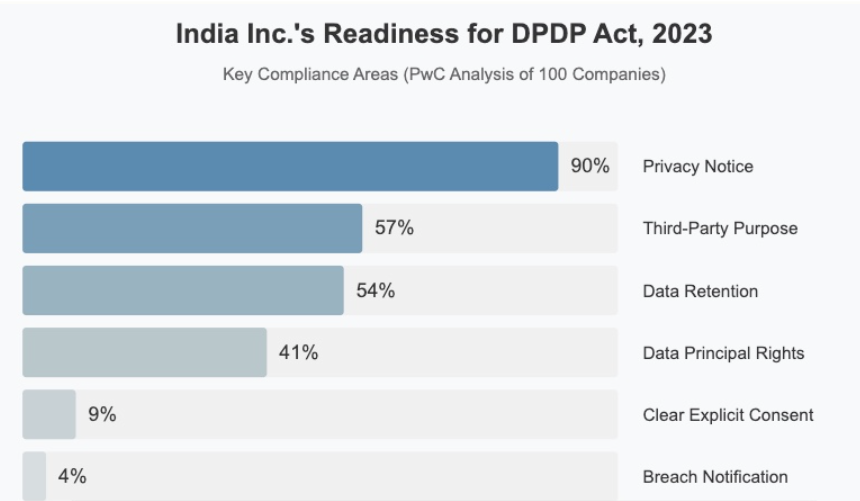
According to EY's "The India Data Protection Readiness Report," 50% of surveyed Indian organizations still lack the necessary skill sets to implement DPDP Act requirements, though many are open to outsourcing data privacy functions. The technical implementation of compliance measures presents a major challenge for 32% of organizations.
PwC's assessment of 100 Indian companies, including listed companies and educational institutions, revealed widespread deficiencies.
The report highlighted that while most Indian companies (90%) have privacy notices, there are significant gaps in other critical DPDP compliance areas particularly in explicit consent (9%), breach notification (4%), and multilingual notices (2%).
For recruitment functions specifically, these gaps pose serious risks when handling candidate data. TA departments must urgently address:
- Consent collection during application processes
- Candidate data storage and retention policies
- Cross-border data transfer restrictions
- Right to access and erasure requests from applicants
- Third-party recruitment vendor compliance
The penalties under the DPDP Act are significant. Security breaches can attract fines of up to Rs 250 crore. Unlike GDPR, penalties are fixed amounts not percentages of turnover and there is no cap on total fines across multiple violations.
Organizations should conduct recruitment-specific DPDP readiness assessments to identify and remediate compliance gaps before enforcement actions begin.
Diversity and Anti-discrimination in Indian Recruitment
Gender Representation
Women constitute just 20% of the overall workforce in India, with men accounting for the remaining 80%, according to the 'Mind the Gender Gap' report by CFA Institute, which incorporated insights from 300 Indian companies through their Business Responsibility and Sustainability Report (BRSR) disclosures.
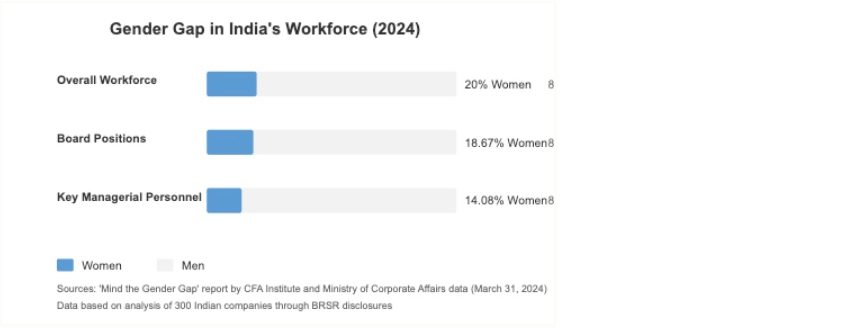
The leadership gap is even more pronounced. As of March 31, 2024, women hold only 18.67% of board positions in listed companies, according to the Ministry of Corporate Affairs (MCA).
Fair hiring practices remain a challenge despite regulatory efforts.
This disparity exists despite several regulatory measures designed to increase women's representation:
- Companies Act, 2013 (Section 149): Mandates at least one-woman director on boards of listed companies and certain public companies. While this has improved representation from near-zero levels previously, the data shows compliance remains largely minimal rather than transformative.
- SEBI Listing Regulations: Requires the top 1000 listed entities to have at least one independent woman director, raising the bar beyond tokenistic appointments.
- POSH Act, 2013: Creates safer workplaces by requiring prevention mechanisms against sexual harassment, a critical factor in retention.
- The Equal Remuneration Act, 1976: Prohibits gender-based discrimination in recruitment, promotions, and compensation, though enforcement challenges persist.
How to address these gaps
To address these gaps, talent acquisition teams can implement several practical measures:
- Conduct comprehensive diversity audits of current recruitment processes
- Implement blind resume screening to reduce unconscious bias
- Implement inclusive recruitment strategies that actively seek diverse candidate pools
- Create returnship programs for women rejoining the workforce
- Partner with women-focused professional networks and educational institutions
- Utilize AI tools thoughtfully to identify and reduce bias in job descriptions
Compliance laws for use of AI in recruitment
AI adoption in recruitment is accelerating among Indian companies. According to a NASSCOM study, 90% of Indian firms are willing to invest in AI talent, though only 50% have a clear understanding of the ethical implications of AI in recruitment.
Major Indian companies are using AI-powered resume screening tools to process thousands of applications quickly and have implemented AI-driven video interviewing platforms that assess candidates based on multiple factors.
Regulatory Framework for AI in hiring
India is developing regulatory frameworks to govern AI use in recruitment. The Workforce Rights (Artificial Intelligence) Bill, 2023, introduced in the Rajya Sabha, aims to protect employee rights by ensuring transparency in AI usage, requiring explicit consent from employees, and providing a "right to refuse" decisions based solely on AI-generated processes
India does not yet have a standalone AI regulation for employment. The regulatory framework for AI in recruitment currently operates through the DPDP Act's requirements for explainability and consent, the IT Act's provisions on data security, and Equal Employment Opportunity laws that apply to any screening tool regardless of whether it is AI-powered or human-led.
The DPDP Act is the most directly applicable framework for AI-assisted hiring in India in 2026. Any AI tool that processes candidate data must operate within the consent parameters the candidate agreed to. Any automated recommendation affecting a candidate's progression must be explainable the organization must be able to document the basis for that recommendation. These are not aspirational standards. They are current legal obligations.
For TA teams evaluating AI-powered screening tools, three specific questions matter:
- Does the tool process only data the candidate explicitly consented to?
- Can it explain the basis for every recommendation it makes?
- Can it action a candidate's data deletion request across every system where their data was processed?
If the vendor cannot answer all three clearly, the organization is carrying compliance risk that no policy document offsets.
Read our full guide on AI and DPDP compliance in hiring for the complete picture.
Conducting a TA compliance audit
When implemented thoughtfully, a TA compliance strategy and audit becomes more than risk management it transforms into a strategic advantage that enhances both candidate experience and quality of hire.
Comprehensive Documentation Review
Start your compliance journey where most issues originate: in your recruitment paperwork. Examine all documents that touch candidates during their application journey:
- Job descriptions and advertisements
- Application forms and candidate questionnaires
- Interview guidelines and evaluation forms
- Offer letters and rejection communications
What makes this review valuable isn't just checking boxes it's analyzing these materials through multiple lenses. Are your job requirements genuinely occupation-related, or could they unintentionally exclude qualified candidates? Do your privacy notices truly inform candidates about how their data will be used?
The documentation phase often reveals surprising gaps. Many organizations discover outdated consent language that doesn't meet DPDP Act standards, or retention policies that keep candidate data far longer than legally justified.
Pro tip: Include a diverse review team to catch potentially exclusionary language that might not be apparent to everyone.
Data Privacy and Processing Assessment
This assessment phase asks fundamental questions about your information ecosystem:
"Do we know exactly where candidate data lives throughout our entire recruitment process?"
Map the complete journey of candidate information from initial collection through storage, sharing, and eventual deletion. This visual mapping often reveals surprising vulnerabilities where data protection breaks down.
During this phase, test your organization's readiness to handle data subject requests. Can you efficiently fulfill a candidate's right to:
- Access their complete application information?
- Correct inaccuracies in their profile?
- Delete their data if requested?
Pay special attention to cross-border data transfers and third-party processing agreements, especially with recruitment agencies or assessment vendors who may not align with your privacy standards.
Bias Mitigation and Equal Opportunity Evaluation
This final pillar examines whether your recruitment practice delivers on the promise of equal opportunity. Unlike other compliance areas, bias often operates invisibly making this assessment particularly challenging.
Analyze your recruitment funnel with demographic data to identify potential problem areas:
Is your candidate pool diverse at initial application but homogeneous at final selection? This pattern often signals systemic issues worth investigating.
Review your interview structures with these questions in mind:
-
Are all candidates evaluated on consistent, job-relevant criteria?
-
Do interview panels reflect diverse perspectives?
-
Can your team articulate clear, objective reasons for selection decisions?
Bias detection isn't just about uncovering deliberate discrimination. Even well-intentioned processes can create barriers through seemingly neutral practices like requiring specific educational credentials or prioritizing referrals from existing (potentially homogeneous) teams.
Measuring compliance ROI
The business case for compliance investment is stronger than most organizations realize. A single DPDP Act violation can cost up to Rs 250 crore. A discrimination claim in an enterprise hiring context can result in legal settlements, regulatory investigations, and brand damage that takes years to recover from. Set against these costs, a compliance infrastructure investment is not a risk management expense. It is a business continuity decision.
Beyond avoiding penalties, compliance excellence creates measurable business value:
- Reduced Legal Exposure: Track potential liability avoided through proper documentation, consent management, and bias mitigation processes. Quantify this using industry benchmarks for typical settlements or penalties.
- Candidate Experience Enhancement: Measure improvements in application completion rates and candidate satisfaction scores following compliance-driven process improvements. Transparent data practices and bias-free selection particularly impact these metrics.
- Operational Efficiency: Document time saved through standardized, compliant processes that reduce rework and administrative burden. Many organizations report efficiency gains after compliance streamlining.
- Hiring Outcome Improvements: Monitor key metrics like time-to-hire, quality-of-hire, and first-year retention rates. Compliant processes typically deliver more consistent, defensible hiring decisions.
- Reputation Value: Measure application volume increases and cost-per-hire decreases resulting from employer brand protection as a trusted, ethical recruiter.
By converting these benefits into financial terms, talent acquisition leaders can demonstrate that compliance isn't merely a cost center but a strategic investment delivering tangible returns across the recruitment lifecycle.
Future-proofing your recruitment compliance
Most compliance failures in talent acquisition are not failures of policy. They are failures of execution at the point where a recruiter is managing 40 open roles and a consent form does not get logged, an audit trail goes unwritten, or a flag in the data never reaches the person who needs to act on it.
The compliance framework exists. The recruiter does not have the bandwidth to maintain it manually at that volume.
RippleHire is built as one platform where recruiters and AI agents work together, each owning the part of hiring they do best. In the compliance context, that split is precise. Agents coordinate the documentation, the audit trail, and the monitoring. Recruiters make the decisions those records need to justify.
Run that against what TA compliance in India actually requires in 2026:
- Controls and guardrails enforce consent-based data processing and generate a complete audit trail for every candidate interaction automatically, without requiring recruiter effort at each step
- Explainability is built into the platform architecture every AI recommendation surfaces the specific criteria that produced it, so auditors and compliance teams can review the basis for any decision
- Fraud Management runs credential checks, identity verification, and rehire governance during the active hiring process, not after an offer has gone out
- The same platform that handles DPDP requirements for Indian hiring handles GDPR requirements for candidates in EU countries, run across 86 million applications in 50-plus countries in the last year alone
- Recruiter adoption holds because agents remove the manual coordination recruiters return to spreadsheets to escape which is also where audit trails break down
The result is a compliance posture that holds up not because every recruiter followed every procedure correctly under pressure, but because the platform makes the compliant action the easy action.
If compliance governance is on your agenda for 2026, see how RippleHire approaches it in practice before evaluating ATS compliance in your current stack.
Book a RippleHire demo and see how agents and recruiters divide the compliance work across your specific hiring environment.
Frequently Asked Questions
Who is responsible for DPDP compliance in large enterprise recruitment teams?
In large enterprises, DPDP compliance responsibility is typically shared between talent acquisition leadership, the legal department, and data protection officers. The CHRO or Head of Talent Acquisition usually owns the recruitment compliance strategy, while legal teams provide regulatory guidance and data protection officers handle specific technical safeguards. Enterprise organizations should create a dedicated compliance committee with representatives from these departments to oversee candidate data protection, meeting quarterly to review processes, address gaps, and ensure all recruitment teams and vendors follow the same data protection standards.
What are the essential compliance documents for the talent acquisition process?
Essential compliance documents include privacy notices that meet DPDP Act requirements, candidate consent forms for data processing, standardized job descriptions that avoid discriminatory language, interview evaluation forms with objective criteria, background verification consent forms, offer letters with compliant terms and conditions, and documentation retention schedules. These documents should be regularly reviewed by legal experts to ensure they meet changing regulatory requirements across employment law, data protection regulations, and anti-discrimination standards.
How often should companies conduct talent acquisition compliance audits?
Companies should conduct comprehensive talent acquisition compliance audits at least annually, with more frequent targeted reviews when significant regulatory changes occur. Organizations experiencing rapid growth or operating in highly regulated industries should consider bi-annual audits. Implement quarterly monitoring of key compliance metrics and establish ongoing reviews of recruitment data to identify potential bias patterns. After any major changes to recruitment processes or technology platforms, conduct focused compliance assessments to ensure continued adherence to regulations.
What technology investments are most critical for enterprise recruitment compliance?
The most critical technology investments for enterprise recruitment compliance include applicant tracking systems with built-in compliance features, secure candidate data storage with role-based access controls, automated consent management tools, audit trail capabilities that document every hiring decision, and AI explainability features that can surface the basis for any automated recommendation. Large enterprises should prioritize platforms that can standardize compliant processes across multiple locations and departments without requiring manual recruiter effort to maintain the compliance record.
What cross-departmental collaboration is needed for effective TA compliance in enterprises?
Effective talent acquisition compliance in enterprises requires regular collaboration between recruitment, legal, IT security, and diversity teams. Create a formal compliance working group with quarterly meetings to review regulatory changes, process gaps, and emerging risks. Recruitment teams should consult legal before implementing new selection tools or changing candidate data practices. IT security must be involved when evaluating new recruitment technologies. Diversity teams should participate in bias audits and evaluation of screening criteria.