
.svg) Product
Product


.png)





Table of content
A global ATS deployment usually looks like a success at headquarters. The platform goes live in the home country, adoption climbs, recruiters settle into the workflow, and leadership signs off on scaling it to the rest of the world. Trouble surfaces only when the same configuration reaches the fourth or fifth market, where local rules, languages, and hiring habits refuse to fit a template built for the first country.
By early 2023, around 100 data-localization measures were already in force across 40 countries, according to an OECD report, and more than two-thirds of them combined local storage rules with limits on moving data across borders. That single trend explains why running one ATS across regions rarely behaves the same way in every market.
Technology is seldom the real issue. Failure tends to come from treating "global" as one configuration instead of a global core with room for regional configuration beneath it.
5 things global enterprises get wrong when running one ATS everywhere
The pattern is consistent across large rollouts. A platform performs well at HQ, and within about six months TA leads in three or four other regions start building workarounds. Each of the mistakes below carries a specific operational cost, and each one is avoidable at the configuration stage rather than after go-live.
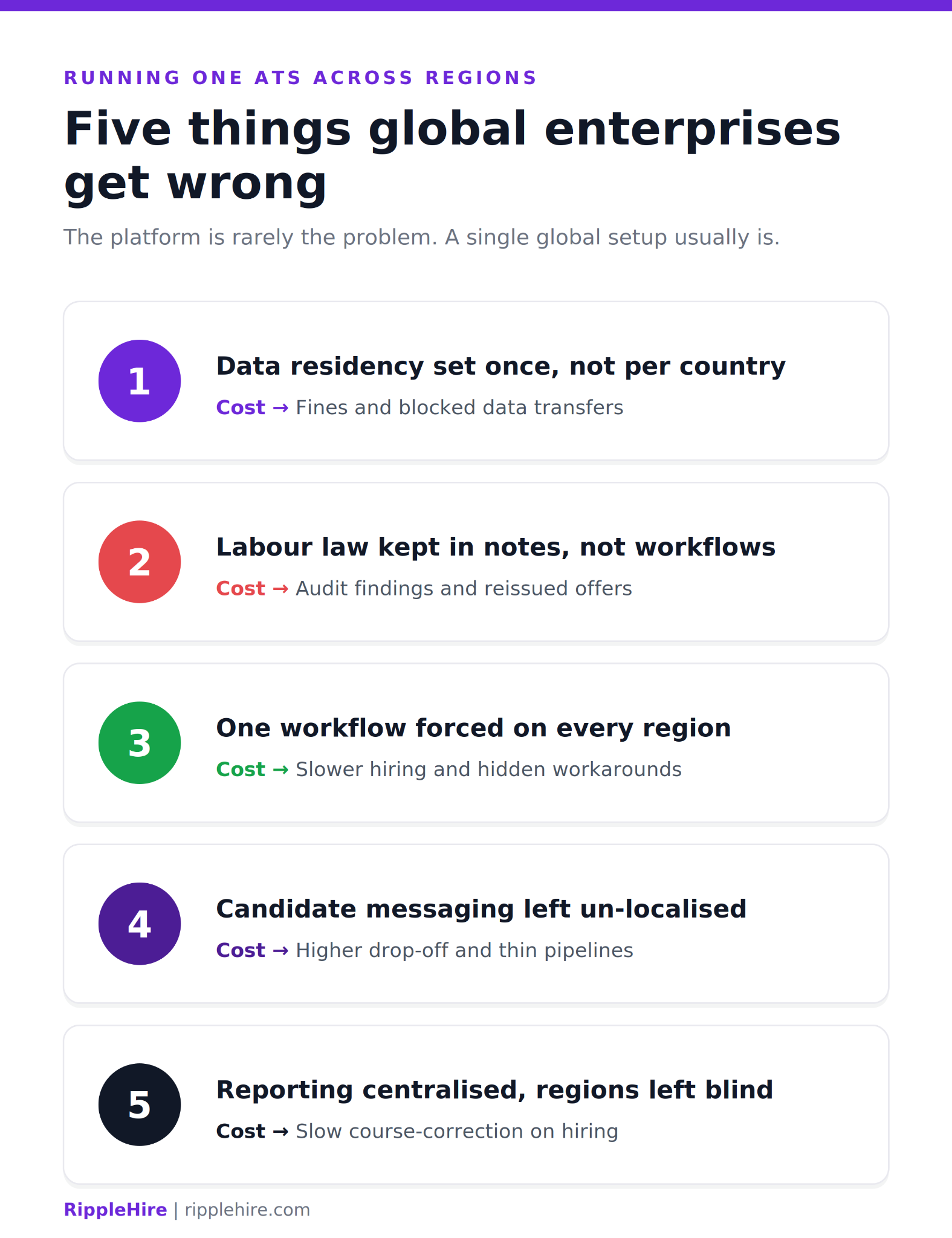
Treating data residency as one setting instead of per-country
Data residency often gets set once, during the first implementation, and then fades into the background. A single storage region is chosen for the whole platform, usually wherever the vendor or the HQ IT team finds it convenient. That choice holds up until candidate data from a market with its own residency rules starts flowing into a server the local regulator never approved.
The cost shows up as legal exposure rather than a broken screen. India's central bank requires certain payment-related data to stay on domestic servers, Russia mandates that citizens' personal data be collected and stored locally, and the European Union restricts transfers to countries without adequate safeguards.
Enforcement is real. Regulators fined a ride-hailing company €290 million in 2024 for storing European driver data in the United States without proper protections, according to the DLA Piper survey. Hiring data carries the same personal information that triggers these rules, so a candidate database consolidated in one region can put an employer on the wrong side of several regulators at once.
Handling labour-law differences with notes instead of workflow logic
Labour law varies far more than rollout plans assume, and teams often try to bridge the gap with guidance documents rather than system rules. A recruiter in one country receives a PDF or a wiki page explaining what to do differently, while the workflow itself stays identical everywhere. Written guidance breaks down the moment hiring volume rises or a new recruiter joins without reading it.
Several differences genuinely need workflow logic, not a note:
- Works councils in Germany and the Netherlands can require employee-representative involvement before certain roles are posted or filled.
- Background-check rules differ sharply, with some countries limiting what an employer may verify and at what stage.
- Pay-transparency laws in parts of the EU now require salary information to appear at specific points in the hiring conversation.
- Probation periods, consent wording, and mandatory notice vary by jurisdiction and change what a compliant candidate offer looks like.
When these live in a document instead of the workflow, compliance depends on individual memory. The operational cost lands as inconsistent practice across regions, audit findings that take weeks to unwind, and offers that have to be reissued because a required step was skipped.
Rolling out one interview and approval workflow everywhere
A single interview and approval workflow is the part leaders most want to standardise, because it promises consistency and cleaner reporting. Standardising the stages makes sense. Forcing every region through identical approval steps and interview formats does not, since hiring norms and team structures differ by market.
Consider how one fixed workflow strains in practice:
- An approval chain designed for a large HQ finance team adds days of delay in a small market where two people run the entire operation.
- A mandatory panel-interview stage suits senior roles but slows high-volume frontline hiring in regions that compete on speed.
- A fixed offer-approval hierarchy clashes with markets where a country manager holds sign-off authority the global template never accounted for.
The operational cost here is speed. Vacancies stay open longer in exactly the markets where talent moves fastest, and regional teams build side processes, spreadsheets, and offline approvals to route around the system.
Underestimating language and localisation in candidate communication
Candidate communication is where a global rollout meets the public, and it is often the least localised part of the system. Interview invitations, status updates, and offer letters frequently go out in the HQ language and tone, even in markets where candidates expect their own language and a different level of formality. Localisation runs deeper than translation, since date formats, name conventions, address fields, and consent language all shift by country.
The gaps that matter most in candidate-facing communication include:
- Automated emails and messages sent only in English to markets where that lowers response and completion rates.
- Consent and privacy notices that must appear in the local language to be valid.
- Interview scheduling that ignores local time zones, working weeks, and public holidays.
The operational cost is a weaker candidate experience in precisely the places where the employer brand is least established. Drop-off rises, offer acceptance slips, and the markets meant to grow fastest end up with the thinnest pipelines.
Centralising reporting without letting regional TA see their own dashboards
Reporting tends to be built for the centre first. Global dashboards give leadership a consolidated view, which is genuinely useful, but regional TA leads are frequently left without a clear line of sight into their own funnel. When a regional head has to request a report from a central analytics team every time a business leader asks about open roles, the data stops driving day-to-day decisions.
Centralised-only reporting removes ownership from the people closest to the hiring. A regional lead who cannot see time-to-fill, source performance, or drop-off for their own markets cannot act on any of it either. The operational cost is slower course-correction: a problem that a local dashboard would surface in a day instead waits for a monthly review, long after the hiring window has closed.
A simple rule: global core, regional configuration
None of these problems argue against a single global platform. They argue against a single global configuration. The workable model keeps a firm global core, meaning the standards that should never vary, and allows a regional layer to flex wherever local reality demands it.
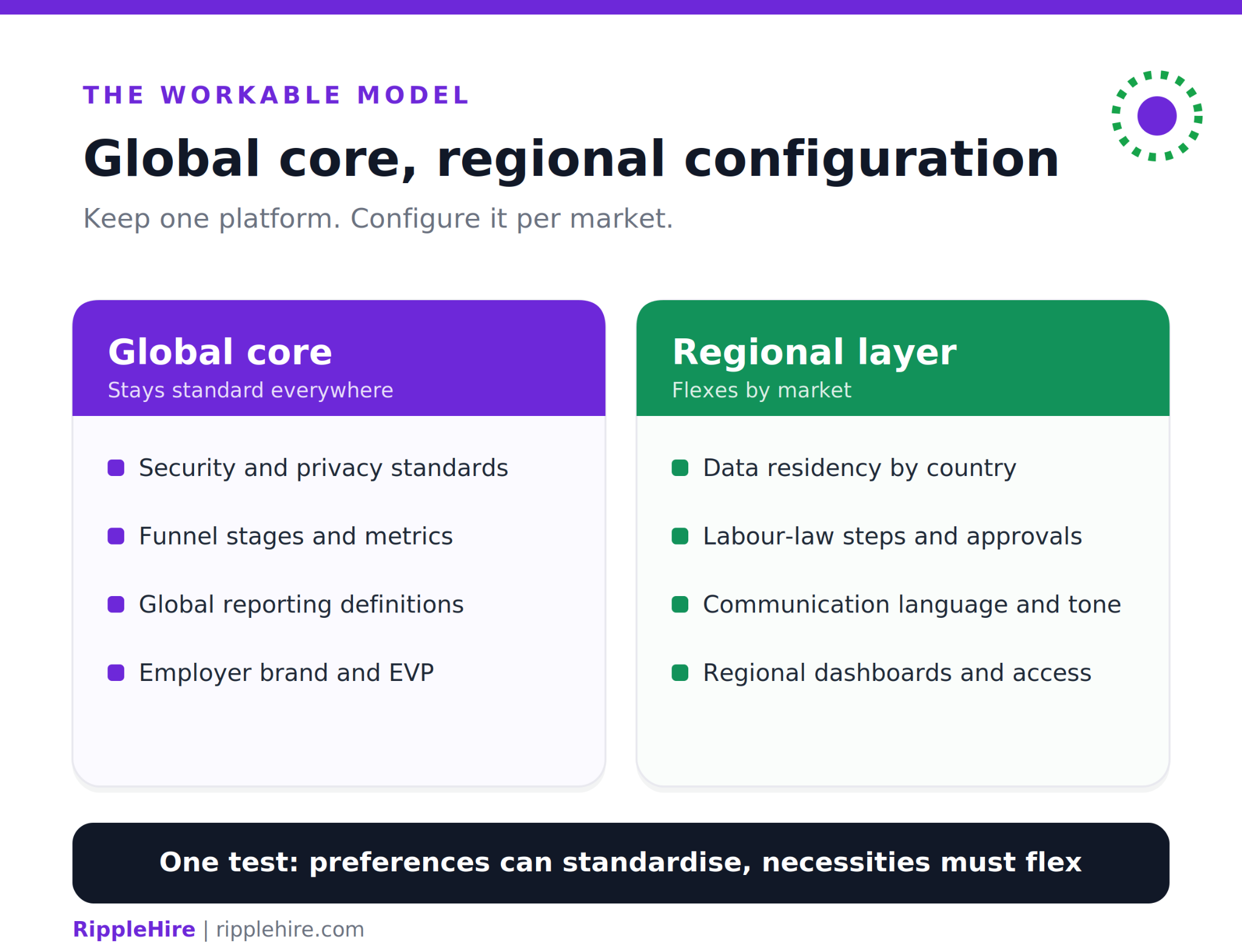
Deciding what belongs in each column before rollout, rather than after, is what separates a clean multi-country deployment from a set of workarounds.
|
Area |
Global core (standard everywhere) |
Regional configuration (must flex) |
|
Data and security |
Security certifications, encryption, access controls, one privacy-by-design standard |
Storage residency region and cross-border transfer rules, set per country |
|
Hiring stages |
Common funnel stages, shared terminology, global metric definitions |
Approval chains, interview formats, panel requirements |
|
Compliance |
A policy that every market meets local law |
Specific labor-law steps encoded per country: works councils, background checks, pay transparency |
|
Candidate communication |
Brand voice, template structure, consent framework |
Language, tone, date and name formats, time zones, holidays |
|
Reporting |
Global definitions and the executive dashboard |
Regional dashboards with local ownership and self-serve access |
|
Employer brand |
EVP, values, non-negotiable candidate-experience bar |
Local messaging and channels |
A useful test when sorting any item is whether a difference is a preference or a legal and operational necessity. Preferences can safely standardize. Necessities need room to vary, and the platform has to allow that variation without a separate instance for every country.
Run one platform where recruiters and agents hire across every market
The global-core, regional-configuration model only works if the platform underneath it can hold both at once. This is where RippleHire fits. RippleHire is built as the place where recruiters and agents work together, on an ATS designed for global enterprises hiring across 50+ countries, with AI agents that operate inside your policies, compliances, workflows, and reporting structure instead of forcing one template on every market.
For a multi-country operation, that translates into a few practical strengths:
- Configurable compliance: A framework-based approach lets each market follow its own local and global hiring laws, and adjust as those laws change.
- Localized communication at the source: A Gen AI copilot writes country-compliant job descriptions in any language, and candidate FAQ and follow-up bots keep applicants informed in their own market.
- Compliance-aware matching: AI matching and recommendation stack-ranks candidates in line with global compliances, so shortlisting stays consistent and defensible across regions.
- Security and data trust built in: ISO 27001, SOC 2 Type 2, and GDPR compliance, with contextual models that keep your data inside your environment.
- Workflows and reporting that mirror your structure: The ATS and its agents are built to reflect your business units, team structure, workflows, and reporting needs, which gives regional teams their own view rather than a request queue.
Book a demo to see how RippleHire helps recruiters and agents hire together across 50+ countries, with a global core and the regional flexibility each market actually needs.
FAQs
What is a global ATS deployment?
A global ATS deployment is the rollout of a single applicant tracking system across an organization's operations in more than one country. The aim is one platform for hiring data, workflows, and reporting worldwide. A successful deployment keeps common global standards while allowing each country to adjust for local laws, languages, and hiring practices, rather than applying one identical configuration everywhere.
How do you ensure multi-country ATS compliance?
Multi-country ATS compliance starts with treating each market's rules as configuration, not paperwork. Map data residency, labor law, background-check limits, consent wording, and pay-transparency rules for every country before rollout, then encode those requirements into workflows rather than guidance notes. Assign local ownership so someone in each market keeps the setup current as laws change. Regular audits and clear access controls keep the system defensible across regions.
Why does the same ATS work in one country but break in another?
The platform rarely breaks; the configuration does. A setup built around the first country's laws, language, and approval habits carries assumptions that do not hold elsewhere. When those assumptions meet different residency rules, labor requirements, or hiring speeds, local teams begin building workarounds. The system still runs, but it stops matching how that market actually hires, which is why problems appear all at once.
How should a company start deploying an ATS across regions?
Begin by separating what must stay standard everywhere from what should flex by market. Define global elements such as security standards, funnel stages, and reporting definitions first. Then work country by country to map local requirements for data, labor law, language, and approvals. Pilot in one or two representative markets before scaling, and give regional teams ownership of their own configuration and dashboards from the start.
What should stay standard and what should change by country in global hiring?
Keep the core standard: security and privacy standards, shared funnel stages, common metric definitions, and the employer brand. Let the local layer flex where reality demands it, including data residency, labor-law steps, communication language, approval chains, and regional reporting views. A useful test is whether a difference is a preference or a legal and operational necessity. Preferences can standardize, while necessities need room to vary.