
.svg) Product
Product


.png)


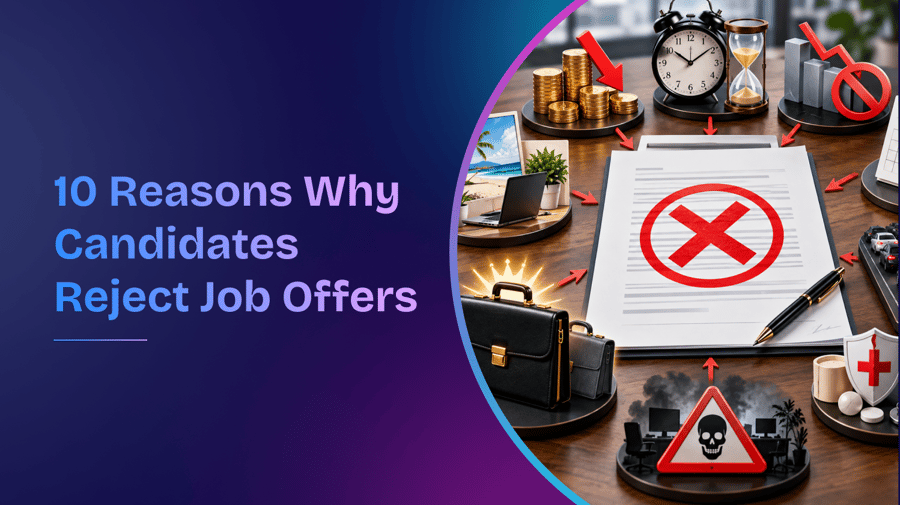


Table of content
Why Candidates Reject Job Offers? 10 Reasons You Must Know As a Recruiter or TA
Quick answer: Candidates most often reject job offers because of a slow or disorganized hiring process, uncompetitive pay or benefits, unclear or misleading job descriptions, weak rapport with interviewers, an unverified or inconsistent company culture, negative employer reviews online, and material conditions like work location, travel, or schedule that only surface at the offer stage. Industry research puts overall offer-rejection rates as high as 50%, which means for every two offers a company extends, one is likely to be declined.
Landing on the "right" candidate is only half the job. The other half is convincing that candidate you're the right employer and a surprising number of companies lose that second half of the deal. Below are the 10 most common reasons offers get turned down, and what recruiters and TA teams can do about each one.
The 10 reasons, at a glance
- Company culture isn't clearly or authentically communicated
- The hiring process takes too long
- The total compensation package isn't competitive
- The candidate didn't click with their interviewer
- Communication during the process was slow or vague
- The company has poor reviews
- There's no visible path for growth
- The role doesn't match the original job description
- The overall hiring experience felt disorganized or impersonal
- Material conditions- location, travel, schedule, pay structure only surface at the offer stage
Each is covered in detail below, with a fix you can act on this quarter.
Not presenting clear & positive company culture
If candidates can't tell what it's actually like to work at your company, they'll assume the worst or simply pick the employer who made it easier to picture themselves there.
A strong, clearly communicated culture is one of the biggest differentiators in a competitive hiring market, especially with younger candidates who weigh day-to-day experience as heavily as the paycheck.
This is especially true for Gen Z candidates, who tend to research a company's values, DEI commitments, and work-life balance as closely as they research the role itself, and who are quick to walk away from offers that feel generic or performative.
Culture can't just live on a careers page it needs to show up consistently throughout the application and interview process.
Let candidates meet future teammates before an offer goes out. A 20-minute informal call with two or three team members does more to build confidence than another round of culture-deck slides.
A lengthy & tiring recruiting process
Timeline is one of the single biggest drivers of offer rejection, and it's largely self-inflicted.
Roughly 45% of candidates who reject offers cite dissatisfaction with the recruiting process itself, not the offer. In India, the average hiring cycle now runs 35–45 days for most white-collar roles, stretching to 44–60 days for senior positions and top candidates are typically off the market within 10–18 days of becoming available, well before most companies can complete their process.
To fix this , map your current time-to-offer and cut it in half where possible. Automating scheduling, consolidating interview rounds, and setting internal SLAs for feedback turnaround (e.g., 48 hours per stage) are your highest-leverage solutions.
The remuneration package is not right
If the number is below market and candidates can find that out in five minutes of searching, they will and they'll walk.
Top talent isn't free, and lowballing a strong candidate rarely gets you a strong hire; it gets you whoever's left after everyone else says no. Candidates today have easy access to market salary data, so a below-market offer reads less like negotiation room and more like a red flag about how the company values people.
To avoid losing candidates to below-market pay ,benchmark compensation against real competitor data before finalizing a salary range. If budget constraints prevent competing on base pay, state this transparently and highlight alternative value drivers such as remote work flexibility, family healthcare coverage, or generous leave policies.
The candidate doesn’t click with interviewer
Sometimes, and it matters more than most hiring teams admit a mismatch here can undo an otherwise strong offer.
Every interview is a two-way evaluation. While the interviewer is assessing fit, the candidate is quietly deciding whether they can imagine working closely with this person or team. A cold, rushed, or dismissive interviewer can outweigh a great salary and brand name.
Train interviewers specifically on candidate experience, not just evaluation technique, so every interaction leaves a positive impression. Since every touchpoint shapes how a candidate views your company, ensuring interviewers are engaging, respectful, and prepared helps prevent losing top talent late in the process.
Low communication skills
Vague or delayed updates read to candidates as a preview of what post-hire communication will look like and they'll often choose the offer where it felt clearer.
Candidates notice when a recruiter seems rushed, distracted, or slow to respond. The logic is simple: if a company can't prioritize clear communication while trying to win someone over, it's unlikely to improve once that person is on payroll.
If your hiring volume makes individual follow-up hard to sustain, that's a signal to bring in dedicated recruiting support rather than let communication quality slip.
Your company holds bad reviews on online platforms
Very possibly influencing your rejections even if no candidate ever mentions it most are checking Glassdoor or AmbitionBox before they accept.
According to Glassdoor's employer branding research, 86% of job seekers check employer reviews and ratings before deciding where to apply, and only about 1 in 5 will even apply to a company with a 1-star rating. Negative reviews aren't something to suppress or dismiss they're a direct line to the specific issues costing you candidates.
Pull your reviews quarterly and look for repeated themes rather than one-off complaints. Bring the pattern to leadership and HR as an actual agenda item, not a PR problem to manage around.
No opportunities to grow in your organization
If a candidate can't see where the role leads in two or three years, a competing offer with a clearer trajectory will usually win.
Career growth is rarely static in a candidate's mind even for a first job, most are already thinking about the next one. Companies that only sell the immediate role, without a picture of what comes after, lose ground to employers who paint that longer arc.
During interviews, actively ask what the candidate wants their career to look like in three years then be specific about how your organization could support that, with real examples: certifications sponsored, internal mobility, past employees who've moved up.
The job position is not exactly your company described it to be
This is one of the most preventable and most damaging reasons for rejection, because it signals dishonesty rather than just a process issue.
If the day-to-day responsibilities, scope, or reporting line shift meaningfully between the job posting and the offer conversation, candidates feel misled and rightly so. Even a great compensation package won't offset the sense that they were sold something different from what's on the table.
Have hiring managers, not just recruiters, review and sign off on every job description before it's posted, and flag any responsibilities that are likely to expand mid-role. Honesty about scope up front costs less than a rejected offer later.
The candidate had a negative experience with the hiring process
Remember that every applicant is watching your hiring process. After all, it will be their first introduction to your organization.
There are various ways you may develop your hiring abilities to make sure the hiring process is efficient, successful, and even fun for your prospects. Your candidate will lose interest in working for your company if the hiring process is chaotic, disorganized, or managed in a way that is judged incompetent in some ways.
The best solution to tackle this problem is audit your process end-to-end from the candidate's point of view, not the recruiter's. A structured, well-run ATS and a clear internal handoff process between recruiters and hiring managers fix most of this without adding headcount.
New conditions surface right before the offer
A late-disclosed condition can undo weeks of hard-won trust, even when the condition itself is entirely reasonable.
This happens more often than most hiring teams realize. A candidate who assumed the role was hybrid finds out at the offer stage that it's fully onsite. A candidate who has mentally committed to one version of the role, then discovers a materially different one right as they're expected to sign, reasonably starts to wonder what else wasn't mentioned.
To avoid this ,map out the conditions most likely to make or break a decision work location, travel, schedule, pay structure, unusual reporting lines and surface them explicitly early in the process, not just in the offer letter. The written offer should read as a confirmation of what the candidate already understands about the role, not the first time they're learning what it actually involves. Standardizing this in your offer templates, so the same set of conditions gets disclosed consistently for every role, is the simplest way to make sure nothing slips through until the last stage.
Checklist: reduce your offer-rejection rate
☐Introduce candidates to future teammates before the offer stage
☐Set internal SLAs for feedback turnaround at each interview round
☐Benchmark compensation against current market data, not last year's
☐Train interviewers on candidate experience, not just assessment
☐Keep communication consistent, automate updates if volume is high
☐Review employer ratings quarterly and act on recurring themes
☐Discuss growth and career path explicitly during interviews
☐Have hiring managers sign off on job descriptions before posting
☐Audit the full hiring journey from the candidate's perspective
☐Surface likely deal-breaker conditions (location, travel, schedule, pay structure) early, not just in the offer letter
Bottom line
Most offer rejections aren't really about the money , they're a symptom of a hiring process that lost the candidate's confidence somewhere along the way. A faster, clearer, more honest process consistently outperforms a slightly higher salary.
This is where RippleHire's agentic AI ATS is built to help by pairing recruiters with AI agents that handle the friction points covered above so recruiters can focus on the relationship. Amy, RippleHire's interview agent, and the Interview Copilot keep candidates moving through early rounds without the scheduling delays that drive rejections; the Offer Agent speeds up offer creation and approval so strong candidates aren't left waiting; and the Document Validation Agent clears verification bottlenecks before they stall an offer. Agents handle the repetitive, time sensitive steps recruiters stay focused on closing.
The talent is rare. Your process shouldn't be.
See how modern hiring automation can streamline your talent acquisition schedule a demo today to keep your candidates engaged and reduce offer dropouts .
FAQs
Why do candidates reject job offers even after showing interest initially?
Candidates may reject offers due to misalignment between expectations and reality such as unclear job roles, poor recruiter communication, unattractive compensation, lack of growth, or red flags during the hiring process.
How can companies prevent top candidates from rejecting offers?
To reduce rejections, companies must offer competitive compensation, communicate clearly and consistently, showcase a strong and authentic work culture, move fast in their process, and personalize the offer experience based on candidate priorities.
Does company culture really influence offer acceptance?
Yes. Candidates, especially millennials and Gen Z, evaluate whether a company's culture aligns with their personal values. A lack of cultural clarity or authenticity can lead to offer rejection even if the compensation is good.
What’s the most overlooked reason candidates reject offers?
A role that doesn't match its original description. When responsibilities or reporting lines shift between the posting and the offer, candidates feel misled and are more likely to walk away, regardless of pay.
Is it worth investing in a recruitment platform to reduce offer dropouts?
For most growing teams, yes. A structured ATS shortens time-to-offer, standardizes communication, and gives hiring managers and recruiters shared visibility the combination that fixes most of the reasons candidates cite for declining.