RippleHire vs a single super-agent ATS · Updated October 2026

One global agent won't survive global regulation. A recruiting harness will. Agents coordinate. Recruiters close.

A single SuperAgent that orchestrates every stage is easy to buy and easy to demo. It also makes every country run at the pace of its strictest regulator. Our bet went the other way: a recruiting harness of specialised agents, each with its own rules, autonomy level and scope, connected with your recruiters in Agent Builder. The difference is small while your processes look alike. It grows when they differ by job family or by country, because hiring rules differ between markets and keep changing.

Two ways to run hiring AI

ONE SUPERAGENT campus field offers senior EU roles Super Agent one shared orchestration layer every workflow routed through it SPECIALIST AGENTS 1 campus agentown rules, own scope 2 offer agentown rules, own scope 3 compliance agentown rules per country one recruiting harness change one, the rest are untouched

Why we built specialised agents

We chose specialised agents for three reasons, all about control.

10 agents
Rules

Each job family keeps its own

Campus intake, blue-collar drives, lateral hiring and senior appointments follow different rules, and those rules change at different times for different reasons. Keeping each set inside its own agent means changing one without reopening the others.
Depth
One task, tuned properly

Your offer approval process and your campus screening process need nothing from each other. Tuning one agent to do both acceptably is a harder problem than tuning two to do one each. Enterprises run different teams with different skills for the same reason.

A specialised agent per action, tuned to that action alone.
Control
An off switch per country

Different markets require different AI controls, and the rules keep moving. Your legal and compliance teams decide what is allowed where. Your ATS has to execute that decision without a re-implementation, which means switching one behaviour off in one country while the rest keeps running.

Enable and disable individual agents per country and process.

One request. Ask both vendors to configure it live.

A request we hear often: when a candidate accepts an offer, move them to the next stage automatically, so the HRMS sync runs without your ops team doing it by hand. Do it for field roles only, and leave campus, corporate and senior hiring as they are. Ask each vendor to set it up in front of you, including us.

What to ask any vendor

  1. Can I create my own agent?
  2. Can I change an agent you provide, so it works differently for different jobs?
  3. Do I have to come to you to make that change?
  4. How does the agent work for campus hiring compared with lateral hiring?
  5. Show me each answer. Don't just describe it.

If every change goes through the vendor, every change waits.

What RippleHire does

  1. Yes. Your team builds agents in Agent Builder, with no code.
  2. Yes. Turn auto-advance on for field roles only. Campus, corporate and senior hiring stay as they are.
  3. No. Your team makes the change itself.
  4. Campus and lateral hiring each get their own agent, with their own rules.
  5. We will show you all four in the demo.

Applies only to the jobs you chose.

Ask every vendor the same five questions, and ask them to show the answers live.

A single orchestrator is easier to buy, learn and demo. Ask what happens when one job family or one country needs different behaviour from another.
With specialised agents, every agent has its own rules, its own autonomy setting and its own audit trail.
ScreenagentFollowupScheduleagentApproveflowComplyagentOfferagent Agent Builder
The recruiting harness

Agent Builder is the harness. You build the next specialist yourself.

Specialised agents only help if they work together and you can add the one your process needs. Agent Builder is the business-friendly face of the RippleHire harness: it stitches recruiters and agents into any hiring workflow, based on region, internal requirements and constraints. Your TA ops team can create an agent, give it its own rules, set its autonomy level and scope it to a geography or business unit, with no code and no vendor ticket.

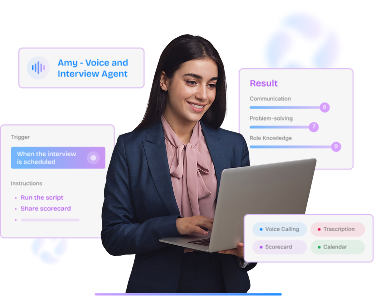
  • Amy runs Level-1 video interviews around the clock and returns scored reports
  • An AI voice agent handles pre-screen calls and flags AI-written resumes
  • Agents for offer validation, approval chasing, pre-join check-ins and compliance
  • Set the rules once per geography: an Australia agent and a Germany agent play by different rules
  • Switch any single agent off for one country without touching the rest
  • Three operating modes, set per region, business unit or job family: Assisted, Semi-autonomous and Autonomous
  • Agents coordinate, recruiters close: agents run the systematic work, recruiters make the decisions
Ask any vendor built around a single orchestrator the same thing: who adds a new kind of specialist, how long it takes, and whether that change touches every other workflow. Then ask us the same.

Read: ATS is dead. Harness is what you need for the next decade.

Ten requirements, Eight requirements, side by side

These are the eight requirements that usually decide an evaluation. Where it says “not published, ask for a demo”, we found no published capability, so ask the vendor to show it.

DimensionRippleHireA staffing-first ATS
High-volume and blue-collar hiringStrongStrong
Mobile and WhatsApp workflowsStrongStrong
AI architectureRecruiting harness: specialised agents per task, connected in Agent BuilderOne SuperAgent orchestrating every workflow
Customer-built agentsAgent Builder, no codeNot published, ask for a demo
Agent-level control by geography and business unitScope and autonomy set per agentNot published, ask for a demo
Level-1 interviews and voice screeningAmy and the AI voice agent, core productNot published; ask for a demo, and whether it is core product or an add-on
Regional workflow depthDifferent rules per geography in one tenant, plus regional job boards and LinkedIn RSC (premium tier)Not published, ask for a demo
Post-offer and pre-join intelligencePrediction and interventionNot published, ask for a demo

Both products are strong on the first two rows, and the third is a difference in design. Each of the last five can be checked in a short demo.

Seven things that need a specialist

Each of these has its own rules, its own edge cases and often its own regulator, so each gets its own agent.

RippleHire advantage

Agent Builder, the harness

Your TA ops team creates new agents with no code, gives each its own instructions and autonomy level, and scopes it to a country or business unit. Ready templates include a Smart Interview Scheduler that routes Java, data science and frontend candidates to different voice-interview agents from a single trigger, and score-gated fast-tracks that promote or reject on the voice and video thresholds you set.

Ask to see an agent a customer built unaided.

RippleHire advantage

Offer validation agent

Document checks, rehire rules and compliance validation before an offer goes out, then automatic chasing of every approver who has not signed.

Ask any vendor to show the agent that chases an approver.

RippleHire advantage

Pre-join agents

Ask what predicts a drop-off, and what it does about it.

Ask what predicts a drop-off, and what it does about it.

RippleHire advantage

Shield fraud detection

Duplicate applications, fake resumes, identity mismatches, deepfakes and agency double-submissions, flagged before a recruiter reviews the profile. It catches fake companies and universities ahead of background checks.

Ask what flags an impersonated candidate pre-interview.

RippleHire advantage

Gamified referral engine

Leaderboards, points, badges and instant rewards, with source credit and payouts tracked automatically, plus vendor tiers and throttling so agencies cannot flood your pipeline.

Ask what they do to raise participation.

RippleHire advantage

Requisition and position validation

We block a second requisition against a position that is already filled, and we flag it when the requisition is raised, before the HRMS sync. Field designations repeat constantly, so a recruiter raising ten to fifteen requisitions a day cannot tell two apart from the job title alone.

Without it: two people land on one position ID and the HRMS sync fails.

RippleHire advantage

Per-country compliance agents

Agents that apply different consent and disclosure rules per country, for example India's DPDP Act alongside EU disclosure duties, running side by side in one tenant, each with its own audit trail.

Ask to see autonomy set differently for two countries.

What a single super-agent ATS does well

These strengths hold up in an evaluation, and you should weigh them.

Login-less mobile experience, high-volume drives and enterprise credentials

The best super-agent platforms have removed the login. Recruiters, candidates, interviewers, approvers and leadership all act from WhatsApp or a phone without an account. For blue-collar and grey-collar hiring, walk-in drives and bulk screening, removing that friction matters a lot, and it demos well.

They also have enterprise credentials: serious funding, a Deloitte India alliance and a full certification set (ISO 27001, ISO 27701, SOC 1 and SOC 2).

Our claim is narrow. A single agent works well while your processes look alike. At enterprise scale they rarely do: campus hiring runs differently from lateral hiring for a banking client, and a Germany requisition follows different rules from an Australia one. Ask both vendors to scope one automation to one job family and one business unit in front of you, and decide from what you see.

Questions to ask before you sign

Each one can be answered in a live demo. Start with the first.

  1. Set up auto-advance for field roles only, live, without editing each job.

    When a candidate accepts, move them on so the HRMS sync fires. Field roles only, corporate and senior untouched. If the answer is that it applies to all jobs and you opt out one by one, the feature will never get used.

  2. Make one agent work differently in two of our countries, and show the audit trail.

    Hiring rules on automated decisions and candidate disclosure differ by country and keep changing. Ask them to configure one behaviour two ways, live, and show what the audit trail records for each.

  3. Show me an agent a customer built without your team involved.

    If new behaviour has to come from the vendor's orchestrator, every future process change becomes a roadmap request.

  4. What runs between offer accepted and Day 1, and what predicts a drop-off?

    Ask which agent works that window, and what flags a candidate taking a counter-offer before the no-show.

  5. Is it core product or an add-on, and does it work on mobile?

    Ask for every capability you are shown, including L1 interviews. In high-volume hiring, many candidates take their first interview on a phone.

The recruiting harness enterprise IT services runs on

LTIMindtree, Mphasis, Birlasoft, Bahwan Cybertek and 50+ enterprises run RippleHire, making tens of thousands of hires a year across global markets. We built specialised agents because those volumes needed them.

40%Lower time-to-hire
3 to 5xHires per recruiter
60%Fewer no-shows
4.7/5Candidate experience
4.5/5Recruiter experience
86M+Candidate applications processed
12MInterviews captured, 50+ countries
31Brandon Hall awards


Ask us for the Harvard Business Publishing case study on how this platform was built, and why we chose many agents over one.

Give us 45 minutes. Bring one rule you want to apply to some jobs and not others.

We will scope it in front of you, show you what it left alone, and show you the audit trail. Then ask your other shortlisted vendor to do the same.

Schedule the comparison demo