
.svg) Product
Product

.png)


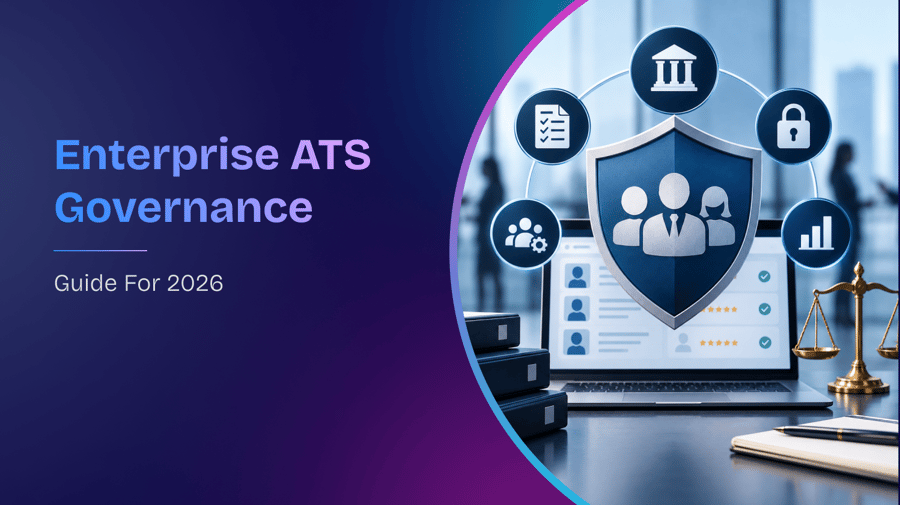


Table of content
Enterprise hiring involves more than finding the right candidates. It demands a system of controls, audit trails, and compliance workflows that hold up under regulatory scrutiny across every jurisdiction where you operate. An enterprise applicant tracking system sits at the center of this challenge. If the platform you choose cannot enforce governance at scale, your recruiting operation carries risk that your security, legal, and HR teams may not detect until an audit or incident exposes it.
This guide walks you through every layer of recruitment governance you need to evaluate, build, and maintain inside an enterprise ATS. You will learn what governance means in the context of talent acquisition, how to assess platforms against compliance criteria, and how to design workflows that keep your hiring function audit-ready from requisition to appointment.
Key Takeaways: Enterprise ATS Governance Guide for 2026
- Recruitment governance covers approval hierarchies, data handling policies, audit trails, and regulatory compliance across every hiring stage.
- An enterprise ATS must enforce jurisdiction-specific rules for GDPR, DPDP, EU AI Act, and local pay transparency laws automatically.
- Role-based access control, immutable audit logs, and consent management are non-negotiable features in any governance-ready platform.
- RippleHire delivers 100% audit readiness with built-in compliance tracking, fraud detection, and configurable governance workflows.
- Governance is not a one-time setup; it requires ongoing monitoring, SLA tracking, and regular reviews to remain effective.
What Is Recruitment Governance in an Enterprise ATS?
Recruitment governance is the set of policies, controls, and accountability structures that dictate how hiring decisions are made, documented, and reviewed across your organization. It goes beyond compliance checklists. Governance defines who can approve a requisition, how candidate data is collected and stored, what audit trail is required for each hiring action, and how exceptions are escalated.
In an enterprise ATS, governance should be embedded in the platform itself. Approval hierarchies, data retention policies, consent capture, and SLA enforcement should run automatically. When governance lives in spreadsheets or shared documents instead of the system your recruiters use daily, gaps are inevitable.
For talent acquisition leaders managing hiring across business units, geographies, and legal entities, a governance framework is the foundation that makes consistent, fair, and defensible hiring possible at scale.
Why Governance Matters More in 2026 Than Ever Before
The regulatory environment around hiring has expanded significantly. GDPR enforcement has matured. India's Digital Personal Data Protection (DPDP) Act is now active. The EU AI Act requires transparency and bias monitoring for AI-assisted hiring decisions. Pay transparency laws are rolling out across the EU and multiple US states.
According to the 3Sixty Insights State of HR Compliance 2026 benchmark report, 71% of organizations say their HR compliance needs have increased over the past two years, and nearly one in four report that keeping up has become harder. This gap between perceived readiness and actual complexity is where governance breakdowns happen.
If your ATS does not enforce compliance workflows automatically, your team is left to manage this growing burden manually. That approach does not scale. The organizations that invest in structured recruitment compliance workflows now will be the ones prepared for the next wave of regulatory change.
How to Define a Governance Framework for Enterprise Hiring
Start with Policy Mapping
Before configuring anything in your ATS, document your governance requirements. Map each jurisdiction where you hire to the specific data privacy, anti-discrimination, and AI transparency regulations that apply. For multinational operations, this means maintaining separate compliance profiles for each country or region.
Your policy map should cover consent requirements, data retention timelines, candidate communication obligations, and any mandatory audit or reporting thresholds. This document becomes the blueprint for how your ATS should be configured.
Establish Clear Ownership
Governance fails when no one owns it. Assign explicit accountability for recruitment compliance across your TA operations, legal, and IT security teams. Define who reviews policy changes, who monitors compliance dashboards, and who is responsible for audit responses.
In many enterprises, TA operations teams take the lead on day-to-day governance enforcement, with legal and security providing oversight. The ATS should support this by offering role-based dashboards that surface the right data to the right stakeholder without exposing information outside their remit.
Build Governance into Workflows, Not Around Them
The most common governance mistake is treating it as an add-on. Compliance checks, approval gates, and documentation requirements should be embedded in the hiring workflow itself. When a recruiter creates a requisition, the system should enforce the correct approval hierarchy. When a candidate applies, consent should be captured automatically with a timestamped record.
If governance requires your recruiters to leave the ATS and update a separate system, adherence will drop. The platform should enforce governance by default, not rely on individual compliance awareness.
Core Governance Features Every Enterprise ATS Must Have
Role-Based Access Control (RBAC)
RBAC ensures that every user in your ATS sees only the data and functions relevant to their role. Recruiters see their assigned requisitions and candidate pipelines. Hiring managers see interview schedules and feedback forms. Compliance officers see audit trails and consent records. Leadership sees aggregate performance metrics.
Effective RBAC goes beyond simple permission levels. It should support multi-entity architectures where different business units, geographies, or legal entities have distinct access rules governed from a single admin console.
Immutable Audit Trails
Every hiring action, from candidate record access to AI-generated recommendations, interview feedback submissions, offer approvals, and document uploads, should be logged with a timestamp, user identity, and outcome. These records must be immutable. No user should be able to edit or delete an audit trail entry.
When your legal team or an external regulator requests a complete history of a hiring decision, the ATS should produce it on demand without manual reconstruction. RippleHire logs every action across the hiring lifecycle with this level of detail, making audit responses a matter of running a report rather than assembling records from multiple systems.
Consent Management
Under GDPR, DPDP, and similar frameworks, you need documented proof of candidate consent for data collection, processing, and storage. Your ATS should capture consent at the point of application with plain-language notices, record the specific lawful basis for processing, and support one-click withdrawal.
Consent records should be tied to the candidate profile and accessible to compliance officers at any time. Automated retention and erasure policies should trigger based on jurisdiction-specific timelines, so your team does not have to track expiration dates manually.
Jurisdiction-Aware Compliance Workflows
A single global policy does not work when you hire across multiple regulatory environments. Your ATS must support jurisdiction-specific configurations. GDPR consent flows for EU candidates, DPDP requirements for India, CCPA provisions for California, pay transparency disclosures where mandated, and EU AI Act documentation for AI-assisted decisions should all be configurable per country or region.
This requires a platform architecture that separates compliance logic from core workflows, allowing TA ops teams to update rules for one jurisdiction without affecting others. RippleHire's multi-entity architecture supports exactly this, with different workflows, approval chains, and compliance rules for different business units governed from one platform instance.
SLA Tracking and Enforcement
Governance is not only about legal compliance. Operational governance, including SLA adherence, recruiter accountability, and process consistency, is equally important for enterprise hiring functions. Your ATS should track SLAs per role type, business unit, and geography, with automated alerts when a threshold is about to be breached.
When SLA data lives in the same system as your hiring workflows, you can identify bottlenecks before they affect candidate experience or business outcomes. This operational visibility is a governance capability that many platforms overlook.
How to Evaluate an ATS for Governance Readiness
Ask About Security Certifications
Start with the basics. Does the vendor hold ISO 27001 certification? Is there a current SOC 2 Type II audit report? Are these independently verified by a recognized auditor, or self-attested? Independent certification is the minimum standard for enterprise procurement. Self-attestation is not sufficient.
RippleHire has held ISO 27001 certification since 2016, audited annually by BSI, and maintains SOC 2 Type II certification. This level of independent verification matters when your CISO or procurement team assesses vendor risk.
Test the Audit Trail Depth
Request a demo that shows you the audit trail for a single candidate journey from application to offer. Can you see every user who accessed the record? Every AI recommendation with its reasoning? Every approval, override, and document submission? If the vendor cannot show you this in a live environment, the feature may not exist at the depth you need.
Evaluate Configuration Flexibility
Ask whether your TA ops team can configure approval hierarchies, SLA rules, and compliance workflows without raising IT tickets. If every configuration change requires engineering support, your governance framework will always lag behind regulatory changes.
No-code configuration is not a luxury for enterprise ATS governance. It is a requirement. Your TA operations team should be able to update workflows in response to new regulations or policy changes without waiting for a release cycle.
Check Multi-Entity Support
If you operate across multiple business units, geographies, or legal entities, verify that the ATS can support distinct governance configurations for each while maintaining unified reporting. Running separate instances for each entity creates data silos and makes consolidated reporting nearly impossible.
Building Compliance Workflows That Scale
Step 1: Map Your Regulatory Obligations by Jurisdiction
Create a matrix that lists every country or state where you hire, alongside the specific regulations that apply. Include data privacy laws (GDPR, DPDP, CCPA), anti-discrimination requirements, pay transparency mandates, and AI governance rules (EU AI Act, NYC Local Law 144).
This matrix becomes your configuration guide. Each row should translate into a specific workflow rule in your ATS.
Step 2: Configure Consent Flows Per Region
Set up region-specific consent capture at the point of application. EU candidates should see GDPR-compliant notices with granular consent options. Indian candidates should see DPDP-aligned plain-language disclosures. California candidates should see CCPA-specific rights notifications.
Each consent interaction should be timestamped, linked to the candidate record, and retrievable for audit purposes. Auto-redaction of sensitive identifiers should be configurable for jurisdictions that require it.
Step 3: Define Approval Hierarchies by Entity and Role Level
Not every requisition needs the same approval path. Entry-level roles in one business unit may require a single manager approval, while senior leadership hires may need sign-off from a department head, HR business partner, and compensation committee. Configure these hierarchies in your ATS so they enforce automatically with every new requisition.
Step 4: Set Data Retention and Erasure Policies
Different jurisdictions have different rules about how long you can retain candidate data. GDPR typically requires deletion or anonymization after the purpose of collection has been fulfilled. DPDP has its own retention framework. Your ATS should enforce automated erasure timelines per jurisdiction, removing the risk of manual oversights.
Step 5: Enable AI Transparency and Bias Monitoring
If your ATS uses AI for candidate matching, screening, or recommendations, you need documentation for every AI-assisted decision. The EU AI Act requires notification of AI use, bias audit data, and human review gates. NYC Local Law 144 mandates annual bias audits for automated employment decision tools.
Your platform should generate this data automatically. RippleHire's AI agents include explainable reasoning for every recommendation, with automatic bias audit data generation and mandatory human review gates across all AI-influenced decisions.
Step 6: Monitor and Review on an Ongoing Basis
Governance is not a set-and-forget exercise. Schedule quarterly reviews of your compliance configurations, SLA performance, and audit trail completeness. Assign ownership for each review cycle and document findings. Regulatory requirements shift, and your governance framework must shift with them.
Fraud Detection as a Governance Layer
Hiring fraud is a governance risk that many organizations underestimate. Fake profiles, duplicate candidate submissions, referral abuse, impersonation during interviews, and falsified credentials all undermine the integrity of your hiring process. Without automated detection, these issues often go unnoticed until after the hire.
A governance-ready ATS should include AI-based fraud detection as a standard capability, not an optional add-on. Flags for suspicious patterns should surface in the recruiter's workflow with specific evidence, giving your team the information to act before the candidate reaches an offer stage.
RippleHire includes built-in fraud management that detects impersonation, fake credentials, duplicate candidates, and referral abuse, with each flag accompanied by the specific evidence rather than a generic alert.
How Role-Based Dashboards Support Governance
Governance requires visibility, but not everyone needs to see the same data. Recruiters need pipeline metrics and SLA status. TA leaders need funnel performance and source attribution. Compliance officers need audit trails and consent records. Finance needs cost-per-hire and vendor performance. Leadership needs aggregate hiring health metrics.
Your ATS should deliver role-specific dashboards that surface the right information to each stakeholder. This approach eliminates the need for manual report assembly and reduces the risk of unauthorized data access. When every stakeholder can see the data relevant to their governance responsibilities in real time, compliance becomes a shared accountability rather than a single team's burden.
Integrating Your ATS with Your Enterprise Technology Stack
Governance does not end at the ATS boundary. Your enterprise applicant tracking system needs to integrate with your HRMS, identity provider (for SSO and SCIM provisioning), background verification vendors, job boards, and communication tools. Each integration point is a potential governance gap if data flows are not controlled and logged. Every connection between your ATS and external systems should be documented, monitored, and included in your governance audit scope.
Evaluate whether the ATS supports API-based integrations with your existing stack. Check whether data exchanged through integrations is captured in the audit trail. Verify that SSO and MFA are enforced for all users, including vendor accounts. RippleHire connects to major HRMS platforms, job boards, and background verification vendors through optimized APIs, with every data exchange logged for audit purposes.
Common Governance Gaps and How to Close Them
Gap: Manual Compliance Tracking
If your compliance monitoring relies on spreadsheets, email reminders, or periodic manual checks, you have a governance gap. Automated compliance tracking built into the ATS workflow eliminates this risk by enforcing rules at the point of action.
Gap: Disconnected Reporting
When hiring data lives across multiple systems, reconciling it for audit or leadership reporting introduces errors and delays. A unified ATS that covers sourcing, screening, interviews, offers, and onboarding in one platform removes the reconciliation burden.
Gap: No AI Decision Documentation
Many organizations use AI in hiring without documenting the reasoning behind AI-assisted decisions. This creates significant regulatory exposure under the EU AI Act and similar legislation. Your ATS should log every AI recommendation with its reasoning, inputs, and outcome automatically.
Gap: Inconsistent Onboarding Compliance
Governance often breaks down at the onboarding stage. Document collection, background verification, and regulatory disclosures should be managed in the same system as the rest of the hiring workflow, with the same audit trail and compliance enforcement.
In Conclusion: How to Build a Governance-Ready Hiring Operation
Recruitment governance is not a feature you purchase. It is an operating discipline that requires the right platform, the right policies, and ongoing commitment from your TA operations, legal, and IT security teams. The enterprise ATS you choose is the foundation of that discipline.
Start by mapping your regulatory obligations across every jurisdiction where you hire. Evaluate platforms against the governance criteria covered in this guide: RBAC, immutable audit trails, consent management, jurisdiction-aware workflows, SLA tracking, fraud detection, and AI transparency. Configure your ATS to enforce governance by default, not as an afterthought.
RippleHire gives enterprise TA teams the governance architecture, compliance automation, and real-time visibility to run hiring as a controlled, auditable operation across business units and geographies. If you are building or upgrading your recruitment governance framework, explore how RippleHire supports audit-ready hiring at enterprise scale.
FAQs about Enterprise ATS Governance Guide for 2026
What does recruitment governance mean in an enterprise ATS?
Recruitment governance refers to the policies, controls, and accountability structures built into your ATS to ensure hiring decisions are consistent, documented, and compliant. It covers approval workflows, data handling, audit trails, and regulatory adherence across all hiring stages and jurisdictions.
Why is ATS governance more important in 2026?
New regulations including the EU AI Act, India's DPDP Act, and expanding pay transparency laws have increased the compliance burden for enterprise hiring. Manual tracking methods cannot keep pace with these requirements. Automated governance in your ATS is now a practical necessity, not a future consideration.
How does RippleHire handle compliance across multiple jurisdictions?
RippleHire supports jurisdiction-specific consent flows, data retention policies, and compliance configurations for GDPR, DPDP, CCPA, and the EU AI Act. Each jurisdiction can have its own workflows and rules while sharing a unified reporting layer, so your team manages everything from one platform.
What should I look for in an ATS audit trail?
Your ATS audit trail should log every hiring action with a timestamp, user identity, and outcome. This includes candidate record access, AI decisions with reasoning, interview feedback, offer approvals, and document submissions. Records should be immutable and exportable on demand for internal or external audits.
Can an enterprise ATS detect hiring fraud automatically?
Yes. A governance-ready ATS should include AI-based fraud detection for fake profiles, duplicate candidates, impersonation, and referral abuse. RippleHire flags each instance with specific evidence in the recruiter's workflow, enabling your team to take action before a fraudulent candidate reaches the offer stage.
How do role-based dashboards support governance?
Role-based dashboards ensure each stakeholder sees only the data relevant to their governance responsibilities. Recruiters see pipeline and SLA data. Compliance officers see audit trails and consent records. Leadership sees aggregate hiring metrics. This structure reduces unauthorized data access and makes compliance a shared responsibility.
What is the difference between compliance and governance in hiring?
Compliance is about meeting specific legal and regulatory requirements. Governance is broader. It includes compliance but also covers operational standards, process consistency, SLA enforcement, and decision accountability. A governance-ready enterprise ATS addresses both dimensions in a single platform.