
.svg) Product
Product

.png)


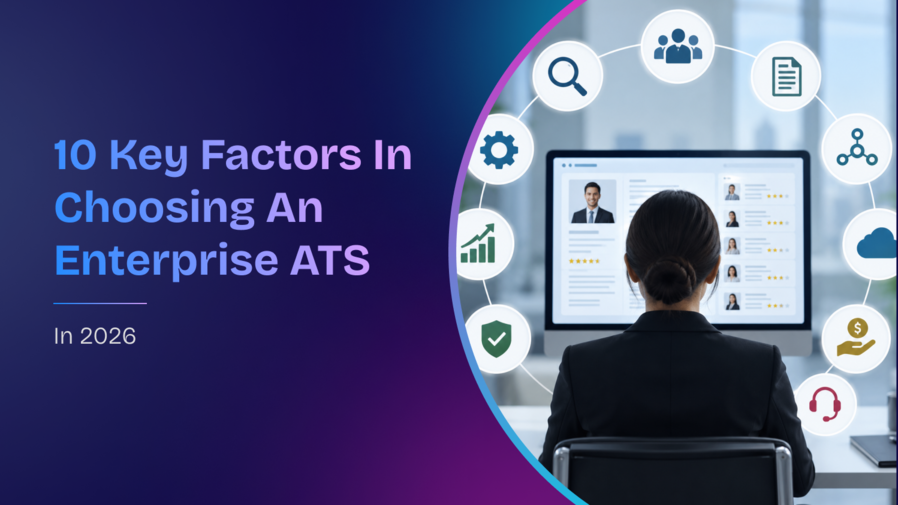


Table of content
Choosing an enterprise applicant tracking system goes far beyond comparing feature lists. For organizations hiring across multiple geographies, business units, and regulatory jurisdictions, the real test is how well the platform enforces governance, supports compliance, and handles process complexity at scale.
This article breaks down the key factors you should evaluate before committing to an enterprise ATS. Each factor directly affects your ability to hire at speed while keeping risk, fairness, and accountability front and center. RippleHire gives you a unified platform built for exactly this kind of enterprise-grade hiring.
Key Takeaways: Key Factors in Choosing an Enterprise ATS
- Governance controls like role-based access and immutable audit trails are non-negotiable for any enterprise ATS selection process.
- Multi-jurisdiction compliance readiness ensures your ATS handles GDPR, DPDP, and country-specific hiring laws without manual workarounds.
- Configurable approval workflows let you adapt the ATS to your org structure rather than forcing a rigid one-size-fits-all process.
- RippleHire delivers 100% audit readiness with immutable action logs and jurisdiction-aware compliance workflows built into the platform.
- AI transparency and structured bias monitoring protect your organization from regulatory penalties and long-term reputational damage.
What to Look for When Selecting an Enterprise Applicant Tracking System
1. Role-Based Access and Permission Governance
Your ATS must enforce who sees what. At enterprise scale, a recruiter in Mumbai and a CHRO in London need different data access. Role-based access control (RBAC) prevents unauthorized exposure of sensitive candidate information.
Look for platforms that support MFA, SSO integration via SAML 2.0, and SCIM provisioning. These ensure your security policies extend into the hiring system, not around it. Granular permissions also reduce the risk of accidental data leaks during high-volume hiring cycles.
2. Immutable Audit Trails for Every Hiring Action
Regulators and internal compliance teams need a clear record of every decision, override, and candidate interaction. An enterprise ATS should log all actions with timestamps, user identity, and documented outcomes.
Immutable audit trails mean no one can alter or delete records after the fact. This is critical for industries like BFSI, where every hiring decision faces regulatory scrutiny. When audit requests land on your desk, you need to produce a full evidence trail in minutes, not weeks of manual reconstruction.
3. Multi-Jurisdiction Compliance Readiness
If you hire across India, the EU, the Middle East, and North America, your ATS must handle different data protection regimes simultaneously. GDPR in Europe, the DPDP Act in India, CCPA in California, and pay transparency laws across multiple states all require distinct workflows.
The right platform configures consent capture, data retention, and erasure policies per jurisdiction. According to SHRM's 2025 State of Recruiting report, organizations with automated compliance workflows reduce regulatory risk incidents significantly compared to those relying on manual checks.
4. Configurable Approval Workflows and Process Controls
Enterprise hiring involves layered approvals: headcount sign-off, budget clearance, offer authorization, and background verification triggers. A rigid ATS forces you into spreadsheet workarounds. A configurable one mirrors your actual org structure and adapts as it evolves.
You should be able to set approval chains by role, geography, or hiring type without needing IT to build custom logic each time. This means your talent acquisition team stays autonomous while the platform enforces the governance rules your compliance team defined.
5. AI Transparency and Bias Monitoring
Enterprise ATS platforms increasingly use AI for screening, ranking, and interview scheduling. That creates a new governance layer. You need to verify that every AI recommendation includes explainable reasoning and that bias audits happen on a regular cadence.
Look for platforms that generate annual bias audit data automatically, support human review gates for all AI-influenced decisions, and notify candidates when AI is used. The EU AI Act and NYC Local Law 144 already mandate these controls. Falling behind on AI governance is no longer optional.
6. Integration Architecture and Data Interoperability
Your ATS does not operate in isolation. It connects to your HRMS, background verification vendors, job boards, video interview tools, and payroll systems. Poorly designed integrations create data silos that slow down hiring velocity and introduce compliance blind spots.
Evaluate how the platform handles API-based integrations with your existing stack. Bi-directional data sync, webhook support, and pre-built connectors for tools like SAP SuccessFactors, Workday, and Darwinbox should be standard. The fewer manual handoffs between systems, the fewer compliance gaps you need to close.
7. Scalability Under High-Volume Hiring Pressure
An enterprise ATS needs to perform when you open 500 requisitions in a quarter or process 10,000 applications in a single week. Scalability is not just about server capacity. It covers workflow automation, bulk candidate actions, and the ability to run parallel hiring campaigns across multiple business units simultaneously.
RippleHire has processed over 86 million candidate applications across 50+ countries. That kind of proven scale matters when your hiring volumes spike during campus drives, seasonal ramps, or large-scale post-acquisition talent integrations.
8. Candidate Experience as a Governance Metric
Candidate experience is not just an employer branding metric. It signals process quality and governance maturity. A poor experience often reflects broken workflows, missing communications, or manual steps that should have been automated long ago.
Your ATS should track candidate experience scores and feed them back into your governance reporting. Automated engagement keeps candidates informed at every stage, which directly reduces dropout rates and protects your offer-to-joining ratios. Treating candidate experience as a measured KPI keeps your entire hiring funnel accountable.
9. Fraud Detection and Credential Verification
Recruitment fraud, including impersonation, fake credentials, and proxy interviews, is a growing risk for enterprises hiring at volume. Your ATS should include built-in verification checkpoints rather than relying on external tools bolted on as an afterthought.
Document validation agents that check credentials the moment they are submitted give your interview panels confidence in the candidates they are evaluating. This is especially important for regulated industries where a single fraudulent hire carries outsized compliance and reputational risk.
10. Decision Intelligence and Real-Time Reporting
Governance depends on visibility. If your TA leaders cannot see pipeline health, recruiter productivity, or bottleneck stages in real time, governance becomes reactive instead of proactive. You end up fixing problems after they have already caused delays or compliance exposure.
Your ATS should offer real-time dashboards that surface hiring metrics at every level, from individual recruiter throughput to business-unit-level compliance status. Data-driven decisions backed by evidence move faster and face less pushback during leadership and stakeholder reviews.
Why RippleHire Is the Best Enterprise ATS for Governance-First Hiring
Selecting the right enterprise ATS is ultimately about trust. You need to trust that the platform enforces your governance policies, adapts to your compliance requirements, and scales alongside your hiring ambitions.
RippleHire is built for this. With ISO 27001 and SOC 2 Type II certifications, immutable audit trails, jurisdiction-aware compliance workflows, and AI agents that keep a human in the loop, RippleHire gives enterprise talent acquisition teams the control they need. Trusted by enterprises across 50+ countries and recognized with 31 Brandon Hall HCM Excellence Awards, RippleHire turns governance into a competitive advantage.
Ready to see how it works with your own hiring scenarios? Book a walkthrough with your team today.
FAQs about Key Factors in Choosing an Enterprise ATS
What makes an ATS enterprise-grade?
An enterprise-grade ATS handles multi-geography hiring, role-based permissions, regulatory compliance, and high-volume workflows. It integrates with your HRMS and identity systems while maintaining complete audit readiness.
How does governance differ from basic ATS compliance?
Compliance means meeting minimum legal requirements. Governance goes further by enforcing structured approval chains, access controls, and decision audit trails. RippleHire builds governance into every workflow by default.
Why is AI transparency important in an enterprise ATS?
AI transparency ensures every automated screening or ranking decision includes explainable logic. This protects your organization from bias-related penalties under the EU AI Act and similar regulations.
Can a single ATS handle compliance across different countries?
Yes, if the platform supports jurisdiction-aware configurations. RippleHire offers configurable consent flows, retention policies, and erasure workflows for GDPR, DPDP, CCPA, and country-specific hiring laws.
What role do audit trails play in enterprise recruitment?
Audit trails record every action taken on candidate records, including who accessed data, what decisions were made, and when overrides occurred. They are essential for regulatory audits and internal investigations.
How do you measure whether your ATS governance is working?
Track metrics like compliance incident rates, audit preparation time, candidate experience scores, and offer-to-joining ratios. RippleHire surfaces these through real-time dashboards accessible to every stakeholder.