
.svg) Product
Product

.png)




Table of content
You spend weeks searching for the right candidate for a high-stakes role. The profile looks strong, the initial screening goes well, and then suddenly the candidate gets rejected because the interviewer felt their vibe was off. Meanwhile, you are exhausted from restarting the search for the third time this quarter.
The problem usually is not your recruitment strategy. The breakdown happens inside the interview room.
When interviewers walk in unprepared, rely too heavily on gut feeling, or evaluate candidates inconsistently, they damage hiring outcomes. In BFSI, that cost adds up fast. Frontline attrition rates are already rising, while many specialized BFSI roles stay open far longer than hiring teams would like, and every delayed decision puts more pressure on recruiters, hiring managers, and already-stretched teams
At the same time, candidates are becoming harder to assess on paper. AI tools can polish resumes, improve interview answers, and make applicants appear equally qualified. Which means interviews are no longer just another stage in the process. They have become the most important decision point in hiring, and often the biggest hiring risk.
This blog unpacks how untrained interviewers weaken hiring outcomes and what organizations can do to fix it.
Why interview quality matters more than ever
Why interview quality matters more than ever
Hiring teams today are not struggling with a lack of candidates. They are struggling with signal clarity.
Applications are flooding in faster than ever, but it has become harder to separate genuinely capable candidates from well-prepared ones. Resumes look perfect. Interview answers sound rehearsed. In many cases, candidates know exactly how to optimize for the hiring process without necessarily being the right fit for the role.
That shifts enormous responsibility onto the interview itself.
In BFSI, interviews are rarely about checking one skill in isolation. A candidate may need to demonstrate regulatory awareness (RBI, SEBI, or IRDAI guidelines depending on the function), customer judgement, communication ability, risk sensitivity, and role-specific expertise within the same conversation.
The evaluation becomes even more difficult when interviewers are balancing hiring responsibilities alongside their targets and work pressure.
As hiring complexity increases, inconsistent interviewing becomes a much bigger operational risk. One interviewer making subjective or poorly informed decisions can weaken months of sourcing effort and directly affect quality of hire, hiring speed, and business performance
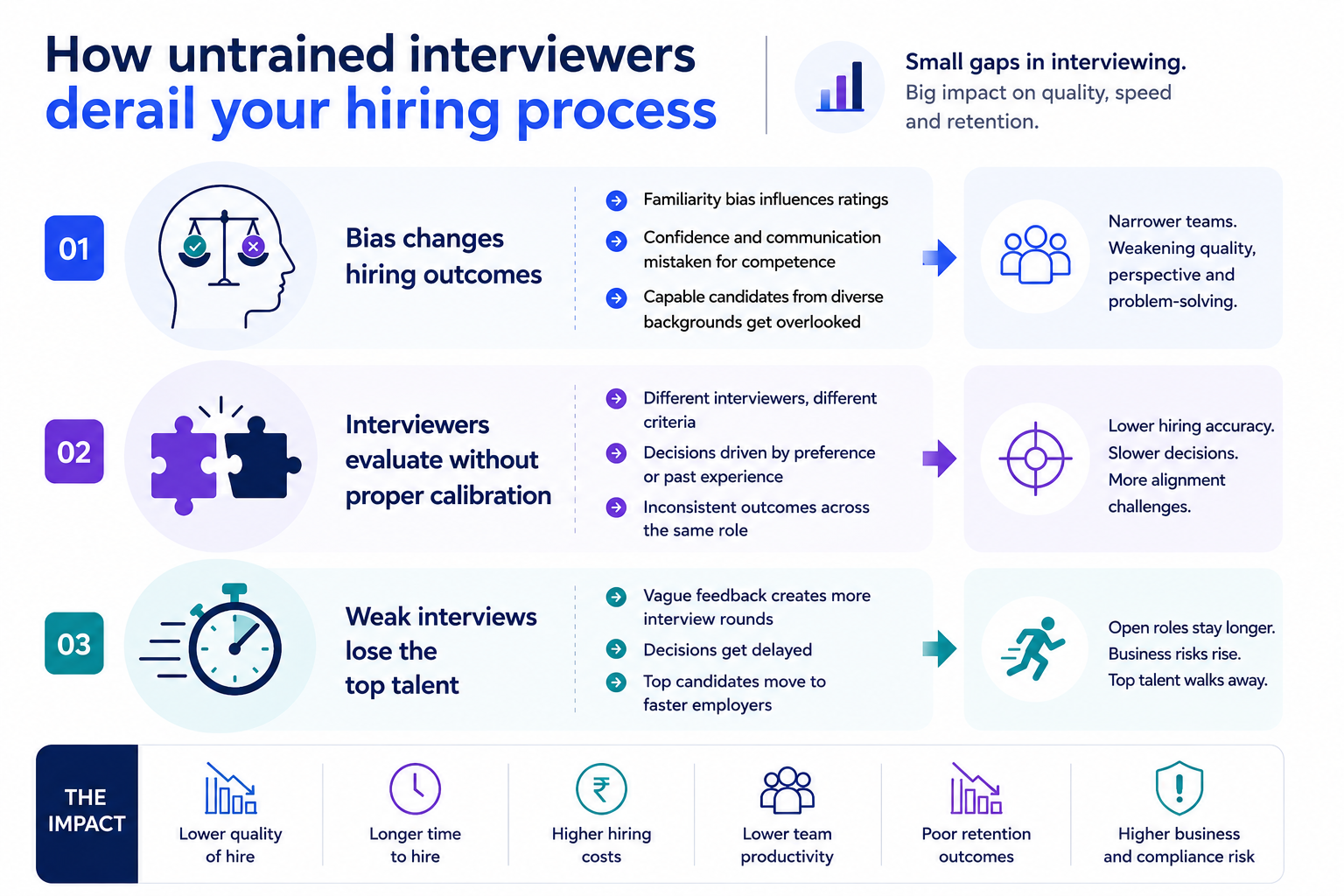
How untrained interviewers derail hiring process
Interviewing problems rarely fail loudly. The damage builds gradually across hiring cycles until quality, speed, and retention all start slipping together.
Bias changes hiring outcomes
Every interviewer brings unconscious hiring bias into the evaluation process.
Some naturally favor candidates from familiar colleges or companies. Others mistake confidence for competence. Strong communicators often get rated higher even when their actual readiness for the role is weaker.
In BFSI, that becomes a serious hiring risk because high-performing employees do not always come from conventional backgrounds. Many succeed because of discipline, adaptability, customer judgement, and decision-making under pressure.
Professional services firms face a similar challenge. Client-facing roles demand structured thinking, problem-solving ability, and stakeholder management. Yet interviewers often reward presentation style more heavily than analytical depth.
As instinct starts replacing structured evaluation, capable candidates get filtered out for the wrong reasons. Over time, hiring quality weakens and teams become narrower in perspective, experience, and problem-solving ability.
Interviewers often evaluate roles without proper calibration
Strong performers do not automatically become strong interviewers.
A senior technology leader may know how to assess engineering capability but struggle to evaluate customer judgement, regulatory awareness, or risk sensitivity for a fintech operations role. Similarly, experienced consultants often assess junior candidates against years of personal industry experience instead of the actual requirements of the role.
The problem gets worse when interviewers lack structured evaluation criteria.
One interviewer focuses only on technical depth. Another prioritizes communication style. A third evaluates based on personal preference or past experience. The result is inconsistent hiring decisions where candidates succeed or fail depending on the panel they meet rather than their actual suitability for the role.
This weakens hiring accuracy, slows decision-making, and creates constant alignment challenges for recruiters.
Weak interviews lose the top talent
Poor interviews create operational friction across the entire recruitment process.
Feedback often comes back vague or unusable:
“Needs better communication”
“Not confident enough”
“Doesn’t feel like the right fit”
Recruiters cannot move forward confidently with subjective feedback, so additional rounds get added to compensate for weak evaluation. Stakeholders ask for more opinions. Decision-making slows down.
Poor role fit surfaces fast. Frontline hires made without structured, scenario-based evaluation are disproportionately likely to exit within the first 90 days, compounding the attrition pressure RBI has already flagged across the sector.
In BFSI, those delays have direct business consequences. An open compliance role can increase operational risk exposure. Delayed hiring in wealth management can affect acquisition targets. Understaffed consulting teams can slow client onboarding and project execution timelines.
Meanwhile, strong candidates rarely wait indefinitely. Long interview cycles often signal internal inefficiency, pushing top talent toward faster-moving competitors.
The real cost of weak interviewing
Poor interviewing does not just create bad hires. It creates repeat work, longer vacancies, slower ramp-up, and higher replacement costs.
The real cost of weak interviewing
In BFSI, the pressure is already visible. RBI’s 2023-24 banking report noted that private sector bank attrition had risen to around 25%, and warned that high turnover creates operational risk, customer service disruption, loss of institutional knowledge, and increased recruitment costs.
Consider a BFSI company hiring 500 mid-level employees annually. If just 15% of those hires turn out to be poor fits because of inconsistent evaluation standards, that results in 75 problematic hires each year.
Now factor in the associated costs:
- Recruiter sourcing and coordination time
- Interview panel bandwidth
- Training and onboarding investment
- Productivity ramp-up delays
- Replacement hiring costs
- Team management overhead
- Customer and operational impact
According to SHRM workforce studies, the average cost per hire has already risen to around $4,700 globally, and this can rise further for senior and technical roles. Research also shows that internal costs such as interviewer time, hiring manager involvement, onboarding effort, and productivity loss can increase the true hiring cost by 2-3 times beyond the visible recruitment expense.
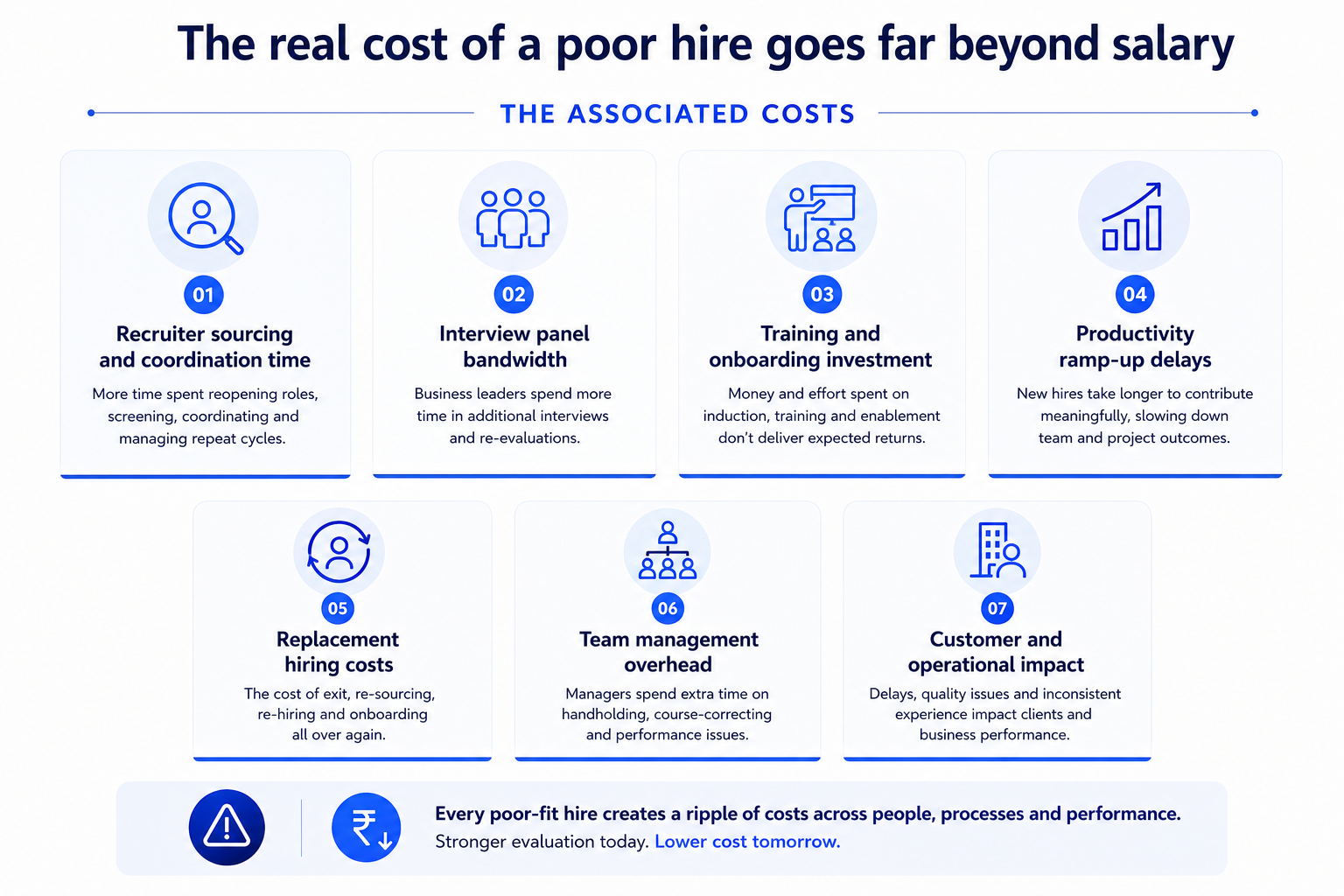
And the hiring cost is only part of the problem. Weak interviews also lead to candidate drop-offs, employer brand damage, delayed business delivery, recruiter burnout, and operational risk from poor role fit.
How BFSI hiring teams can improve interview quality
Standardize what good evaluation actually looks like
Interviewers walk into conversations with different definitions of what ‘good’ means. That creates inconsistent hiring decisions across panels.
Businesses need clear competency frameworks tied directly to each open role. Every interviewer should know what skills, behaviors, and business capabilities they are expected to assess before the interview begins. Structured scorecards and role-specific evaluation criteria make hiring decisions far more reliable.
| Competency | What Weak Evaluation Looks Like | What Structured Evaluation Looks Like |
|---|---|---|
| Regulatory awareness | Assumed from resume, rarely probed | Scored against role-specific compliance scenarios |
| Customer judgment | Rated on confidence and delivery | Scored against realistic client scenarios |
| Risk sensitivity | Left to interviewer instinct | Scored against defined risk-response criteria |
Train interviewers like you train customer-facing teams
Interviewing is a business-critical skill, not an informal responsibility.
BFSI firms regularly train employees on compliance, risk handling, customer communication, and operational processes. Interviewing requires the same discipline. Interviewers should be trained on structured questioning, bias awareness, role alignment, and evaluation consistency instead of relying purely on instinct or past experience.
Reduce decision fatigue with structured interview workflows
Weak interviews often happen because business leaders are juggling hiring alongside their operational targets.
Simple workflow changes can significantly improve evaluation quality. Pre-defined interview objectives, guided question banks, structured feedback formats, and faster interviewer alignment reduce confusion and make interviews more focused. Recruiters also spend less time chasing vague feedback or coordinating repeat rounds.
Support interviewers with AI assistance
The biggest problem with weak interviews is not intent. It is inconsistencies created by scale.
As hiring volumes increase, interview quality naturally starts varying across panels. Feedback becomes harder to compare, decision-making slows down, and recruiters spend extra time managing interview operations instead of improving hiring outcomes.
Businesses often try solving this by adding additional interview rounds or involving more stakeholders. That usually creates unnecessary complexity.
A stronger approach is to build structure into interviews from the start.
Role-specific scorecards, guided interview frameworks, standardized feedback collection, and clear competency alignment help interviewers evaluate candidates with greater consistency. Instead of relying entirely on memory or instinct, interviewers get clear direction on what actually matters for the role.
This is where AI becomes genuinely useful in hiring.
Not as a replacement for recruiters or interviewers, but as an operational layer that improves consistency behind the scenes. AI can surface relevant interview questions, identify missing competency coverage, summarize interviewer feedback, and reduce repetitive coordination work that slows hiring teams down.
That shift matters because recruiters should not spend most of their time chasing feedback, aligning panels, or manually coordinating interview loops. Their real value comes from judgement, stakeholder management, and candidate engagement.
Where to start:
- Replace open-ended questions ("Tell me about yourself") with role-specific scenario prompts
- Build one scorecard per role tied to the competencies that actually predict performance
- Track pass-rate variance across interviewers to catch calibration drift early
- Keep AI in a support role surfacing questions and flagging gaps, not scoring candidates
How RippleHire helps hiring teams improve interview quality
How RippleHire helps hiring teams improve interview quality
RippleHire is built around exactly that operating model where recruiters and agents work together to create a faster and more reliable hiring process.
Instead of adding more manual coordination layers, RippleHire helps hiring teams bring more structure, consistency, and visibility into the interview process without slowing recruiters down.
- AI profile recommendation engine helps recruiters identify stronger-fit candidates faster by improving candidate matching and reducing low-quality profiles entering the funnel. This helps teams spend less time filtering volume and more time engaging with genuinely relevant talent.
- Interview management workflows simplify scheduling, panel coordination, interviewer alignment, and feedback collection so hiring teams spend less time managing process delays. Recruiters get clearer visibility into interview progress, pending decisions, and bottlenecks before they start affecting hiring timelines.
- Interviewer copilot supports structured evaluations through guided interview questions, competency-based assessments, and more consistent interviewer feedback. This helps interviewers stay focused on role-relevant signals instead of relying entirely on instinct or fragmented evaluation styles.
The outcome is not just faster hiring. It is a more reliable hiring process with stronger decision-making, lower operational friction, better interviewer alignment, and more consistent candidate experiences across the funnel.
Book a demo to see how RippleHire can help your team improve interview quality and reduce hiring risk at scale.
Frequently Asked Questions
What causes inconsistent interview outcomes in BFSI hiring?
Inconsistent interview outcomes in BFSI hiring are primarily caused by unstructured evaluations rather than candidate quality. Key drivers include:
- Subjective evaluation: Relying on personal gut feel rather than role-specific competency frameworks.
- Over-indexing on soft skills: Judging candidates on communication style or panel chemistry instead of technical capability.
- Complex role requirements: Balancing regulatory awareness, risk judgment, and customer handling without standardized scoring criteria.
How can BFSI hiring teams reduce bias in interviews?
BFSI hiring teams can reduce bias by standardizing evaluation criteria before interviews begin:
- Implement structured scorecards: Map questions directly to defined job competencies instead of general impressions.
- Mandate interviewer training: Train panels on unconscious bias and structured questioning, similar to compliance and risk training.
- Calibrate interview panels: Align multi-interviewer expectations to ensure consistent scoring across candidates.
What is a structured interview scorecard and why does it matter for BFSI hiring?
A structured interview scorecard is a standardized evaluation tool listing the exact skills, behaviors, and regulatory competencies required for a role. For BFSI hiring teams, it matters because:
- Ensures consistency: Prevents hiring outcomes from depending on panel preferences.
- Multi-skill alignment: Evaluates regulatory knowledge, risk sensitivity, and customer judgment against objective benchmarks.
- Defensible hiring: Creates clear audit trails for compliance and fairness.
How does AI support interview quality without replacing recruiter judgment?
AI enhances interview quality by acting as an operational assistant behind the scenes while leaving final hiring decisions to humans. AI supports interviewers by:
- Surfacing guided questions: Suggesting relevant, competency-based questions during the interview loop.
- Identifying skill gaps: Flagging missing competency coverage across interview rounds.
- Summarizing feedback: Aggregating interviewer feedback to reduce alignment friction and decision fatigue.
What does poor interview quality actually cost a BFSI hiring team?
Poor interview quality leads to high turnover, delayed hiring, and significant operational costs:
- Direct recruitment costs: SHRM studies estimate the average cost per hire is $4,700, which increases significantly for senior BFSI roles.
- Hidden operational expenses: Productivity loss, panel time, and onboarding effort push the true cost of a bad hire to 2x–3x the visible hiring expense.
- Increased turnover risks: RBI reports note private bank attrition reaching ~25%, where poor role fit directly increases operational exposure and replacement costs.