
.svg) Product
Product

.png)




Table of content
7 Hiring Challenges in the Finance Industry and How to Solve Them in 2025
Finance hiring in 2026 faces a critical bottleneck:
The roles that need filling most urgently AI-enabled risk, compliance technology, and data analytics in banking are the hardest to recruit for. The candidates who fit them are passive, expensive, and evaluating multiple offers simultaneously.
Meanwhile, most BFSI talent acquisition teams are running a process built for a different era: reactive sourcing, manual screening, and a 14-day time-to-offer in a market where 24 hours is the new benchmark. Moving from legacy recruitment to an automated pipeline is what bridges that gap.
Here is a quick breakdown of traditional versus modern hiring methods, followed by practical ways to solve finance’s 7 primary talent challenges:
Traditional vs Modern finance recruitment
| Recruitment Bottleneck | Traditional HR Approach | AI-First Modern Strategy | Key Business Impact |
| Long Time-to-Offer | Manual multi-week panel evaluations | AI interview agents for 24/7 1st-round screens | Reduces screening loop from 14 days to under 24 hours |
| High Talent Scarcity | Posting vacancies reactively on job boards | Continuous candidate sourcing & referral networks | Creates active talent pools before roles open |
| Skill Gaps in AI/Data | Filtering strictly on resume titles/degrees | Skills-based screening & internal L&D programs | Unlocks non-traditional candidates with high learnability |
| High Early Attrition | Idealized offer pitches with vague job perks | Transparent, realistic job previews & flexible pay | Lowers 90-day candidate drop-off and turnover |
The 7 Recruitment challenges in finance and how to solve them
1. Attracting and retaining young talent
Stability, brand reputation, and compensation used to be enough to win early career talent in finance. They no longer differentiate an employer on their own.
Younger professionals are entering a workforce being reshaped by AI. They are evaluating employers on how much they will actually learn not just how established the brand is.
What works:
Show candidates specifics, not generics
What skills will they build? What tools will they use? How does internal mobility actually work? These are the questions early-career candidates are asking. A generic "career growth" line on a careers page does not answer them.
Current employees make this credible in a way a careers page cannot. A structured employee referral program turns those relationships into a repeatable pipeline rather than one-off word of mouth.
Birlasoft turned their employee referral program into the most powerful sourcing engine in IT services a direct example of what a structured referral approach produces at scale.
Use behavioral data, not just satisfaction scores
Employee activity data should not be decorative. Stay in regular contact with team members through quarterly meets to get honest experience feedback. Connect with managers to identify early signs of dissatisfaction through performance analysis before those signals become resignation letters.
2. Closing the financial services skills gap
The finance professional of 2026 increasingly needs more than traditional financial knowledge.
Depending on the role, TA teams are now screening for AI fluency, data analytics, cybersecurity awareness, or automation literacy alongside core finance skills. Exact-match candidates for that combination are rare.
Waiting indefinitely for someone who already checks every box is not a sourcing strategy. It is a vacancy that stays open.
What works:
Hire for skills, not job titles
Separate requirements into must-have skills, trainable skills, and preferred extras. This surfaces transferable talent someone with strong financial judgment who can be trained into an AI-enabled risk role, for example instead of filtering them out because their title does not match.
Pair skills-based hiring with L&D investment
Attracting candidates is one side. Keeping existing teams current as compliance and reporting standards shift is the other. A standing learning and development program does both simultaneously.
Build pipelines through employee referrals
Leverage the networks of existing employees to build a candidate lineup before roles open. Employee referral programs consistently surface qualified candidates who are not actively applying to job postings which is where most of the finance talent pool sits.
3. Managing attrition and burnout
Finance roles carry regulatory deadlines, transaction volumes, and seasonal close pressure that other industries do not.
When that pressure combines with unclear expectations or weak management, attrition accelerates. Recruiters end up filling the same seat twice in one year.
What works:
Set accurate expectations before the offer
Give candidates a realistic picture of workload, peak periods, and expectations during the hiring process itself not an idealized version of the role.
This reduces early attrition more than optimizing purely for offer acceptance. A hire who knew what they were joining stays longer than one who did not.
Review early attrition data by source
Analyzing early exits by hiring manager, sourcing channel, and team often reveals that the real problem is not sourcing. It is onboarding, or management, or a specific team environment. The fix is different for each.
Invest in manager capability
Burnout accelerates under unclear expectations and unreliable management. Including management development in L&D modules directly reduces the attrition recruiters end up absorbing.
4. Long, multi-round hiring processes
Financial roles justifiably need rigorous screening given the compliance and risk exposure involved.
But rigor and speed are not opposites.
Candidates in a scarce-talent market rarely wait through a slow process for a company whose reputation alone was supposed to close the deal. Legacy banks average 14 days to reach an offer for frontline sales roles. Digital-first competitors do it in under 24 hours. That gap is where candidates go elsewhere.
What works:
Move first-round screening off the recruiter's calendar
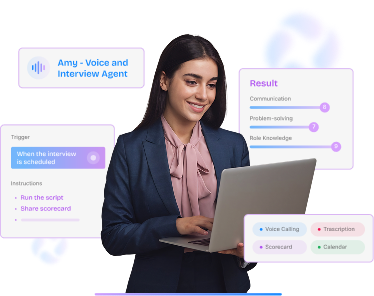
Amy, RippleHire's AI interview agent, runs structured first-round conversations around the clock. Hiring managers see a qualified shortlist instead of a raw applicant queue. Days-open compress without cutting corners on evaluation depth.
Make every stage visible
Deploying dedicated interview management software keeps every stage visible so no candidate stalls in a scheduling bottleneck.
Identify the actual bottleneck
Most slow processes have one or two stages that account for most of the delay usually panel scheduling or hiring manager feedback turnaround. Fixing those two stages compresses the overall timeline more than optimizing every stage equally.
5. Matching candidate pay expectations
Finance employers are no longer just competing with other banks for specialized talent.
A data scientist or cybersecurity specialist evaluating a finance role has options in technology, consulting, and fintech all of which may be bidding for the same profile with more flexible packages.
What works:
Restructure pay around fixed and variable components
Break compensation into fixed and performance-linked variable components to stay competitive without permanently inflating fixed payroll. This gives candidates upside while protecting the organization's cost base.
Discuss budget ranges early
Before several interview rounds have passed, surface the approved range. Both sides save time when a role's budget is out of step with what the market is paying for a scarce skill.
Shift from perks to relevant benefits
With distributed teams now standard across financial services, perks tied to physical office presence do not convert. Internet allowances, parental leave, learning budgets, and healthcare coverage address what candidates are actually evaluating.
6. Finding experienced and specialized Talent
Demand for senior finance professionals has stayed resilient even as entry-level hiring contracts.
The profile TA teams are chasing hardest experienced, specialized, and often passive is also the hardest one to reach through job postings alone.
What works:
Source before the vacancy opens
Maintain an active talent pipeline so you are not starting from scratch when a role opens. A dedicated talent sourcing motion keeps a warm pool of past applicants, referrals, and passive candidates active between hiring cycles.
Stay active on professional channels between campaigns
Posting regularly on LinkedIn and engaging with finance communities builds brand recognition with passive candidates before they are actively looking. According to LinkedIn, 40% of passive candidates would accept a new position without an increase in pay if the company had a strong employer brand. When they are ready to move, the organization is already familiar.
Re-engage strong past applicants
Candidates who were not selected for a previous role are a high-quality pool. They already expressed interest, already went through some evaluation, and already know something about the organization. A structured re-engagement approach converts them at higher rates than cold outreach to new candidates.
7. Delivering a strong candidate experience
A confusing application, repeated document requests, or a delayed offer does not just cost one hire.
It shapes how that candidate and their network talks about the employer afterward. That compounds the other six challenges.
In finance, where candidate pools are narrow and reputation travels fast, poor candidate experience has an outsized cost.
The breakdown rarely happens all at once. It accumulates stage by stage.
| Hiring Stage | What Candidates Experience Today | What They Should Experience | Where Most Organizations Fall Short |
|---|---|---|---|
| Application | Generic form, no confirmation | Instant acknowledgment, timeline given | 65% of candidates never receive an update |
| Screening | Wait 5 to 14 days for contact | AI-screened shortlist contacted within 24 hours | Manual screening creates avoidable lag |
| Interview | Unstructured, different criteria per interviewer | Structured, consistent, feedback provided | Most panels have no shared evaluation criteria |
| Offer | Takes 3 to 5 days after final round | Same-day or next-day verbal, written within 48 hours | Approval workflows add days without adding value |
| Post-offer | Silence until start date | Structured pre-boarding engagement | 60 to 90 day notice periods create dropout risk |
What works:
Automate the parts candidates feel most
Status updates, scheduling confirmations, and follow-up communication are the touchpoints candidates notice most. Automating these removes the manual bottlenecks that cause silent drop-off.
RippleHire's multi channel communication keeps candidates informed at every stage across WhatsApp, SMS, or email on the channel they actually use instead of leaving them waiting for a reply.
Close the feedback loop with every candidate
Sending feedback from every candidate, selected or not, shows recruiters exactly where the funnel is losing people.
According to the 2024 Greenhouse Candidate Experience Report, 79% of candidates would reapply to a company if they received feedback after a rejection.
It also leaves rejected candidates with a better impression of the organization than a template rejection and silence.
The bottom line
Modern finance recruitment requires doing more with less closing complex skill gaps rapidly without inflating budgets.However, hard work alone can't overcome legacy bottlenecks like manual screening and disconnected tools.
RippleHire bridges this gap by unifying recruiter expertise with AI agents. By automating routine screening, scheduling, and pipeline management, your team can focus on high-value candidate relationships while meeting stringent speed and compliance standards.
What that looks like in practice
Rajeev Menon, Executive Vice President at LTIMindtree:
"RippleHire delivers powerful features with an intuitive experience, digitizing every stage of our hiring funnel. It has enabled us to make data-driven decisions and manage the candidate journey seamlessly."
RippleHire has processed more than 86 million candidate applications across 50 countries.
Book a demo to see how RippleHire compresses time-to-fill and modernizes your finance hiring pipeline.
FAQs
What are the biggest recruitment challenges in the finance industry?
The seven major challenges are skills shortages, attracting younger talent, employee attrition, lengthy hiring processes, salary expectations, finding experienced professionals and delivering a strong candidate experience. AI and digital transformation are making several of these challenges more pronounced.
How is AI changing recruitment in financial services?
AI is changing both recruitment processes and the jobs being recruited for. Automation is reducing demand for some repetitive tasks while increasing demand for technology, data and analytical capabilities.
How can BFSI companies overcome the finance skills shortage?
Companies can combine skills-based hiring, reskilling, internal mobility, employee referrals, proactive sourcing and talent communities. Instead of waiting for candidates who meet every requirement, recruiters should identify transferable skills and learning potential.
How can financial institutions reduce time-to-hire?
Organizations should identify bottlenecks across sourcing, screening, interviews, approvals and offers. Automating scheduling, communication and repetitive administrative work can reduce delays, while structured interviews and clear hiring-manager SLAs can speed up decisions.
Why are employee referrals important for financial services recruitment?
Employee referrals provide access to trusted professional networks and can help organizations reach qualified candidates who are not actively applying to jobs. A structured referral program also gives recruiters a measurable way to track referral activity and hiring outcomes.