Product






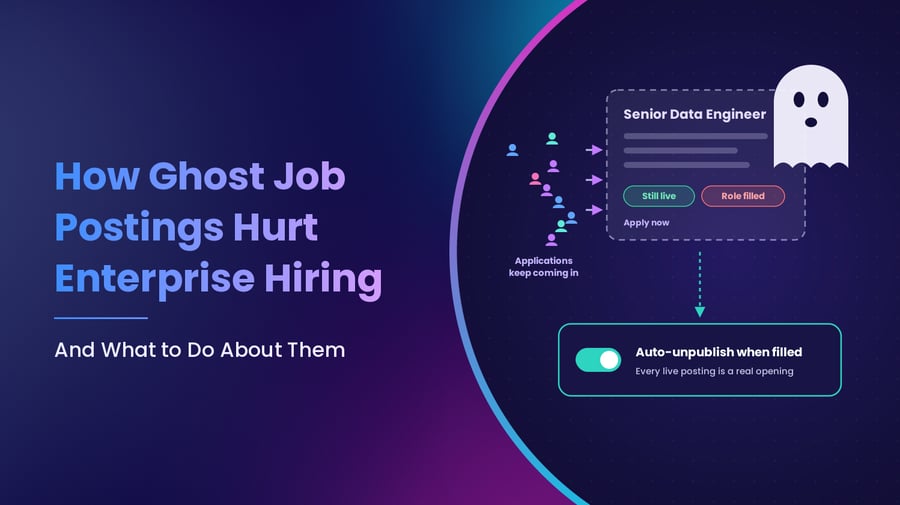


Table of content
Your ATS shows 300 open requisitions. Some are actively recruiting. Some were filled two weeks ago through an internal transfer. A few were frozen by Finance last month, and their postings are still collecting applications on three job boards.
This is how most ghost jobs appear in enterprise hiring. Positions get filled, budgets change, hiring freezes happen and requisitions get revised. The original posting stays active because the change never reaches the system or channel where candidates are applying.
Job seekers have noticed. In a 2025 Clarify Capital survey, three in four job seekers surveyed said they suspected companies of posting ghost jobs, and 97% wanted employers to disclose when a posting was for future hiring or pipeline building.
For enterprise talent acquisition (TA) teams managing hundreds of open requisitions, keeping job postings accurate is now a core operational responsibility. This article explains why stale requisitions happen, what they cost enterprises, and how automated requisition hygiene can prevent them.
What are ghost jobs, and why are regulators paying attention?
Ghost jobs are job advertisements for positions that don’t exist or that an employer has no immediate intention of filling. They include postings created deliberately to collect resumes, along with legitimate vacancies that went inactive while the advertisement stayed up.
A 2025 report from the US Congressional Research Service identified both intentional and accidental causes, including changed hiring circumstances and third-party websites that keep displaying removed vacancies. For enterprise TA teams, the accidental category deserves the most attention, because it grows out of ordinary recruitment workflows.
How genuine job postings become ghost jobs
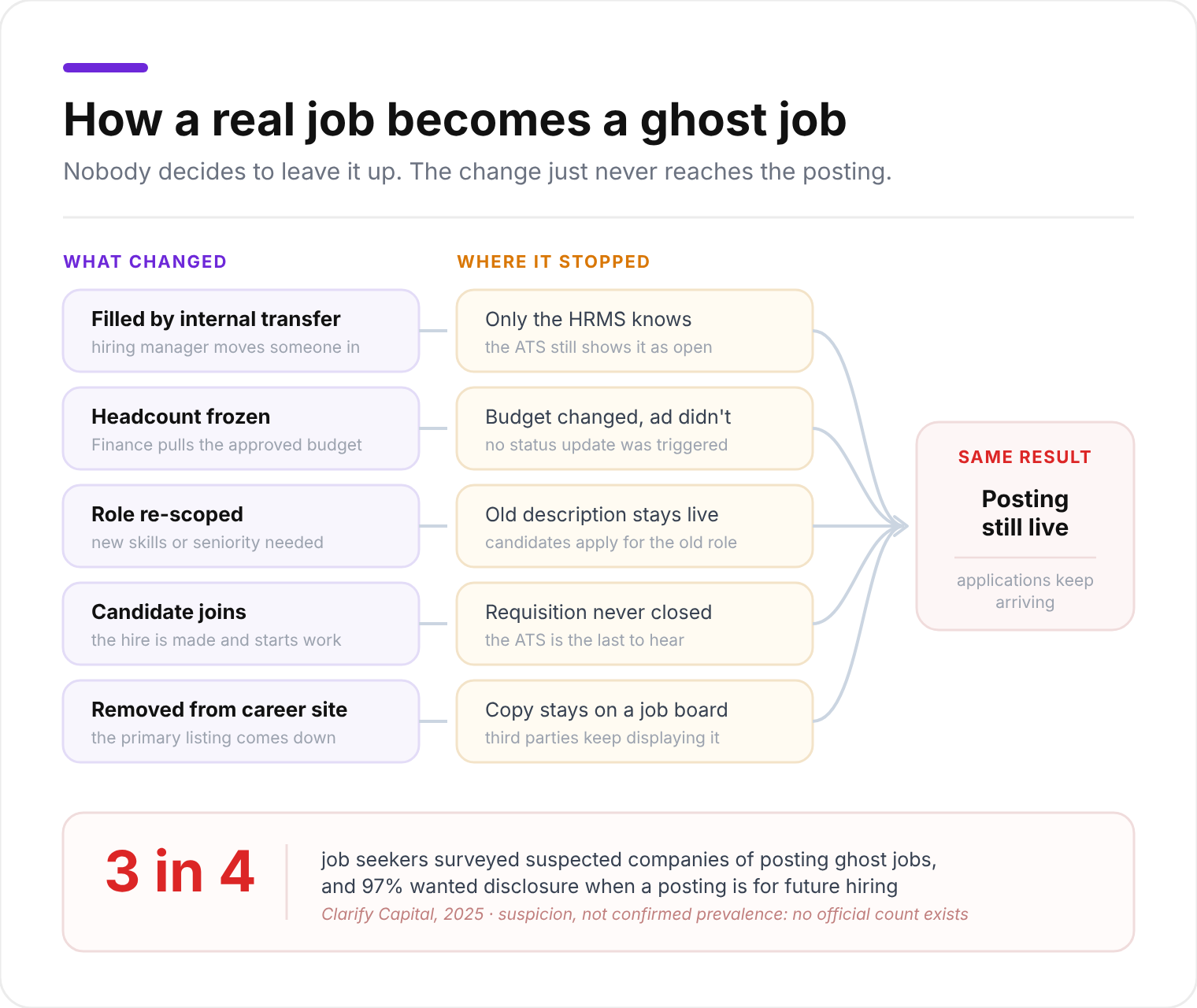
A legitimate opening can change in several ways during recruitment:
- A hiring manager fills the position through an internal transfer.
- Finance freezes the approved headcount after recruitment begins.
- A business unit changes the skills or seniority required for the role.
- A candidate joins, but the requisition stays open in the ATS.
- The job is removed from the career site but stays visible on an external job board.
In each case, the posting can keep attracting applicants after the original hiring requirement has changed.
The Congressional Research Service also notes that there are no official statistics on how common ghost jobs are. That makes it important to separate suspected ghost postings from confirmed cases of employers advertising positions without genuine hiring intent.
Ontario’s 2026 rules make vacancy disclosure a compliance issue
Regulators have started addressing the accuracy and transparency of job advertisements. On January 1, 2026, Ontario introduced new requirements under its Employment Standards Act for publicly advertised job postings. Employers with at least 25 employees must generally state whether a publicly advertised position is for an existing vacancy.
Covered employers must also:
- Disclose expected compensation or compensation ranges, subject to applicable exceptions.
- Disclose the use of AI to screen, assess or select applicants.
- Tell interviewed applicants whether a hiring decision has been made within 45 days of their last interview.
- Keep copies of publicly advertised postings and associated application forms for three years after public access is removed.
Employers can still advertise future roles, as long as the posting says so. The rules focus on transparency about whether an existing vacancy is available. They also exclude general recruitment campaigns, internal-only postings and work performed outside Ontario. You can review the details in the Ontario government’s official guidance.
For enterprises hiring across countries, this raises an operational question: can your recruitment system keep vacancy information accurate and apply the right posting rules in each jurisdiction?
The hidden costs of ghost jobs in enterprise hiring
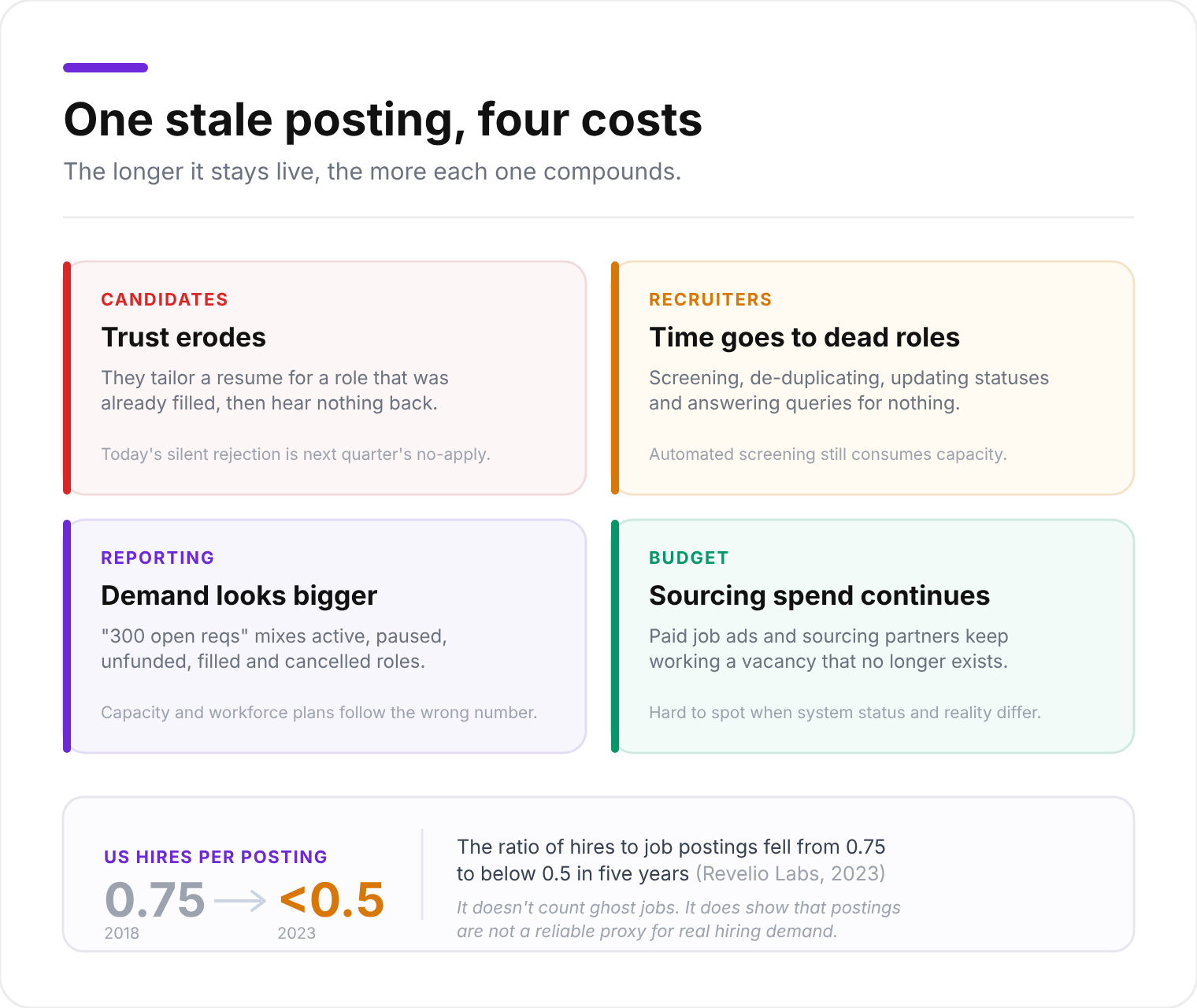
An outdated posting can look like a small administrative issue. Its effects add up across recruitment teams, sourcing budgets and workforce planning, and the higher your hiring volume, the more they compound.
1. Your future talent pool shrinks
Candidates have little visibility into why a hiring process stops. They see a vacancy, apply and wait. If the position was already filled or frozen, that application had little chance of leading anywhere, and repeated experiences like this make people less willing to engage with your company again.
That matters for enterprises that regularly hire similar talent across locations and business units. Someone who applies unsuccessfully today may be a strong candidate for another role six months later. Accurate postings and timely status updates when a role closes, changes or stalls keep that relationship intact for your recruiters.
2. Recruiters spend time on applications they cannot use
Every stale posting creates extra work. New applications keep entering the ATS. Recruiters may review resumes, identify duplicates, update statuses and answer queries about positions that are no longer available.
Even with automated screening, these applications use up processing capacity and complicate pipeline management. The burden grows when several postings stay active across departments or channels. Recruiter burnout research points to shifting priorities and repeated coordination work as major sources of pressure on TA teams, and stale requisitions add to both.
3. Recruitment reports overstate actual demand
One of the less obvious costs of ghost jobs is unreliable hiring data. Those 300 open requisitions in your ATS may include:
- Positions that are actively recruiting
- Roles awaiting renewed budget approval
- Vacancies that hiring managers have paused
- Positions already filled outside the ATS
- Requisitions that need to be canceled or redesigned
When these statuses aren’t maintained, TA leadership can’t easily tell how much hiring demand is real. Recruiter capacity gets allocated to inactive roles, workforce plans show vacancies that are no longer funded, and hiring dashboards count requisitions that should no longer be included.
Market data shows why posting volume needs careful reading. Revelio Labs found that the US ratio of hires to job postings fell from 0.75 in 2018 to below 0.5 in 2023. Roles can stay unfilled for legitimate reasons, and postings don’t always map to individual vacancies, so the figure can’t tell us how many postings were ghost jobs. It does show why enterprises should track actual hiring activity alongside advertised vacancy counts.
4. Paid sourcing continues after hiring stops
A stale requisition can also create avoidable sourcing costs. If a role stays live in paid job distribution campaigns, recruitment marketing budgets keep funding a vacancy that no longer needs candidates. The same happens when sourcing partners keep working against outdated requisitions.
Finance and TA teams may struggle to spot this spending when a job’s real status differs from its status in recruitment systems. Accurate requisition closure keeps sourcing activity tied to approved hiring demand.
Why stale job requisitions happen in large enterprises
Ghost job postings usually start in the gaps between the people who approve hiring, the people who run it and the systems that publish vacancies. These are process problems, and clearer rules and better system coordination can fix them.
1. Hiring approvals change after the posting goes live
Recruitment usually starts with an approved position and budget. Business priorities can shift while the role is open: a hiring manager is told to pause, or Finance asks for additional authorization. If the ATS never receives that status change, the posting stays active.
The requisition approval workflow should cover changes during recruitment as well as the initial approval. For example, moving a requisition to "On hold" should trigger a review of its job posting. Rule-based approval workflows help enterprises coordinate these approvals and keep eligible hiring requests moving.
2. Positions get filled without triggering job closure
A role may be filled through internal mobility or a hiring process run outside the original recruitment workflow. The HRMS may show the new assignment while the ATS still treats the requisition as open. If the systems don’t exchange status updates, recruiters keep receiving applications.
Job closure should connect to an authoritative hiring event. Once the approved hiring target is met and the organization confirms the positions are filled, the system should check whether the public posting needs to come down. The exact trigger should follow company policy, especially where offers may be withdrawn or additional positions remain open.
3. A single role appears across multiple recruitment channels
Enterprise vacancies rarely stay on one career page. They may appear on:
- Company career sites
- External job boards
- Internal mobility platforms
- Recruitment partner websites
Publishing across channels increases reach, and it also multiplies the places where outdated information can linger. Copies held by third parties often stay live after a posting is removed from the ATS or career site. Organizations need a record of where each vacancy was published, which channels support automatic unpublishing, and where manual follow-up is required. A structured job distribution workflow helps manage publishing sequences and channel-specific rules.
How to prevent ghost jobs with better requisition hygiene
Preventing ghost jobs takes a reliable way to keep recruitment records aligned with current hiring decisions. The goal is to make requisition closure a standard part of the hiring process, so recruiters can stop relying on reminders and manual tracking.
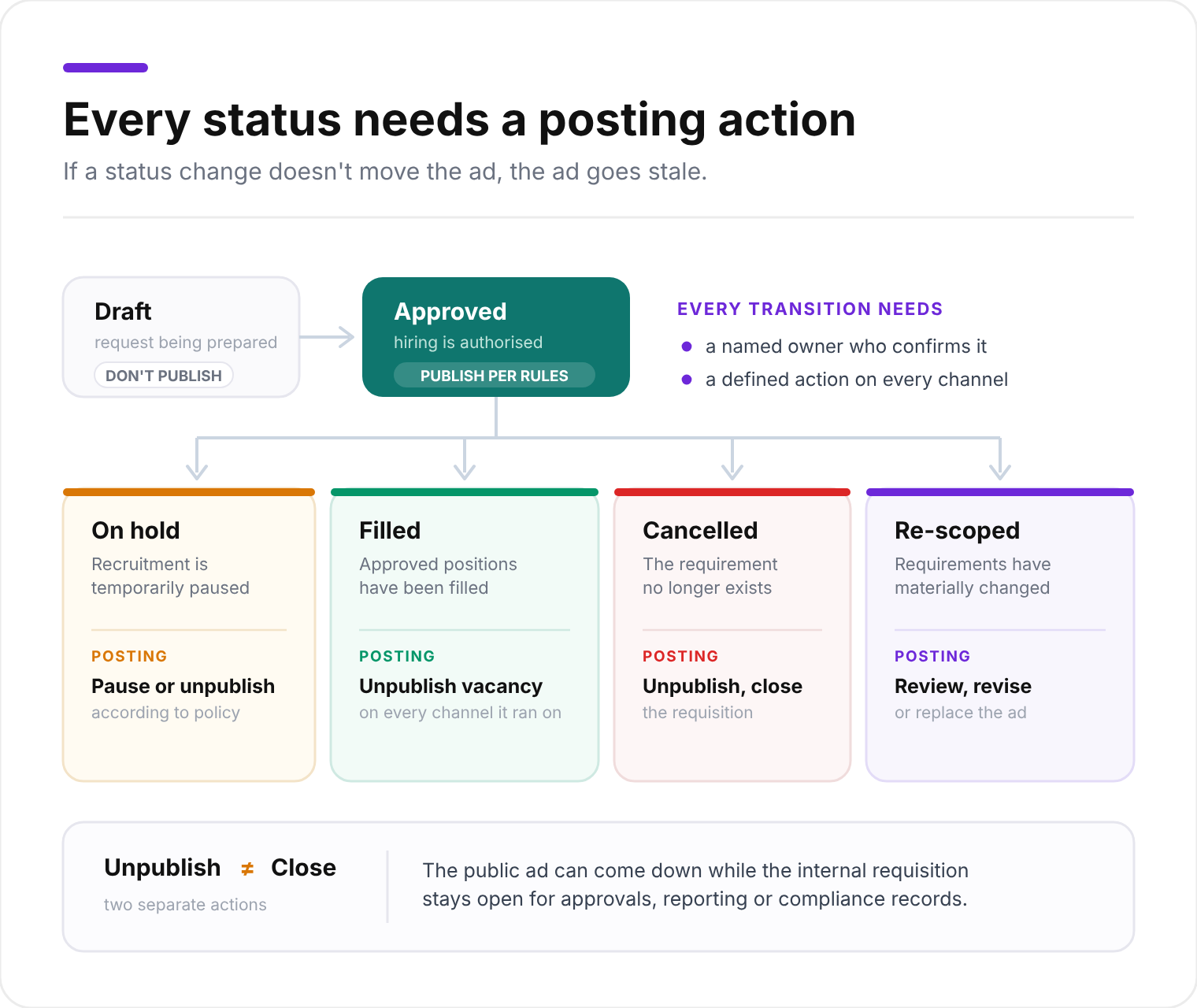
1. Define clear requisition lifecycle rules
Start by defining every status a requisition can hold.
| Requisition status | Meaning | Posting action |
|---|---|---|
| Draft | Hiring request is being prepared | Do not publish |
| Approved | Hiring is authorized | Publish according to sourcing rules |
| On hold | Recruitment is temporarily paused | Pause or unpublish according to policy |
| Filled | Approved positions have been filled | Unpublish the associated vacancy |
| Canceled | The hiring requirement no longer exists | Unpublish and close |
| Re-scoped | Role requirements have materially changed | Review, revise or replace the posting |
Each status change should have a defined owner and a matching action. If a role moves to Filled, the process should specify who confirms the fill, which channels need updating and how existing applicants are handled.
Treat unpublishing a job advertisement and closing its requisition as two separate steps. A company may need to remove a public posting while keeping the internal requisition for approval, reporting or compliance purposes.
2. Introduce automatic expiry and re-validation
Some positions stay open for long periods because they need specialized skills. Others simply stop progressing. TA Ops can set different review thresholds by hiring type, business unit or seniority. For example:
- Standard vacancies require re-validation after 30 days without meaningful activity.
- High-volume roles are reviewed against their approved hiring targets.
- Specialized roles follow longer review periods agreed with hiring managers.
- Frozen requisitions need renewed authorization before republication.
These thresholds are illustrative, so adjust them to your recruiting process. When a posting reaches its threshold, the system should decide whether it can close automatically or needs human review. For roles that are still open, the hiring manager confirms continued demand.
3. Automate posting closure when approved conditions are met
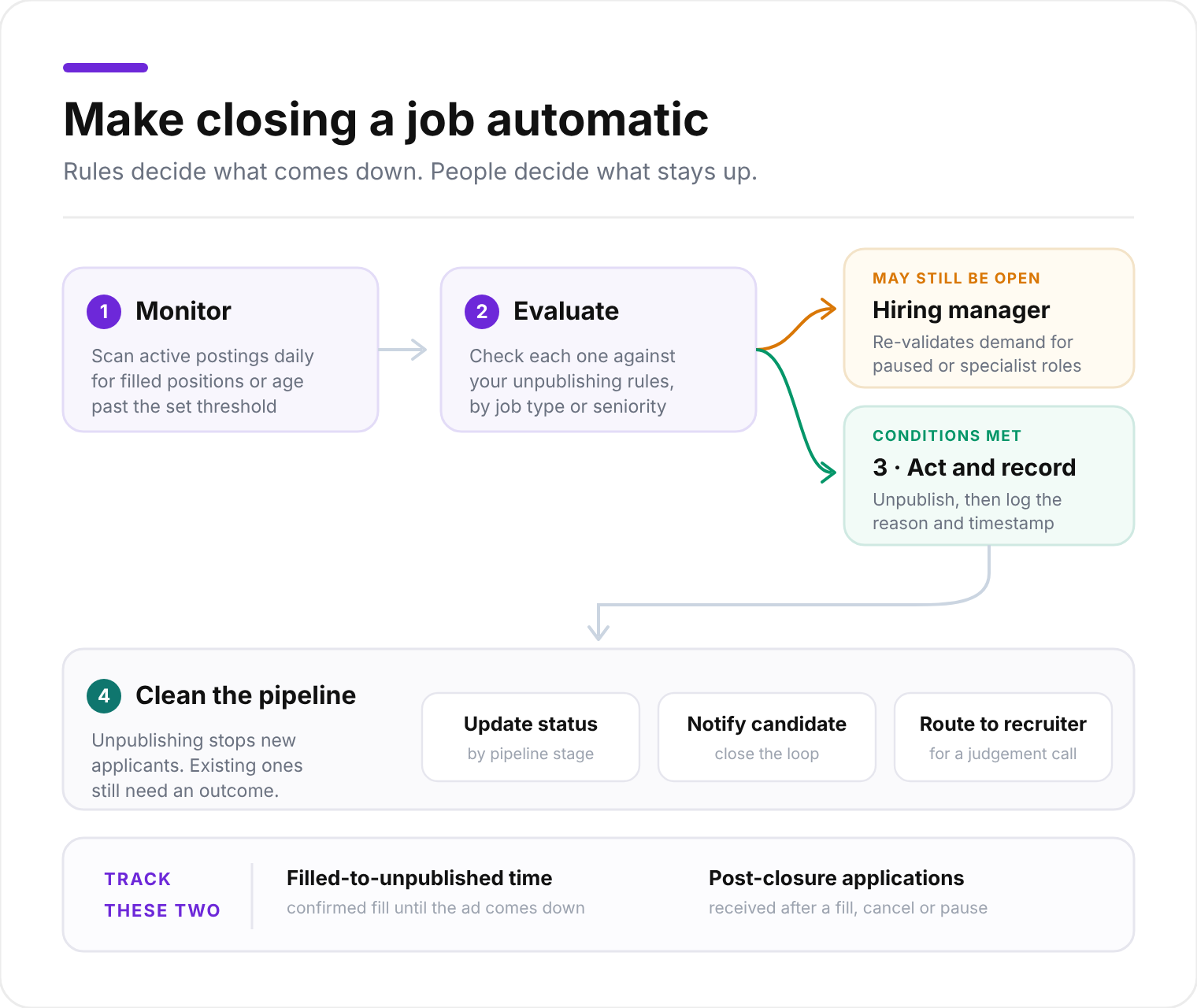
Once requisition rules are defined, enterprises can automate the repetitive checks. A job closure workflow runs in three stages:
- Monitor: Review active postings for filled positions or configured age thresholds.
- Evaluate: Identify postings that meet the organization’s unpublishing conditions.
- Act and record: Unpublish eligible postings and log the reason and time of each action.
Automation removes the need for recruiters to remember every completed vacancy. Build in safeguards for temporarily paused roles and positions that remain legitimately open, and confirm which external channels support automatic removal.
4. Clean the candidate pipeline when a requisition closes
Unpublishing stops new applications. The candidates already in the pipeline still need attention. A closed requisition may hold applicants awaiting screening decisions, interview outcomes or communication.
Pipeline hygiene workflows help TA teams find candidates who have been inactive beyond configured thresholds and take the right next step. Depending on the candidate’s stage and your rules, that could mean updating their status, notifying them of the outcome or routing their record for recruiter review. For roles posted in Ontario, this also supports the requirement to tell interviewed applicants about hiring decisions within 45 days.
How to measure job requisition hygiene
Once these controls are in place, TA Ops needs a way to check that they’re working. A requisition hygiene dashboard can track:
- Stale posting rate: The percentage of active postings past their configured age or inactivity threshold without re-validation.
- Filled-to-unpublished time: The time between confirming a position is filled and removing its posting.
- Post-closure applications: Applications received after the requirement was filled, canceled or paused.
- Unverified active requisitions: Positions still publicly advertised without current confirmation of hiring demand.
- Channel closure discrepancies: Roles removed from the career site that are still advertised elsewhere.
These metrics show where the process needs work. A high number of post-closure applications, for example, may mean external job boards aren’t receiving status changes promptly. Regular reviews also help TA leaders confirm that recruiter capacity and sourcing budgets are going to genuine vacancies.
Keep job postings accurate with RippleHire’s Zero Ghost Jobs Agent
Requisition hygiene gets harder as enterprises manage more roles, business units and channels. RippleHire is the ATS where Recruiters and Agents work together. Agents handle coordination work according to configured rules, so Recruiters can focus on closing live roles.
The Zero Ghost Jobs Agent helps TA teams stop filled and expired job postings from staying active:
- Daily monitoring: The agent reviews active jobs automatically.
- Configurable thresholds: Set posting age and filled-position conditions, with different rules by job type, department or seniority.
- Automatic unpublishing: Remove eligible postings from the career site, with the option to extend the workflow to other channels.
- Action records: Track the reason and timestamp whenever the agent unpublishes a posting.
- Candidate pipeline cleanup: Use the Pipeline Hygiene Agent to manage candidates past configured inactivity thresholds and communicate their outcomes.
The Zero Ghost Jobs Agent stops new applications to a filled or expired posting while keeping existing candidate records available for your team to manage. Recruiters stay focused on live vacancies and candidates who can still progress.
Book a demo to see how RippleHire’s Zero Ghost Jobs Agent keeps your job postings accurate and cuts manual requisition cleanup.
Frequently asked questions
What is the difference between a ghost job and a stale job requisition?
A ghost job is an advertisement for a position that doesn’t exist or that the employer doesn’t currently intend to fill. A stale requisition is an internal hiring record that hasn’t been updated to reflect the latest business decision. The two overlap when a filled or canceled requisition stays publicly advertised. An older requisition with active recruitment is simply a long-running search.
How long should an enterprise keep a job posting active?
The right period depends on the role. A high-volume operational position may need frequent reviews, while a specialized leadership role can stay open longer. TA Ops should set review thresholds based on hiring type, business requirements and recruitment activity. When a posting reaches its review date, the hiring manager confirms whether recruitment continues, and organizations can automate expiry or re-validation according to these approved rules.
How can TA teams identify ghost jobs across multiple job boards?
Keep a record of every channel where each requisition is published. Compare live advertisements against the ATS requisition status and approved hiring demand, and look for filled, canceled or paused roles that are still visible externally. Where integrations exist, automate posting updates and removal. For channels without reliable synchronization, assign an owner to verify closure, and run periodic checks for duplicated or copied advertisements.
Should companies remove job postings during a hiring freeze?
Companies should review public advertisements when hiring is frozen and decide whether the positions are still available. If recruitment has stopped indefinitely, an open posting can mislead candidates about current opportunities. For temporary freezes, the organization can unpublish the role and keep the internal requisition for later reactivation. Either way, the public posting status should be accurate, and candidates already in the process should hear what’s happening.
How do ghost jobs affect recruitment analytics and workforce planning?
Ghost jobs can make an enterprise’s active vacancy count look higher than its real hiring demand. That skews recruiter workload planning, sourcing budget allocation and hiring performance reporting. A filled requisition left open, for example, keeps adding to vacancy aging metrics. Reporting that separates approved, active, paused, filled and canceled requisitions gives leadership an accurate picture of current demand.