
.svg) Product
Product

.png)




Table of content
Talent acquisition teams invest weeks of effort and resources to secure top candidates aligning interview panels, managing multi-stage assessments, and closing complex offer negotiations, all to finally get a 'yes.'"
And then, during the 30, 60, or 90 days between offer acceptance and start date, the candidate simply stops responding.
There is no message, no explanation, just a stalled pipeline and a role that has to be restarted from scratch.
Post-offer ghosting is rarely a mystery. It is almost always the result of a predictable gap: an organization moves on to the next open requisition while the candidate sits in their notice period receiving only occasional administrative emails.
In India, where notice periods of 60 to 90 days are standard, this vulnerability window is wider than anywhere else in the world. A candidate who accepts an offer in January and starts in March has eleven weeks to receive counteroffers, reconsider their decision, or simply drift away because the new employer was not present enough to keep them engaged.
Speed still matters in recruitment, but clarity and connection matter more. Candidates expect consistent touchpoints, clear next steps, and confidence that their new organization is actively preparing for their arrival. When that experience is missing, dropouts follow.
While most talent acquisition leaders recognize this problem, few teams have the bandwidth to manually maintain high-touch relationships across dozens of open requisitions simultaneously.
This guide explores the root causes of post-offer ghosting, why traditional tactics fall short, and how agentic AI enables recruiting teams to maintain continuous, personalized engagement across every candidate's notice period without adding manual overhead.
Quick Answer: Post-offer ghosting occurs when candidates lose connection with your organization during the gap between offer acceptance and day one. Agentic AI reduces dropouts by delivering personalized touchpoints based on individual candidate risk profiles, streamlining pre-boarding coordination, and fostering early team connections before day one. Recruiting teams set the parameters and handle high-value conversations, while Agentic AI handles the continuous engagement that prevents radio silence.
What is Agentic AI in Post-Offer Engagement?
Unlike standard recruitment automation which blindly fires pre-scheduled emails on day 3 or day 10. Agentic AI acts as an autonomous coordinator. Its single goal is keeping every accepted candidate engaged, informed, and connected from offer acceptance through day one.
Instead of waiting for a recruiter to trigger each step, an agentic system continuously operates in the background:
Monitors real-time behavior: Tracks response times, email opens, and portal interactions across the notice period.
Adapts engagement dynamically: Adjusts the frequency and type of content based on how each individual candidate is responding.
Surfaces timely risk indicators: Alerts recruiters the moment a candidate shows signs of disengagement, allowing for early human intervention.
Recruiters set the guardrails and handle high-touch conversations. Agentic AI handles the continuous background coordination that no talent acquisition team has the bandwidth to manage manually at scale.
Why Post-Offer Ghosting Happens and Where Traditional Approaches Fall Short
The surface-level drivers of post-offer ghosting are well-known: counteroffers from current employers, last-minute competing offers, or general cold feet about changing roles.
However, the deeper, actionable root cause is simpler: candidates accept an offer and then feel forgotten.
Once an offer is accepted, recruiting teams naturally pivot to the next open requisition. Meanwhile, the candidate spends 30, 60, or 90 days in their notice period receiving only sporadic, administrative emails. Their current employer who is actively present makes a compelling argument to stay, while the new organization remains largely silent and gives them nothing to hold on to.
In today's market, candidate commitments fade quickly without active reinforcement. Traditional post-offer approaches fail to prevent this due to three major structural limitations:
Fixed-schedule automation lacks context
Standard automated sequences send identical emails on pre-set days regardless of whether a candidate opens them or disengages entirely. They cannot detect silence or adapt to individual behavior.
Manual follow-up fails at scale
Recruiters managing dozens of requisitions simultaneously cannot maintain frequent, personal relationships with every offered candidate. Attention naturally goes to squeaky wheels, while quietly drifting candidates slip away undetected.
Pre-boarding portals create administration, not connection
A login link and a stack of compliance forms is paperwork, not engagement. When a candidate's primary interaction with your brand feels transactional, it fails to build the emotional commitment needed to withstand a counteroffer.
Ultimately, traditional methods treat every candidate identically. They fail to track subtle engagement signals, miss early drop-out risks, and react only after a candidate has already decided to walk away.
3 Ways Agentic AI Helps Recruiting Teams Reduce Post-Offer Ghosting
3 Ways to Use Agentic AI in Post-Offer Engagement
1. Personalized Engagement Based on Individual Dropout Risk
The candidates most likely to ghost after offer acceptance usually fit specific high-risk profiles: those with long notice periods, high-demand skills, senior positions with multiple competing opportunities, or roles in markets where counteroffers are standard practice.
A junior role with a 30-day notice period in a stable industry requires a completely different engagement approach than a senior engineering hire with a 90-day notice period in a hyper-competitive market. Sending both the exact same weekly email is not an engagement strategy ,it is just inbox management.
Agentic AI evaluates specific signals to determine where each candidate sits on the dropout risk spectrum:
- Notice period length - Longer notice periods carry higher risk because the window for doubt and counteroffers is much wider.
- Seniority level - Senior candidates typically have more alternative options and receive more aggressive retention offers from their current employers.
- Market demand for their skills - Candidates in high-demand fields face active competition for their attention throughout their notice period.
- Post -acceptance communication patterns- Changes in response times, engagement with pre-boarding materials, and question frequency signal how connected the candidate feels.
- Historical cohort outcomes - Hiring patterns from past cohorts inform how to engage current candidates in comparable situations.
When a candidate's engagement signals shift such as slower response times or reduced interaction with pre-boarding materials the recruiting team is immediately flagged. The recruiter decides how to intervene, while Agentic AI surfaces the risk signal at the right moment rather than weeks after the candidate has made a decision.
A candidate who receives communication that reflects their specific situation ,their notice period length, their role, and the exact concerns raised during interviews experiences something genuinely rare in hiring at scale: they feel like the organization is paying attention.
That experience is what makes them resistant to a counteroffer. It isn't just the compensation or the title, it is the confidence that the organization they are joining knows who they are and consistently demonstrates it.
2. Pre-Boarding Coordination That Feels Structured, Not Administrative
Consider what most enterprise pre-boarding processes actually feel like from the candidate's perspective.
They accepted an offer they were excited about. Shortly after, they receive a login link, a list of documents to upload, an IT form, and a calendar invite for an orientation session three weeks away. Nothing in that experience reflects the inspiring conversations held during four rounds of interviews. Nothing makes the candidate feel like they are being welcomed into something specific. It feels like a transaction, not a relationship.
Agentic AI transforms pre-boarding from a static checklist into an adaptive journey. Rather than overwhelming candidates with administrative demands all at once, it sequences activities based on what makes sense for each individual:
Strategic task distribution: Spreads compliance and paperwork strategically across the notice period so candidates never feel overwhelmed on week one.
Gradual role-based immersion: Introduces new hires to relevant tools and systems through bite-sized, personalized tutorials tailored to their technical background.
Cross-departmental orchestration: Coordinates automatically across HR, IT, facilities, and hiring managers so equipment, access permissions, and team welcomes are ready on day one without manual chasing.
Just-in-time logistics: Delivers practical info such as parking instructions, team schedules, and first-week expectations right when the candidate actually needs it.
When a candidate requests a start-date adjustment or encounters a document delay, the system adapts the timeline automatically. The recruiting team is notified only when human intervention is required, allowing routine onboarding logistics to run smoothly in the background.
A candidate who completes pre-boarding steadily across eight weeks arrives on day one fully prepared, connected to their manager, and confident in their decision. That difference directly improves early engagement, speeds up time-to-productivity, and builds a strong employer brand from day one.
3. Early Team Connection That Builds Commitment Before Day One
Most organizations treat new hire integration as a post-arrival activity reserving team introductions, culture immersion, and project walkthroughs until after the person formally starts.
This creates an 8-to-12-week connection gap. During their notice period, candidates have no tangible link to their new organization, while their current employer and colleagues remain actively present. The new role exists only as an abstract future commitment.
Abstract commitments are easy to walk away from. Specific relationships and ongoing conversations are considerably harder to leave behind.
Agentic AI bridges this gap by creating structured, low-friction opportunities for candidates to connect with their future team before day one:
- Targeted peer connections: Identifies potential mentors or peers based on the candidate's background and arranges casual, virtual introductions.
- Role-specific culture immersion: Shares targeted team stories, ongoing projects, and company values that directly align with the candidate's expressed interests during interviews.
- Personalized context sharing: Provides future team members with relevant context beforehand so early conversations feel warm, personal, and substantive rather than perfunctory.
- Interactive learning touchpoints: Delivers lightweight, self-paced content that gives incoming hires an insider’s view of how the team operates.
Recruiting teams configure the parameters and schedule touchpoints, while Agentic AI manages the logistics and monitors candidate engagement.
A candidate who has already spoken with three future team members, understands their first-quarter goals, and feels genuine connection is materially harder for a current employer to retain. When a counteroffer lands in week six of a 90-day notice period, existing relationships on the other side make all the difference.
The Compliance Context Indian TA Teams Cannot Overlook
Post-offer engagement in India involves collecting and processing personal data during the pre-onboarding period. Documents, identification, payroll setup details, and communication preferences are all candidate data subject to DPDP Act requirements.
Every communication, document request, and piece of candidate data processed during the notice period must rely on explicit consent and generate an auditable trail. This is not a separate compliance project ,it is a core architecture requirement. Any platform used for post-offer engagement must operate on consented data by default and automatically record every automated action.
Read our comprehensive DPDP compliance guide for TA teams to ensure your candidate data processing stays fully compliant.
Building the Foundation for Your Post-Offer Agentic AI Journey
While agentic AI represents the future of post-offer engagement, its effectiveness depends entirely on having clean, structured recruitment data. This is where RippleHire's High Performance AI ATS creates the perfect starting point.
RippleHire's Onboarding and Appointment module connects the candidate journey directly to day-one readiness through one streamlined workflow that recruiting teams configure and monitor. Features like Digital Signatures remove delays between offer generation and candidate acceptance ,while Multi-channel automated reach keeps candidates updated on WhatsApp, SMS, or email based on their preference.
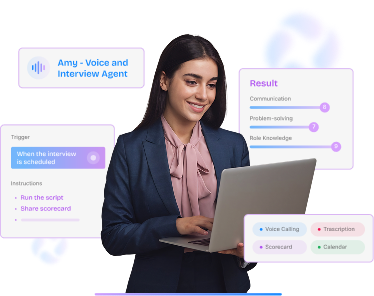
Amy, RippleHire's AI interview agent handles early-stage candidate interactions and passes rich context forward through the hiring funnel, ensuring post-offer touchpoints reflect what candidates expressed interest in during interviews.
Built-in Reporting and Analytics then gives TA leaders complete visibility into pre-onboarding progress, joining ratios, and engagement signals across cohorts.
Ready to eliminate post-offer ghosting and prepare your hiring engine for agentic AI?
Schedule a demo with RippleHire today.
Frequently Asked Questions
What is new hire ghosting and why does it happen after offer acceptance?
New hire ghosting after offer acceptance occurs when a candidate who has committed to joining an organization stops communicating and does not arrive on their start date. It most commonly happens when candidates receive counteroffers from their current employer, accept a competing offer during their notice period, or lose emotional connection to the organization they are joining because of limited engagement between offer acceptance and day one. In India, where notice periods of 60 to 90 days are standard, the post-offer window is particularly long and requires active management to reduce dropout risk.
How is agentic AI different from standard automated emails for post-offer engagement?
Standard automated emails follow fixed schedules and send identical content to every candidate regardless of how they respond. They cannot recognize when a candidate is disengaging or adjust their approach accordingly. Agentic AI monitors how each candidate interacts with communications and surfaces signals for the recruiting team to review. It creates different engagement pathways based on each candidate's risk profile including notice period length, seniority, market demand for their skills, and communication patterns after offer acceptance. Recruiting teams configure the approach. Agentic AI applies it consistently and flags situations that require direct recruiter involvement.
What signals suggest a candidate is at risk of ghosting before their start date?
Key signals include delayed response times, reduced engagement with pre-boarding materials, reluctance to complete documentation, and sudden requests to postpone start dates. Candidates who unexpectedly ask questions about policies or benefits they did not previously inquire about are often comparing options. Candidates who stop opening emails or responding to messages after a period of active engagement are showing a clear disengagement pattern. The earlier these signals are surfaced, the more time the recruiting team has to intervene before a decision is made.
How does agentic AI help with candidates who have very long notice periods?
Long notice periods carry the highest ghosting risk because the window for counteroffers and reconsideration is widest. Agentic AI creates sustained engagement across the full notice period through personalized communication, pre-boarding activity spread across the timeline, and early introductions to the team and culture. The goal is to ensure that by the time the start date arrives, the candidate already has relationships, context, and a sense of belonging at the organization. That foundation is the strongest protection against counteroffers that arrive during a 90-day notice period.
Can agentic AI handle pre-boarding coordination across multiple departments?
Yes. Pre-boarding coordination typically involves IT, facilities, HR, and the hiring manager, each needing to take action at different points in the candidate's joining timeline. Agentic AI coordinates across these departments based on the sequence the recruiting team configures, sending notifications to the right people at the right time and adjusting when a step is delayed or a candidate's circumstances change. Recruiting teams receive visibility into overall status and are flagged when something requires a decision, allowing routine coordination to happen without pulling recruiter attention away from active hiring work.